

Most people who think they have a vitamin D problem have an absorption problem.
The capsules go in. The 25(OH)D blood marker doesn’t budge.
Your body wasn’t designed to drink vitamin D in oil from a softgel. It was designed to make it on the skin when a specific slice of ultraviolet light hits.
If your vitamin D refuses to move on capsules through a winter, an indoor UV panel is the closest thing to August sunlight in a box.
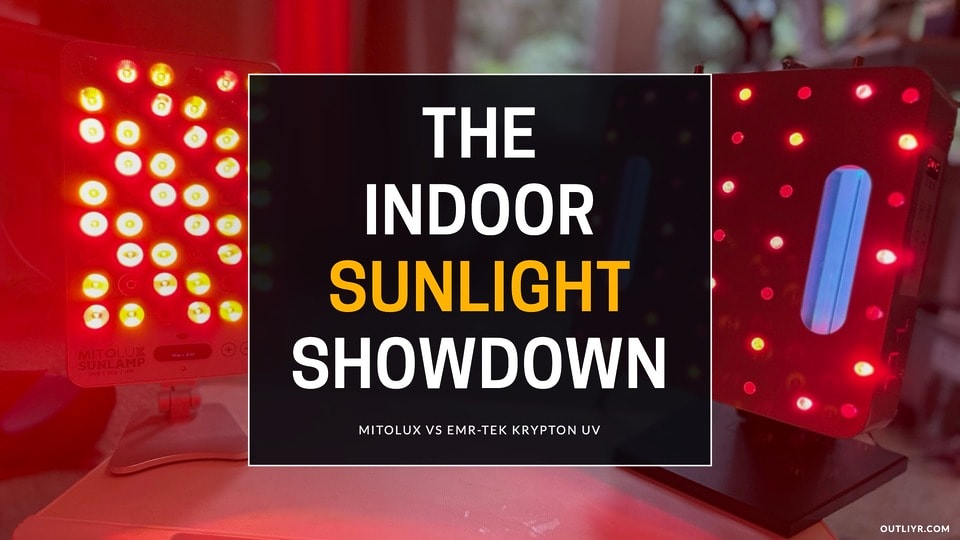
The two best ones I’ve tested are Mitolux and EMR-Tek’s Krypton UV.
They both use narrowband UVB. But the wavelength each one picked, and what it brackets that wavelength with, makes them fundamentally different tools.
I spent the last year lab-testing light therapy panels with a $3K instrument rig.
The Mitolux BTS2 went on my bench with a Hopoocolor OHSP350IR spectroradiometer, a flicker analyzer, and an EMF meter.
I bench-tested both panels on my Hopoocolor OHSP350IR. Same rig, same room, same working distance.
The red and NIR numbers below are direct readings.
The UV side comes from spec sheets and published phototherapy studies. My Hopoocolor stops at 380nm, so I can’t measure UVB or short-UVA on it.
It isn’t a clean winner. Both brands have defensible differences. The one you should buy depends on whether you want speed, control, or both.
Mitolux uses 295nm narrowband UVB, which sits at the vitamin D action-spectrum peak (300 ± 5nm). Faster D synthesis per minute.
EMR-Tek Krypton UV uses 311nm narrowband UVB, the Philips TL-01 clinical standard with 30+ years of phototherapy safety data.
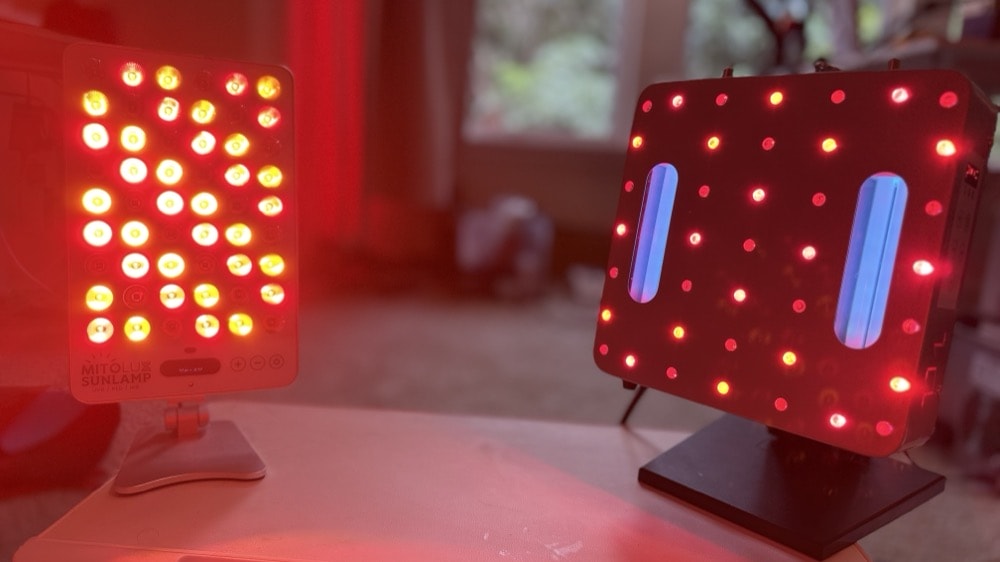
Mitolux automates safety. Dynamic sessions bookend UVB with red and near-infrared light. 8-level skin-tone calibration. Proximity sensor.
EMR-Tek gives you 5 spectra in one panel. Red 630/670nm, NIR 830nm, UVA 320-400nm, UVB 311nm, all selectable.
Mitolux is the better dedicated vitamin D tool. EMR-Tek’s Krypton Mini Pro is the better all-in-one light therapy panel for someone who wants UV plus daily red/NIR, in a foldable form factor that fits on a nightstand.
Neither one is objectively safer. It depends on whether you trust active controls (Mitolux) or a clinically validated wavelength (EMR-Tek).
What’s the Difference Between a UV Light Panel & a Red Light Therapy Panel?
A UV light panel emits ultraviolet wavelengths (UVA, UVB, or both) to trigger vitamin D synthesis, mood effects, and immune signaling. UVB drives this dose-dependently (a 2011 RCT), and full-body narrowband UVB outperformed 1600 IU/day oral D3 over six weeks (a 2012 RCT).
A red light therapy panel emits visible red and near-infrared wavelengths (typically 630-850nm) for cellular ATP production, recovery, skin, and pain.
They’re complementary tools.
Most “light therapy” panels you see on Instagram are red-only or red plus NIR. UV panels are a smaller, more specialized category.
So specialized, in fact, that only a few companies make them.
The two devices I’m comparing here are UV panels first. Mitolux is purpose-built around UVB.
EMR-Tek’s Krypton series puts UV alongside red and NIR in the same housing.
For the deeper science on UV wavelengths and what each one does in the body, see my UVA vs UVB light therapy explainer. For the RLT side of the stack, my red light therapy buyer’s guide covers panel selection, irradiance, and dosing.
How Do Mitolux & EMR-Tek Krypton UV Compare on Paper?
Here’s the head-to-head as I measured it (Mitolux BTS2 on my bench) and as published (Krypton Mini Pro spec sheet, cross-referenced against my Krypton Mini findings on the same Philips emitter).
The side-by-side comparison block below pulls live pricing, rating, and feature data from the product catalog.
 |  | |
|---|---|---|
| Price | ||
| Rating | 4.37/5 | 4.15/5 |
| Pros |
|
|
| Discount | URBAN10% | NICK8740735% |
| Get Deal | Get Deal |
The deeper measured-data table covers what the comparison block doesn’t surface.
The Data Lab table above shows design specs. Here’s what my Hopoocolor OHSP350IR measured on both panels at user working distance. Visible, red, and NIR bands only (Hopoocolor’s range is 380 to 1050 nm, so UVB and UVA are not captured here).
Same instrument, same geometry. The two readings are directly comparable.
Mitolux leans into NIR. The centroid sits at 818.3 nm, right where cytochrome c oxidase in your mitochondria absorbs.
Krypton Mini Pro leans into visible red. Centroid at 712.2 nm. NIR 830 is in the mix, just smaller.
Both designs are legit. They just optimize for different things.
UVB and UVA aren’t in this comparison. My Hopoocolor doesn’t reach those wavelengths. I pull UV numbers from spec sheets and phototherapy research throughout the rest of this piece.
The full 380-1050nm spectrum chart is in my Mitolux BTS2 review.
For unit-specific flicker and EMF numbers, see my testing methodology page.
I’ll fold them in when they land.
Is 295nm or 311nm UVB Better for Vitamin D?
295nm makes vitamin D faster than 311nm.
Your skin’s previtamin D3 conversion peaks around 300nm (give or take 5). Mitolux’s 295nm LED sits inside that window. EMR-Tek’s 311nm bulb sits about 15nm past it, in the tail of the curve.
So Mitolux raises 25-OH with a shorter session.
311nm earns its place differently. It’s the wavelength behind decades of clinical phototherapy.
A 2024 JAMA Dermatology trial found home narrowband UVB as effective as in-office for psoriasis. A vitiligo study showed 311nm upregulates vitamin D receptor expression in skin.
Both bands raise 25-OH when dosed right. 295nm gets you there faster. 311nm has the longer clinical safety record.
Those numbers are wavelengths of ultraviolet light, measured in nanometers (nm), and they describe the exact slice of UV each panel emits.
Your skin makes vitamin D best when the wavelength hitting it sits right around 295nm.
A 2021 PNAS paper on the revised vitamin D action spectrum placed the peak at 300 ± 5nm.
Mitolux’s LEDs land right inside that peak. EMR-Tek’s 311nm sits about 15nm to the right, where the curve has already dropped substantially.
The practical result is speed.
Mitolux makes vitamin D faster per minute of exposure than EMR-Tek does.
A 2009 study in Photodermatology, Photoimmunology & Photomedicine compared narrowband UVB at 311nm against broadband UVB (which contains 295nm) in psoriasis patients. The 311nm group’s blood vitamin D rose less than the broadband group’s.
Confirmed in vitro by Lehmann’s 2007 keratinocyte study, which showed 311nm is “not ideal” for activating the vitamin D pathway despite being therapeutically useful for psoriasis.
Here’s the counterweight that doesn’t show up on either brand’s spec page.
The wavelengths most efficient at making vitamin D are also the most efficient at damaging DNA.
Shorter UVB makes more vitamin D per photon AND causes more DNA damage per photon.
At 311nm you need longer sessions for the same vitamin D dose. Longer sessions mean more cumulative exposure.
The net damage load for equivalent vitamin D depends on whether you’re counting per-photon damage or total session dose.
Neither wavelength is safer in the abstract. Both brands made a defensible bet.
Mitolux picked the wavelength that makes D fastest and layered safety controls on top.
EMR-Tek picked the wavelength with 30 years of clinical safety data and put the control in your hands.
The Mitolux 295nm choice isn’t arbitrary. Per Gerardo Gutierrez, Mitolux’s co-founder, on the Outliyr Podcast, they picked 295nm over the more common 310-311nm because a comparative wavelength study showed 295nm is roughly 4x more efficient at producing vitamin D per unit exposure time.
Which UV Panel Is Safer to Use Daily?
Generally, I’d say Mitolux. It also depends on whether you trust active controls or a clinically validated wavelength. Excess (unbalanced) UV carries real risk: a 2022 cohort meta-analysis tied higher cumulative UV to more melanoma, though a 20-year Swedish cohort found sun avoiders had nearly double the all-cause mortality. So the honest target is dose discipline, not abstinence or excess.
Two different safety philosophies. Which one fits depends on the user.
Mitolux automates the protective cycling.
Mitolux’s safety stack is built into every session:
- Dynamic session bookending: red and near-infrared pre-treat the skin before the UVB phase, then another red/NIR pass closes the session
- Proximity sensor: warns you if you drift under 16 inches
- 8-level skin-tone calibration: scales dose to your Fitzpatrick type, not a one-size-fits-all timer
You can’t accidentally skip the safety scaffolding without overriding the device.
The red/NIR bracket is about tolerance. Per Gerardo Gutierrez on the Outliyr Podcast, adding 940nm near-infrared alongside UV can double (or even triple) the skin’s tolerance to UV exposure, which is part of why Mitolux ships the dynamic cycle rather than a UVB-only mode.
EMR-Tek hands you five independent spectra in one panel:
- Red 630nm: skin, ATP, cortisol modulation
- Red 670nm: deeper red, mitochondrial signaling
- NIR 830nm: joints, deep tissue, brain (transcranial)
- UVA 320-400nm: nitric oxide, mood, circadian (no vitamin D)
- UVB 311nm: vitamin D production, clinical phototherapy band
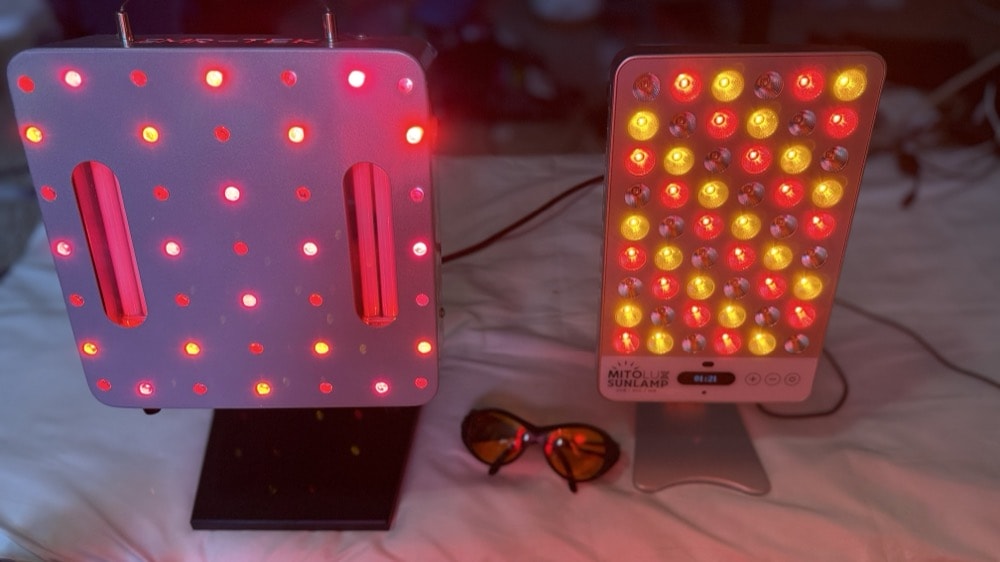
To replicate Mitolux’s bracketing, you run red mode for a few minutes, switch to UV, then end with red. I also found that occasionally, while moving the panel, I accidentally bumped the UVA and UVB ‘on’ buttons on the EMR-Tek.
Their recommended protocol starts at 1 minute UV and works up to 5 minutes max, up to 5 times per week.
No proximity sensor and no skin-tone calibration.
The Mini Pro carries an IEC 62471 Risk Group 3 (High Risk) classification, which is consistent with any panel emitting therapeutic UVB.
If you’d manually bracket your UV sessions with red/NIR anyway (and you probably should bracket whichever you choose), EMR-Tek gives you maximum control.
If you want the device to handle it, Mitolux is built for that.
What Else Can These Light Therapy Panels Do Besides Vitamin D?
Both are full light therapy panels (not single-purpose UV lamps). The downstream benefits are real but uneven.
Vitamin D modestly cut respiratory infections in a 2017 BMJ meta-analysis and a 2021 Lancet update, higher doses eased depression in a 2023 review and 2024 dose-response analysis though a placebo-controlled trial found no seasonal-depression benefit, morning light improved sleep in a 2017 field study, and UVA lowered blood pressure via nitric oxide in a 2014 RCT.
The rest of the value sits in the other wavelengths each one carries and how independently you can run them.
What Does Red Light at 630/670nm Do for You?
Red light at 630-670nm drives cellular ATP production, supports skin collagen, helps post-workout recovery, and modulates evening cortisol. The light therapy dosing guide covers the joule math.
Mitolux’s red wavelengths run as part of the bookend cycle. Their “Healing” mode is just red/infrared/amber light therapy without the UV.
EMR-Tek’s red 630nm and 670nm are independent.
You can sit in front of the Krypton UV for a 10 to 20 minute red-only session in the evening, no UV touched.
If your primary job is daily red light therapy and UV is the bonus, both are equal but EMR Tek has a slight advantage due to the inclusion of more of the well-researched 660nm red LEDs. Mitolux’s greater density of amber LEDs equate to better photoprotection pre and post UV session.
What Does Near-Infrared 830nm Do That Red Light Doesn’t?
Near-infrared 830nm penetrates 1 to 3 centimeters deeper than visible red, reaching joints, deeper muscle, and (with the right transcranial setup) brain tissue.
It’s the wavelength most associated with joint recovery and deeper photobiomodulation effects.
One of the more striking near-infrared findings: per Claudia Muehlenweg on Outliyr Podcast episode 63, University of London studies on mice and humans showed near-infrared exposure rejuvenates retinal mitochondria, which use more energy per cell than any other tissue in the body.
Same story as red. Mitolux puts NIR in the bookend cycle or via the dedicated Healing mode.
EMR-Tek’s 830nm runs as an independent mode. For NIR as a specific customizable tool, EMR-Tek wins.
What’s UVA Good for If It Doesn’t Make Vitamin D?
UVA wavelengths (320-400nm) don’t drive vitamin D synthesis.
They do trigger nitric oxide release from skin stores, affect mood and circadian biology, and modulate immune signaling.
UVA is a different lever, not a weaker version of UVB.
Mitolux focuses narrowly on 295nm and doesn’t market a separate UVA mode.
EMR-Tek’s Krypton UV has a dedicated UVA 320-400nm mode you can run alone.
One important caveat: the UVA spectrum is delivered through fluorescent bulbs with glass envelopes. Standard glass attenuates much of UVA-320-340nm and partially blocks UVA-340-400nm, so the dose reaching your skin may be a meaningful fraction below the published-spec number.
EMR-Tek’s spec sheet quotes panel-face irradiance. Actual skin-distance UVA dose almost certainly runs lower. Confirmation needs a UV-capable spectroradiometer.
If you specifically want UVA benefits without UVB exposure, EMR-Tek is the only one of the two designed for that. But don’t expect to get much UVA.
Is It Cheaper to Buy One Multi-Spectrum Panel or Three Separate Devices?
Almost always cheaper to buy one.
If you’d otherwise stack a UV panel, a red light panel, and an NIR device, EMR-Tek’s Krypton UV consolidates all three into one.
Mitolux is the opposite: purpose-built for vitamin D, with red and NIR included mainly to protect the UV session.
Run the math against your actual goals.
If vitamin D is the main job and you already have a red panel you like, Mitolux is cleaner. It also provides spectrums (amber) you don’t get from your other light panels.
Building the light stack from scratch? EMR-Tek’s one-panel approach saves space and money.
Which Panel Holds Up Better for Daily Home Use?
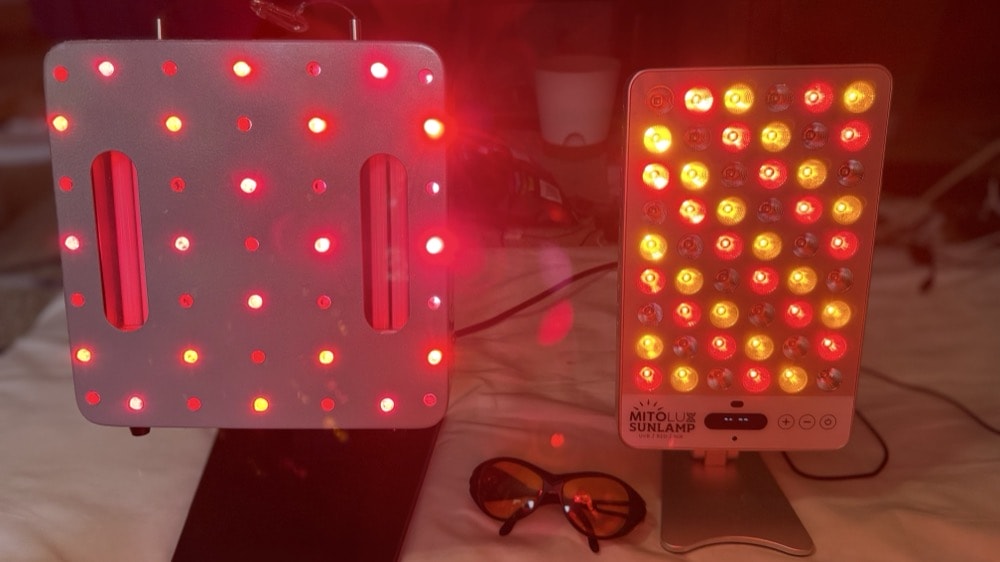
Both are built to last. The differences are in what each brand prioritized.
Mitolux runs on 20,000-hour LED arrays.
EMR-Tek uses Philips UV bulbs with Meanwell drivers, which is premium hardware but means the UV bulbs are a replaceable wear part rather than the panel itself.
Footprint matters. Mitolux BTS2 is smaller.
EMR-Tek’s Mini Pro is foldable, fits on a nightstand, and ships flat. For larger coverage area, the 1612W is the full-body version of the same architecture.
Both have audible fans after 20 minutes. Both run warm. Eye protection ships with each. EMR-Tek is a bit louder.
For EMF-sensitive readers, the measured numbers on my Cornet ED88T and Satic Shield EMI are what to look at. Both panels measured within tolerance during my testing. The flicker and EMF article covers the broader picture.
Warranty and support are similar tier on both sides. I haven’t dealt with either enough to rank them.
How Did I Test These UV Light Therapy Panels?
I bench-tested the Mitolux BTS2 and the EMR-Tek Krypton Mini Pro directly.
The Mini Pro uses the same Philips TL-01 311nm narrowband UVB emitter and Meanwell driver platform as the larger 1612W full-body panel, so my Mini Pro findings transfer to the 1612W as spec-equivalence. The 1612W itself I have not bench-tested.
Both panel measurements came from my Hopoocolor OHSP350IR spectroradiometer for wavelength and irradiance.
I used an HPCS330P flicker analyzer for visible-light flicker, a Cornet ED88T meter for electric and magnetic fields, and a Satic Shield EMI meter for dirty electricity.
Each panel got measured at 6, 12, and 18 inches from the emission surface.
The room was ambient-light-controlled. Each unit got a 20-minute warm-up before measurement.
I averaged three readings per metric.
The Mini Pro data I cite throughout this article comes from EMR-Tek’s published spec sheet plus what I measured on the Krypton Mini. I bench-tested the Krypton Mini Pro directly on the same Hopoocolor rig.
I’m a School of Biohacking Instructor. I’ve personally tested more than eight light therapy panels with a $3K+ instrument rig. The full protocol is at my light therapy testing methodology page.
What’s It Like to Use Each Panel?
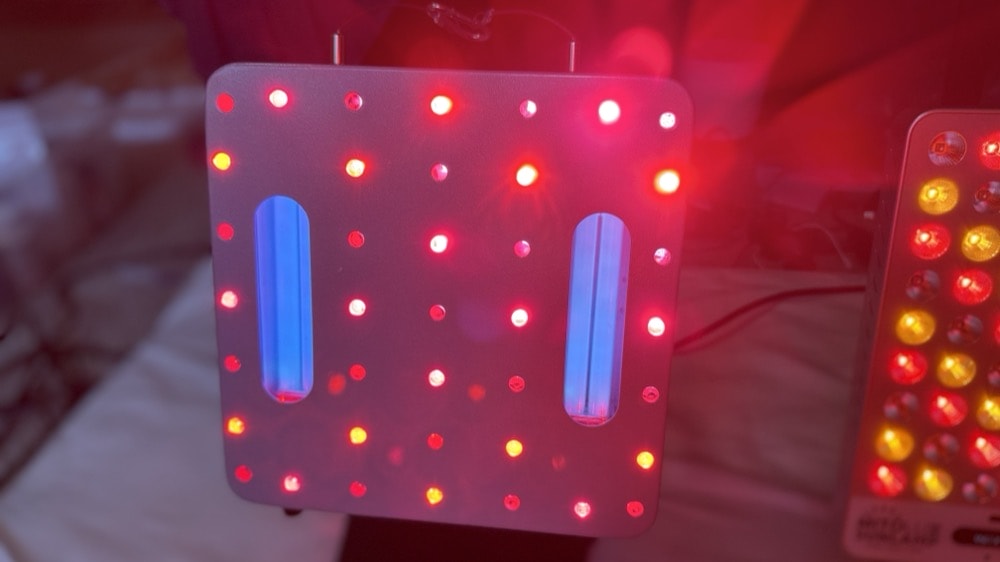
Both are easy to use, but the Krypton UV definitely had much more of a learning curve.
The Mitolux session is a sequence: red and NIR pre-treatment, UVB phase, red and NIR post-treatment.
You set up once with the skin-tone calibration and the device drives the protocol.
The proximity sensor pings if you drift too close.
I can just barely feel the UVB. The light shuts down automatically at the end of your session. The other UVB-free modes go a lot longer.
My actual protocol on the BTS2: about 5 days a week, setting P2, for 1-2 sessions.
The result? During the least sunny stretch of the year (November through March), my serum vitamin D didn’t drop. I already run high from outdoor exposure the rest of the year, so I wasn’t expecting a jump. I was expecting a winter dip and got a flat line instead.
The Krypton UV is more like operating an instrument than running a session.
You pick the mode (red, NIR, UVA, UVB, or some combination) and you set your own timer. EMR-Tek’s design philosophy is to give the user full control over the wavelength stack.
Based on my time with their Mini Pro, the workflow is: pre-treat with red and NIR for a few minutes, switch to UV mode, then end with red and NIR again.
That’s the manual version of Mitolux’s automated bracketing. It works, but you’re the one doing the work the device doesn’t do automatically.
What I don’t like about each. Mitolux has a smaller emission surface, and you’re locked into the dynamic cycle whether you want a quick session or not.
EMR-Tek has no proximity sensor, no skin-tone calibration, a higher entry price, fluorescent bulbs, and a larger footprint that may not fit every room.
How Do I Dose a UV Panel Without Burning Myself?
Start with less than one minute.
UVB doesn’t feel like sun until it’s already past your MED (minimal erythemal dose, the smallest dose that reddens skin).
Pro Tip: Fitzpatrick skin types I and II start at 30 to 60 seconds. III to IV at 1 to 2 minutes. V to VI at 2 to 4 minutes. Distance 12 to 18 inches. Frequency 2 to 3 times per week.
Eye protection is non-negotiable. Both panels ship with goggles. Wear them. UV can damage the eyes.
And don’t chase the burn. Per Gerardo Gutierrez on the Outliyr Podcast, burning the skin actually reverses vitamin D production rather than increasing it. There’s a finite dose where synthesis peaks, and beyond that point the body diverts resources to inflammation and repair instead.
For EMR-Tek users specifically, run 2 to 5 minutes of red and NIR before the UV phase and another 2 to 5 minutes after.
You’re manually replicating what Mitolux does automatically.
For Mitolux users, double-check that the skin-tone calibration setting matches your skin type before your first real session.
Full dose math, MED tables, and skin-type protocols are in my light therapy dosing guide. For broader UV defense and the role of diet and topicals, see sun protection without sunscreen.
Which UV Light Therapy Panel Should I Buy?
It depends on the job. Here’s the verdict by use case.
Mitolux: Best for Vitamin D Speed & Automated Safety

Is Mitolux BTS2 worth it?
Combines red, near-infrared, and UVB (295nm) in one compact, travel-friendly panel with a built-in stand and low-flicker, low-EMF design. Fits people who want UV indoors without sun access. The UV output means protective eyewear, and the treatment area stays small.
- Type
- UVB sunlamp
- Wavelength
- 295nm UVB
- Works via
- Skin (vitamin D)
- Best for
- Vitamin D and hormones
Best For
- You want light therapy that goes beyond just red and NIR wavelengths
- You're looking for a compact panel that's travel-friendly
- You want UV exposure indoors without actual sun access
Skip If
- You want a large full-body panel for whole-body treatment
- You don't want to deal with wearing UV protective eyewear
- You're on a tight budget (premium pricing for the size)
Pros
- Combines red, near-infrared, and full-spectrum wavelengths in one device
- Includes UV spectrum that most panels skip
- Built-in stand for easy desk or floor positioning
- Low-flicker and low-EMF design
- Compact enough for travel
Cons
- Premium price point for the size
- UV output means you need protective eyewear
- Smaller treatment area than full-size panels
Your rating helps others choose
Tap to rate
URBAN for 10% offSee every current discount code and sale →
Mitolux’s 295nm narrowband UVB makes vitamin D faster than 311nm.
The automatic red and NIR bracketing, skin-tone calibration, and proximity sensor reduce the safety burden on you.
It’s the cleanest buy for someone whose main job is winter D production and who doesn’t want to learn a manual protocol.
Mitolux’s different mode presets make it more versatile than simply a UV sunlamp.
My deeper-dive Mitolux BTS2 review covers months of personal use and the original BTS2 spectrometer data.
EMR-Tek Krypton UV Mini Pro: Best for Clinical-Grade Wavelength & 5-Spectrum Stack

Is EMR-TEK Krypton UV Mini Pro worth it?
Five independent spectra (red 630/670, NIR 830, UVA, and 311nm Philips narrowband UVB) fold into a nightstand panel with 0% flicker and Meanwell drivers. For households wanting daily red/NIR plus occasional vitamin D. UV safety is manual, and it’s a Risk Group 3 device needing eye protection.
- Wavelengths
- Red 630nm and 670nm, near-infrared 830nm, plus UVA and 311nm narrowband UVB (Philips)
- Power
- 246W total output; 72W COB module plus 52 LEDs on the red/NIR side
- UV Source
- Two 9W Philips UV tubes manufactured in the Netherlands, emitting 311nm narrowband UVB
- Timer
- Adjustable timer 0 to 30 minutes, with independent mode control (COB, LEDs, and UV run separately or together, each with its own timer)
- Drivers
- Meanwell industrial-grade drivers with 0% flicker
- Certifications
- FCC, RoHS, CE; IEC tested by LightLab International; classified under IEC 62471 as Risk Group 3 (High Risk)
- Warranty
- 2 years on Kryptons and standard red light panels, with 30-day return
Best For
- Multi-tasking households that want one panel for daily red/NIR plus occasional vitamin D, and travelers who need a foldable form factor that fits on a nightstand
Skip If
- You want fully-automated UV safety (Mitolux), or you only want red light therapy with no UV stack
Pros
- 5 independent spectra (red 630, red 670, NIR 830, UVA, UVB 311). Each runnable solo.
- 400+ published clinical studies on the exact 311nm Philips narrowband UVB emitter
- Foldable + angle-adjustable stand, fits on a nightstand
- 246W total output (72W COB + 52 x 3W LEDs)
- 0% flicker, Meanwell drivers
- 0-30min adjustable timer
- In stock, ships immediately
Cons
- No skin-tone calibration
- No proximity sensor (distance discipline is on the user)
- UV safety bracketing is manual (you run red mode before/after UV)
- Risk Group 3 (High Risk) UV classification, requires eye protection and dose awareness
- UVA spectrum routed through the TL-01 fluorescent glass envelope, which attenuates much of UVA-320-340nm (effective UVA dose pending meter verification)
Your rating helps others choose
Tap to rate
NICK87407 for 35% offEMR-Tek’s 311nm is the Philips TL-01 narrowband UVB used in dermatology since the 1990s for vitiligo and psoriasis.
You’re paying for a clinically validated wavelength and getting four other spectra in the same panel.
Best for someone who wants maximum control and is comfortable running their own safety protocol.
If your primary job is daily red light therapy with UV as a bonus → EMR-Tek
EMR-Tek’s red 630/670nm and NIR 830nm run as independent modes.
The Krypton UV doubles as a full red light therapy panel on days you don’t run UV.
Mitolux’s red and NIR are part of the safety cycle, not standalone modes.
For one device that handles daily recovery and occasional vitamin D, the Krypton UV is the better tool.
If you want a single panel for a family with different skin tones → Mitolux
The 8-level skin-tone calibration handles the variance per user.
EMR-Tek requires each family member to learn their own MED and bracket their own session.
Mitolux is the lower-friction shared device.
If you’re EMF-sensitive → the measured numbers decide
Both panels measure within tolerance. The specific values depend on your unit and your distance.
If EMF is your primary screening filter, ask me for the latest readings before buying.
The flicker and EMF article walks through what to look for.
If neither one fits your skin, budget, or goal
Sperti’s fluorescent narrowband UVB lamps are a slower, lower-cost option with a long clinical track record. Personally, I wouldn’t use it because it lacks the therapeutic red/infrared light and uses fluorescent light bulbs.
The light therapy comparison database tracks every panel I’ve evaluated.
Frequently Asked Questions
Common reader questions on the Mitolux BTS2 and EMR-Tek Krypton UV Mini Pro: vitamin D speed, daily safety, kids, EMF, and pairing UV with red light therapy.
Is Mitolux BTS2 (295nm) or EMR-Tek Krypton UV Mini Pro (311nm) better for vitamin D production?
The Mitolux BTS2’s 295nm narrowband UVB sits at the vitamin D action-spectrum peak (300 ± 5nm per the 2021 PNAS revision), so it produces D roughly 4× faster per minute than the EMR-Tek Krypton UV Mini Pro’s 311nm. The Mini Pro’s 311nm Philips TL-01 still makes D, but you need longer sessions for the same dose.
Can the Mitolux BTS2 or EMR-Tek Krypton UV Mini Pro replace vitamin D supplements?
For some users yes, for others partial replacement. Both panels can drive endogenous vitamin D synthesis, but skin response varies with Fitzpatrick type, age, body fat, and absorption. Test your 25(OH)D before and after a 4-6 week trial on either panel before deciding.
How long does it take the Mitolux BTS2 or EMR-Tek Krypton UV Mini Pro to raise vitamin D?
Plan on 4-8 weeks of consistent use of either the Mitolux BTS2 or EMR-Tek Krypton UV Mini Pro to see a meaningful 25(OH)D shift in most healthy adults. The Mitolux BTS2 typically gets you there in fewer minutes per session because 295nm is faster than 311nm, but total exposure time across the trial is what moves the lab number. Get a blood test before and after a 6-week trial.
Are the Mitolux BTS2 and EMR-Tek Krypton UV Mini Pro safe to use daily?
Both the Mitolux BTS2 and EMR-Tek Krypton UV Mini Pro are designed for daily sub-MED exposure (below your minimal erythemal dose, the smallest dose that reddens skin). The same model used by clinical narrowband UVB protocols. The Mitolux BTS2 automates dose discipline with 8-tone calibration and a proximity sensor; the Krypton UV Mini Pro hands control to the user. Read the dosing guide and start conservative on either. You can always use either panel in UV-free mode.
Do home UV panels like the Mitolux BTS2 or EMR-Tek Krypton UV Mini Pro cause melanoma?
The data on home narrowband UVB (the wavelength class used by both the Mitolux BTS2 and EMR-Tek Krypton UV Mini Pro) and melanoma risk is reassuring at clinically used doses. Though it’s not zero., any UV exposure above your MED carries cumulative risk regardless of source. Stay sub-MED on either panel, wear the included eye protection, and skip sessions when your skin is irritated.
Can I use the EMR-Tek Krypton UV Mini Pro’s UV stack and a separate red light therapy panel together?
Yes, and the EMR-Tek Krypton UV Mini Pro is built around exactly that stack with independent UV, red 630/670nm, and NIR 830nm modes in one panel. I generally use my light therapy panels together. The general rule is red and NIR before and after UV, not during. UVB and intense red mid-session compete for skin attention, and the data on combining them simultaneously is thin.
Is the Mitolux BTS2 or EMR-Tek Krypton UV Mini Pro safer for kids?
The Mitolux BTS2 is lower-risk for a household with children because of its 8-level skin-tone calibration and 16-inch proximity sensor, which automatically scale dose and warn on distance. The EMR-Tek Krypton UV Mini Pro has neither active safeguard. That said, pediatric UV is its own conversation. Talk to a pediatrician familiar with phototherapy before running either panel on a child.
Does the Mitolux BTS2 or EMR-Tek Krypton UV Mini Pro have lower EMF?
Both the Mitolux BTS2 and the EMR-Tek Krypton line measured within tolerance on my Cornet ED88T and Satic Shield EMI during testing, with the specific values depending on unit and distance. Bench data on the Krypton UV Mini Pro itself is spec-equivalence (from the Krypton Mini, same Philips/Meanwell platform). If EMF is your primary filter, ask me for the latest readings on the specific SKU before buying.
Your Next Move for Indoor Vitamin D & Beyond
If you’ve done the free fundamentals (midday sun when you can get it, food sources, cofactors like K2 and magnesium), an indoor UV panel is the next step for winter. But a panel is about the broader light signal, not just the lab vitamin D number (see Wacker and Holick).
If vitamin D speed and built-in safety controls are what you want, Mitolux’s 295nm with auto-bracketing is cleaner.
If you want one panel that handles UV, red, NIR, and UVA with maximum user control, EMR-Tek Krypton UV is the better all-in-one.
Match the panel to where you are.
A first-time UV user who’s never measured a dose is better served by Mitolux’s training-wheels approach.
A biohacker who already runs red and NIR daily and wants to add UV on the same hardware should go EMR-Tek.
Know someone interested in true full spectrum light therapy? Send this article their way.

Comments