

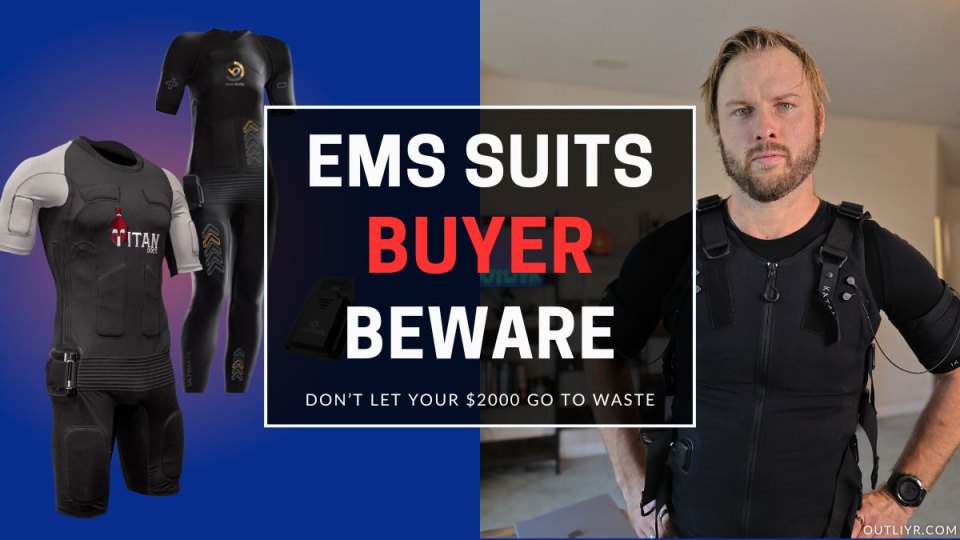
So you’re about to drop $2,000+ on a state-of-the-art electrical muscle stimulation suit?
Choose wrong, and you may end up with a useless paperweight.
I’ve studied the industry for years, consulted several of the world’s leading experts, and personally tested these systems. Skip to the top systems below:
Our Top EMS Suit Picks
TitanBody EMS Suit
Full-body training in 20 min · dry electrodes · $1,895 ($1,705.50 w/ code)
Best for time-efficient full-body strength training.
Code: URBAN · Save 10%
SQAI EMS System
FDA-cleared · no monthly fees · medical-grade electrodes · $2,795
Best for time-starved professionals and joint-conscious athletes who want maximum muscle activation in minimal time without heavy weights or gym equipment.
VisionBody EMS Suit
Fully wireless · antimicrobial silver-fiber · $2,490
Best for mobile professionals and home gym enthusiasts who prioritize wireless freedom and want an ems suit they can train anywhere without being tethered to…
Katalyst EMS Suit
Market leader · guided workouts · wet electrodes · $2,999 + subscription
Best for users who prioritize guided workout experiences and a polished app ecosystem over ownership autonomy.
Before buying a full-body electronic muscle stimulator machine, there are a few things you’ll want to know. If I had known these previously, I would have chosen differently.
Let’s review, compare, and contrast the top full-body EMS suits. Whether your goal is fat loss, muscle growth, athletic performance, to support bodybuilding, or just get in peak shape, you have several good options.
Studies on EMS confirm it matches traditional training for strength and body composition when used correctly. Marketing materials claim 20-minute sessions deliver results comparable to 90-120 minutes of conventional exercise
Outliyr concludes wet versus dry electrode trade-off matters. Wet systems like Katalyst and SQAI require 3-5 minute spray prep but offer proven conductivity. Dry systems like VisionBody and TitanBody are instant-on but need sweat activation
Outliyr warns that subscription models create potential long-term risk. Katalyst’s $40/month requirement means paying $1,920 over 4 years on top of $2,999 suit cost. Companies can fold and brick your investment
Professional studio systems remain the gold standard. Miha Bodytec and XBody deliver superior effectiveness but lack home-use availability and require expensive ongoing memberships
Customer service quality varies drastically. SQAI excels with responsive support. Katalyst and VisionBody face widespread 2025 complaints by unsupported customers and unfulfilled promises
Budget $2,000-3,000 total for a functional full-body EMS machine. Factor in subscriptions, replacement parts, and warranty considerations. The full cost often far exceeds the hardware sticker price
What Is Full-Body EMS & How Does it Work?
Full-body electrical muscle stimulation (EMS) is a training technology that causes complete muscle contractions by applying low-frequency electrical impulses through electrodes embedded in a wearable suit. Unlike spot TENS units, whole-body EMS activates up to 90% of your muscle fibers simultaneously, including deep stabilizers you can’t voluntarily recruit.
The control unit sends electrical signals through electrodes on major muscle groups:
- Chest
- Back
- Arms
- Abs
- Glutes
- Quads
- Hamstrings
These also indirectly activate adjacent muscle groups like the forearms and calves. It’s one of the ways to boost fitness as with other biohacks like blood flow restriction training or using vibration plates.
The marketing efficiency promise vs. reality
Most EMS manufacturers claim 20 minutes equals 90-120 minutes of traditional training. But does it?
Research partially backs this. Studies show EMS activates more muscle fibers per contraction than voluntary effort alone (PMC, PMC, PMC, PMC).
But here’s the catch: you still need to move during EMS sessions.
You won’t build a six-pack while passively binging Netflix. Still, EMS suits are slowly becoming one of the essential biohacking products for upgrading your biology today.
The Science: Does EMS Actually Build Muscle & Burn Fat?

Seeking max efficiency, the brain recruits slow-twitch muscle fibers first when performing traditional exercise.
EMS reverses this, activating fast-twitch (Type II) fibers responsible for power and explosive strength.
I experienced this firsthand after ~20 minutes of EMS, my hamstrings and quads were completely torched in ways regular squats don’t replicate.
I can also easily get my heart rate up to 170 beats per minute and keep it there for the duration of the workout. That’s my equivalent of vigorous hill sprints.
Research backs the category beyond my own sessions. I hosted Bjoern Woltermann, who founded Katalyst, on the podcast.
He pointed to German trials that ran women into their seventies through EMS: in one year-long study, with sessions of about 18 minutes every four days, “the EMS group gained 0.6% of bone density” while the untrained group lost roughly the same.
That is a measurable change from short, infrequent sessions.
But soreness doesn’t necessarily indicate growth or even benefit.
Luckily, some researcher sought out to answer what are all the benefits of electromuscle stimulation training.
Several studies stand out related to:
- Muscle & strength building
- Fat loss
Strength benefits
An 8-week study combining EMS with resistance training showed a 43% squat strength increase versus 20% with resistance training alone (Elsevier).
A 16-week whole-body EMS protocol delivered 7.3% quadriceps strength improvement.
Another comparative study found EMS matched high-intensity resistance training for muscle mass gains: +8.8% versus +9.4% (PMC).
Fat loss benefits
EMS elevates metabolism 12-15% for hours post-workout. Self-quantified users consistently report burning 400-500 calories in 20 minutes.
A 14-week study showed EMS groups maintained stable metabolism while control groups saw metabolic drops plus significant reductions in body fat measured by skinfold thickness and waist circumference.
But let’s shatter a myth: you cannot spot-reduce belly fat with EMS. It supports fat loss through increased calorie burn and muscle preservation during weight loss. Check out other ways to biohack your weight loss.
Safety note: overexertion during EMS can cause rhabdomyolysis, a serious condition where damaged muscle fibers leak into the bloodstream. Published case studies have documented creatine kinase levels up to 240,000 U/L after excessive EMS sessions.
Always start at the lowest intensity, limit sessions to 20 minutes, and allow 48-72 hours between workouts. If you experience unusual muscle pain, dark urine, or swelling after an EMS session, seek medical attention immediately.
For a deeper dive into optimal training frequency, recovery windows, and all the documented benefits, see my complete guide to EMS training benefits.
Which Are the Best EMS Suits in 2026?
The best EMS suit overall is TitanBody, which pairs dry electrodes and fast setup with the longest power box warranty in the consumer market and no subscription. Every other suit below wins one narrower use case, from movable electrode pads to guided app workouts.
I’ve tested many systems, analyzed hundreds of user reviews, Reddit threads, and Trustpilot feedback to understand the EMS market in 2026.
Each system has distinct trade-offs. Here’s what I found after testing and researching each one.
Here’s the insider scoop.
TitanBody EMS Suit

Is TitanBody EMS Suit worth it?
For me, yes. I switched from Katalyst to TitanBody in June 2026 and love how light and customizable it is. I can change settings, workout parameters, and even exercise duration from the app mid-session. The dry electrodes mean no wetting down the whole suit, a real win in the Austin summer heat. I also like that TitanBody does not lock anyone into a membership fee. The downside: no on-screen instructor guidance like Katalyst, so I run conventional movements or keep YouTube open nearby.
- EMS Type
- Whole-body EMS
- Electrode Type
- Dry (sweat-activated)
- Electrodes
- 20 zones
- Session Duration
- 20 min
- Warranty
- 1-year suit / 3-year powerbox
- Subscription
- No
- Size Range
- 2XS to 6XL
- App
- Yes (12 built-in presets)
Best For
- Time-efficient full-body strength training
- You're recovering from injury and need low-impact resistance
- You want to add intensity to workouts without heavy weights
Skip If
- You have a pacemaker or implanted electronic device
- You prefer traditional weight training and have ample gym time
- You're on a tight budget (EMS suits are a premium investment)
Pros
- Extremely customizable: fine-tune the exact stimulation parameters you want based on the research
- Save custom settings so you jump right back into your program
- You're not forced into the usual EMS warm-up
- Lighter and more portable than Katalyst
- Comfortable through a full range of motion without damaging the suit
Cons
- No silver or antimicrobial fabric, and with no base layer it smells faster
- The stimulation doesn't feel as deep as Katalyst
- Sometimes the suit ignores the stimulation pattern, either stimulating for too long or stopping, especially if you background the app
- The battery pack on the right hip gets slightly in the way during certain movements
- The suit must fit you precisely because it isn't adjustable
Your rating helps others choose
Tap to rate
URBAN for 10% offSee every current discount code and sale →
TitanBody enters the market learning from the logistics chaos of others. Still, I approached TitanBody with deep skepticism. Another new EMS company making big promises? Pass.
But here’s what caught my attention: dry electrode technology, value, and excellent support.
The system itself uses 20 dry electrodes covering major muscle groups, fewer than VisionBody’s 24 but more than most competitors. Titan Body Generation 2.0 has even more electrodes and is coming soon with a bunch of new upgrades. I’ve already pre-ordered TitanBody V2, and I’ve also used V1 several dozen times now.
Beyond the electrode count, TitanBody’s obsessive focus on operations sets them apart from the rest.
Orders even ship within 24 hours. Not “2-4 weeks.” Not “we’ll get back to you.” TitanBody built their entire customer experience around not doing that.
They offer free custom tailoring if the fit isn’t perfect. I needed this because I have a very long torso. Yes, it takes 3-4 weeks. But this is in an industry where other companies won’t even respond to support emails about defective suits. Their size range spans 2XS to 6XL, wider than competitors.
The warranty structure tells you everything about their confidence. Three-year power box warranty. One-year suit warranty. That’s the longest power box coverage in the consumer EMS market.
Price is solid for one suit + power box. You can add-on an extra suit for a fee. Or get a Titan Twin set of 2 suits + 2 power boxes for a cheaper per item cost. If your suit wears out or you drop two sizes? Replacement suits at any time cost $495.
It’s a dry electrode system, meaning zero spray prep. Put it on, warm up enough to break a light sweat, and the electrodes activate naturally.
The companion app includes 12 built-in training presets targeting strength, endurance, recovery, and hypertrophy. You can control frequency, pulse width, and intensity for individual electrode zones or the entire suit. Based on my own research, I built some custom programs for strength and power.
The challenges? It’s new. Limited long-term user reviews exist beyond early adopters. The app ecosystem is less developed than Katalyst’s premium video library. The muscle stimulation doesn’t feel quite as deep as with my previous Katalyst suit, and I make up for that by doing slightly longer sessions.
My take: TitanBody is setting a new EMS industry standard. They ship fast, support aggressively, provide a generous warranty, and make replacement parts actually accessible. The 3-year power box warranty, 24-hour fulfillment, free custom tailoring, and $495 replacement suits show they understand the real pain points. Early adopter risk exists, but their policies significantly reduce it.
SQAI EMS System
Is SQAI EMS System worth it?
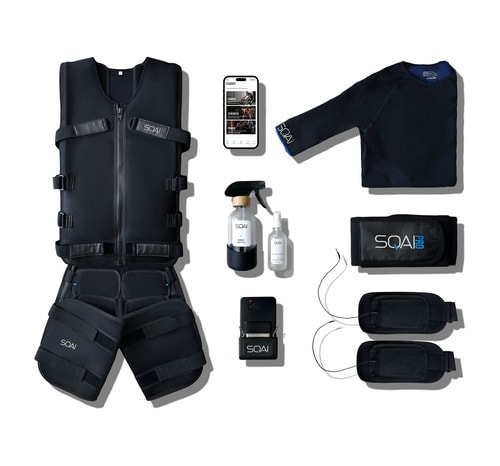
FDA-cleared full-body EMS suit activates around 90% of muscle fibers in 20 joint-friendly minutes with no subscription, built for time-starved users who want maximum activation fast. The upfront cost is high, and the adaptation period brings significant soreness.
- EMS Type
- Whole-body EMS
- Electrode Type
- Wet (spray required)
- Electrodes
- Movable / disconnectable
- Session Duration
- 20 min
- Warranty
- 1-year suit / 2-year powerbox
- Subscription
- No
- Returns
- 30-day
- Programs
- Strength / cardio / massage / recovery
Best For
- Time-starved professionals and joint-conscious athletes who want maximum muscle activation in minimal time without heavy weights or gym equipment
Skip If
- You're budget-constrained, enjoy traditional weight training, or have contraindications for electrical stimulation (pacemaker, epilepsy).
Pros
- FDA-cleared with medical-grade rubber-carbon electrodes for safety and performance
- Activates ~90% of muscle fibers vs. 40-50% from conventional weight training
- No subscription required: one purchase, unlimited workouts
- Joint-friendly design suitable for all ages and fitness levels
- Handcrafted in Spain with antimicrobial, anti-odor materials
Cons
- High upfront cost
- Significant muscle soreness during the initial adaptation period
- 2-year warranty on power box is shorter than some competitors
Your rating helps others choose
Tap to rate
SQAI (pronounced “sky”) emerged as my top recommendation for 2025. Though I’ll admit, I almost dismissed them entirely. I met the SQAI team at the Health Optimization Summit in Austin, Texas in 2025.
My first impression? Their technology didn’t seem anywhere near as advanced as Katalyst. And honestly, in many ways, it still isn’t.
But here’s what I missed initially: SQAI has unique advantages that matter more than flashy tech when you’re investing $2,795 in equipment that needs to work for years.
The system earns 4.7/5 stars on Trustpilot with users reporting strength gains, reduced back pain, and improved mobility (Trustpilot, Trustpilot).
Here’s what sets SQAI apart: the electrode pads are movable and disconnectable. You can change their placement on your body. I initially overlooked this feature, but it’s brilliant for two reasons.
First, replacing a bad electrode is easy and cheap so you won’t fight their support team for warranty replacements. Second, you can precisely target muscle groups. The suit fit matters less because you position electrodes exactly where you need them.
Then, there’s also no subscription required. You pay $2,795 once and own it forever. After watching Katalyst’s subscription model brick $2,500 suits when their support collapsed, this matters. A lot.
Orders ship within one week, not the multi-month nightmares sometimes plaguing others. Customer support is “excellent” according to multiple independent reviews, and my own experience with their team matches.
Programs include strength, cardio, massage, and recovery modes. They offer a complimentary onboarding call with personalized setup plus 1-year warranty and 30-day returns.
The downsides? It’s another wet electrode system requiring 3-4 minute spray prep before each session. That’s faster than Katalyst’s 5 minutes but not instant like dry systems. The price is higher than some but doesn’t require a membership subscription.
At the time I tested them, SQAI didn’t have the same automatic ramp-up, ramp-down intensity adjustment technology that Katalyst offers. Their pre-recorded workouts aren’t as polished either. But you can simply pull up a YouTube video and follow along. Whether that’s a pro or con depends on whether you value autonomy over hand-holding.
It’s a small company (1-10 employees), raising long-term viability questions. But ironically, their no-subscription model means your suit keeps working even if they go under. The exact opposite of the other subscription traps.
My take: SQAI delivers the best customer support, zero subscription headaches, and a product that won’t become a $2,795 paperweight if the company hits turbulence. Possibly justifying the higher upfront price.
VisionBody EMS Suit
Is VisionBody EMS Suit worth it?
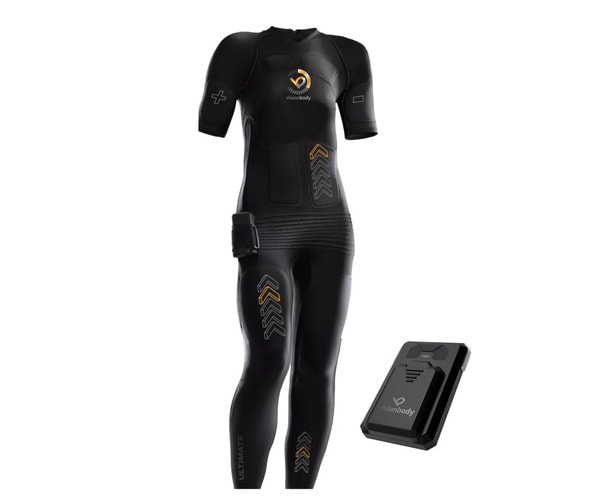
Fully wireless full-body EMS with silver-fiber electrodes and 20-minute sessions, FDA-cleared and machine-washable. Built for mobile professionals who train anywhere. Connectivity can drop mid-workout, and the upfront cost matches premium rivals.
- EMS Type
- Whole-body EMS
- Electrode Type
- Dry (sweat-activated)
- Electrodes
- 24 zones (incl. calves / shoulders)
- Session Duration
- 20 min
- Warranty
- 6-month suit / 3-year powerbox
- Subscription
- Currently no
- Origin
- German-made
- Machine Washable
- Yes
Best For
- Mobile professionals and home gym enthusiasts who prioritize wireless freedom and want an EMS suit they can train anywhere without being tethered to cables or a base station
Skip If
- You prefer guided studio-style EMS training with an instructor, want the cheapest EMS option, or need flawless Bluetooth connectivity.
Pros
- Fully wireless design: train freely at home, outdoors, or while traveling
- Machine-washable antimicrobial silver material, no base layer needed
- No subscription fees: full workout library included with purchase
- FDA-cleared for safety and performance
- 20-minute sessions replace hours of conventional resistance training
Cons
- High upfront cost comparable to premium EMS competitors
- Wireless connectivity can drop mid-workout, disrupting sessions
- Suit fits tight without water: initial sessions can pinch until you build a sweat
Your rating helps others choose
Tap to rate
Since 2014, VisionBody has offered German-made EMS suits. Their suits contain the most electrode coverage I’ve seen at 24 electrodes including calves and shoulders.
Unlike most of the others, it’s a dry electrode system, meaning no water spraying (the suit works with your sweat). Since they’ve been in the industry longest, they also have the most case studies on everything from body fat loss to muscle gain. One customer said: “I originally started in an extra large suit and 14 months later fit into a small”.
If you check out third-party review sites, you’ll see an impressive 4.7/5 stars on Trustpilot across 312+ reviews (Trustpilot). The most of any suit.
Confusion arises regarding whether VisionBody has a subscription fee. Currently, VisionBody does not require a paid membership. But marketing copy on the website briefly indicated that it may come in the future.
Similar to Katalyst, delivery nightmares plague VisionBody. Some Redditors report 3-month delays instead of promised 2-week shipping (Reddit). Incomplete shipments with missing chargers and non-working cables also sometimes happen (Reddit).
My take: Tech excellence undermined by operational chaos. When it works, it’s solid. But quality control and customer service inconsistencies create risk.
Katalyst EMS Suit
Is Katalyst EMS Suit worth it?
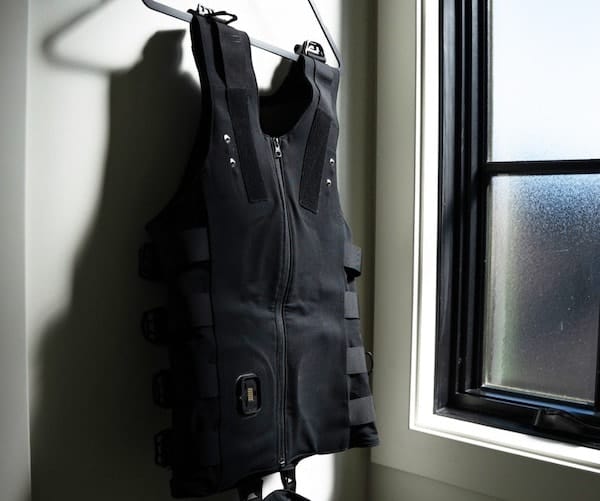
I bought the Katalyst Gen 3 in 2022 and upgraded to the Gen 4 in December 2024, training in it through 2025. The wet electrodes deliver strong, even full-body activation, and the guided app workouts are the most polished of any suit I tested. The dealbreaker was not the hardware: support collapsed in 2025, and it still locks owners into a mandatory $40/month subscription on top of the $2,999 suit.
- EMS Type
- Whole-body EMS
- Electrode Type
- Wet (spray required)
- Session Duration
- 20 min
- Warranty
- 1-year suit / 3-year powerbox
- Subscription
- Required
- FDA Cleared
- Yes
- App
- Premium guided video library
- Setup Time
- ~5 min with practice
Best For
- Users who prioritize guided workout experiences and a polished app ecosystem over ownership autonomy
Skip If
- Customer support reliability matters to you, you want subscription-free EMS ownership, or you're budget-conscious about $4,000+ total 4-year cost
Pros
- Excellent workout technology with effective full-body muscle activation
- Best-in-class app ecosystem with 100+ guided video workouts
- Wireless design for freedom of movement during training
- FDA-cleared hardware with proven electrode conductivity
Cons
- Customer service collapsed in 2025 with months of unanswered support tickets
- Mandatory subscription required to use the suit
- Impulse pack replacement cost when batteries die post-warranty
- Wet electrode system requiring 3-5 minute spray prep each session
Your rating helps others choose
Tap to rate
Katalyst was the gold standard in 2021-2024. I bought my Gen 3 suit in 2022. I upgraded to the Gen 4 in December 2024. By 2025, the company imploded.
Multiple users, including my own experience, report zero support responses for months (Reddit, Reddit, Reddit, Reddit). Support team layoffs, delayed Gen 4 shipments, unfulfilled refund requests plague the company (Reddit, Reddit, Reddit).
The tech itself? Still excellent. Effective workouts, gorgeous app interface, wireless freedom, FDA-cleared hardware. Setup takes 25 minutes initially but drops to 5 minutes with practice. Like all the suits, you’ll need to spray electrodes with water before every session. I’ve logged 100+ workouts with it, and you can see my experience here in this Katalyst EMS Suit Review.
Here’s the deal breaker: $2,999 suit price plus $40/month subscription for app access. The suit is pretty much useless without the app.
Worse, users report $1,299 charges for impulse pack replacements when batteries die post-warranty, batteries that cost ~$10 (Reddit).
My take: Great tech, concerning business operations in 2025-2026. Proceed with extreme caution or choose alternatives.
What Other EMS Systems Are Worth Considering?
Beyond the main consumer systems, several professional and alternative options deserve mention. These systems often deliver superior results but come with trade-offs in accessibility or cost.
Miha Bodytec: the professional gold standard
Miha Bodytec represents “the real deal” in EMS technology according to serious users. It’s studio-based professional equipment, not available for home use. German-engineered with 15+ years market experience, it activates 98% of muscle fibers and is used by professional athletes.
The downside: studio-only access requiring membership fees. You can’t buy it for home training.
XBody: studio-based effectiveness
XBody operates similarly to Miha. Professional studio equipment with proven results. Users report 3.3-8.8% body fat reduction in the first month with multiple training modes: strength, cardio, relaxation.
Equipment costs run high. Older models hit $60,000; newer units around $20,000+. Earlier versions required cables. Like Miha, it’s studio-only.
Justfit: limited consumer data
Justfit offers both consumer and professional options with award-winning suits. Suits are washable with cables and electrodes, with dry options available. But I found minimal independent user feedback (Trustpilot, Just Fit Pro Reviews). The product line seems confusing without clear differentiation.
Wiemspro: professional overkill for most users
Wiemspro delivers professional-grade features with wireless options and customizable training. But costs are extreme, battery box alone runs $8,500+ with complex setup. One user who switched from Wiemspro to VisionBody explained: “Wiemspro was super expensive. The battery box alone was $8,500 and the suit was another $3,000+. I’m never going back”
It’s best suited for studios and professionals. Overkill for home users.
Antelope: compression-wear EMS from Germany
Antelope takes a different approach with compression-wear style EMS garments. German-made with separate tops and bottoms rather than a full suit, starting around $1,350. Their design integrates electrodes into athletic compression clothing, making it look and feel more like regular workout gear. Worth considering if you prefer the compression-wear form factor over a traditional EMS suit.
EasyMotionSkin: patented dry electrodes, questionable operations
EasyMotionSkin claims patented dry electrode technology. However, their website hasn’t been updated since 2023, several buttons return 404 errors, and the overall presentation raises concerns. For a product category where safety and support are paramount, an unresponsive company is a significant red flag. I cannot recommend it in good conscience.
How Should You Choose Your EMS System in 2026?
Choosing an EMS suit requires balancing tech specs against business stability and total cost of ownership.
Here’s my framework I used to analyze the market and determine which systems are worth considering.
Budget beyond the hardware
Hardware costs range drastically from about $1,700 up beyond $3,000 for the suit and core accessories.
There’s the real issue of hidden costs too. Failed cables, electrode issues, body size (hopefully) improvements. In extreme cases, simple accessories like a new power pack can cost $1,299.
Together, hidden costs can double or even triple the initial investment. This is why customer support is such a critical factor. My evaluation considers the full cost of ownership over time.
Wet vs. dry electrode trade-offs
Wet systems like Katalyst and SQAI require spraying electrodes before each use. Users report 5-minute prep once mastered, but it’s messy. Best for those prioritizing proven conductivity and app ecosystems. They’re most consistent.
Dry systems like VisionBody and TitanBody work with your sweat. “No spray needed. Put on and go” according to users. Best for convenience seekers, those that sweat fast and heavy, and frequent travelers.
Dry offers more convenience; wet delivers slightly better initial conductivity.
Customer support makes or breaks ownership
Customer service might be the defining feature of EMS in 2026 and beyond. Why? EMS hardware notoriously fails. Consistent training should change your body, and you don’t want to be stuck with an unusable suit.
Brand business objectives change, and suddenly customers may be forced into purchasing an ongoing membership.
Understanding and genuinely helpful customer support will determine your experience with electromuscle stimulation technology in general.
The subscription trap question
As recent industry changes have shown, the global EMS supply chain is fragile and brands attempt to offset unpredictable costs with steady user-generated recurring subscription revenue.
Products that require a subscription, by definition, must restrict control over the suit to their platform. Otherwise, if you could use the suit without their app, you wouldn’t need to pay an ongoing fee.
The real issue is what happens in the future? If the company goes out of business, will my suit still work? This is much less of an issue for unrestricted suits.
The main benefit of suits with a membership is accelerated research and development. Recurring income facilitates greater investment in innovations, new trainings, feature releases, etc. No guarantee, but it’s possible.
Red flags vs. green flags
Before making any purchase, here are the factors I would consider.
Avoid if:
- Company stopped (or is very slow) to respond to customer service inquiries
- Pricing or subscription terms changed without clear communication
- Delivery delays exceed 8 weeks with no updates
- Multiple reports exist of defective parts not replaced
- Battery or component replacement costs exceed 50% of suit price
At the same time, here are the positive attributes I look for.
Green flags include:
- Fast shipping under 4 weeks
- 30-day return policies
- Multi-year warranties of 2-3 years
- Responsive customer support with real humans
- No subscription requirement or crystal-clear subscription terms
Common EMS Suit Questions
These questions emerge repeatedly among EMS users and prospective users. Here’s what the evidence and real experiences show.
Do EMS suits actually work or is it marketing hype?
Science says yes with caveats. Studies confirm EMS matches traditional resistance training for strength and muscle gains when used correctly, but it’s not passive toning (PMC, PMC, PMC, PMC, PMC).
Users report “incredible muscle soreness in hamstrings and glutes” after 20 minutes. Multiple reviews document visible fat loss and strength gains.
With a major catch: you must actively move during sessions. EMS amplifies (but doesn’t replace) effort.
How long does setup actually take?
Manufacturers claim 5 minutes. Real users report 11-25 minutes first time. After practice, wet systems take 3-7 minutes. Dry systems drop under 2 minutes.
Prep includes putting on base layer, wetting electrodes for wet systems, wearing the suit, connecting your power box, and adjusting fit.
Wet vs. dry: Which performs better?
Dry pros: zero prep time, travel-friendly, no mess. Dry cons: requires sufficient sweat for conductivity, slightly reduced initial stimulation. Wet pros: immediate conductivity, proven performance. Wet cons: 3-5 minute spray prep every session, potential mess.
How Are EMS Suits washed and cleaned?
EMS suits (mainly the base layer) should be hand washed gently, always without fabric softener or bleach. Then hung to air dry to protect the electrodes and material. Of course, the electronic power box must be removed first.
Make sure you follow the manufacturer’s specific instructions for this part of your suit maintenance.
What happens when the EMS battery dies post-warranty?
EMS batteries do die and malfunction after heavy use; it has happened to me twice in about 3 years. Katalyst users report charges up to $1,299 for new impulse packs when batteries fail outside of warranty. VisionBody uses replaceable Canon camera batteries running ~$20-50. SQAI offers a 2-year warranty on their power box. TitanBody provides a 3-year power box warranty.
Always check warranty length and battery replacement policies before buying.
Are studio systems like Miha and XBody worth it versus home systems?
Generally, no. Studio pros include professional guidance every time, higher-grade equipment, and no upfront $2,000+ cost. Studio cons include ongoing membership fees of $100-300 monthly, location-dependent availability, and less flexibility for travel.
The math: a home system pays for itself after 8-15 months of equivalent studio sessions. I prefer (and use) home systems for the autonomy and long-term ROI.
What’s the actual learning curve?
Week 1: carefully follow setup videos. Week 4: most are up and running in 5 minutes. Month 3: it’s second nature & barely requires thought.
Critical first session advice: start LOW on intensity. You’ll be incredibly sore if you crank intensity too high.
Can EMS suits replace traditional weight training?
Not entirely. EMS suits excel at time-efficient muscle activation and can match traditional training for strength gains in studies, but they cannot replicate heavy compound movements like deadlifts or squats for maximal strength development.
Consider EMS a powerful complement to conventional training, or a standalone solution for those seeking time efficiency, recovering from injury, or unable to access traditional equipment.
Are EMS suits safe for everyone?
No. EMS suits are contraindicated for people with pacemakers or implanted electronic devices, pregnant women, those with epilepsy or seizure disorders, and individuals with active skin conditions in electrode contact areas.
Always consult your physician before starting EMS training, especially if you have cardiovascular conditions. Start at the lowest intensity setting during your first session to assess your tolerance.
How much does a full EMS system really cost over 4 years?
Total 4-year ownership cost varies dramatically by brand.
TitanBody: approximately $1,895 upfront with no subscription, plus $495 if you need a replacement suit. SQAI: $2,795 one-time cost with no ongoing fees. VisionBody: $2,490 with minimal replacement costs ($20-50 Canon batteries). Katalyst: $2,999 hardware plus $40/month subscription ($1,920 over 4 years) totaling approximately $4,919, plus potential $1,299 impulse pack replacements.
Subscription-free models offer significantly lower total cost of ownership.
Where Do You Land Among Biohackers?
85% of biohackers take magnesium. 66% train for strength. The largest age group is 65+. Answer a few quick questions and get your free Health Optimizer Profile: your stack, spending, data obsession, and longevity focus, scored against the community.
Final Verdict: How to Pick a Top Electronic Muscle Stimulator in 2026
Electronic muscle stimulation therapy is a promising frontier of fitness.
It’s a great way to efficiently build strength, power, VO2 max, cardio, sport-specific skills, and even biohack your muscle recovery.
Even top brands can implode.
If you’re ready to buy, here’s my 2026 recommendation hierarchy:
- TitanBody is the best value EMS suit for bodybuilding, athletes and overall value
- SQAI is the EMS suit with moveable electrodes
- VisionBody is the original and most proven EMS suit for home use
- Katalyst is the best EMS suit for guided workouts if you don’t mind a subscription
Although I have and use a grandfathered Katalyst Gen 4 suit, if I had to choose over again, I’d likely pick TitanBody. When my Katalyst broke, I upgraded to TitanBody and their upcoming version 2 suit will be even better.
For more ways to upgrade your training, check out the best biohacking fitness gear, learn about blood flow restriction training, or explore all the benefits of EMS training. You can also browse essential biohacking products to complement your EMS routine.
Have you tried any of these EMS suits? Drop your experience in the comments below.

Comments