

Light therapy devices flicker, and that flicker has real biological consequences for comfort, performance, and safety.
Most brands don’t disclose their flicker rates, and even popular devices have had mixed results across product generations.
This guide covers what flicker is, how to measure it, and which levels to avoid.
You can’t reliably detect flicker by eye. Measuring with a flicker meter is the only way to confirm device stability
Most red light therapy devices flicker, even when the light looks steady to your eyes. Flicker is usually caused by AC power and low-quality LED drivers
Low-frequency flicker (<120 Hz) is the most problematic, stressing the visual cortex and autonomic nervous system even when it’s not consciously visible
Light quality matters as much as wavelength and dose. Red light therapy works best when photon delivery is stable, predictable, and biologically calm
Outliyr reminds that flicker has real biological effects, including eye strain, headaches, nervous system stress, and reduced comfort especially during longer or stronger sessions
Outliyr found that many brands don’t disclose flicker data. If a manufacturer can’t provide measured flicker specs, it’s a red flag for engineering quality
Independently Tested
Nick independently measures devices using a professional light spectrometer, power meter, flicker meter, EMF meter, and dirty electricity meter.
What Is Red Light Therapy Flicker & Why Does It Matter?
Flicker, even if you don’t notice it, is the rapid pulsing of light that affects your eyes, brain, and nervous system.
It affects many man-made lights, and many of the best at-home red light therapy panels spend extra to actively mitigate flicker.
Why LED lights flicker
Most LEDs run on alternating current (AC) power that cycles 50 or 60 times per second. This creates natural fluctuations in brightness. LED drivers control how electricity flows to the diodes, and cheap drivers allow more flicker through.
Standard light dimming uses PWM (pulse width modulation) technology. It rapidly switches LEDs on and off to control brightness.
LEDs flicker more than incandescent light bulbs because they respond instantly to power changes instead of glowing through thermal inertia.
LED light bulbs or LED chips that produce light, when they pulse, they turn from 100% emission to zero in terms of the wattage of emitted light 120 times a second. Fluorescent light bulbs go from 100% power to like 30 or 40% power.
Brian Richards, founder of SaunaSpace, on the High Performance Longevity podcast
How flicker affects your brain & body
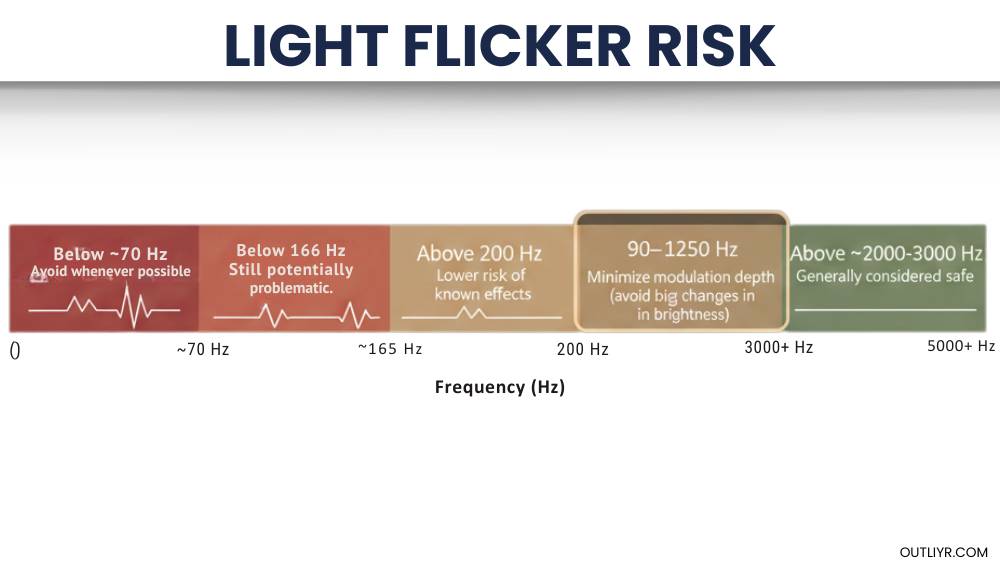
Flickering light dramatically impacts your biology without you even consciously seeing it. Common symptoms mirror those of stress: headaches, eye strain, and visual fatigue from heavy exposure.
Flicker below 120 Hz (low frequency) causes measurable physiological stress and forces your eyes to constantly adjust (PubMed).
This creates chronic low-level tension in your autonomic nervous system.
Some people experience trouble concentrating, muscle tension, and irritability. Flicker can disrupt sleep patterns by taxing your visual cortex (PubMed).
Frequencies between 15-20 Hz are particularly problematic and can trigger seizures in sensitive individuals.
On the High Performance Longevity Podcast, Carrie Bennett explained that she treats flicker-free daytime light and darkness at night as parts of a circadian-friendly lighting environment in her clinical work.
The red-light buyer’s guide covers other hardware checks, and my testing methodology explains how flicker fits into the measurement process.
Why flicker matters in therapy devices
As this red light therapy dosage guide shows, benefit depends on multiple factors. Flicker creates inconsistent light delivery during your therapy session.
When LEDs pulse on and off, the irradiance (power density) fluctuates instead of staying steady. This means you get erratic dose delivery with peaks and valleys instead of continuous therapeutic exposure.
Your cells receive inconsistent photon delivery, which makes therapeutic outcomes less predictable.
Higher device build quality reduces flicker and improves dose consistency. Brands like LightPath LED and Mitolux prioritize constant current drivers specifically for this reason.
What Types of Light Flicker Affect Your Health?
Flicker is more than just visible blinking.
There are a couple of key variables that determine the biological effects of flickering light:
- Flicker Percent: Measures how much the light output drops with each cycle (0–100%). Low is better: under 5% is ideal, above 30% is concerning for most people
- Flicker Index: Scores how smooth or “spikey” the fluctuation is (0–1 scale). Values under 0.02 are excellent, while 0.2 or higher can mean discomfort (Arrant-Light)
- Flicker Frequency: Tells how many times per second the light pulses (Hz). Lower frequencies (<120 Hz) are most stressful on the brain and can cause headaches or fatigue. High frequencies (>2000 Hz) are usually safe for most people
- Driver Type: Cheap LEDs use PWM, switching on/off rapidly. Better devices use constant current drivers (or ultra-fast PWM at 10kHz+), which keeps light output steady and safe
Look for low <5% flicker percent and low <0.02 flicker index, high 2,000 Hz or greater frequency, and constant current drivers for the best and safest therapy experience.
Which Light Therapy Devices Have the Worst Flicker?
All light therapy wavelengths (including red, near-infrared, blue, green, UV, and full-spectrum) can flicker if the device uses unstable circuitry or low-quality drivers.
Flicker is common in LED panels and lamps for red light therapy, blue light (acne/SAD), green light (migraine), UV treatments, and even infrared saunas (Sci Rep).
- Red and near-infrared devices: Prone to flicker from AC or cheap drivers, affecting mitochondrial energy dosing and dose consistency
- Blue and green devices: Higher photon energy and brain sensitivity make flicker more noticeable, with blue and green light especially problematic for neurological symptoms or migraines (Sci Rep, Biology)
- UV, fluorescent,and full-spectrum lamps: Both LED and fluorescent models can flicker; fluorescent uses a different mechanism but still produces pulsing, sometimes at frequencies that affect the nervous system
- Infrared saunas: PWM control of heating elements introduces low-frequency flicker, which may cause hidden nervous system effects during relaxation
Avoid this by choosing a device with stable, high-quality drivers to minimize unwanted biological effects.
What Are the Health Risks of High Light Flicker?
High flicker from light therapy devices triggers both immediate and chronic biological stress. Short-term, you’ll notice headaches, eye strain, and trouble focusing within 10-30 minutes of exposure. Your visual cortex processes thousands of brightness changes per second even when you can’t consciously see them.
Long-term, chronic flicker exposure keeps your sympathetic nervous system slightly activated, contributing to HPA axis dysregulation and impaired sleep. Frequencies between 15-25 Hz pose the greatest danger, potentially triggering seizures in people with photosensitive epilepsy.
Migraine sufferers, those with ADHD, autism, and traumatic brain injury show heightened sensitivity at much lower thresholds. After testing 67+ devices with calibrated spectrometry equipment, I’ve found that cheap panels often flicker at 100-400 Hz with percentages above 20%.
Here are some of the health effects of excess exposure.
Short term reactions
Immediate symptoms are generally short-lived (while exposed) and dissipate rapidly when you remove the source.
Initial symptoms of light flicker include:
- Headache
- Head tension
- Eye strain, burning, dryness
- Trouble focusing after therapy sessions
- Irritability and restlessness
These reactions happen because your visual cortex processes many thousands of brightness changes even though you’re not consciously aware of them.
Long term concerns
Chronic flicker exposure creates persistent low-level nervous system stress.
Longer-term symptoms and conditions associated with high exposure to light flicker:
- Increased stress and stress hormones
- Hypothalamic-pituitary-adrenal (HPA) axis dysregulation
- Impaired sleep
- Slower muscle recovery
- Greater risk of athletic injuries
Your sympathetic nervous system (fight or flight response) stays slightly activated during sessions. This affects your hypothalamic-pituitary-adrenal axis over time. Sleep disruption can develop if you use flickering devices in the evening.
The constant visual processing interferes with parasympathetic recovery.
Some researchers suggest that long term flicker exposure may contribute to hormonal dysregulation through chronic cortisol activation [PLoS One].
Flicker sensitivity conditions
People with certain conditions and disorders are like canaries in the coal mine; they show heightened sensitivity to all forms of flicker (Sci Rep).
Populations more sensitive to light flicker include:
- Migraine sufferers
- ADHD
- Autistic
- Traumatic brain injury
- Epileptics
The threshold for triggering symptoms in these groups is much lower than average.
ADHD populations often report increased restlessness and focus problems with flickering lights.
Individuals on the autism spectrum may experience sensory overload from flicker that others don’t notice.
Post-concussion patients frequently have temporary flicker sensitivity during recovery.
Anyone with photosensitive epilepsy must avoid flicker between 15-25 Hz completely.
How Do You Measure Flicker in Light Therapy Devices?
You can’t reliably detect flicker by eye. The only accurate method is a dedicated flicker meter. The Opple Light Master Pro costs roughly $150-200 and measures the three critical metrics: flicker percent, flicker index, and frequency across all wavelengths including red and near-infrared.
To test, turn off ambient lights, aim the meter at your device from normal treatment distance, and take readings at each intensity setting. Flicker often changes at different power levels. Target flicker percent below 5% and index under 0.02 for excellent stability.
A smartphone camera pointed at the device can reveal visible banding from low-frequency flicker, but this DIY method misses higher frequencies entirely. I’ve spent over $3,000 on calibrated testing equipment including a HOPOOCOLOR spectrometer, and proper measurement tools consistently reveal problems invisible to cheaper methods.
The most accessible is the Opple Light Master Pro, an easy-to-use meter costing ~$150-200 that measures flicker percent, index, and frequency for any wavelength, including red and NIR.
To test:
- Turn off other lights
- Aim the meter at your device from a typical usage distance
- Take a few readings at each intensity setting (since flicker can vary)
What matters:
- Look for flicker percent below 5% and index under 0.02 for best comfort and quality
- Higher flicker frequencies (above 2000 Hz) are less biologically stressful
Testing your own devices is the only way to be sure you’re getting steady, safe light and not hidden flicker. My testing methodology covers the exact meters and protocols I use.
What Flicker Levels Are Safe vs Dangerous?
You want low flicker because it keeps your nervous system calm. Flicker does not have benefits. Patterns should be stable from repeated testing.
| Flicker Metric | Excellent | Acceptable | Concerning | Dangerous |
|---|---|---|---|---|
| Flicker Percent | <3% | 3-5% | 5-20% | >20% |
| Flicker Index | <0.01 | 0.01-0.02 | 0.02-0.2 | >0.2 |
| Frequency (Hz) | >10,000 | 2,000-10,000 | 500-2,000 | <500 |
| Driver Type | Constant current | High-freq PWM (10kHz+) | Mid-freq PWM | Low-freq PWM (<500 Hz) |
| Nervous System Impact | Imperceptible | Minimal | Moderate stress | Headaches, eye strain, seizure risk |
Look for the following flicker stat thresholds:
- Good: <5% flicker percent, <0.02 flicker index
- Great: <3% flicker percent, <0.01 flicker index
Frequencies above 10,000 Hz (10 kHz) are essentially imperceptible to your nervous system.
Visible flicker that you can see with your eyes indicates poor quality engineering.
PWM at low frequencies (below 500 Hz) is the most problematic (Cadence PCB). Your nervous system detects these pulses even when your eyes adapt.
How To Choose A Low Flicker Light Therapy Device
Choosing a low-flicker light therapy device starts with asking the right questions. Request specific flicker percent and flicker index values from the manufacturer, not vague ‘flicker-free’ marketing claims. Devices using constant current drivers maintain steady output, while cheaper PWM-driven panels pulse on and off to control brightness.
Red flags include: no flicker specs on the website, built-in dimming with dozens of intensity settings, battery power, and full panels priced under $100. Battery devices almost always use PWM dimming to conserve charge.
The ideal specs are flicker percent under 3%, flicker index under 0.01, and frequency above 5,000 Hz. If a brand can’t answer basic flicker questions, their engineering quality is probably poor. Independent third-party lab results are the gold standard.
Questions to ask brands
Ask manufacturers directly if they test flicker during production.
Request specific flicker percent and index values, not vague claims about “flicker free” operation.
Many won’t provide it, but try to find out what driver type they use (constant current vs PWM).
Some higher quality brands will specify driver frequency if PWM is present.
Ask if they have independent third party testing results from labs. Companies that understand light therapy device testing will provide documentation
If they can’t answer basic flicker questions, the engineering quality is probably poor.
Warning signs of high flicker devices
Some of the telltale signs of poor manufacturing are obvious.
Look for the following red flags when investigating light therapy products for flicker:
- No flicker specs listed anywhere on the website or manual
- Multi-mode LEDs with built-in dimming
- Dozens of intensity settings
- Battery-powered
- Extremely low prices (<$100 for full panels)
Panels with multiple modes and the ability to dim the LEDS often use problematic PWM by default. Portable/battery-operated devices usually use PWM dimming to extend battery life.
When Does Light Flicker Not Matter?
While you generally want to avoid flicker, certain situations make it less problematic.
Light flicker matters less in the cases of:
- Very high frequency flicker >3,000 Hz because it has negligible impact on the nervous system and visual cortex
- Standard ambient lighting with a power density below 5-10 mW/cm² (most) because it has a much smaller biological impact
- Rapid exposure of 2-4 minutes will cause low total flicker load on your body and is sufficiently short for your nervous system to handle
The stronger the light and/or the longer you’re exposed, the more important flicker becomes.
Frequently Asked Questions About Light Therapy Flicker
Do red light devices flicker?
Yes, most red light therapy devices flicker unless manufacturers specifically engineer low-flicker drivers. The flicker comes from AC power supplies and PWM dimming circuits.
Quality panels use constant current drivers to minimize flicker <3-5%. Cheap devices often flicker at 100-400 Hz with percentages >20%.
You can’t tell by looking, so you need to test with a flicker meter or request specs from the manufacturer.
Which red light panels have low flicker?
Brands that publish flicker index below 0.02 and flicker percent below 5%. Devices using high frequency PWM (above 10 kHz) are also acceptable.
Most manufacturers don’t disclose flicker data, so you need to ask directly or test yourself. Higher priced panels from established brands tend to have better driver engineering, but price alone doesn’t guarantee low flicker.
Can flicker cause headaches?
Yes, light flicker is a well documented trigger for headaches and migraines. Your brain processes rapid brightness changes even when you can’t consciously see them. Low frequency flicker <200 Hz creates the most biological stress.
Symptoms typically appear within 10-30 minutes of exposure. People with existing migraine disorders show heightened sensitivity to all flicker frequencies (Sci Rep).
If you get headaches during or after light therapy, test your device for flicker immediately.
How do I know if my therapy light flickers?
The best method is measuring with a professional flicker meter like the Opple Light Master Pro. Point the meter at your device and check flicker percent, index, and frequency.
You can also try the smartphone camera test: open your camera app and point it at the light. Visible bands or ripples on screen indicate flicker. However, this method only catches low frequency flicker and misses higher frequencies.
For complete data, invest in a proper measurement tool.
Is high flicker dangerous?
High flicker isn’t immediately dangerous for most people, but it creates chronic stress. Short term effects include headaches, eye strain, and nervous system tension. Long term exposure can cause sleep disruption and autonomic imbalance.
The main danger is for people with photosensitive epilepsy who can have seizures from flicker between 15-25 Hz.
High flicker also undermines therapy effectiveness by delivering inconsistent doses. You’re better off avoiding it completely.
Does flicker affect light therapy results?
Yes, flicker creates inconsistent irradiance that affects dose delivery. When your device pulses on and off, you receive peaks and valleys instead of steady therapeutic light.
This makes time-based dosing calculations less accurate. The average power delivered may be significantly lower than peak measurements suggest.
Your cells receive irregular photon delivery rather than consistent stimulation. While studies show LED therapy works, low flicker devices should produce more predictable and reliable outcomes through stable power delivery.
What is a safe flicker level for daily use?
Flicker percent <5% is safe for most people during daily use while a flicker index <0.02 indicates excellent stability suitable for sensitive individuals.
Frequencies above 2000-3000 Hz reduce biological impact even if percent is moderate. The combination of low percent (under 3%), low index (under 0.01), and high frequency (above 5000 Hz) is ideal for therapeutic devices.
Can I use a flickering device if I don’t notice symptoms?
Yes, you can use devices with moderate flicker if you don’t experience obvious symptoms, but you’re still creating subtle and unnecessary biological stress.
Your nervous system detects flicker below conscious awareness. This produces low-level sympathetic activation that may affect recovery and sleep quality.
Do infrared saunas have flicker problems?
Yes, infrared saunas use PWM temperature control that creates flicker in the heating elements. Far infrared emitters pulse on and off to maintain set temperatures, typically at 1-10 Hz during heating cycles.
Most sauna manufacturers don’t disclose modulation patterns. Carbon panel saunas tend to have smoother output than ceramic heaters. This hidden flicker affects your autonomic nervous system while you’re trying to relax.
If you’re sensitive to light flicker, you may also react to infrared modulation patterns in saunas.
The Danger of Light Flicker: Final Verdict
Flicker is one of the most overlooked variables in light therapy and healthy lighting. Actually, all artificial light exposure.
You can’t see it with your eyes, but your nervous system registers every pulse. Thousands per second.
Most light therapy devices flicker at levels that create unnecessary biological stress, reduce dose consistency, and undermine the benefits you’re trying to achieve
This applies to red light panels, blue light devices, green light therapy, UV equipment, full spectrum lamps, and even the best infrared saunas.
Stress all accumulates in one “bucket,” so this becomes a large waste.
Here are some things you can do to fight flicker stress:
- Test products before you buy and/or ask manufacturers for flicker specs
- Measure your current devices with an Opple Light Master Pro or similar meter
- Buy devices that use constant current drivers instead of PWM dimming
- Watch for symptoms post-session that indicate excess exposure (headaches, eye strain, or tension)
- Avoid cheap devices <$100 since almost all use low quality drivers with high flicker
- Test flicker at every intensity level if your device has adjustable power
- Sit farther away and/or shorten sessions if you suspect flicker issues
The good news?
You can avoid these problems.
The quality of your light matters just as much as the wavelength and dose.
One day this will all become common knowledge.
Do you have experience with light flicker? Leave your comment or questions below!
Comments