

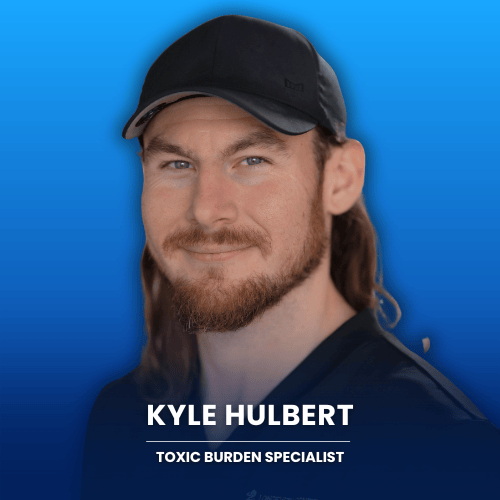
With Kyle Hulbert of The Longevity Centers of America, Episode 264




What You Will Learn
- The testosterone-159 wakeup call: A varsity rower at age 21 with 8 to 10 hours of sleep tested at roughly 10x below a healthy young man’s level, exposing how lifestyle-perfect athletes still crash when toxic burden is hidden. [00:00:55]
- Why six doctors missed it: Conventional practitioners told Kyle his symptoms were “in his head” until an integrative physician ran the right panel and a concierge doctor referred him to a mercury specialist. [00:04:53]
- The cilantro myth, debunked: Excreting mercury requires two thiool bonds to be excreted. Cilantro has one, so it mobilizes mercury rather than removing it Only DMPS, DMSA and alpha-lipoic acid are true mercury chelators. [00:10:47]
- Why a blood test misses heavy metals: Metals live in tissues, not blood. A positive blood result means either a recent exposure or that tissues are already overflowing. A negative result tells you almost nothing. [00:14:32]
- The provocation test, explained: The gold-standard mercury and metals test uses a pre-IV urine sample, an IV chelating agent (DMPS or EDTA), and 8 hours of urine collection. Combined panels run about $400 at Kyle’s clinic. [00:16:49]
- Heavy metals affect 25 to 30 percent of people: Broadened to all toxins (mold, glyphosate, endocrine disruptors), Kyle’s clinical estimate rises to 60 to 70 percent of the population dealing with measurable symptoms. [00:13:26]
- EBOO vs TPE pricing reality: EBOO runs $830 single or $750 in a 3-pack at Kyle’s clinic and boosts blood oxygen by about 35 percent for a week. TPE typically runs $10,000+ and uses pooled donor albumin. [00:34:34]
- Mold and heavy metals are linked: Kyle’s clinical observation is that about 90 percent of mold-positive patients see their mold issues resolve once heavy metals are removed. Metals serve as biofilm scaffolding. [00:27:39]
- Procaine IV is the underrated reset: A novocaine-class abesthetic delivered IV that interrupts fight-or-flight signaling via calcium channel blockers. Often stacked with a stellate ganglion block for severe anxiety. [01:04:01]
Why It Matters
Most people with brain fog, fatigue, low testosterone, and severe mental health symptoms are told their bloodwork is “normal” and sent home. Kyle Hulbert, CEO of The Longevity Centers of America, has helped 1,500+ patients in a single year reveal the toxic burden, hormone dysfunction, and missed root causes that conventional panels never see. This episode gives you the specific tests, chelators, and clinical modalities (and their real prices) so you can stop chasing symptoms and start removing the load.
Who Should Listen
- High performers with “normal labs” who still feel exhausted, foggy, or hormonally flat and suspect something deeper is going on.
- Biohackers comparing detox modalities (EBOO, ozone, sauna, chelation) who want price-vs-effect comparisons from inside a working longevity clinic.
- Anyone with persistent mold, parasite, or chronic-fatigue diagnoses who wants to know what the heavy-metal-first hypothesis means for their protocol.
Episode Overview
On the High Performance Longevity podcast, Kyle Hulbert, CEO of The Longevity Centers of America and co-host of Longevity Unlocked, walks Nick through the exact biochemical detective work that took him from a 159 ng/dL testosterone reading at age 21 to running a 1,500-patient-per-year detox and longevity clinic. The conversation opens with Kyle’s personal collapse during his master’s degree (brain fog, fatigue, severe anxiety and depression) and the integrative physician who finally connected hormones to a deeper, hidden cause: mercury.
Kyle then walks through the chemistry of chelation in plain English: why mercury requires two thiol bonds (which is why cilantro fails and DMPS, DMSA, and alpha-lipoic acid succeed), why standard blood panels miss tissue-bound metals, and what a provocation test actually measures. He breaks down the major clinical modalities (EBOO, TPE, plasmapheresis, 10-pass ozone, infrared sauna, PEMF, procaine IV, stellate ganglion block) with real price points and contrarian risk-reward calls. The mold-and-metal connection (90 percent of mold-positive patients clear once metals are out) is one of the strongest takeaways.
The takeaway: stop waiting for a “normal” panel to validate how you feel. Start with the provocation test, address the toxic burden first, then layer hormones, peptides, and performance protocols on a clean foundation. Kyle’s clinic prices most of these modalities at a fraction of national averages, but the listening value here is the framework, not the upsell.
Episode Score Card
Three of the modalities Kyle discusses (and the hormone therapy that started his journey) have BioHarmony reports. Here’s how they score on Outliyr’s evidence-graded framework:
- Ozone Therapy: 4.4/10 (Caution). Powerful but operator-dependent and easy to misdose.
- Infrared Sauna: 6.4/10 (Recommended). Solid detox-support tool when paired with a binder.
- PEMF Therapy: 6.5/10 (Recommended). Best results from high-intensity, practitioner-grade devices.
- TRT: 4.0/10 (Caution). Address root causes (including toxic burden) before lifelong hormone therapy.
Want YOUR personalized scores? Take the 2-minute quiz at Outliyr Bioharmony Profile
Key Terms Quick Reference
[00:16:49] Provocation test: Gold-standard urine test for heavy metals. Pre-IV urine sample, then an IV of a chelating agent (DMPS for mercury and arsenic, EDTA for lead and other metals) pulls metals from tissues into urine collected over 8 hours. Comparing pre vs post excretion reveals true tissue burden.
[00:10:08] Sync effect: When mercury is pulled out of the body during chelation, some mercury from the brain migrates back into the body to restore equilibrium. This can produce neurological symptoms (feeling drunk, brain fog) even when the chelator is not crossing the blood-brain barrier directly.
[00:12:54] Andy Cutler method: Mercury detox protocol using alpha-lipoic acid (ALA) dosed every 3 hours around the clock for multi-day cycles. ALA crosses the blood-brain barrier, making it useful for removing mercury from the brain after the body burden has been reduced.
[00:36:25] EBOO (extracorporeal blood oxygenation & ozonation): Closed-loop blood-filtration system. Blood exits one arm, passes through a dialysis filter, gets ozonated, oxygenated, and UV-irradiated, then returns via the other arm. Filters microplastics, glyphosate, mold toxins, viruses, and bacteria. Boosts oxygenation about 35 percent for about a week.
[00:11:39] Chelation: Binding heavy metals with agents that have the correct molecular structure (such as two thiol bonds for mercury) so they can be excreted. True mercury chelators: DMPS, DMSA, ALA. EDTA binds lead, cadmium, aluminum, and other non-mercury metals.
[00:49:35] Biofilm: Protective ecosystem (Kyle calls it “sludge”) that mold and other pathogens build to evade the immune system. Heavy metals act as the scaffolding of biofilms, which is why many biofilm-buster nasal sprays contain EDTA (a heavy-metal chelator).
[01:04:15] Procaine IV therapy: IV administration of procaine (a novocaine-relative) that acts on calcium channel blockers to interrupt fight-or-flight signaling, giving the nervous system a hard reset. Often stacked with a stellate ganglion block (SGB) to magnify the effect.
[01:05:15] Stellate ganglion block (SGB): Injection of an anesthetic into the stellate ganglion in the neck that hard-resets the sympathetic nervous system. Popular for PTSD and severe anxiety. Done bilaterally. Kyle’s clinic follows it with a procaine IV.
Why Do Normal Lab Tests Miss Heavy Metal Toxicity?
The short answer
Heavy metals do not live in the bloodstream. They live in tissues. A standard blood-based heavy metal screen tells you almost nothing about your true tissue burden, which is why people with severe symptoms keep getting handed “normal” lab reports.
What Hulbert found
Based on clinical practice plus genetic variant data, Kyle estimates 25 to 30 percent of the population is symptomatic from heavy metals specifically, and 60 to 70 percent from toxins broadly (mold, glyphosate, endocrine disruptors, viral co-infections). Metals pass through the blood transiently after exposure and then deposit into tissue. If a blood test shows metals, it means either a recent exposure or that tissues are already overflowing. The gold-standard tool, the provocation test, costs about $400 at Kyle’s clinic for a combined DMPS plus EDTA panel versus roughly $700 each at most providers. A standard Quest Diagnostics heavy metal screen runs about $36 but is largely uninformative.
What to do about it
If you have persistent symptoms with normal labs, ask your practitioner about a provoked urine test. Pee in a cup before the IV (to measure baseline excretion), then receive an IV of DMPS (for mercury and arsenic) or EDTA (for lead, cadmium, aluminum, and other metals), then collect urine for 8 hours. The pre-vs-post comparison reveals the true tissue burden. Hair tissue mineral analysis and unprovoked urine tests cannot reliably substitute. Kyle reframes the modern mental health epidemic as a generational toxic-load problem, so addressing the metals first often produces dramatic symptom resolution before any psychiatric intervention.
“Heavy metals don’t like to live in the blood. They like tissues. They live in the blood transiently. So you get exposed, they go into the bloodstream, then they get deposited into tissues.”– Kyle Hulbert
Related: Remove Heavy Metals, Mycotoxins, Microplastics & Other Toxic Waste
What Is The Right Way To Detox Mercury From The Body?
The short answer
Only three agents can effectively chelate mercury from the body: DMPS, DMSA, and alpha-lipoic acid (ALA). Each has two thiol bonds, which is the molecular requirement for grabbing mercury tightly enough to excrete it. Cilantro has one thiol bond, so it mobilizes mercury without removing it.
What Hulbert found
Kyle did 30+ DMPS IVs before transitioning to oral chelators. He explains the “sync effect”: as mercury exits the body, brain-stored mercury migrates back to maintain equilibrium, which is what produces the drunk-feeling and brain-fog flares during early detox. ALA crosses the blood-brain barrier, so Kyle uses the Andy Cutler method (ALA dosed every 3 hours around the clock for multi-day cycles) after the body burden has dropped. His own mercury score moved 34 to 7 with chelation, then back up to 14 after rapid weight loss freed mercury stored in fat tissue. That rebound is one of the most important warnings in the episode.
What to do about it
Confirm metals via provocation test first. Address the body burden with IV DMPS or EDTA in a clinic, or oral DMSA at home, before attempting the brain compartment. Only then layer in the Andy Cutler ALA protocol. Never lose significant weight without binders (activated charcoal, glutathione) in place, because fat-soluble toxins liberate as you burn fat. Skip cilantro and chlorella as primary chelators. Selenium is the one mineral with literature supporting its ability to displace mercury via the sync effect, but it is supportive, not a true chelator.
“People will tell you that cilantro will detox mercury. They don’t understand the science, they don’t understand how it works. So to bind to mercury you have to have two thiol bonds, right? Cilantro has one.”– Kyle Hulbert
Related: Forgotten Health Protocols: EDTA, Megadose Vitamin C & More
EBOO vs TPE: How Do These Detox Modalities Compare?
The short answer
EBOO (extracorporeal blood oxygenation and ozonation) is a closed-loop blood-filtration system. TPE (therapeutic plasma exchange) removes your plasma and replaces it with pooled donor albumin. Kyle’s clinical comparison favors EBOO on cost, risk profile, and breadth of what it filters.
What Hulbert found
EBOO at Kyle’s clinic costs $830 single or $750 in a 3-pack versus a national average of about $1,500 (some NY/LA clinics charge $3,000+). It filters microplastics, glyphosate, mold toxins, viruses, and bacteria via dialysis filter plus ozonation plus UV light. It also boosts blood oxygen by about 35 percent for a week, which Kyle positions as the closest legal analog to blood doping for athletes. TPE typically runs $10,000+ and uses pooled donor albumin drawn from hundreds to thousands of donors mixed in a single vat, which Kyle considers a meaningful risk that the marketing rarely discloses. Plasmapheresis runs $2,000 to $3,000 to separate and discard your plasma. The math on ozone dosing: 30 rectal treatments equal one 10-pass; three 10-passes equal one EBOO. So 50 to 100 at-home rectal ozone sessions equal a single EBOO.
What to do about it
If you are choosing between blood-purification modalities, ask the clinic which filter material they use (plastic-based filters reintroduce microplastics, cellulose-fiber filters do not). Compare what is actually being removed versus added back. For most use cases EBOO offers better risk-reward than TPE at a fraction of the cost, and is dramatically safer than older 10-pass ozone protocols. Athletes can stack EBOO with infrared sauna plus activated charcoal as a binder for mobilized toxins. At-home alternatives (rectal ozone, sauna, PEMF) work but require many more sessions to match the clinical dose.
“EBOO, right? Extracorporeal blood oxygenation, ozonation, it’s closed loop system. Blood runs out of one arm, runs through dialysis filter, gets ozonated, oxygenated, runs through an ultraviolet light and back in the other arm kills viruses, bacteria, it filters microplastics, it filters glyphosate, it filters mold, toxins, all kinds of stuff.”– Kyle Hulbert
Related: Ozone Therapy: Nature’s Disinfectant & Super Oxygenation
The Hulbert Toxic Burden Removal Protocol
A sequence Kyle uses with clinic patients to address hidden toxic burden in priority order, before layering hormone or peptide protocols on top.
- Test before guessing: Run a provoked urine test (DMPS or combined DMPS plus EDTA) to establish your tissue burden of mercury, lead, and other metals. Skip the unprovoked blood and urine panels.
- Upgrade water and food first: A non-plastic water purifier (solid units around $100, premium $300 to $400) plus the EWG Clean 15 and Dirty Dozen lists. Skew toward smaller fish (salmon, anchovies, sardines) and away from large predators.
- Move the lymph: Minimum 8,000 steps daily. The lymphatic system has no pump of its own. Walking is what moves mobilized toxins toward elimination.
- Swap household products as they run out: Soaps, detergents, body wash, cookware (stainless steel), plastic storage, synthetic fabrics. Use EWG-certified replacements. Do not throw everything out at once; rotate as items deplete.
- Chelate the body burden: IV DMPS or EDTA in clinic, or oral DMSA at home. Plan for multiple sessions. Use binders (activated charcoal, glutathione) to capture mobilized toxins.
- Then address the brain compartment: Only after body burden is down, run the Andy Cutler ALA protocol (alpha-lipoic acid every 3 hours around the clock for multi-day cycles) because ALA crosses the blood-brain barrier.
- Layer adjuncts strategically: Infrared sauna plus binder for sweating, high-intensity PEMF for cell membrane modulation, EBOO for systemic blood purification, procaine IV plus stellate ganglion block for nervous system reset.
Common toxic burden mistakes
- Relying on a blood panel or hair test to rule out heavy metals. Both will routinely show “normal” while tissues are loaded.
- Using cilantro or chlorella as a primary mercury chelator. Cilantro has one thiol bond, not two. It mobilizes mercury without removing it.
- Losing significant weight before detoxing. Fat sequesters toxins. Rapid fat loss without binders dumps them back into circulation.
Source: Kyle Hulbert’s Toxic Burden Removal Protocol, The Longevity Centers of America
Frequently Asked Questions
How do you actually test for heavy metal toxicity?
The gold standard is a provoked urine test. You collect a pre-IV urine sample, get an IV of a chelating agent (DMPS for mercury and arsenic, EDTA for lead and other metals), then collect urine for 8 hours. Comparing pre vs post excretion shows your true tissue burden, which a blood test, hair tissue mineral analysis, or unprovoked urine test cannot reliably do.
Why doesn’t a blood test show my heavy metal levels?
Heavy metals don’t live in the blood; they live in tissues. They only pass through the bloodstream transiently before being deposited. A positive blood result means either a recent exposure or that tissue levels are so high they’re overflowing. A negative blood result tells you almost nothing.
Does cilantro really detox mercury?
No. To bind mercury, an agent needs two thiol bonds. Cilantro has only one. It can mobilize mercury but not effectively excrete it, which means it just moves the metal around the body. The only true mercury chelators are DMPS, DMSA, and alpha-lipoic acid (ALA).
What percentage of people are actually dealing with heavy metal toxicity?
Based on Kyle’s clinical practice plus genetic data, roughly 25 to 30 percent of the population is dealing with symptoms from heavy metals specifically. Broadened to all toxins (mold, glyphosate, viral co-infections, endocrine disruptors), that figure rises to 60 to 70 percent.
Is mold or mercury the bigger problem when I have mold symptoms?
In Kyle’s clinical experience, about 90 percent of people who test high for mold see their mold problems resolve once heavy metals are removed. Heavy metals act as the scaffolding of biofilms that mold uses to survive. About 10 percent are true mold cases (usually obvious moldy environments), but most should check heavy metals first.
What’s the difference between EBOO & TPE?
EBOO (extracorporeal blood oxygenation and ozonation) is a closed-loop system: your blood is filtered through a dialysis filter, ozonated, oxygenated, exposed to UV light, and returned to you. It filters microplastics, glyphosate, mold toxins, viruses, and bacteria. TPE (therapeutic plasma exchange) discards your plasma and replaces it with pooled donor albumin, introducing risks from unknown donor contents. EBOO is typically a fraction of TPE’s cost.
Where do you start if you can’t afford clinic-level care?
Water first (a non-plastic purifier system, around $100 for a solid unit). Then food: use the EWG Clean 15 and Dirty Dozen lists and watch large-fish consumption (skew toward smaller fish, salmon, anchovies). Walk 8,000 steps a day to move lymph. Then swap household products (soaps, detergents, body wash, cookware, plastic storage, synthetic fabrics) as they run out, using EWG-certified replacements.
How do I avoid driving toxins back into circulation when I lose weight?
Fat sequesters fat-soluble toxins. Losing fat too fast liberates them. Kyle’s own mercury score dropped from 34 to 7, then rebounded to 14 after rapid weight loss. At minimum, use binders during fat loss. Ideally, test toxic burden first and address it; most people lose fat more easily after detox anyway.
What’s the most underrated longevity-clinic modality most people haven’t heard of?
Procaine IV therapy. Similar to novocaine but delivered IV, it works on calcium channel blockers to interrupt fight-or-flight signaling, giving the nervous system a reset. Kyle did one weekly during the stressful period after his son was born. It’s also commonly stacked with a stellate ganglion block (SGB) for anxiety to magnify the effect.
Products, Tools, & Resources Mentioned
Outliyr independently evaluates all recommendations. We may get a small commission if you buy through our links (at no cost to you). Thanks for your support!
Clinical detox modalities
EBOO (Extracorporeal Blood Oxygenation & Ozonation): Closed-loop blood-filtration system that filters microplastics, glyphosate, mold toxins, viruses, and bacteria via dialysis plus ozonation plus UV light. Kyle’s clinic price: $830 single or $750 in a 3-pack. Best for systemic toxic burden and oxygen boost.
DMPS, DMSA, and EDTA: True chelating agents. DMPS and DMSA bind mercury and arsenic. EDTA binds lead, cadmium, aluminum, and other non-mercury metals. Administered IV or oral. Practitioner-directed only.
Procaine IV therapy & Stellate Ganglion Block (SGB): Nervous-system reset combo. Procaine interrupts fight-or-flight signaling via calcium channel blockers; SGB hard-resets the sympathetic ganglion. Best for severe anxiety and PTSD.
The Longevity Centers of America: Kyle’s clinic, offering provocation testing, chelation IVs, EBOO, procaine, and SGB at below-market rates. Two locations.
Supplements & binders
Activated charcoal: Universal toxin binder. Use alongside sauna, PEMF, or chelation to capture mobilized toxins before they recirculate.
BodyBio Glutathione: Master antioxidant for phase II liver detox. Pair with detox protocols to support the natural elimination pathways.
Liposomal glutathione: Higher-bioavailability glutathione for those who want a more absorbable form.
Alpha-lipoic acid (ALA): Crosses the blood-brain barrier. Used in the Andy Cutler method dosed every 3 hours around the clock for multi-day cycles. Source from a reputable supplement brand.
NAC (N-acetylcysteine): Liver detox support and glutathione precursor. Supportive supplementation, not a true chelator.
Selenium: The one mineral with literature supporting its ability to displace mercury in the brain via the sync effect.
At-home detox tools
Sunlighten Infrared Sauna: Sweating modality that mobilizes toxins from the first layer of body fat. Pair with activated charcoal binder.
Outliyr Infrared Sauna Review: Side-by-side comparison of the top infrared sauna brands if you are shopping.
Haelo PEMF: High-intensity PEMF device. Kyle notes that practitioner-grade PEMF modulates cell membranes to push toxins out, unlike consumer “sit-on-it” mats.
HigherDOSE PEMF Mat: Consumer-grade PEMF mat for at-home daily use.
BON CHARGE PEMF Mat: Alternative consumer PEMF option with strong customer service.
EarthPulse PEMF: Sleep-focused PEMF device for nightly recovery use.
Promolife Ozone Kit: At-home ozone generator setup for rectal insufflation and other at-home ozone protocols.
SimplyO3 Complete Kit: Alternative complete at-home ozone kit.
Water, air & food
AquaTru Water Filter: Countertop reverse-osmosis system that removes lead, fluoride, microplastics, and PFAS. Kyle’s recommended starting point.
Outliyr AquaTru & Water Filter Review: Full comparison of water-filtration options at different price points.
AquaBliss Shower Filter: Removes chlorine and contaminants from shower water. Skin and lung absorption matter as much as drinking water.
Jaspr Air Purifier: Whole-room HEPA-plus air purification. Kyle’s recommended next step after water and food.
Seatopia: Farmed fish raised in controlled, purified environments. Kyle’s preferred low-mercury fish source.
Testing & references
MyMico Labs (mycotoxin antibody test): Kyle’s preferred mycotoxin test. A blood-based antibody assay measuring what the body is actively fighting, vs urine excretion tests.
Environmental Working Group (EWG): Source for the Dirty Dozen and Clean Fifteen pesticide lists and EWG-certified household product database.
Longevity Unlocked podcast: Kyle’s own podcast. Deep dives on procaine, SGB, EBOO, heavy metals, and regenerative injections.
About Kyle Hulbert
Kyle Hulbert is CEO of The Longevity Centers of America, co-host of Longevity Unlocked, and an integrative nutrition coach specializing in detoxification, hormones, and root-cause health. After collapsing at age 21 with a testosterone reading of 159 ng/dL alongside brain fog, fatigue, anxiety, and depression that six conventional doctors dismissed, Kyle traced his condition to heavy metal toxicity and low testosterone. In 2024 he left his family business to help build a clinic model that makes advanced detox treatments accessible. In the first year, the center helped 1,500+ patients detox and rejuvenate, then expanded to a second location. Today he focuses on people who have “normal” labs but feel terrible, mapping the hidden toxic burden, hormone dysfunction, and missed root causes that quietly sabotage energy, mood, and performance.
Connect with Kyle: Website | Instagram | YouTube | LinkedIn | TikTok
Related Episodes & Articles
- Episode 199: Remove Heavy Metals, Mycotoxins, Microplastics & Other Toxic Waste
- Episode 188: Forgotten Health Protocols: EDTA, Megadose Vitamin C & More
- Episode 149: The Benefits of Parasites & What You Should Do Differently
- Episode 138: Magic Beans: Reversing Poisoning With Legumes & Natural Detox
- Episode 52: Ozone Therapy: Nature’s Disinfectant & Super Oxygenation
- Article: Best Infrared Saunas Review
- Article: Best Ozone Therapy Machines for Home Use
- Article: Human Parasites Cleanse
Music by Alexander Tomashevsky
Full Episode Transcript
Nick Urban [00:00:01]:
You’re listening to High Performance Longevity. The show exploring a better path to optimal health for those daring to live as an outlier in a world of averages. I’m your host, Nick Urban, bioharmonizer, performance coach, and lifelong student of both modern science and ancestral wisdom. Each week we decode the tools, tactics and timeless principles to help you optimize your mind, body, body and performance span things you won’t find on Google or in your AI tool of choice. From cutting edge biohacks to grounded lifestyle practices, you’ll walk away with actionable insights to look, feel and perform at your best across all of life’s domains. Kyle, welcome to the podcast.
Kyle Hulbert [00:00:53]:
Glad to be on. Thanks for having me.
Nick Urban [00:00:55]:
Walk me through how you got to where you are today. I know that at one point you got your test results back and you had a testosterone level of about 150. Total test, total testosterone. And that is roughly 10 times lower than normal. How did you get to that point and what got you out of that?
Kyle Hulbert [00:01:16]:
That’s a great intro. Yeah, I, for the record, I was 21 years old when I got that result. So as a 21 year old, you should be over a thousand as a healthy 20 year old, 21 year old. But it was kind of a, it was kind of a long story, but it was a slow decline for me. You know, it started probably in undergrad and I was living a clean life. Like, I was the weirdo, right? I was not, I was not drinking, I was not partying. Like, I was the dd I was, I was the guy. Like, you need a, you need a designated driver, you call Kyle because he doesn’t drink.
Kyle Hulbert [00:01:52]:
I was getting 8, 9, 10 hours sleep a night. Varsity athlete, still falling asleep in class. And it was like, I don’t know what’s going on. Maybe I’m, maybe I’m just training too much, right? You know, I’m training a lot for rowing and maybe I’m just tired. It kept getting worse as I started getting through my, like, senior year, started having some brain fog, started having more fatigue. And then it all kind of came to a pinnacle when I was in my master’s degree. This is where all the symptoms hit me. I’m talking brain fog, fatigue, hormonal shutdown, that low testosterone.
Kyle Hulbert [00:02:27]:
That’s when I got my first testosterone test. Joint pain, stomach problems, digestive problems, allergies, everything. Literally like all the symptoms. And I could not figure out what’s going on. So, you know, I started down the biohacking rabbit hole, right? Because I, I went and Saw like six doctors and normal, average practitioners. And they were like, half of them said, I, I don’t know, we, we can’t find anything. The other half were like, you know, I think it’s just in your head, and I think you just need to, you know, just muscle through. And I was like, this is not in my head.
Kyle Hulbert [00:03:08]:
I am a young male who eats clean, lives clean, works out like, gets plenty of sleep, drinks purified water, like, what is going on? Why am I, why do I have all these problems? And so my first stop was that testosterone test. I listened to a bunch of podcasts, read a bunch of books, and Dave Asprey said, test your testosterone levels. So I was like, dave Asprey, yes, I’ll go test my testosterone levels. 159. And I was just like, what it, what does that mean? And I, the doctor who I saw to test, because I had to find an integrative doctor, because a normal doctor wouldn’t test that in a young male. He was like, how are you as fit as you are? He’s like, you don’t have much body fat and you got a fair amount of muscle, but you have no testosterone. Like, I don’t even understand. I was like, well, I work out four hours a day.
Kyle Hulbert [00:04:04]:
He’s like, well, we need to get you on some replacement therapy. So he put me on HCG at the time, which was insane. And in one week, all of my mental health problems, which was probably my, my biggest symptomology, I mean, I had anxiety, depression, suicidal thoughts. All of my mental health problems went away in one week. And that’s where I was like, wow, this biohacking thing, taking, taking your biology into your own hands and being your own advocate. There’s something here. This is legit. This is not just made up woo stuff.
Kyle Hulbert [00:04:42]:
And that helped me tremendously, but it wasn’t the solve for me. Right. It led me on a journey that eventually led me to where I am now with the Longevity centers of America. And I can go into that if you want before we do.
Nick Urban [00:04:53]:
You just tested your testosterone, you didn’t do any other tests and that gave you an idea of where to focus. And then from there you started feeling better. And I’m guessing after getting on HRT of some kind, then you were able to find more.
Kyle Hulbert [00:05:08]:
That’s exactly what happened. Yeah. So I went, I went to this doctor and was like, hey, I read that I should do a testosterone test. I have all these symptoms. It seems like I have low testosterone. He was like, okay, just try It. So I did a testosterone test, and it was low. That fixed some of the brain fog, some of the fatigue.
Kyle Hulbert [00:05:29]:
But the mental. The mental issues I was dealing with, the anxiety, the depression, suicidal thoughts, those went away. That gave me enough drive to keep looking further, because I still had gut problems. I still had all kinds of allergies that I didn’t have previously. I still had brain fog. I still had difficulty getting that last bit of fat off, gaining muscle, even with the testosterone, joint pain. So that kind of led me to dive deeper, and I went to. I went to all the things.
Kyle Hulbert [00:06:01]:
Like, I started going to conferences and reading the books and listening more podcasts. You know, you got. There’s Ben Greenfield and Dave Asprey were the two. Like, those are the guys. And I went to Dave Asprey’s conference and. Weird place, by the way, if you ever go to a. A biohacking conference, it’s like this little pocket that’s, like, outside the normal world. And it’s like all these people who are filled with, like, light and love.
Kyle Hulbert [00:06:28]:
Like, you could just, like, walk up to someone, hug them, no idea who they are, and they’re just like, yeah, bring it in. It’s a. It’s a very cool spot. But here I was, obese, inflamed, 270 pounds, still fatigued, looking like a hot mess next to all these, like, beautiful, gorgeous people who are, like, optimized to a T. And I’m wandering around, you know, looking for a solve. So I find this, like, concierge. Like, it’s a thing where you get a health coach and then a doctor pulls advanced labs and he reviews them with you once a quarter and end up signing up. And this guy was like, hey, your hormone replacement therapy is kind of working for you.
Kyle Hulbert [00:07:11]:
He’s like, I can die again. We’re gonna do hormone optimization. So he fixed at that point my growth hormone, my thyroid, and optimized my testosterone, which helped me feel a lot better. But there was still something going on. And so he said, you know, I can’t really help you with. With the deeper stuff, but I’ve got this buddy. He’s in South Florida. I want you to go test for mercury.
Kyle Hulbert [00:07:30]:
I have a feeling it’s mercury. I was like, okay, you know, let’s. Let’s give it a shot. So I drive down to South Florida. Four hours. Well, first I do a console.
Nick Urban [00:07:43]:
450.
Kyle Hulbert [00:07:43]:
450 bucks for 12 minutes. And he’s like, yeah, we’ll do a test. We’ll do a test. For you, heavy metals. Come on down, drive all the way down, spend 8, 900 bucks doing the test, drive back up, wait for my results. Another 450 consult for 10 minutes, and he goes, you have mercury. So I’m almost two grand into this thing, but now I know I have mercury. And it’s so weird to get that diagnosis where it’s like, hey, this is not a good thing.
Kyle Hulbert [00:08:16]:
But it feels like a good thing. Yeah.
Nick Urban [00:08:19]:
Because you only have a solution.
Kyle Hulbert [00:08:20]:
Yeah. Because now I know I found something that explains everything. And so that doctor then says, hey, I want you to go to. I have another practice. It’s a little closer to you. I want you to go there and you get treated. And that’s where I met my business partner, Dr. Benjamin Kosubewski.
Kyle Hulbert [00:08:39]:
He was the one that treated me for my mercury poisoning. And it was a journey. And my business partner’s hilarious. He’s a physician at our practices. And he’s like, you know this is gonna suck, right? I was like, what do you mean? He’s like, yeah, detox sucks. He’s like, for the first 10, you’re gonna feel like garbage. And I was like, okay. I mean, I guess let’s do it.
Kyle Hulbert [00:09:02]:
He’s like, but after the first 10, he’s like, I promise you, you’ll turn the corner. I was like, okay, let’s try it. After that first detox, I get in my car, and I’m driving down the road, and I am trying to keep this thing in the lines. I swear, I’m, like, drunk. I’m like, oh. Oh, my gosh. Like, just. I had to, like, take a minute.
Kyle Hulbert [00:09:23]:
It was a flu, like, symptoms, whole nine yards. But as we went through it, I would lose 2 or 3 pounds of inflammation weight every time I did a detox iv. And at that point, I was in my doctorate degree, and most of the courses are in research. So I just applied all that research knowledge to diving into mercury and detox. And I read every meta analysis there was on chelation and mercury detox.
Nick Urban [00:09:46]:
So you were feeling drunk because you were mobilizing the mercury that was stuck and stored in your tissues?
Kyle Hulbert [00:09:52]:
Yep. And it was so high that it literally affected my brain.
Nick Urban [00:09:55]:
And obviously, there’s ways of doing that. Some are safer than others. And if you’re mobilizing mercury that is in tissues and. Or in your brain, is there a particular way to do that safely?
Kyle Hulbert [00:10:08]:
Yes. Yeah. There’s ways to do it correctly, and there’s wrong ways to do it. What I was actually doing wasn’t Mobilizing it in my brain, it was actually just taking out of the body, but something called the sync effect. So when you take mercury out of the body, some of it from the brain goes back into the body to bring your levels to equilibrium. And so just that, that movement alone, I wasn’t even detoxing the brain yet, but I had so much in my brain that I was feeling the effects. One of the, to answer your question though, one of the worst ways to do this specifically with mercury is the all natural ways. Cilantro is a great example.
Kyle Hulbert [00:10:47]:
People will tell you that cilantro will detox mercury. They don’t understand the science, they don’t understand how it works. So to bind to mercury you have to have two thiol bonds, right? Cilantro has one. So if you have one bond, you cannot effectively grab onto mercury long enough to excrete it from the body. So what it does is cilantro just moves it around. You might detox a little bit, but for the most part it just mobilizes it and causes havoc. So the all natural ways of detoxing, for someone who has very low mercury, probably not a bad idea. You might get rid of some, someone with high mercury.
Kyle Hulbert [00:11:26]:
All you’re doing is just mobilizing it all over the place.
Nick Urban [00:11:29]:
Yeah, it’s interesting to think like it would be nice if there was an all natural solution to the problem, but it’s not an all natural problem. So there won’t necessarily be an all natural solution.
Kyle Hulbert [00:11:39]:
Yeah, I mean mercury is not a living thing, right? It’s not. It is not. It needs to be bound by something that has the correct bonds. And so really like DMPS is what I did. It’s a chelator. It has the two thiol bonds. There are really only two or three true chelators that can effectively pull mercury from the body. It’s dmps, DMSA and ala.
Kyle Hulbert [00:12:03]:
Alpha lipoic acid. Oh yeah.
Nick Urban [00:12:06]:
With ala, that, that is a natural route, but you have to take that really often, don’t you? Like multiple times per day.
Kyle Hulbert [00:12:11]:
Yeah. And it’s so funny cuz one time I was, I was doing a detox with ala, post my IVs and I grab it at vitamin shop. There’s better places to buy supplements. But I was, I was on the road and I go to checkout and he goes, be careful with that. And I was like why? And he was like, I don’t know, everybody just gets headaches when they take it. Because he didn’t realize that people are mobilizing Mercury. And so ALA actually will cross the blood brain barrier. So I actually like using ala like for me post the dmps because DMPS pulls it from the body.
Kyle Hulbert [00:12:46]:
ALA will help remove it from the brain and you have to take it roughly every three hours around the clock for three a cycles.
Nick Urban [00:12:52]:
Yeah, that’s what I remember.
Kyle Hulbert [00:12:54]:
It’s the Andy color method. Yeah. It’s not, it’s not fun. It works, but it’s not fun.
Nick Urban [00:13:00]:
Kyle, I’m sure people tuning in are like, wow, this is great for Kyle, but how many of us actually have issues with mercury or other toxic burdens? How do you even know? Like, can you go based on traditional serum blood labs? Which I think the answer is no. Can you go based on symptomology? Like, how do you even know if this could be one of the root causes of health conditions or some weird constellation of symptoms?
Kyle Hulbert [00:13:26]:
Yeah. So let me answer the first question. Our estimation based on what we’ve seen, genetic mutations, variations, and then just clinical practice, is about 25% of the population is dealing with 25 to 30% of the population is dealing with some sort of negative effects due to heavy metas. Specifically, if you want to broaden that out and say some sort of negative effects due to toxins in general, it’s probably north of 60 or 70% of the population.
Nick Urban [00:13:57]:
So including people who feel good and don’t necessarily know that there is an issue.
Kyle Hulbert [00:14:01]:
Yeah, so there’s pro. There’s a lot of people out there that feel good, don’t necessarily know there’s something wrong, but they could be great. They could be the next level. It could be an ultra high performer. So Our estimation is 60 to 70% from all toxins, but about 25 to 35% from heavy metals. And to answer your question with the blood test, heavy metal blood tests are not a good way to test for heavy metals. Heavy metals don’t like to live in the blood. They like tissues.
Kyle Hulbert [00:14:32]:
They live in the blood transiently. So you get exposed, they go into the bloodstream, then they get deposited into tissues. If you test for heavy metals in the blood and they are present, one of two things is true. You either got recently exposed, which is not great. Usually you’ll know, like if you have high lead on a blood test and it was a recent exposure, you probably know what happened. You were in a machinery plant or you had lead paint, you ate a windowsill, whatever it might have been. Or your tissue levels are so high that the tissues can’t contain the sheer amount of heavy metals. And it’s overflowing into the bloodstream.
Kyle Hulbert [00:15:12]:
So if you test positive on a blood test, you for sure have a burden of heavy metals. But if you test negative, you don’t necessarily do not have them.
Nick Urban [00:15:22]:
What about the other forms of testing? Like the hair tissue mineral analysis is one, but it’s complicated and many practitioners get it wrong. Are there any good ways of testing for heavy metals specifically? Because that seems like it’s a good place for many people to start.
Kyle Hulbert [00:15:38]:
Yeah. So the hair tissue mineral analysis, it is, it actually is an excellent test. However, you cannot interpret the results on its face. Very, very few practitioners know how to accurately read a heavy metal analysis from a hair tissue mineral analysis. There’s a very specific, like, hey, if these three are high and these three are low, that means that this metal is what you have. Very, very few know how to do that. Um, chances are the practitioner that you’re working with does not know how to do that. Um, we’re, we’re Talking about maybe 1% of the practitioners that use them know how to accurately do that.
Kyle Hulbert [00:16:16]:
Um, another bad way is a normal urine test. If you go test for heavy metals by peeing in a cup, you send it out and it says zero. All that told you is that you’re not excreting any. So it doesn’t tell you how much you have. It just means that you’re not getting rid of it. Now, if you send it away and they’re high, it actually doesn’t necessarily mean you have a lot either. It means you’re really good at getting rid of them. So the best way, the gold standard to test for heavy metals is a provocation test.
Kyle Hulbert [00:16:49]:
So it’s a provoked urine test. What you do is you pee in a cup before you send that off, and you see how much you excrete by yourself. You get an IV of the chelating agent that goes into the tissues, binds to the heavy metals, and you excrete them. And you pee in a jug for eight hours. You shake it up, pour it in a cup, send it off, and that’ll show you post when, when the metals are bind, bound to the chelating agents, how much you’re excreting. So you can compare how much you excrete naturally to how much you excrete with the agent. And then that’s. That’s kind of the gold standard way to test.
Nick Urban [00:17:24]:
It’s also a much simpler approach.
Kyle Hulbert [00:17:26]:
I mean, if, if you look at it, it’s like you don’t need a practitioner to interpret those results for you. Like, you can look. Hey, there’s my pre test. It says zero. There’s my post test. It says 50. That’s not good. Hmm.
Kyle Hulbert [00:17:38]:
Okay.
Nick Urban [00:17:38]:
And so with this in general, are you always using an IV to provoke the metals to leave?
Kyle Hulbert [00:17:47]:
Yes, in our practice, we use iv. Um, I have experimented with lots of oral chelators. Um, they are miserable. They. The side effect profile is much worse than the iv. Um, you just. Your gut gets destroyed. The brain fog, the fatigue, it’s all worse.
Kyle Hulbert [00:18:09]:
The IV seems to be much, much less symptomology.
Nick Urban [00:18:12]:
Okay. And you were saying already that the first 10 sessions or so were miserable, so I can only imagine.
Kyle Hulbert [00:18:17]:
I did. So I did the orals after I did about 30 sessions of IV, and they were worse than my initial IV sessions after I had already gotten the majority of it out.
Nick Urban [00:18:28]:
And this is. This is all the orals, including, like, something like ED. EDTA.
Kyle Hulbert [00:18:32]:
So EDTA oral. It still will wreck your gut. The. The IVs just across the board. Yeah, honestly, all of them. Um, the one oral that I think is. Is probably not that bad is dmsa. It’s also not as effective.
Kyle Hulbert [00:18:53]:
Um, so it just doesn’t work as well as DMPs for mercury, and it doesn’t work as well as ETA for all the other metals.
Nick Urban [00:19:00]:
So is that a good rule of thumb? EDTA for all the other metals. And then dmsa, was it for dmp?
Kyle Hulbert [00:19:06]:
Dmps is mercury and arsenic. Ah. So it binds to those two preferentially. And then EDTA binds to lead, cadmium, aluminum, everything else.
Nick Urban [00:19:16]:
Do you know how you were exposed to such high levels of mercury?
Kyle Hulbert [00:19:21]:
I think I. Honestly, it was just death by a thousand cuts type deal. You know, I was born during the. Can I talk about vaccines on here? Is that fine? Okay, well, I don’t know.
Nick Urban [00:19:34]:
I was.
Kyle Hulbert [00:19:35]:
I was born during the thimerosal vaccine period, and I had every single one on the CDC schedule. So that’s where I started. My mom had amalgam fillings, so I got some in the womb. Research has shown that the heavy metal burden of the. The mother transfers preferentially into the firstborn. So I got some there. And then in high school, know, I was always like a. Like in middle school, so like a fat kid.
Kyle Hulbert [00:20:05]:
And so I was like, I. I don’t want to be a fat kid. And so in high school, I started working out and eating protein. I was like lean meat. What’s the leanest protein I can get? Tuna. Cans of tuna, mustard on top, Just Costco, just boom, hammering it. And I Ate hundreds of cans of tuna. And so I think it was all of those things combined that just kind of tipped me over the edge.
Kyle Hulbert [00:20:28]:
Yeah.
Nick Urban [00:20:28]:
The tuna one, that is a good reminder. And it’s not even just the canned tuna. It’s, I’m sure the fresh tuna and other large fish as well.
Kyle Hulbert [00:20:35]:
Yeah, what’s. What’s interesting too is people with Japanese ancestry actually have a genetic mutation that allows their body to like interpret the specific type of mercury that’s in tuna in large fish, and they actually excrete it almost perfectly.
Nick Urban [00:20:50]:
Wow. Okay, so we’ve covered mercury and some of the heavy metals, but you also mentioned that that doesn’t. That’s only a small percentage. 25 to 30 ish percent. What are the other big ones that you’re seeing? Or is it. Are all the other 40% or so? Is that a evenly distributed amongst a hundred different things?
Kyle Hulbert [00:21:12]:
I would say it’s fairly evenly distributed. I wouldn’t say it’s a hundred different things. We see a lot of like hot spots, like few items that really pop. Glyphosate being a major one. You can’t avoid it. You eat organic. But the guy’s farm next to the organic farm is spraying glyphosate and the wind happens to blow, boom. Glyphosate.
Kyle Hulbert [00:21:37]:
So that’s a big one. We see mold is another big one. We see viral infections. So Epstein Barr, we see a lot of Epstein Barr lime, we see that as well. Um, and then there’s all you. There’s a whole bunch of other toxins, endocrine disruptors, other pesticides, and smaller things that people get kind of introduced to lower amounts that kind of work as co infections against a lot of those main things.
Nick Urban [00:22:04]:
Yeah. So I mean, glyphosate is another huge topic. It’s nearly impossible to completely avoid even if you’re eating cleanest or drinking filtered water. Are there any kind of like universal things that people can do to minimize the burden of all these different things? Because regardless of whether you have like an acute problem with glyphosate or a heavy metal, it’s probably good if you can reduce your exposure to it, because you can’t start actually eliminating and getting your total burden down until you stop increasing your exposure, until your exposure reduces. You’re kind of like spinning your wheels if you can’t remove or reduce exposures.
Kyle Hulbert [00:22:41]:
Yeah. So I mean, it’s the basic lifestyle stuff. I mean, you start with the water. You mentioned it. Drinking purified water, I mean, that’s huge. And not I’m not talking like bottled purified water. Cause then we’re just getting microplastics. I’m talking about like get a purifier system, one not made out of plastic.
Kyle Hulbert [00:23:00]:
So I think that’s like the best place to start. And then look at your food. Is Next the clean 15 and the dirty Dozen Environmental Working Group. That’s an easy way to start so you can look up. The clean 15 is the, the 15 things that don’t really have a lot of pesticides on them. Whether you buy them organic or not. The Dirty Dozen are the things that you really should buy organic. The organic ones will still have some glyphosate on it, but it won’t be such high quantities as the non organic ones.
Kyle Hulbert [00:23:28]:
So eating is non organic as you can. And then where I go after that is really just encouraging people to clean up their like at home life. So there’s a lot of products we use that have crazy endocrine disruptors and toxins in them. Hand soap, what you wash your dishes with, what you wash your clothes with, your body wash, your shampoo, your cologne, all of these things. And I, I don’t tell people to like just go through their house and throw everything out and buy everything new. Like just when you run out of something, just go on ewg, like find an EWG certified one and just replace it with that, just one by one. And then you’ll just reduce your systemic burden. You know, switching out your pans from Teflon nonstick to stainless steel.
Kyle Hulbert [00:24:15]:
Stainless steel cooks better anyway once you get used to it. Not storing in plastic, storing glass. All these things are like really good lifestyle changes. Wearing 100 cotton or natural fabrics, not plastic. Especially with your T shirts and your underwear.
Nick Urban [00:24:34]:
There’s so many things here to do. Is there a hierarchy of importance? You mentioned water being a good place to start perhaps. And then food after that and then all the environmental stuff that surround you after both of those two.
Kyle Hulbert [00:24:47]:
Yeah. So I would start with water just because it is the most affordable, easiest thing to do. Like you can get a stainless steel water bottle and a good purifier for, I don’t know, they make a meal for like a hundred bucks. You can get a really good one. You want to get a really nice one, they’re 3, 400 bucks, but you can get a good one that does the job for like 100 bucks. I would start there, then onto the food, you know, making those switches, moving towards organic. Watching, watching kind of the fish you intake for me is a big Thing, obviously, you know, I buy my fish from Seatopia. Yeah, they, they’re kind of rewriting the script on whether ocean based wild caught is better.
Kyle Hulbert [00:25:31]:
They actually are farm raised, but in highly controlled, purified environments. I’m not saying you have to buy expensive fish like I do, but you know, watching, just watching those things, like maybe don’t eat a bunch of tuna, maybe eat some salmon, some anchovies, some smaller fish. But yeah, I would move from water to food. And then before I actually got into the lifestyle stuff around the house, I would actually throw in walking and which is, which is weird, right? Because it’s not, you’re not like reducing exposure technically. But what you’re doing is you’re moving the lymphatic system. You’re going to have your entire body work better by getting steps. I like a minimum of 8,000 a day. That seems to be what’s supported by the research.
Kyle Hulbert [00:26:14]:
10,000 seems to be made up by the people who invented the pedometer. So 8000 really seems to be supported by the research. But move the lymphatic system and then move into the things you use at home. And chances are all these things you use at home, like as you run out of things, if you do this for six months, you’re gonna drastically cut your exposure to these toxins.
Nick Urban [00:26:38]:
One thing I’m not sure I heard you mention is the role of mold and mycotoxins. Are you seeing that play a big role? Cause that’s one area where if you do have it in your environment and you’re exposed to it on a daily basis, you can do all the things, all the biohacks, all the fancy protocols, all the supplements, nothing works. And you still may not notice any improvement or at least significant enough improvement to make progress.
Kyle Hulbert [00:27:00]:
Yeah, so I have an interesting take on this. We have seen through clinical practice and in my own life that most people do not have a mold issue. So they have mold symptoms. They, they’re exhibiting mold illness. However, the, is the root issue is not mold. And the reason I say this is 90% of the people that we test, 90% that strike high on mold. So you have a high mold test. 90% of those people, if you remove their heavy metals, their mold problems go away.
Kyle Hulbert [00:27:39]:
So the, the heavy metals act like a scaffolding. It’s like the structures, the foundation of the biofilms that the mold builds their house in. Now I will say there are a 10% of people that it is classic mold. There’s no way of getting around it. And Usually these are the people who live in a very moldy environment. I just don’t like to go too far down that path without checking heavy metals first. Because if you are in the majority that we’ve seen, chances are even if you do have some mold in your environment, you might not be nearly as reactive to it if you can drop those heavy metals. So I, if you go down the route of checking your entire house for mold, and it is true, you are those, that person who just reacts to mold.
Kyle Hulbert [00:28:27]:
It’s a wild ride. I mean, you’re talking crazy renovations and ripping stuff out and tens of thousands of dollars and the whole nine. You. Yeah. And.
Nick Urban [00:28:36]:
And with mold and heavy metals, there’s oftentimes also issues with parasites. Have you come across that? Cause that’s kind of like the trio. It’s like when you see one, you may or may not see the others.
Kyle Hulbert [00:28:48]:
Yep. So we, we test a lot of our patients for parasites and it’s seen as part of our, it’s actually a part of a lot of our protocols. But the, honestly the way we attack it is usually heavy metals first, then parasites, and then you can stack on the mold because most people, by the time you get to the mold after those two, you’re good. We see all kinds of different parasites. Everyone has parasites. Like, let’s just put that out there. Every single person has some level of parasites. You cannot avoid it.
Kyle Hulbert [00:29:22]:
It’s a problem when there’s too many specific types and all those need to be treated differently. You can’t just say ivermectin fixed me. Because ivermectin doesn’t kill all types of parasites. So there’s very specific medications, very specific anti parasitics for certain types of parasites. So yeah, I mean that’s something we see a lot.
Nick Urban [00:29:43]:
I’m sure you’ve seen this, but in the literature, a lot of people claim that parasites are really a non issue in the western world. In the US it’s apparently in some of the research, non existent. But then you talk to clinicians like yourself and other people who are working in clinics and you hear, you know what, like we treat our patients for parasites, we use anti parasitics and they tend to work really well and resolve a lot of issues. How do you handle that? Like dichotomy, that’s like a Tuesday.
Kyle Hulbert [00:30:11]:
Like that’s, that’s our entire, that’s our entire world. I mean we, I, I don’t even know the number of stories that we have. Like we had one guy come in essential Turners, right. He’s shaken like this, like, badly. We did a heavy metal test. He had high lead. He took those results to his gp, to his primary physician. And his primary physician said, those people are quacks.
Kyle Hulbert [00:30:40]:
They don’t know what they’re doing. That’s not a thing. It doesn’t exist.
Nick Urban [00:30:44]:
High lead doesn’t exist.
Kyle Hulbert [00:30:46]:
Yeah, okay. That’s what he said. So. But that’s what people believe. Chronic lead poisoning is not a thing. Acute, sure, but chronic doesn’t exist. And so we chelated him, we took out the lid, and tremors gone. His.
Kyle Hulbert [00:31:05]:
His practitioner asked for our information to call and apologize. So we see that all the time. And like, with parasites, like, we had a. We had a patient who had muted. She had muted testosterone. She’s young, healthy, active.
Nick Urban [00:31:22]:
Just.
Kyle Hulbert [00:31:22]:
Testosterone was low. She was on TRT for a little bit. She wanted to get pregnant, so dropped the trt, obviously. And before she started trying, she was like, hey, I’m gonna try parasite cleanse. We did parasite testing. She had parasites. She did the parasite test cleanse for specifically her parasites. And her Testosterone tripled.
Kyle Hulbert [00:31:49]:
Her A1C went down. Her testosterone tripled. She felt vibrant. We were like it was the parasites. So, I mean, we see it all the time. People don’t think these things are a problem because they’re not part of the western medicine zeitgeist. What you get taught in medical schools that are funded by big pharma, but in the real world, when clinics like ours are treating people, we see the results.
Nick Urban [00:32:15]:
Yeah, there’s a weird, like, misattribution of everything to genetics. Oh, I’m just like, genetically producing really low testosterone, like 100, 150, the total testosterone. And it seems that a good place to look, if nothing else, and say you’ve looked at everything else already would be some kind of toxicity or major deficiency or just excess. Even if you have something like the right thing in. Too high of a dose can also be toxicity.
Kyle Hulbert [00:32:44]:
Yeah, I mean, if you look at, like, if you look at kind of the trio you mentioned, like, if you go test for heavy metals, mold, parasites, you throw in Epstein bar, you throw in lime. Like, if you tested for all of those, you’re going to get the majority of people who are really struggling with toxicity. You’re going to find the root in one of those.
Nick Urban [00:33:09]:
How would you describe. Say you’re at a dinner party, what the Longevity Centers of America actually is.
Kyle Hulbert [00:33:15]:
Oof, man, that’s a hard one. I mean, my spiel, right. Like, I got into this. This is. It’s not really like a business. For me, this is like a passion. Like, I’m driven because this saved my life. My business partner saved my life.
Kyle Hulbert [00:33:33]:
I was in my master’s degree. I wanted to jump off the balcony. I was like, jump. My brain was like, end it. And I went from there to a vibrant person enjoying and loving my life and my family, my community, and my business. So, like, this thing changed my life. So that’s why I do this. And so part of the reason we created the Longevity centers is when my business partner, he worked for another doctor at the time.
Kyle Hulbert [00:33:55]:
When he called me, he said, I’m losing patients because they can’t afford it. And he said, I want you to help me rewrite the script and make longevity medicine, integrative medicine, functional medicine, affordable to people. And so that’s kind of my spiel. I’m like, hey, we take all these cutting edge technologies. We have the best of the best tech. We have functional integrative approaches. We also use pharmaceuticals when necessary. We’re integrative.
Kyle Hulbert [00:34:24]:
You know, we use both. But we take this whole wide ranging set of tools, figure out what the problem is, approach it, and we do it for a reasonable cost.
Nick Urban [00:34:34]:
It’s a great mission. Are there things in the industry in longevity, perhaps biohacking that you say might be interesting, or maybe they’re not even interesting at all, but they’re definitely not worth the ridiculous price tags people are paying for them.
Kyle Hulbert [00:34:49]:
Oh, you name it, it doesn’t even. The list won’t end. Probably at the top of it is tpe, Therapeutic plasma Exchange. I cannot for the life of me figure out why people are paying ten grand for this. It makes no sense. If you look at the other options that are available, TPE is not the best option. So for the audience, there’s this new thing called tpe. It’s relatively new.
Kyle Hulbert [00:35:16]:
It’s being blown out of proportion right now. The intro to that is plasmapheresis. So right now, people will pay 2 to $3,000 for plasmapheresis, which is separating off your plasma and throwing it away. So if you want to not pay two to three grand for that, you can go to your local plasma center and they’ll pay you for it. Yeah, they will literally pay you for that treatment. TPE goes a step further, separates off your plasma, replaces it with albumin. And this is the question that nobody asks. Where does the albumin come from? From a donor.
Kyle Hulbert [00:35:52]:
Yep. And not. Not a donor. Hundreds, thousands of donors. And it’s mixed in a giant vat, and they mix it all around and they pasteurize it. We know there are things that survive pasteurization. There’s bacteria, viruses that will survive that. And then we infuse high quantities of that back into the patient.
Kyle Hulbert [00:36:16]:
That’s not a risk we’re willing to take. Why would you pay $10,000 for that treatment? It doesn’t make any sense. Like in Europe, they don’t actually do that.
Nick Urban [00:36:25]:
We don’t even know everything that’s in the plasma. We know we have a small list of what we know is already in the plasma, let alone like, we’re not filtering everything out just by pasteurizing it, as you already mentioned. But there’s also stuff in there that we don’t even know yet.
Kyle Hulbert [00:36:38]:
Mm. It’s. It is wild. It blows my mind that people are like thinking that this is the next big thing. Especially when we have a treatment like eboo, right? Extracorporeal blood oxygenation, ozonation, it’s closed loop system. Blood runs out of one arm, runs through dialysis filter, gets ozonated, oxygenated, runs through an ultraviolet light and back in the other arm kills viruses, bacteria, it filters microplastics, it filters glyphosate, it filters mold, toxins, all kinds of stuff that will do the majority of the work that you’re looking to do. Hope trying to do with TPE without introducing large quantities of someone else’s blood product to you.
Nick Urban [00:37:16]:
Is there research on ebu? I know, like when I looked at it a bunch of years ago, there wasn’t like a huge body of research around it specifically. That might be changing and perhaps no one is going to invest the finances and time, energy to study it because it’s not nearly as profitable as some other alternatives.
Kyle Hulbert [00:37:34]:
Yeah, there are. The research a few years ago was scarce. You’re right, it’s increasing now. What you’re not, you’re not seeing like large scale double blinded clinical trials because honestly, nobody’s gonna put billions of dollars into that. It’s just you are seeing a lot of reports, case studies, smaller studies, things like that. Working amazingly for autoimmune conditions, working amazingly for Epstein Barr virus, for general longevity and health. I mean, you think about, we’re super oxygenating the body for athletes. It’s kind of the closest you come to blood doping.
Kyle Hulbert [00:38:15]:
I mean, you’re increasing your oxygen by 35%.
Nick Urban [00:38:18]:
How durable is that? Does it last at all? Or is that like for a few minutes afterward?
Kyle Hulbert [00:38:22]:
It’s. It lasts for about a week. Oh, yeah. So we, we have athletes that’ll come and do EBU with us like the day before their match or game. Yeah, get that little. Yeah, it’s legal, it’s fine.
Nick Urban [00:38:34]:
Because a lot of times like the performance enhancing substances will give them like a 3 to 5, maybe 10% boost in whatever process they’re optimizing for. So to hear like a 30 plus percent, that’s huge.
Kyle Hulbert [00:38:46]:
I mean that’s a massive amount of oxygenation. But most recently the, the thing that, because I was actually listening to a podcast the other day that’s comparing TPE and EBOO and the person on the podcast didn’t understand really what they were. But that’s, that’s besides the point. But she was saying nobody knows what IBU filters. This was about, I don’t know, six months ago. But we have actually a lot of, a lot of studies or at least people who are looking at like they’ve cut open the filter, they’ve analyzed what’s caught in the filter and there’s people that we’ve personally, at our clinic, we send the results that drain off the inflammation, we send that out for testing so we can actually measure what we’ve pulled from the specific patient time and time again. Glyphosate through the roof. We see a bunch of other pesticides, endocrine disruptors.
Kyle Hulbert [00:39:35]:
We see mold toxins. We have not measured the microplastic count. That has not been measured to my knowledge yet. And the reason I think this is is because a lot of of the providers that are offering EO use a plastic based filter.
Nick Urban [00:39:52]:
Yes.
Kyle Hulbert [00:39:53]:
So there is a plastic based filter which I think is reintroducing some microplastics.
Nick Urban [00:39:58]:
Yeah.
Kyle Hulbert [00:39:59]:
And there is a natural cellulose fiber based filter which is what we use.
Nick Urban [00:40:05]:
Yes, I’ve heard that about this specifically and I’m not sure if it was with TP also, but it’s like, yeah, you’re using plastic tubing everywhere. Like the, the filters maybe are plasticized. Then you’re going to be introducing some. Hopefully it’s going to be less than you’re removing. But it sounds like there are alternatives around that.
Kyle Hulbert [00:40:23]:
Yeah. So I mean if you look at like what comes in contact, any kind of like iv, of course you’re touching some kind of plastic substance. Right. And like maybe the walls of the two or the filter are plastic. But if you actually filter everything through plastic microporous filters, you’re gonna get some reintroduction, some serious reintroduction. Wow. Yeah.
Nick Urban [00:40:50]:
Okay. That’s a pretty glaring1 Because TPE is becoming like a big thing in the longevity Industry, especially as influencers, are spending ridiculous amounts to get that done. And then people want to follow in their footsteps and they do that as well. Are there other things that you’re saying? Actually, before we even go on to that, there’s other forms of ozone therapy that people use, like therapeutically, like whether it’s at home devices, and they use it like intranasally or rectally. There’s a lot of different ways of introducing it. Or in the clinic, like there’s. I know 10 pass. That’s one that used to be popular.
Kyle Hulbert [00:41:20]:
I haven’t.
Nick Urban [00:41:20]:
I don’t hear as much about that one anymore as I do about EBU.
Kyle Hulbert [00:41:23]:
IBU killed the 10 pass. The 10 pass is essentially, you get a high dose of ozonation, but you don’t have filtration. The EBU actually gives you more exposure to ozone and, and adds the filtration and is dramatically safer. If the practitioner hits the wrong button on a 10 pass, you could die. Oh, it’s the thing. Yeah. You have to have an expert practitioner to run 10 pass. So Eboo is a much safer system.
Kyle Hulbert [00:41:55]:
So the fact that it’s much safer, it’s easier to run, it doesn’t. You don’t have to be like active as the practitioner. You set it up, you let it run, you monitor. You’re not like actively switching and pressing the button and adding the ozone. 10 pass is kind of like moot at this point. You know, there’s, there’s simple autohemotherapy. So you just take a bag of blood, add ozone to it, drain it back in. You’re getting a tiny little exposure to ozone.
Kyle Hulbert [00:42:20]:
It’s just not enough to really move the needle. You’d have to do a lot of those, the rectal ones. While I do think it’s beneficial, it just doesn’t have anywhere close to the power of an EBU. I think by our calculations, you’d have to do 30 rectal treatments to equal one 10 pass. And I think you’d have to do three 10 passes to equal one IBU.
Nick Urban [00:42:39]:
Oh, wow.
Kyle Hulbert [00:42:40]:
So it’s somewhere like, I don’t know, it’s 50 to 100 rectal treatments to get one IBU. I don’t know about you, but I really don’t want to stick something up my butt every day of the week.
Nick Urban [00:42:49]:
Yeah, I’ll pass on that. What’s the cost of an IBU session? Like normally in most places around the country, if you can even find it at most places, let’s just say most places that Offer it. And then also with you guys, the
Kyle Hulbert [00:43:01]:
average cost is 1500 bucks. So around the country, 1500 seems to be average. It’s usually from like 1250-17. There’s a lot of places in like New York or LA, or even West Palm that charge 3,000 or more for EO treatment, we charge 830. Or if you buy a three pack, it’s 750 each. So we’re about half price. The, the average.
Nick Urban [00:43:27]:
How are you able to do that? I would imagine the markup isn’t so high that everywhere else is just doubling, tripling the price.
Kyle Hulbert [00:43:36]:
Yep, it is. They just market them. We just cut margin. There’s literally no secret sauce. It’s literally, hey, we’re going to do it for less and see more questions.
Nick Urban [00:43:46]:
Nice business model.
Kyle Hulbert [00:43:47]:
It’s, you know, people ask like, how is this so cheap? Like, are you cutting corners? I’m like, no, we have the best machine with the best filters with the best tubing. It’s just people are charging a stupid amount for it.
Nick Urban [00:44:00]:
Are there any things that for people who can’t make it over to you guys that they can do at home or perhaps based on your research, what you’ve guinea pigged on yourself, they should avoid? What do you think?
Kyle Hulbert [00:44:13]:
I mean, my thing is, like, you don’t have to come see us. This is not, this is not about aronics. Like, this is about education. So, like, if you think you have a problem that normal medical doctors can’t diagnose, look into toxins. So find a practitioner that can do a provocation test, do a my Mico labs, a mycotoxin antibody test. We could get into why that one is better than the other ones. You know, do a line panel. Like, look into these things.
Kyle Hulbert [00:44:42]:
There are practitioners in just about every major, somewhat major city in the US that will do some sort of this if you look hard enough. So I would say find a guide. Do testing. Do not try to treat yourself for things that you do not know. If you have, you’ll be wasting money and potentially hurt yourself. Yeah, trust me, I’ve, I’ve tried. I’ve, I’ve learned some lessons. So it’s one of those things that’s like, work with someone who can guide you.
Kyle Hulbert [00:45:16]:
Work with a practitioner and test before you try anything. If you have. If you see some marketing stuff about how this supplement is going to detox your heavy metals, just take a minute and think about it. Like, re. Listen to this podcast. There’s only three things that’ll pull mercury, you know, like the supplements, the juice cleanses, all these things, they are not going to pull these heavy duty toxins from you. It’s just not gonna work like that. So don’t buy into the marketing hype.
Kyle Hulbert [00:45:45]:
Now you can have supplementation, improve your detoxification support NAC for the liver, you can improve your kidney function, you can improve sweating, you can move inference on great, great options. But they, those things are not gonna actively detoxify you. So test before treat and work with a guide is kind of my main, my main advice.
Nick Urban [00:46:07]:
Yeah, when people get detox symptoms from something like say a long, intense sauna session or say repeated sauna sessions, is that because they’re mobilizing, but perhaps they’re not binding to the toxins, like, what
Kyle Hulbert [00:46:19]:
is going on there potentially, or they’re just having, like, heat symptoms. You could just be overdoing it. Honestly, like, I, I see that it’s a thing. Like I did a bunch of long, intense saunas and I don’t feel well. Okay, well, you’re dehydrated, um, so that’s, that’s one thing. But yeah, you could be mobilizing and not binding. In that case, like infrared sauna with a binder. I have no problem with that.
Kyle Hulbert [00:46:43]:
Activated charcoal, it’s definitely not gonna hurt. Is it gonna pull something? Maybe, maybe not. You might catch something in the liver.
Nick Urban [00:46:52]:
Great.
Kyle Hulbert [00:46:54]:
But if you are actually, like, if you’re the type person that hops in the sauna and you start to feel like a herx, like flu, like symptoms, not just dehydration, that would be a clue to say, hey, I need to look under the hood. What’s going on? I’m. There’s something in here that’s going on.
Nick Urban [00:47:12]:
Yeah. And as you’ve already made pretty clear, the place to start with, if you have symptoms that could match would be the heavy metals. And then after that, only after that would it be to look at, say, mycotoxins or other, like, environmental, like, exposures.
Kyle Hulbert [00:47:27]:
Yeah. Because, I mean, can test for glyphosate and everyone’s gonna have it, some level of it. And chances are glyphosate’s not your root cause, Mike. And it might be for some people. You might, like, have glyphosate maxed and have it through the roof. Maybe. But usually it’s not like the thing, you know, we see time and time again. Heavy metal seems to be like a catalyst, especially for the.
Kyle Hulbert [00:47:52]:
The mold population too.
Nick Urban [00:47:55]:
Yeah. And you mentioned a minute ago that for mycotoxin testing, there’s A lot of different approaches to it to know if you’re actually, if you have an issue with that. It’s also very sensitive. A lot of different tests, like, you put it in any environment, essentially, and you’ll come back with something. How do you think people should approach that? Is there a best test?
Kyle Hulbert [00:48:14]:
Yeah. So the most common one is a urine mycotoxin analysis. So mold makes mycotoxins. These are the soldiers of mold to protect it, to make sure it lives. Those are the things that negatively affect our body. So people will basically have you pee in a cup, send it off to the lab and test it for mycotoxins, see if you’re excreting any. It does not necessarily mean you do not or do have mold. It just is telling you what you’re excreting.
Kyle Hulbert [00:48:46]:
Again, there’s no. It’s the same problem as the heavy metal provocation test. So the test we use at the Mymico labs, it’s the only test like it that I have found like in the entire country. And it is a mycotoxin antibody test. It’s a blood test. So it looks for the antibodies to the mycotoxins in the blood. So it shows what your body is actively fighting.
Nick Urban [00:49:08]:
And if you’ve had an exposure, you’ll be actively fighting it and it’s not going to be sequestered away. And your body’s just put it over in a different compartment in like a biofilm or something, and then it. You’ll still react to it.
Kyle Hulbert [00:49:20]:
So, I mean, like, you’ll see people who had an exposure years ago, but if they’re still having mold symptoms, they will mark high on the antibody test.
Nick Urban [00:49:30]:
How do biofilms in general, first of all, what are they and how do they factor into what you guys do?
Kyle Hulbert [00:49:35]:
Biofilms? That’s actually a good question. Scientifically, I cannot give you a great answer on what they are. I’m just not read up on that. I can tell you from a layman’s terms, sure. It’s basically this sludge that mold and things, other things congregate in. And it’s like this little ecosystem that it uses to protect itself in the body so it can grow. Scientifically, I don’t know. Do you know what biofilms are like from a scientific standpoint? I don’t.
Kyle Hulbert [00:50:03]:
No. Okay, you got me. I. I don’t. I don’t get got very often.
Nick Urban [00:50:09]:
I know that that can be one area, especially like marcons and like things in the nasal passageway where if people have issues with Infections the, whatever it is might be hiding in the biofilm and therefore it doesn’t actually like, it evades the immune system. It doesn’t appear on like assays and everything. And it can still be an issue. And then when you break down the biofilm with a lot of different agents that can like create the symptoms of a die off a herxheimer and then it can be like a prerequisite to getting whatever it is out of the body.
Kyle Hulbert [00:50:39]:
What is one of the main agents that people use in those biofilm busters, do you know?
Nick Urban [00:50:43]:
Oh, I know one of the big ones. There’s a bunch of them. One of them is, I think it’s an acetylcysteine.
Kyle Hulbert [00:50:49]:
Yep, that’s one of them. One of them that I see in, especially in the nasal sprays. Edta. Oh, interesting. Heavy metal chelator.
Nick Urban [00:50:57]:
Yeah.
Kyle Hulbert [00:50:57]:
Wonder, wonder why that works. So the biofilms, the foundation, the slab, the stem wall, those are made from the heavy metals. So you disrupt that foundation and then you’re breaking apart the biofilms. It’s crazy to me that nobody puts that together.
Nick Urban [00:51:16]:
It’s, it’s, it’s starting to seem more and more like this is something that people who have any kind of symptoms, they have like some kind of issue that they don’t know the root cause of, should look first and foremost at heavy metals. What’s the cost of a, of like the provocation test. And does the provocation test cover all heavy metals? I would assume because you have to use a particular like substance, you’re only going to be pulling certain ones, mobilizing certain ones.
Kyle Hulbert [00:51:40]:
That’s a, that’s a good question. So you do two, you do ETA and DMPs. Recently we have actually combined them into one test. We can do a dual test now. And so previously I think both tests were in the 700 range at our clinic, and now we’ve got them in the 400 range for the combined one because we’re able to save on the testing cost, which is the majority of the cost. So most places will charge for each test somewhere between 3 and $500.
Nick Urban [00:52:07]:
That’s good to know because I’m gonna have to start recommending people when they can’t explain their symptoms to look at this as one potential avenue.
Kyle Hulbert [00:52:14]:
Yeah, and the, the combination test is like I, I only know of a few practitioners that are doing it, but the results are, I mean they read just like you would do two separate tests. So like if you took the two separate tests and you put them together, the Results are extremely similar with a combination test. It just saves cost.
Nick Urban [00:52:35]:
Why are people not really using the provocation test as like the frontline first analysis to do? People are often turning to the other tests we’ve mentioned previously, and they have their own set of issues for each
Kyle Hulbert [00:52:47]:
different type of cheap. Everything else is cheap. You know, a heavy metal screen for mercury, leaden, arsenic on a quest panel is like 36 bucks. Got hair, tissue, mineral analysis, depending on which one you get, I don’t know, 80 to 200. You know, one urine unprovoked test, maybe 150 to 200 bucks. And then the second part of that is I really just don’t think a lot of practitioners have really thought through it all because. And it is, it’s terrible to admit, honestly, but like it’s a test. It says it tests for mycotoxins and heavy metals.
Kyle Hulbert [00:53:32]:
Right. Like, I have the results. It shows the bar like that, that’s how much is in there. But you gotta think about how it works.
Nick Urban [00:53:40]:
Yeah, I mean it’s, it’s that way with like the blood serum tests. Also, it’s like you look at the minerals in the blood and okay, cool. It looks norma, but that doesn’t necessarily mean you have healthy or normal levels in the tissues. And it’s kind of the same thing there.
Kyle Hulbert [00:53:52]:
Yeah. So you know, mineral levels, that’s a, that’s a whole separate podcast. Um, I mean that’s, that’s another thing you can get into. It’s like, what are we excreting, what are we using, what are we hyper using?
Nick Urban [00:54:03]:
Yeah. And do you guys address that in your clinic?
Kyle Hulbert [00:54:06]:
Yep. So especially with chelation, so people who are going through heavy metal detox specifically based on the metal they have, we will probably replete the with the opposing mineral. And so heavy metals look like minerals, so lead looks like calcium. Molecularly, mercury looks like molybdenum. So we will specifically replete with that mineral. Also, if you’re doing edta, we just replete with all of them because it’s going to pull some, some of all your metals or minerals.
Nick Urban [00:54:36]:
So if you’re repleting with that, obviously you’re adding some back. But are you also trying to displace. I’m not sure if you can displace the heavy metal with the antagon or the functional opposite.
Kyle Hulbert [00:54:47]:
It’s, that’s the theory. I don’t think this has been proven. With the exception of selenium, it does seem that there’s good literature that selenium will actually displace mercury in the brain. So you can actually take relatively high dose selenium. It’ll cause the sync effect and it’ll displace into the body. I don’t recommend you doing that unless you’re actively going through chelation and pulling it out of your body. Because if we’re just shoving it out of the brain, probably not going to feel.
Nick Urban [00:55:11]:
Well, speaking of the brain, last time we talked you told me a controversial idea you had around a potential large factor in the mental health crisis. Do you remember what that was?
Kyle Hulbert [00:55:23]:
Yeah, I mean I say this all the time when we talk about heavy metals. I don’t think we have a mental health crisis. I think we have a heavy metal crisis that has led to mental health symptoms. And the way I look at this is like we know heavy metals are passed down generation to generation, right? Industrial revolution. Think about like maybe the 1920s when everything started kicking up. We started using mercury in production, we started using lead, we started using aluminum and all these different types of things we were making. Pumping out, pumping out, pumping it out. Did it necessarily negatively affect that generation? Maybe some people who got hyper exposed, but you know, the moms accumulated some of it.
Kyle Hulbert [00:56:05]:
Those moms had kids who then accumulated more. Those moms had kids then accumulated more. And then we get to now six, seven, eight generations later and we have this massive accumulation of these generations. And so even the littlest exposures can tip people over. And that’s why we could be seeing people with anxiety, depression, bipolar, all the mental health disorders in their teens.
Nick Urban [00:56:31]:
I’m sure you hear back from people, Kyle, this, I hear you on this. It seems like it’s important, but at the same time my body has a built in detoxification system. Why do I need to do anything beyond that? I can just support that system and I can detox all naturally. I don’t need to add anything in here to support that pathway or to go beyond what that pathway can do on its own.
Kyle Hulbert [00:56:54]:
I would say that for a lot of toxins that probably is accurate for I wouldn’t say majority, but I’d say probably half of all the toxins that’s probably accurate. You can support your body to detox, it will do its job. But the converse of that is we don’t live in the world that our bodies were designed for. We live in a world where there’s 56 vaccines on the schedule all containing some cocktail of toxins. Right? And that’s before we’re five. Not to, not to mention the glyphosate on all the food, not to mention the pesticides being sprayed on the golf course you live on, not to mention all the household products and all these things and the things that your grandmother passed to your mom that passed to you. So we are not living in the world that our bodies were designed to handle. The toxic load is just too much.
Kyle Hulbert [00:57:56]:
And if you look at the actual, like how mercury for example, works in the body, it’s bonded to the moly denum receptors. Your body, if it’s not detoxing it, it can’t peg it as a toxin. It’s not going to get rid of it by itself. It’s going to stay there, it’s lighter, it’s quicker than malignant, it will latch onto that receptor and it will live there.
Nick Urban [00:58:23]:
Well, there’s a lot of ways we can go. We have limited time left if people want to start working and making progress at home. Right now, you’ve already mentioned a lot of the low hanging fruit and I’ll go back and rename them again several times. They include water, food, the way you’re storing and processing and handling food, or I guess like food storage, reducing plastic and then reducing other environmental exposures, minimizing unhealthy fish, meaning fish with high levels of say heavy metals. What else? Any biohacks or more advanced things, people who are already getting outside for their daily walks and perhaps mobilizing some of that lymph. Anything that we can do that is like a more universal thing. Of course it’s gonna all vary depending on someone’s individual exposures. But perhaps there’s other things that can move the needle here.
Kyle Hulbert [00:59:15]:
Yeah, I mean I would say next would be air purification. Make sure you have good air purification in your home. Like I have a, a whole home filtration system, HEPA plus, it’s over. Over hepa. I also have individual air purifiers scatter around the house. I’m a nerd like that. That’s a good next step. You know, cleanse that air that you’re breathing so many hours a day.
Kyle Hulbert [00:59:37]:
You know, you sleep eight hours a day, you shadow purifier in that room. It’s just a really good idea. In terms of biohack, I do like infrared sauna. It’s a very solid one. You get the heat shock proteins. It has a lot of beneficial effects and you do actually they have shown that it does have some detox abilities besides supporting your detoxification systems with that trained sweating response. They actually have measured the sweat from infrared sauna specifically. And it does Seem to pull from that first layer of.
Kyle Hulbert [01:00:07]:
Of body fat. If you want to go further p. M. F. I’m usually the high intensity one. Not necessarily the one that like you just sit on, you don’t feel and you just vibe. But the one that’s like that one that will actually modulate the cell membrane. It’ll actually force toxins out.
Kyle Hulbert [01:00:28]:
You can actually hurt emineph mat.
Nick Urban [01:00:30]:
I was going to say if it’s that forceful, then you probably want to be careful with it as well.
Kyle Hulbert [01:00:35]:
Yep. So usually those are in practitioners offices. So they usually will be like, hey, do this sometimes you want to take some charcoal going into that, kind of clean that up. That’s pretty common. Lymphatic drainage, dry brushing, you could do that. That’s a solid one. I always like throwing in strength training, just not necessarily for detoxification, but for general health. Longevity, you know, muscles, when you train them, release myokines, which support all the organs in your body, including your brain.
Kyle Hulbert [01:01:05]:
That’s Dr. Gabriel Lyons. Go listen to her. If you want to learn about muscle. She’ll tell you everything in the whole world about muscle. You know, having a good body composition, making sure you’re eating clean. You know, if you’re too high body fat, it’s going to compound the estrogenic chemicals that you’re being exposed to because aromatization, the conversion of testosterone to estrogen, happens in body fat. So if you have high body fat and you’re exposed to ultra xenoestrogens, you’re gonna get so many more symptoms.
Kyle Hulbert [01:01:40]:
And I can go on and on. I mean I’ve, I’ve tried every biohack under the sun.
Nick Urban [01:01:43]:
Well also, if you just lose weight, you’re gonna be like breaking down fat tissue and fat sequesters, the fat soluble toxins. And so that can cause heart symptoms in itself.
Kyle Hulbert [01:01:53]:
Yeah, I mean I think there’s been influencers that have talked about this. Like if you lose fat too fast, you’re gonna feel like garbage. And that’s form the toxins releasing. So I actually, during my chelation journey, I got, I started at 34 was my mercury score. I got down to 7. I lost a bunch of weight. I retested. I was 14, popped back up, I freed up mercury.
Nick Urban [01:02:18]:
Is that dangerous? Is it dangerous if you are liberating it like that and you’re breaking down the fat that contains mercury or other things Potentially.
Kyle Hulbert [01:02:25]:
I mean, if you’re highly toxic, I would not start with fat loss. That’s not where I would start. Also, it’s Gonna be nearly impossible, by the way, if you’re highly toxic, your entire system is like, gain fat, hold on to all the calories, Fight or flight. Everything is just store, store, store, store, protect, put it away. Yeah.
Nick Urban [01:02:46]:
So if someone’s using an agent to help them with fat loss, to, say, lose fat really quickly, and you kind of bypass that system, but you’re still, like, breaking down the fat tissue and you’re running it through like, your circulation is, like. That seems like it warrants some extra caution or at least some, like, precaution to use something alongside it to make sure that you’re actually, like, doing it in a safe way. Cause otherwise you can have. Sounds like complications.
Kyle Hulbert [01:03:11]:
Yeah. At a. At a minimum, if you’re losing fat rapidly, I would use binders a bare minimum. In a perfect world, I would get a full gamut of testing, see what your toxic burden is, work on the toxic burden. It’ll probably help you lose fat without even trying, like, in my case. And then you can dive into the agents, and that’s where it gets fun. GLPs, peptides, sloop, BAM15, follistatin, recombinant albumin, binder, you name it. We can have fun with that all day.
Nick Urban [01:03:39]:
Yeah. Well, since you have a longevity center or a constellation of them, what would you say is, like, something that’s underrated that you think, aside from detox, obviously. Like, if someone wants to dip their toes into this realm and they want to go to the next level after addressing total toxic burden and everything, what’s it. What’s on. What’s one underrated modality that they can
Kyle Hulbert [01:04:01]:
look into from a biohacking standpoint or from a clinical standpoint?
Nick Urban [01:04:05]:
Biohacking. Clinical standpoint.
Kyle Hulbert [01:04:07]:
Biohacking. Okay, so something you do in clinic. Yeah. Okay. So I would say procaine. Procaine therapy. Underrated. People don’t know about this.
Kyle Hulbert [01:04:15]:
There is, like, four podcasts on procaine therapy. Like, I think they’re. Two of them are ours, and the other two are. I don’t even know. They’re really old podcasts. But it is a. Basically, it’s like a. It’s similar to, like, novocaine, the numbing agent you get at the dentist, but it’s an administered iv.
Kyle Hulbert [01:04:33]:
It interrupts the fight or flights signaling, so it works on calcium channel blockers, and you get a little high during it. You’re like. But basically it gives your body that moment of reset to kind of bring down the stress. You do a series of these within a month, and it completely revamps like, your stress response. So, like, when I had my. When I had my son, he’s like 11 months now, but when I had my son, um, I did one every week because it was. It was very stressful. I mean, I wasn’t sleeping.
Kyle Hulbert [01:05:07]:
I was building this company, and. And I’m telling you, that was the thing that kept me level and present.
Nick Urban [01:05:12]:
Is that the same as a.
Kyle Hulbert [01:05:14]:
What’s it called?
Nick Urban [01:05:15]:
Stellate ganglion block or something?
Kyle Hulbert [01:05:17]:
Yeah, sgb. Stelli ganglion block. That’s the. So procaine is, I would say, kind of a. It works in a similar way, but that’s the. What I would try before doing that. The SGB is a giant needle in your neck right about there. And basically that is a hard reset of the fight or flight system.
Kyle Hulbert [01:05:38]:
Warps like gangbusters. I mean, we’ve usually. Most of the stories you hear are like, vets with ptsd. It just seems to, like, wipe it out. But generally warps for anxiety, ptsd, it is a hard reset. You’ll get Horner. So you’ll. You’ll look like that for a little bit.
Kyle Hulbert [01:06:00]:
After the. After the injection, you need to do both sides. We usually follow it with a procaine IV to magnify the effects. Okay.
Nick Urban [01:06:07]:
So the procaine therapy is administered via iv, usually.
Kyle Hulbert [01:06:11]:
Cool.
Nick Urban [01:06:11]:
Well, Kyle, anyone who’s made it this far, do you have any final takeaways for them and then also, how can they connect with you? Actually, let’s start with the reverse of that. How can they connect with you and follow your work and then any final takeaways?
Kyle Hulbert [01:06:23]:
Yeah, I think the best way to connect, really, when I’m doing podcasts, is not about our clinics. This is really about education. I want to get this stuff out. This saved my life. I think there’s someone out there maybe listening to this, that this could save their life too. So Longevity Unlocked is our podcast. We go on in depth on all these topics. We have an entire podcast on proking, an entire podcast on sgb.
Kyle Hulbert [01:06:48]:
We have multiple podcasts on heavy metals, regenerative injections, detox, eboob, you name it. So really, the education is there. You can dive in, you can learn more. And then wherever you’re at, just search up from what you think you’re feeling, find a practitioner in your area that can help you with these things, Work with a practitioner, and then final thoughts for people is there’s hope if you do not feel well, if you do not feel like yourself. I was there. I wanted to jump off that balcony. I had that thought and there is hope. There is an answer.
Kyle Hulbert [01:07:29]:
There probably is an answer in science right now that a practitioner has that could help you. So have hope. Keep looking.
Nick Urban [01:07:36]:
Kyle, thank you so much for joining me. It’s a pleasure to chat with you to discuss all of these things we’ve covered today. And until next time, be an outlier.
Kyle Hulbert [01:07:46]:
Love it. Thanks for having me.
Nick Urban [01:07:48]:
Thanks for tuning in to High performance Longevity. If you got value today, the best way to support the show is to leave a review or share it with someone who’s ready to upgrade their healthspan. You can find all the episodes, show notes and resources mentioned@outlier.com until next time, stay energized, stay bioharmonized, and be an outlier.

0 reader comments