


Joint pain is the single most common reason people buy a red light therapy device. For good reason.
Near-infrared wavelengths (810-850nm) penetrate 25 to 50mm deep, reaching synovial tissue, cartilage, and tendons. The absorbed photons stimulate mitochondrial ATP production, reduce inflammatory cytokines, and enhance collagen synthesis.
I own over $3,000 in spectrometer equipment and have self-quantified eight devices with full readings in my light therapy comparison database. Not every device on this list has been through my lab, but the ones that have earned their ranking through measured performance, not marketing claims.
Red light therapy for joint pain uses near-infrared wavelengths (primarily 850nm) to penetrate 25-50mm into joint capsules, reducing inflammation and stimulating tissue repair. Wearable devices deliver the most energy per session because they sit in direct contact with the joint. Panels work better when pain affects multiple areas simultaneously.
Budget portable: Vital Red Light Vital Charge
Wearable belt: Mito Red MitoQUAD Belt
Flexible joint wrap: NovaaLab Light Pad
Knee pain: Kineon MOVE+ Pro
Multi-joint: FlexBeam
Whole-body joints: Mito Red MitoPRO 750+
The Kineon MOVE+ Pro ($499) is the only device on this list that combines red LEDs, near-infrared LEDs, and medical-grade lasers. Lasers deliver coherent, focused energy that penetrates deeper into joint capsules than LEDs alone.
Wearable devices (Kineon, FlexBeam, MitoQUAD Belt) deliver more energy per session than panels because direct skin contact eliminates the 6-inch air gap that absorbs 70-80% of photon energy.
Clinical trials for knee osteoarthritis show 30-50% pain reduction over 4-12 weeks with consistent daily use of 850nm near-infrared at 4-8 J/cm\u00B2 dose.
Near-infrared at 850nm penetrates 25-50mm, reaching the knee joint capsule, shoulder bursa, and hip cartilage. Red light at 660nm only reaches 8-10mm, useful for surface inflammation but insufficient for deep joints.
A cheap device used daily beats an expensive one used sporadically. The MitoQUAD Belt at $349 or Vital Charge at $299 are legitimate entry points if budget is the constraint.
How Does Red Light Therapy Reduce Joint Pain?
Red light therapy reduces joint pain through photobiomodulation: specific wavelengths absorbed by cytochrome c oxidase in mitochondria trigger a cascade of cellular responses. ATP production increases, giving damaged joint cells more energy to repair.
Metabolically, we’re tapping into the stimulation of cytochrome c oxidase. It’s a key enzyme in the mitochondrial respiratory chain. This leads to increased ATP or adenosine triphosphate production, the primary energy molecule in the cells.
Dr. Drew Pierson, board-certified neurotherapist and chief neuroscientist at Sens.ai, on the High Performance Longevity podcast
Reactive oxygen species decrease, reducing oxidative stress in the synovial membrane. Inflammatory cytokines (IL-1, TNF-alpha, IL-6) are downregulated while anti-inflammatory mediators increase.
At the tissue level, this translates to reduced swelling, improved synovial fluid viscosity, and enhanced collagen synthesis in cartilage. Near-infrared at 850nm penetrates 25-50mm deep: far enough to reach the knee joint capsule, shoulder bursa, and hip cartilage.
Does red light therapy actually work for joint pain?
Yes, and the clinical evidence is stronger than most people realize. A 2024 meta-analysis of 10 RCTs with 542 participants found photobiomodulation significantly reduced pain at rest in knee osteoarthritis patients compared to placebo.
A separate 2024 network meta-analysis of 13 RCTs confirmed near-infrared wavelengths between 785 and 850nm produced meaningful pain reduction. Participants report 30 to 50 percent reductions in pain scores over 4 to 12 weeks.
Red light therapy works best as a consistent daily protocol, not a one-time fix.
Which Red Light Therapy Devices Are Best for Joint Pain?
The best red light therapy device for joint pain is Kineon MOVE+ Pro, the only pick here that combines LEDs with medical-grade lasers. Every other device below wins one narrower use case, from budget handheld treatment to multi-joint wraps.
Here’s how these devices compare on the specs that matter for joint pain specifically.
Wearable devices dominate this list for a reason. Direct skin contact eliminates the 6-inch air gap that absorbs 70-80% of photon energy before it reaches the joint. For single-joint pain, a wearable delivers a therapeutic dose in half the time of a panel.
Let’s compare them in more detail.
FlexBeam: best red light therapy for multi-joint pain?
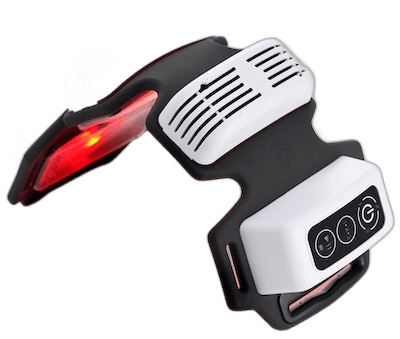
Is Recharge Health FlexBeam worth it?
Flexible, wearable wrap (630nm and 850nm) that straps to knees, shoulders, or back for hands-free targeted therapy, rechargeable and under 500g for travel. It covers specific pain points, not full-body, and battery life caps how long each session runs.
- Wavelengths
- 630nm, 850nm\
- Modules
- 3 (can target 3 areas)\
- Weight
- Under 500g, rechargeable
Best For
- You want a portable red light device you can wear during activities
- You need targeted therapy for specific pain points or injuries
- You travel frequently and want light therapy on the go
Skip If
- You want full-body red light coverage
- You prefer a stationary panel for longer sessions
- You're looking for the most affordable red light option
Pros
- Tri-module design targets up to three areas simultaneously
- Flexible silicone conforms to curved joints
- Rechargeable and travel-friendly under 500g
Cons
- Only two wavelengths (630nm/850nm)
- Lower total LED count than the NovaaLab pad
- No discount currently available
Your rating helps others choose
Tap to rate
URBAN for 10% offSee every current discount code and sale →
FlexBeam’s tri-module design lets you target up to three areas simultaneously, or wrap around larger joints like hips and shoulders. Each module delivers red (630nm) and near-infrared (850nm). The flexible silicone body conforms to curved surfaces better than any rigid panel.
It’s rechargeable, weighs under 500g, and fits in a backpack. If you travel and deal with joint pain in multiple spots, this addresses both problems. The brand is established with a track record in the rehabilitation space.
The tradeoff: only two wavelengths vs. four on the MitoQUAD Belt or the laser+LED combo on the Kineon. For pure NIR penetration to deep joints, the Kineon’s 808nm lasers go deeper. But for covering multiple joints per session, the FlexBeam is unmatched.
Kineon MOVE+ Pro: best red light therapy device for knee pain?

Is Kineon MOVE+ Pro worth it?
Wraps joints with red, near-infrared, and an 808nm medical-grade laser (plus 660 and 850nm LEDs) for hands-free, portable pain and recovery work. Fits chronic joint issues. It treats one area at a time, and results can take weeks of consistent use.
- Wavelengths
- 660nm LED, 808nm laser, 850nm LED\
- Type
- Wearable (LED + medical-grade laser)\
- Design
- Hands-free wrap
Best For
- You deal with chronic joint pain or stiffness
- You want a hands-free light therapy option for active recovery
- You prefer targeted treatment over full-body panels
Skip If
- You need full-body red light coverage
- You're looking for a budget light therapy option
- You don't have specific joint or muscle issues
Pros
- Only device combining LEDs and medical-grade lasers
- Hands-free wrap for knees, elbows, ankles
- Clinical studies supporting joint pain use
Cons
- Treats one joint at a time
- Higher price than LED-only alternatives
- Lasers require eye safety awareness
Your rating helps others choose
Tap to rate
URBAN for 10% offThe Kineon MOVE+ Pro is the only device on this list built specifically for joint pain. It combines red LEDs (660nm), near-infrared LEDs (850nm), and medical-grade lasers (808nm). The lasers deliver coherent, focused energy that penetrates deeper into joint capsules than LEDs alone.
A 2023 comprehensive review in the International Journal of Molecular Sciences found laser-based photobiomodulation showed stronger outcomes for arthritis than LED-only devices, likely due to deeper penetration.
You strap it around your knee (or elbow, wrist, ankle) and press one button. Fifteen minutes later, you’re done. The hands-free design means you can work, read, or stretch during treatment.
The tradeoff: one joint at a time. If you’re dealing with pain in multiple joints simultaneously, the FlexBeam or a panel gives you more coverage per session.
Vital Red Light Vital Charge: best budget red light for joint pain?
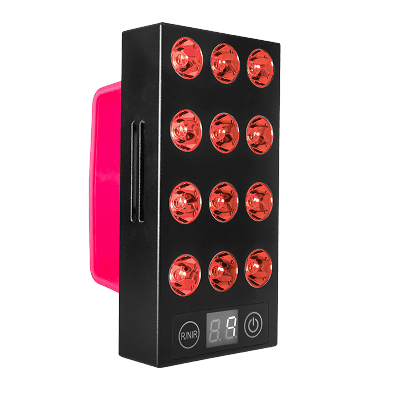
Is Vital Red Light Vital Charge worth it?
Portable handheld red light with four wavelengths (630, 660, 830, 850nm), zero EMF, and a battery lasting 4+ hours. A fit for travel and targeted face or joint work. Just 12 LEDs, so full-body sessions are out, and it weighs 2.2 lbs despite the portable branding.
- Wavelengths
- 630, 660, 810, 850nm\
- LEDs
- 12\
- Battery
- 4+ hours rechargeable
Best For
- You want a portable red light device for travel or on-the-go use
- You need targeted treatment for face, joints, or small areas
- You want an affordable entry point into red light therapy
Skip If
- You need full-body red light coverage
- You want a panel you can mount on a wall or door
- You prioritize maximum irradiance for deep tissue penetration
Pros
- Four wavelengths including 810nm and 850nm NIR
- Rechargeable battery lasts 4+ hours
- Most affordable joint-targeting device at $299
Cons
- Only 12 LEDs limits treatment area
- Not hands-free (must hold against joint)
- Smaller coverage requires repositioning for larger joints
Your rating helps others choose
Tap to rate
URBAN for 11% offThe Vital Charge packs four wavelengths (630, 660, 810, 850nm) into a rechargeable handheld for $299. Both 810nm and 850nm NIR reach joint-relevant depths. For a portable device at this price, that’s unusual.
The rechargeable battery lasts 4+ hours. You can treat joints anywhere: at your desk, on the couch, traveling. If you’re exploring whether red light helps your joints before committing to a $499+ wearable, this is the entry point.
The tradeoff: you have to hold it against the joint. No hands-free treatment. And 12 LEDs means you’re covering a small area per position. For knees, plan on 5 minutes per side (front, medial, lateral).
Mito Red MitoQUAD Belt: best wearable belt for back & hip pain?

Is Mito Red Light MitoQUAD Belt worth it?
Wearable belt carrying 405 TriChip diodes (1,215 chips) across four wavelengths (630, 660, 810, 850nm), UL certified to IEC 60601. Geared to torso and hip treatment you wrap on. Purpose-built for that zone, so knees, elbows, and shoulders are a poor match.
- Wavelengths
- 630, 660, 830, 850nm\
- LEDs
- 405 TriChip (1,215 chips)\
- Size
- Wearable belt
Skip If
- Your problem joints are knees, elbows, or shoulders; the belt is purpose-built for the torso and hips.
- You want one device that covers multiple scattered joints at once; a panel handles widespread pain better.
- You want a rigid panel you stand in front of rather than a wrap.
Pros
- 405 TriChip diodes deliver 1,215 LED chips
- Wraps around waist/hips/thighs
- Four wavelengths including 830nm and 850nm NIR
Cons
- Belt format less useful for knees or elbows
- Heavier than other wearables
- Premium price for a single-purpose device
Your rating helps others choose
Tap to rate
The MitoQUAD Belt wraps 405 TriChip diodes (1,215 individual LED chips) around your waist, hips, or upper thighs. That’s more emitters in direct contact than any panel delivers at 6 inches.
Four wavelengths (630, 660, 830, 850nm) cover both surface and deep-tissue inflammation. For lower back pain, SI joint issues, or hip arthritis, the belt format makes more sense than pointing a flat panel at a curved body part.
The tradeoff: the belt form factor doesn’t work well for knees, elbows, or shoulders. If those are your problem joints, the Kineon or FlexBeam are better fits. The MitoQUAD is purpose-built for the torso and hips.
NovaaLab Light Pad: best flexible pad for joint wraps?

Is NovaaLab Light Pad worth it?
Flexible 450-LED pad (300 NIR at 850nm, 150 red at 660nm) delivers up to 150 mW/cm2 at contact, at just 0.6 lbs. Suits wrapping a joint or body area in contact. It can’t wall-mount for standing sessions, and NovaaLab is newer than Rouge or Mito Red.
- Wavelengths
- 660nm, 850nm\
- LEDs
- 450\
- Size
- Flexible pad
Best For
- You want to wrap the light around a joint, your back, or your stomach instead of standing in front of a panel.
- You value skin contact and close coverage over wall-mounted standing sessions.
- You want the most LEDs per dollar in the budget class.
Skip If
- You want to wall-mount a panel for standing sessions; the pad can't do that.
- You want a long brand track record; NovaaLab is newer than Rouge or Mito Red.
- You need something that travels light or targets a single small joint with laser precision.
Pros
- 450 LEDs in a flexible pad that wraps around any joint
- Direct contact maximizes energy delivery
- 10% discount available
Cons
- Less portable than handheld devices
- Pad format can be awkward for some joint positions
- Newer brand with smaller track record
Your rating helps others choose
Tap to rate
The NovaaLab Light Pad wraps 450 medical-grade LEDs around joints in direct contact. For knees, elbows, and shoulders, the flexible format conforms to curved surfaces better than any rigid panel or handheld device.
At $350 ($315 on sale), you’re getting the most LEDs per dollar in direct contact with your joint. The 300 NIR (850nm) and 150 red (660nm) diodes deliver a therapeutic dose faster than holding a small handheld against the same area. If you want something more versatile, my budget RLT guide covers panels that work for joints and general wellness.
The tradeoff: less portable than the Vital Charge and not as targeted as the Kineon’s laser+LED combo. But for pure LED coverage on a joint surface, nothing at this price comes close.
Mito Red MitoPRO 750+: best panel for whole-body joint relief?
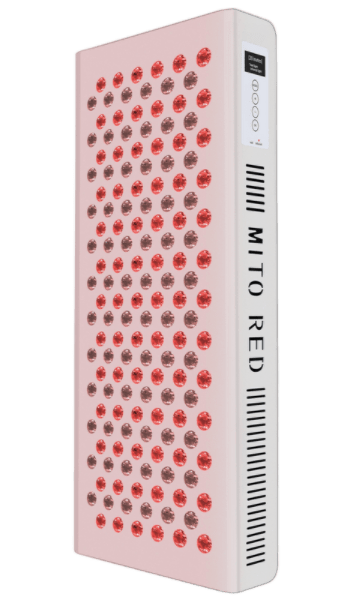
Is Mito Red Light Mito Red MitoPRO 750+ worth it?
Five wavelengths (630, 660, 810, 830, 850nm) with higher irradiance than the original line, third-party tested for irradiance, EMF, and flicker, and modular with other MitoPRO panels. Fits a serious home setup. The fan is audible, and it’s large enough to need a mount.
- Wavelengths
- 630, 660, 810, 830, 850nm\
- LEDs
- High-count panel\
- Coverage
- Multiple joints simultaneously
Best For
- You want a well-tested panel from a reputable red light brand
- You prefer five wavelengths over basic dual-wavelength panels
- You're building a modular home light therapy setup
Skip If
- You're looking for a budget red light panel under $500
- You need something portable or travel-friendly
Pros
- Five wavelengths covering 630-850nm range
- Treats multiple joints in one session from 6-12 inches
- Established brand with strong customer support
Cons
- Panel format less efficient than direct-contact wearables
- $1,295 is a significant investment
- Fan noise during sessions
Your rating helps others choose
Tap to rate
When joint pain isn’t limited to one or two spots, a panel makes more sense than cycling through wearables. The MitoPRO 750+ delivers five wavelengths (630, 660, 810, 830, 850nm) covering both surface and deep tissue simultaneously.
Stand 6-12 inches from the panel and treat both knees, or a hip and lower back, in a single 10-15 minute session. For systemic joint inflammation or autoimmune-related joint pain, the whole-body coverage adds anti-inflammatory benefits beyond the targeted joints.
The tradeoff: at 6-12 inches, 70-80% of surface irradiance is absorbed before reaching deep joint tissue. Wearables in direct contact deliver a therapeutic dose faster. If your pain is in one or two joints, start with a wearable. If it’s widespread, the panel’s efficiency at covering multiple areas simultaneously justifies the $1,295 investment. For even more panel options, my home red light therapy guide covers the full range with more wavelength diversity and smart features.
What Features Matter Most in a Red Light Therapy Device for Joint Pain?
Choosing the right device depends on your specific joints, pain severity, and budget.
Which wavelengths penetrate deep enough for joints?
Near-infrared (NIR) at 850nm is the most important wavelength for joint pain. Red light at 660nm penetrates roughly 8-10mm, covering skin and superficial muscle only. The knee joint capsule sits 15-25mm deep, hips 40-50mm, and shoulders 15-35mm depending on musculature.
Devices with both 660nm and 850nm give the best coverage. Multi-wavelength devices like the MitoPRO cast a wider net when you’re unsure which tissue layer is causing pain.
Should you choose a wearable or a panel for joint pain?
Wearables like the Kineon and FlexBeam excel for single-joint, targeted treatment with direct contact that maximizes energy delivery. Panels like the MitoPRO make sense when pain is widespread, delivering full-body benefits alongside joint relief.
If your pain is primarily in one or two joints, start with a wearable. If it’s systemic (multiple joints, general inflammation, potential autoimmune component), a panel gives more versatility.
What are the recommended protocols for each joint?
Most successful clinical trials use 3-5 sessions per week, 10-20 minutes per session, for a minimum of 4-8 weeks. A 2023 review in Frontiers in Cell and Developmental Biology found consistent application over 4+ weeks produced significantly better outcomes.
- Knees: 15 minutes, direct contact or within 2 inches, 5x per week. Most studied joint for PBM.
- Shoulders: 10-15 minutes, targeting anterior and posterior capsule.
- Hips: 15-20 minutes with high-irradiance device. Depth requires more energy delivery.
- Hands/wrists: 10 minutes, close contact. A 2024 clinical study found LED irradiation improved hand osteoarthritis symptoms.
- Lower back (SI joints): 15-20 minutes with the MitoQUAD Belt or panel. Coverage area matters more than single-point intensity.
Most people who say “red light didn’t work” quit after a week. Consistency matters more than device choice. Light is only one piece of it, and the rest of what I run for tissue repair sits in my recovery collection.
If you’re a brand and want your device independently tested for joint-specific performance, reach out through the light therapy comparison database.
Use my light-therapy dosage guide to set exposure, the buyer’s guide to evaluate hardware, and the testing methodology to interpret my measurements. The home-device roundup covers broader use cases.
Red Light Therapy for Joint Health FAQ
How long does red light therapy take to help joint pain?
Most people notice initial improvements in joint stiffness and pain within 2-4 weeks of consistent daily use (10-20 minutes per session). Significant pain reduction typically takes 4-8 weeks. Clinical trials for knee osteoarthritis generally run 4-12 weeks before measuring outcomes.
Is red light therapy FDA approved for joint pain?
Red light therapy devices are FDA-cleared (not “approved,” which is a different classification) for general pain relief and inflammation reduction. FDA clearance means the device is substantially equivalent to existing cleared devices for that intended use. It does not mean the FDA specifically endorses it for your condition.
Can red light therapy regenerate joint cartilage?
Preclinical evidence shows NIR light at 810-850nm stimulates chondrocyte proliferation and increases type II collagen synthesis. Animal studies demonstrate cartilage thickness preservation. However, human articular cartilage is avascular and regenerates extremely slowly. Red light therapy helps preserve existing cartilage rather than regrow lost cartilage. Starting treatment early gives the best chance of meaningful preservation.
What is the best wavelength for joint pain?
Near-infrared at 850nm is the gold standard for joint pain. It penetrates 25-50mm, reaching the knee joint capsule, shoulder bursa, and hip cartilage. Red 660nm only reaches 8-10mm. For the deepest joints (hips at 40-50mm), 808nm medical-grade lasers like those in the Kineon MOVE+ Pro provide the most penetration.
Is red light therapy safe for joint pain?
Red light therapy has an excellent safety profile. Across hundreds of clinical trials, serious adverse events are essentially nonexistent. Common side effects are mild warmth and occasional skin redness that fades within an hour. People taking photosensitizing medications should consult a physician. Unlike NSAIDs, it carries no risk of gastrointestinal damage or kidney stress from long-term use.
Match the Device to Your Joints
For most people dealing with joint pain, the Kineon MOVE+ Pro is the place to start. It’s purpose-built for joints, combines lasers with LEDs for deeper penetration, and the wearable design makes daily consistency effortless.
If budget is the constraint, the Vital Charge at $299 gets legitimate NIR wavelengths onto your joints. A cheap device used daily beats an expensive one collecting dust.
Your experience will depend on consistency, not equipment.
Match the device to where your pain actually is, treat daily for at least 4 weeks before evaluating, and track your pain scores weekly.
If you found this helpful, share it with someone who’s been living with joint pain. They’ll thank you.

Comments