
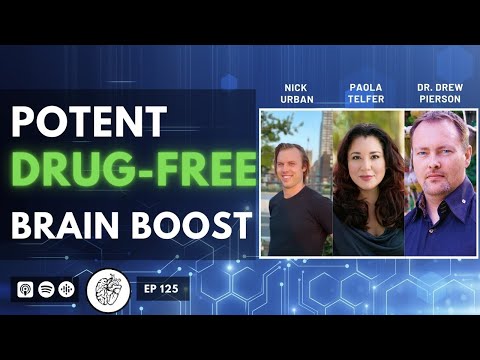
With Dr. Drew Pierson & Paola Telfer of Sens.ai, Episode 125



What You’ll Learn
- 5 brainwave bands explained: Paola uses an ocean analogy to map delta (deep sleep), theta (subconscious/float tank), alpha (relaxed/spa-like), beta (focused attention), and gamma (consciousness/creativity) to everyday mental states. [07:05]
- Neurofeedback as a brain mirror: Using operant conditioning and real-time EEG feedback, Sens.ai rewards desired brainwave patterns with audio/visual cues faster than the speed of analytical thought, training self-regulation without conscious effort. [26:32]
- Personalized photobiomodulation: 7 LEDs at 810nm deliver roughly 250 milliwatts per square centimeter, but Sens.ai reads your peak alpha frequency first, then stims at your personal resonance (e.g. 9.5 Hz vs 10.5 Hz) rather than a generic 10 Hz for everyone. [38:57]
- HRV biofeedback for nervous system balance: Heart coherence training at personalized breath rates (4.5 to 7.5 breaths per minute) harmonizes the brain and heart, creating an alpha-dominant state that primes the brain for deeper neurofeedback training. [34:09]
- Why binaural beats fall short: Dr. Pierson reports only 20-30% effectiveness for binaural beats because auditory processing issues vary widely, while transcranial photobiomodulation delivers energy directly to targeted brain areas and boosts mitochondrial ATP production. [43:56]
- Built-in brain assessments (ERPs): Event-related potential measurements track processing speed, accuracy, reaction time, and error recognition to 1-millisecond precision, letting you benchmark progress objectively rather than guessing. [46:58]
- Nootropic stacking for amplified results: Dr. Pierson combines Sens.ai with piracetam, omega-3s, lion’s mane, creatine, acetylcholine precursors, adaptogens, and Chinese herbs. He also stacks it inside a CVAC altitude pod for increased cerebral blood flow. [01:07:32]
- Structured mission system: Instead of cherry-picking protocols, Sens.ai’s gamified missions build foundational resilience (alpha, SMR, beta) before unlocking advanced states like gamma and synchrony training, mimicking a clinical progression at home. [59:21]
- 3 core brain networks trained: The headset targets the default mode network, salience network, and executive network along the brain’s center line, covering roughly 80% of cognitive function and building front-to-back alpha synchrony over time. [01:10:28]
Why It Matters
Most consumer brain training devices offer generic stimulation at fixed frequencies, ignoring the fact that your optimal alpha peak might differ from the population average by a full hertz or more. Dr. Drew Pierson, a board-certified neurotherapist with 20+ years of clinical neurofeedback experience, and Paola Telfer, the tech entrepreneur who spent 5 years engineering Sens.ai’s personalized 5-in-1 system, explain how real-time EEG-guided training produces lasting neural changes that survive long after you take the headset off.
Who Should Listen
- Biohackers who want measurable cognitive upgrades (focus, sleep, creativity) without pharmaceuticals or clinical visits.
- Meditators struggling to access deeper states consistently who need objective feedback to accelerate their practice.
- Athletes, executives, or gamers looking for a science-backed system to train flow states, reaction speed, and emotional regulation at home.
Episode Overview
On this episode of the High Performance Longevity podcast, Nick Urban sits down with Dr. Drew Pierson, a dual-certified doctor of Western and Eastern medicine, board-certified neurotherapist, and decorated US Navy submarine veteran, alongside Paola Telfer, the tech entrepreneur who founded Sens.ai after discovering brain training’s impact during her own recovery from a motor vehicle accident. Together they unpack the world’s first 5-in-1 consumer brain training system that combines EEG neurofeedback, HRV biofeedback, transcranial photobiomodulation, guided meditation, and cognitive assessments in a single headset.
The conversation covers the 5 brainwave frequency bands (delta through gamma), how operant conditioning trains neural pathways faster than conscious thought, and why Sens.ai personalizes photobiomodulation at 810nm to your individual alpha resonance frequency rather than using a generic 10 Hz. Dr. Pierson explains why binaural beats achieve only 20-30% effectiveness compared to direct light stimulation, how the device targets the default mode, salience, and executive brain networks (covering 80% of cognitive function), and the clinical logic behind Sens.ai’s structured mission system that builds foundational resilience before unlocking advanced gamma and synchrony training.
You’ll walk away understanding how to stack neurofeedback with nootropics and lifestyle practices for amplified results, why event-related potential (ERP) assessments provide objective progress tracking to 1-millisecond precision, and how daily 15-45 minute sessions can produce lasting improvements in focus, sleep quality, emotional regulation, and flow states that persist even after you stop using the device.
Key Terms Quick Reference
Several specialized terms come up throughout this conversation. Here’s a quick reference.
[07:05] Brainwave frequency bands: The 5 measurable oscillation patterns of neural electrical activity: delta (deep sleep), theta (subconscious/dreaming), alpha (relaxed awareness), beta (focused attention), and gamma (consciousness/creativity). All 5 occur simultaneously. One simply becomes more dominant.
[10:21] Gamma binding: The process by which gamma waves (the fastest frequency band) integrate sensory information into unified perception. Dr. Pierson describes it as binding color, shape, and movement into a single conscious experience, while also enabling memory function.
[26:32] Operant conditioning (neurofeedback): A learning method where the brain receives real-time audio/visual rewards when producing desired brainwave patterns. Similar to Pavlov’s dogs, neurons associate specific activity patterns with positive reinforcement, creating lasting neural pathways.
[38:00] Transcranial photobiomodulation (tPBM): Delivering near-infrared light (810nm) through the skull to stimulate mitochondrial cytochrome c oxidase, increasing ATP production and cerebral blood flow. Sens.ai uses 7 LEDs at roughly 250 mW/cm2 with frequency pulsing from 1 to 1024 Hz.
[46:58] Event-related potentials (ERPs): Standardized lab measurements of brain processing speed during cognitive tasks. Sens.ai’s built-in controller measures awareness, decision speed, reaction time, accuracy, and error recognition to 1-millisecond precision for objective progress tracking.
[12:11] Glymphatic system (GLIMP): The brain’s waste clearance mechanism, most active during delta sleep. Dr. Pierson describes it as pumping out metabolic debris and bringing in fresh nutrients, blood flow, and oxygen. Poor delta regulation impairs this critical maintenance process.
[01:10:28] Rich club network: The brain’s core connectivity hub comprising 12 major networks, including the default mode network (rest/introspection), salience network (relevance detection), and executive network (decision-making). These 3 alone account for roughly 80% of cognitive function.
Does Neurofeedback Actually Change Your Brain Long-Term?
The short answer
Yes. Neurofeedback leverages neuroplasticity and operant conditioning to create lasting brainwave pattern changes. Nick reports that after roughly 90 sessions, benefits persist even when he’s not wearing the headset.
What Pierson found
Dr. Pierson has observed measurable shifts across 20+ years of clinical practice. When neurons receive real-time feedback, they form new associations faster than analytical thought can process. He notes that neurofeedback makes neurotransmitters more efficient, so less chemical signaling achieves greater cognitive output. Recovery times drop because neurotransmitters stay in reserve rather than depleting during sustained effort. Over time, alpha waves that initially appear only at the back of the brain migrate forward, creating the front-to-back synchrony characteristic of peak performers.
What to do about it
Start with foundational programs (focus, calm) before advancing to gamma or synchrony training. Train in a quiet environment initially, then gradually introduce distractions as your self-regulation improves. Consistency matters more than session length. Even 15-minute daily sessions create compounding neuroplastic changes.
“We don’t want a headset on all the time. We wanna be able to turn on these states of consciousness when we want rather than them controlling us.” – Dr. Drew Pierson
Why Does Personalized Brain Stimulation Outperform Generic Devices?
The short answer
Your peak alpha frequency varies by individual. Stimulating at a generic 10 Hz produces zero measurable entrainment in some users, while matching their personal resonance creates immediate EEG changes.
What Telfer found
During 4 years of prototype testing, Paola’s team discovered that generic 10 Hz photobiomodulation had zero effect on certain users. Once they read each person’s actual alpha frequency and stimmed at that point (or slightly above it), entrainment appeared clearly on the EEG. The headset uses real-time electrode readings to determine your resonance frequency before each session, then adjusts the 7 LEDs pulsing at 810nm accordingly. This personalization extends to HRV training, where breath rate targets are calculated to your individual range rather than a standard 4-5 seconds in, 6 seconds out.
What to do about it
Use the built-in baselining periods rather than skipping them. The system collects data across multiple sessions to establish your personal range, enabling it to know whether you’re having a good or bad day and adjust difficulty accordingly. Pair the alpha boost with a meditation track for amplified effects rather than multitasking during sessions.
“There’s people that we would stim at 10 Hertz that would have zero effect with the transcranial photobiomodulation. And we realized that once we read their frequency and then stim them there or higher, now we could actually see the entrainment on the EEG.” – Paola Telfer
How Do You Stack Neurofeedback With Nootropics & Lifestyle?
The short answer
Neurofeedback works best when layered on top of sleep, movement, and micronutrient foundations. Dr. Pierson stacks it with racetams, omega-3s, lion’s mane, creatine, and Chinese herbs, and sometimes trains inside a CVAC altitude pod for increased cerebral blood flow.
What Pierson found
Dr. Pierson considers sleep the most critical foundation. Without proper delta regulation, neurofeedback results diminish significantly. He combines sessions inside a CVAC (Cyclic Variable Altitude Conditioning) pod to increase vascularity and brain blood flow simultaneously, cutting his total training time in half. His daily stack includes piracetam, omega-3 fatty acids, lion’s mane at night, creatine, acetylcholine precursors, and traditional Chinese herbs. He also notes that reading a physical book during focus-frequency stimulation produces noticeably easier comprehension.
What to do about it
Prioritize sleep quality and basic nutrition before adding neurofeedback technology. Then layer nootropics as the final enhancement. Start with free or low-cost interventions like heart coherence breathing (apps like HeartMath), then progress to dedicated neurofeedback once the basics are solid.
“You start stacking those things, and they work well, you get your sleep, you get your sun, you get your micronutrients, the minerals are very essential too.” – Dr. Drew Pierson
Related: Best Brain Supplements for Adults
The Pierson & Telfer Brain Training Protocol
Based on the Sens.ai team’s clinical and engineering experience, here’s a practical framework for getting the most from home neurofeedback training.
- Fix sleep first: Without proper delta regulation, no brain training protocol delivers full results. Address sleep hygiene before investing in neurofeedback.
- Complete the assessment mission: The initial ERP-based assessment establishes your cognitive baseline (processing speed, accuracy, error recognition) and recommends your personalized starting mission.
- Build foundational resilience: Train alpha, beta, and SMR (sensorimotor rhythm) before attempting gamma or synchrony protocols. This mirrors the clinical progression Pierson uses with Navy SEALs and professional athletes.
- Train in a quiet environment initially: Electromagnetic interference and ambient noise degrade signal quality. Graduate to distracting environments only after you can maintain state in silence.
- Pair boost sessions with meditation tracks: Photobiomodulation amplifies the training content you pair it with. A gamma boost plus gratitude meditation produces a qualitatively different experience than gamma boost plus email.
- Layer nootropics after fundamentals: Sleep, sun, movement, and micronutrients form the base. Add targeted nootropics (racetams, omega-3s, lion’s mane, creatine) as a final amplification layer.
- Use HRV training as a session primer: 7-20 minutes of heart coherence breathing before neurofeedback creates an alpha-dominant, primed state that deepens subsequent training quality.
Common brain training mistakes
- Jumping straight to advanced protocols: Attempting gamma training without foundational alpha and focus work limits results and can create instability.
- Overthinking during sessions: The feedback operates faster than analytical thought. Trying to “think” your way to the right brainwave state defeats the purpose. Feel into the sounds instead.
- Inconsistency over intensity: Sporadic 2-hour sessions produce less neuroplastic change than consistent daily 15-minute practices. Regularity drives the operant conditioning loop.
Source: Pierson & Telfer’s Sens.ai Brain Training Framework, Sens.ai
FAQ
What are the 5 brainwave frequency bands?
The 5 bands are delta (deep sleep, hormone regulation, glymphatic clearance), theta (subconscious, dreaming, stress release), alpha (relaxed awareness, peak performance, flow), beta (focused attention, analytical thought), & gamma (consciousness, creativity, memory binding). All 5 occur simultaneously, with one becoming dominant depending on your mental state.
How is Sens.ai different from other consumer neurofeedback devices?
Sens.ai combines 5 modalities in one headset: EEG neurofeedback, HRV biofeedback, transcranial photobiomodulation (810nm LEDs), guided meditation, & cognitive assessments with 1-millisecond precision ERPs. It personalizes photobiomodulation to your individual alpha resonance frequency rather than using a generic setting.
Do the benefits of neurofeedback last after you stop training?
Yes. Neurofeedback leverages neuroplasticity & operant conditioning to create lasting brainwave pattern changes. Nick Urban reports persistent benefits after roughly 90 sessions. Dr. Pierson notes that the goal is learning to activate desired states without the headset.
Why does Sens.ai use light instead of binaural beats?
Dr. Pierson reports binaural beats are only 20-30% effective because auditory processing varies widely between individuals. Photobiomodulation delivers energy directly to targeted brain areas, stimulates mitochondrial ATP production via cytochrome c oxidase, & increases cerebral blood flow without relying on auditory pathways.
What should you think about during neurofeedback training?
Nothing specific. The feedback operates faster than analytical thought. Both Dr. Pierson & Paola Telfer recommend feeling into the audio & visual cues rather than trying to consciously produce specific brainwave states. Mind wandering is normal but should be gently redirected back to the feedback sounds.
Do you need a clinical brain map before using Sens.ai?
No. Clinical brain maps compare your brain to a normative database & are most useful for pathologies like concussions. Sens.ai takes a different approach by optimizing you holistically through multi-session baselining, qualitative surveys, & ERP assessments that track your individual progress over time.
What nootropics stack well with neurofeedback training?
Dr. Pierson recommends piracetam, omega-3 fatty acids, lion’s mane (at night), creatine, acetylcholine precursors, adaptogens, & Chinese herbs. He emphasizes that sleep, sunlight, movement, & micronutrients should be the foundation before adding any nootropic supplementation.
Products, Tools, & Resources Mentioned
Outliyr independently evaluates all recommendations. We may get a small commission if you buy through our links (at no cost to you). Thanks for your support!
Devices & technology
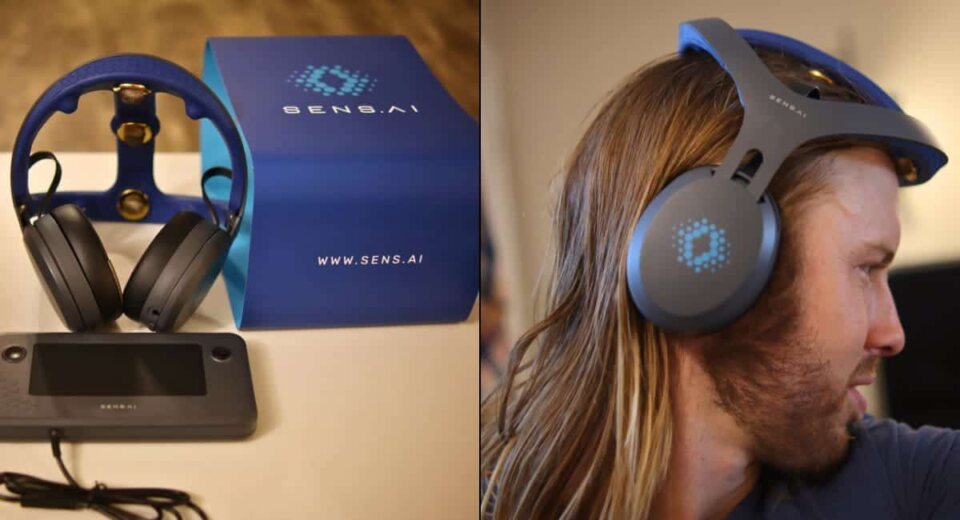
Sens.ai Neurofeedback Brain Training Headset: The world’s first 5-in-1 consumer brain training system combining EEG neurofeedback, HRV biofeedback, transcranial photobiomodulation (810nm), guided meditation, and cognitive assessments. Code URBAN saves 5%.
Books & references
The Body Electric: Electromagnetism & The Foundation of Life: Robert Becker’s foundational work on the electromagnetic nature of the body and brain, referenced by Nick as essential reading for understanding the science behind neurofeedback.
The High Performance Mind by Anna Wise: Explores brainwave mastery for creativity and peak performance. Wise coined the term “mind mirror” for neurofeedback, a concept central to Sens.ai’s approach.
Supplements & nootropics
Nootopia (Utopia): BiOptimizers’ nootropic line mentioned by Dr. Pierson as part of his daily cognitive stack alongside neurofeedback training.
Wizard Sciences (Neuro Rx): Dr. Pierson’s preferred source for targeted neurological supplements including his neurofeedback stacking protocol.
Related content
Sens.ai Brain Training Headset Review: Nick’s comprehensive written review covering practical setup, session workflows, and personal results after 90+ sessions.
About Dr. Drew Pierson & Paola Telfer
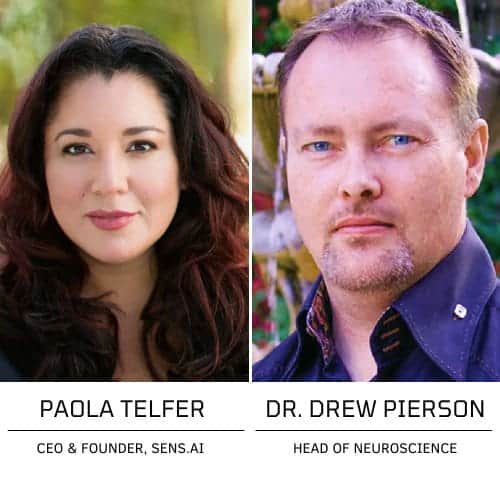
Dr. Drew Pierson is a dual-certified doctor of Western and Eastern medicine, board-certified neurotherapist with 20+ years of neurofeedback experience, and a decorated US Navy submarine veteran who served 6 years. He trained under neurofeedback pioneers including Dr. Barry Sterman, Drs. Siegfried and Sue Othmer, and Dr. Joel Lubar. As former head of neuroscience at 40 Years of Zen, he guided Navy SEALs, fighter pilots, Major League Baseball players, and elite executives to peak cognitive performance. He now serves as chief neuroscientist at Sens.ai.
Paola Telfer is a tech entrepreneur and electrical engineer who founded Sens.ai after discovering neurofeedback’s transformative impact during her recovery from a motor vehicle accident. She spent 5 years engineering the world’s first 5-in-1 consumer brain training headset, drawing on her background designing network intelligence ASICs, managing product portfolios for enterprises and government, and cultivating healthcare provider partnerships. Her mission: make clinical-grade brain training accessible to everyone.
Related Episodes & Articles
- Episode 241: Brain Mapping & Neurofeedback: How Elite Athletes Train Focus, Calm & Performance
- Episode 205: Biohacking Life Tools & Tips from 40 Years of Zen
- Episode 218: Holon Brain Health & Neurofeedback
- Episode 104: Nootopia Nootropic Brain Supplements
- Article: Best Home Neurofeedback Devices & Machines
- Article: Neurofeedback Therapy & Brain Training Benefits
- Article: Muse vs Sens.ai for Neurofeedback
Full Episode Transcript
Nick Urban [00:00:05]: What if you could upgrade your intelligence? And not just your IQ, but all the different forms of intelligence? I’m talking thinking faster, making better decisions, mastering your ability to self regulate emotionally, improving verbal fluency, shooting your motivation through the roof and keeping it there, sharpening your focus and concentration, and even elevating your confidence? Not only that, but doing it the natural route using a technology that even once you stop using it, the benefits stick around for quite a while? Now that might sound far fetched, But there is a system that I’m quite excited about that I’ve been using for about 90 sessions now, and that is called Sens.ai. It’s the world’s 1st 5 in 1 brain training system. Each of your sessions is personalized based on your body’s biofeedback signals, And the session is actually adapted and tweaked and improved in real time. This futuristic technology was just released to the general public. I preordered in the middle of 2022, and it’s finally here. So I brought on the team to the podcast to share what they’ve built and how it can transform your mind. Our 2 guests on today’s show are Dr. Drew Pierson and Paola Telfer. Dr. Drew Pierson is a doctor of both Western and Eastern medicine and a board certified Neurotherapist with 20 years of neurofeedback experience. He’s a decorated submarine veteran that served 6 years in the US Navy, the former head of neuroscience at 40 Years of Zen, where he guided elite executives, enlightened minds, and athletes to peak performance. Paola, on the other hand, is a tech entrepreneur with a passion to develop technology that improves lives. She discovered brain training’s transformative impact on her own life and made it her mission to share this widely with everyone. From there, she founded Sens.ai, and the rest is history.
Nick Urban [00:02:25]: If you wanna check out the things we discuss in today’s episode, the show notes with all the links and resources will be available. And if you’re interested in picking up your own Sens.ai neurofeedback headset, use the exclusive code URBAN. You can also check out my YouTube review of Sens.ai showing you the practicals of how it works, what my session looks like, and everything you need to know, or the written article that I did to accompany that. Alright. Without further ado, Team Sens.ai. Paola and Dr. Drew, welcome to the show.
Paola Telfer [00:03:21]: Hi, Nick. Thanks for having us.
Dr. Drew Pierson [00:03:24]: Yeah. Thanks for having us.
Nick Urban [00:03:25]: It’s great to have you guys here. Let’s begin today with a couple of both of your nonnegotiables you’ve done for your health, your performance, and your bioharmony.
Paola Telfer [00:03:38]: I always start my day before checking my phone. I always do something for my brain. In the morning, you’re kinda still in this dreamy state, and it’s a really nice time for meditative type practices. So I did heart rate variability training, very heart centered with a gratitude meditation, transcranial photobiomodulation that was like a nice alpha tweak, tuning up my peak alpha frequency, and then followed by some neurofeedback that was a mix of alpha, gamma, and again tuning up that peak alpha frequency. So that’s what I did this morning, all within about a 45 minute total, before I looked at my phone.
Nick Urban [00:04:32]: And for anyone listening in who does not understand any of those words, we will clearly define what each of those mean and why you’d wanna go about those. Dr. Drew?
Dr. Drew Pierson [00:04:43]: So sleep is nonnegotiable for me. It’s so important to set up your sleep environment and have good sleep hygiene and have a good night of sleep before you start anything the next day. What I did today, I came in and used what I call another acronym here. CVAC is a cyclic variable altitude pod, basically, and I combine that with the good old Sens.ai and able to train inside something like that and do HRV, photobiomodulation. And I’ll either do 1 of 2 programs typically in there. 1 is focus. It prepares me for the day cognitively focus wise. And the other 1 is Deep Calm, which is a deep relaxation one that we use. That’s like caramel. It’s just so sweet.
Nick Urban [00:05:44]: Yeah. And why inside the CVAC machine?
Dr. Drew Pierson [00:05:47]: I think for stacking and time wise because if I’m using that, you know, 30 minutes, then I have to go and do neurofeedback for 30 minutes. And in the CVAC, it’s increasing vascularity and brain blood flow and better oxygenation of the system. So if we combine those, I think I’m getting a better response cognitively from that.
Nick Urban [00:06:10]: So, basically, you’re amplifying the effects of your training?
Dr. Drew Pierson [00:06:13]: Yes. And I always do my herbs in the morning, so all the Chinese herbs and acetylcholine and essential fatty acids, piracetam, is typically what I’ll take in combination.
Nick Urban [00:06:30]: I didn’t tell either of you guys this, but I also did some training this morning. I did some heart coherence, which is like HRV biofeedback. And then after that, I did a focus session. We will get into what all of that means in a few minutes, but can you guys first break down what are brainwaves?
Paola Telfer [00:07:05]: I’ll start with a layman’s approach and then Dr. Drew can go deep if we want to. So I like to use the ocean analogy when we think about brainwaves. The brain has an electrical nature and, like you’re alluding to with the neurochemicals, a chemical nature. But if we look at neurons firing, they are creating electrical activity in the brain that we can measure. We can measure it at the scalp. So that’s really what we’re doing with neurotech devices and when you hear the term EEG, we’re measuring that electrical neural activity. And so the brainwaves, there’s 5 frequency bands that are defined. They’re that oscillation that’s happening and has been broken down in spectrum. And they’re all happening at the same time, which is something important to note. We’re not exclusively ever like an alpha. Alpha just becomes more dominant. It becomes more powerful.
Paola Telfer [00:08:00]: So what we’re doing is right now, let’s say, we’re mostly in a beta dominant state where our attention is directed outward. We’re perceiving our environment with our senses. And when we go to sleep at night, we’re at the bottom of the ocean, which is more delta. And then in between, there’s all these subtle states that are really powerful and very beautiful that we tend to not be able to tap into with lucidity. So if you’ve ever tried meditation and you sit down for a minute and then you fall asleep, that’s us going straight from beta to delta just because we haven’t developed that skill set of navigating the ocean in between. From the top to bottom, beta, the next level would be more alpha. And that’s more this relaxed, spa-like brainwave, which is actually still very embodied. And then a little bit deeper, now we’re going into theta. Theta is like more float tank, deeper meditative states, and then we go into delta.
Paola Telfer [00:09:34]: So the one that’s missing, the 5th one, is gamma. Gamma is this enigmatic brainwave state that’s been detected in people who have meditated for many years. They’ve done studies on monks and seen very high gamma amplitude and high gamma synchrony. Gamma is actually the fastest of all the brainwaves, higher than beta, but we think of it as being deepest. It’s actually a bit of a juxtaposition. It’s the deepest in the ocean, but it’s like you’ve got sunlight in there. So there’s a lot of lucidity and awareness with it. That gamma state is very, very creative.
Dr. Drew Pierson [00:10:21]: The only thing I’d probably add, gamma is, as far as I’m concerned, consciousness. It brings about consciousness. If you see a red ball and it’s bouncing, and you have to correlate that with the color red, and it’s a ball, gamma really binds that together. Also gives us a memory function. One of the things we do in a telephone is 7 digits. That nests in what we call theta. Theta is about 7 cycles per second. But gamma elicits this fact that we can actually memorize things in those 7 digits. That’s why inherently we tend to have a 7 number gap or limit for memorization. Gamma is one of those eureka frequencies, and it really binds together the memory from the hippocampus.
Nick Urban [00:11:38]: So the way I’ve thought about it, I generally thought that the faster the frequency, the less restorative. For example, if you go down into delta when you’re sleeping, that’s what allows a lot of the different biochemical processes to occur, and so the body can repair and regenerate. And maybe with the exception of gamma, as you go higher, faster frequency, that’s less restorative and can be depleting of the brain’s resources, such as when you’re in a beta dominant state indefinitely?
Dr. Drew Pierson [00:12:11]: Typically, yeah, beta will, if you’re doing focus and concentration and analytical thought and problem solving, all the things that go along with beta, that can be draining over time. Alpha is much more regenerative, and that’s why meditation actually brings about that regenerative nature. Theta taps much more into the subconscious, and it’s in that dreamlike state. It releases a lot of stress in that lower frequency, and that can be very regenerative. Delta is a pure physiologic aspect that really taps into hormones and cycles, what we call GLIMP or brain lymph. Pumping the brain of getting out the stuff that we need to get out and bringing in new nutrients and blood flow and oxygen.
Paola Telfer [00:13:14]: Nick, I think it’s a good point that you’re bringing up because when we approach this in Sens.ai, it was really about creating a flexible and balanced brain. You don’t want to always be in beta any more than you always wanna be in delta. So we’re trying to help people who are maybe more analytically centered to be more heart centered, and vice versa. So people can be more active in the world the way they want to be depending on the task at hand.
Nick Urban [00:13:45]: Yeah. I was about to ask why you guys went about this entire mission in bringing this product to life? What is the benefit of getting more granularity in your ability to access different brain states?
Paola Telfer [00:13:58]: For sure. I can start with how I came across neurotechnology. When I first met Drew, many years ago, it was when he was working on my brain. And that was because I’d had a motor vehicle accident. And so I was in a healing journey. But in that process, I discovered that it actually improved my meditation practices. I was actually able to more consistently, more precisely, target different meditation styles. And it also really helped me in my cognitive performance. I was running another startup at the time. And so I realized that depending on the type of brain training, you could actually be learning to shift gears and it could help different aspects of your life. And that’s when my eureka moment was about everybody needs this. So it was about how do we make this smaller, less expensive, and efficacious at scale.
Nick Urban [00:15:32]: What is it that you can get out of brain training? Like, say I go in, and I have these specific goals regarding performance, or I suffered a TBI, say, from playing rugby or American football. What are the different things that it can do?
Dr. Drew Pierson [00:15:51]: That’s a very broad thing. We could take you to the peaks of these type states. The happiness of gamma, the insights that come along with it, we can help you focus better in certain frequencies with the beta frequencies. You can help the attention centers in the brain really bring themselves together to focus. Alpha is much more of a meditation state, but it’s also necessary for any peak performance. If your alpha isn’t bursting right before you throw that rugby ball or throw a baseball or even while you’re driving, you’re gonna fail typically because the alpha is not there to really promote the smooth flow. Theta can be high or low depending. And if that’s not regulated properly, you’re gonna either have attention issues or stress issues. And delta is so important for sleep, and if you’re not regulated in delta, you’re not gonna sleep well.
Paola Telfer [00:17:26]: When we started looking at this because it is so broad, we looked at it like, well, the ultimate goal is really one of consciousness evolution. So how can we help people to move from more of the me centered, like self care, maybe evolve into a we sort of consciousness and into an all sort of consciousness. But the first thing to do is to meet people where they are today. So even if I say I’m looking for peak performance, but I’m actually having pretty crappy sleep this week, I gotta deal with that first.
Paola Telfer [00:18:22]: And so we actually start with what we call an assessment, so that people can focus on one thing at a time. The app is structured to be personalized and to be a journey that goes with you. We wanted something like a coach, like a brain coach, like having Drew on your shoulder whispering, hey, you should do a little beta today. And so the concept of missions is if we were trying to help 1 person at a time with sleep, how was the quickest way for us to get them to better sleep? And so let’s get them to focus on these specific training programs between these weeks.
Nick Urban [00:19:54]: That was one thing I noticed very quickly. At first, I was concerned that how am I gonna be able to choose between all these? But then once you actually start the mission, it guides you, and you don’t have to worry.
Paola Telfer [00:20:14]: Absolutely. And some folks, since COVID, we’ve become so aware of brain fog and stress management issues. I think it’s important for us to acknowledge, even as peak performers, we have these sort of blocks. And there should be no shame in dealing with that. And you can deal with it privately. Sens.ai will guide you through that step by step.
Nick Urban [00:20:46]: I think it’s pretty clear that there’s a foundational electromagnetic nature of the brain and of the body as first depicted by Robert Becker in his book, The Body Electric. But what about the chemistry side? Is there any interplay between working on the brain’s electromagnetic signature and frequency bands and then also the neurotransmitters or neurochemicals?
Dr. Drew Pierson [00:21:22]: There is. Neurochemicals are very different from the neuroelectrical setup. The neurotransmitters are communication molecules, and they play a role in motivation or pleasure, mood regulation, attention, learning, and memory. But what we find with neurofeedback and any form of photobiomodulation, it starts making these neurotransmitters more efficient, so you don’t need as much to get a lot further. They’re able to be in waiting rather than using them all and then be depleted. And it’s gonna bring down recovery times tremendously just because of that.
Nick Urban [00:22:46]: Drew, Paola already described her background a little bit, but obviously, you’ve been involved in this for quite some time. Will you share a bit about your backstory?
Dr. Drew Pierson [00:22:55]: I got into neurofeedback in the mid nineties and was able to train with some of the most incredible people that brought about neurofeedback into what we know it is today. Barry Sterman, Siegfried and Sue Othmer, Joel Lubar, Joe Kamiya, some of these greats that really set the stage for what I do right now. I became addicted to how to change the brain without medication. I did pediatrics mainly for about 5 years before I went into more of a general practice, and then that evolved into a peak performance practice. Being in San Diego, I get to work with everything from fighter pilots to Navy SEALs to Major League Baseball. It really brought about the aspect of what these peak brains and how they operate. How can we affect greater legions of leadership out there too.
Nick Urban [00:24:35]: And one thing that came up when I was first researching this. I love the potential of neurofeedback and brain training. And there is research showing that it’s as great as you make it sound. At the same time, I was looking at how to actually do this. And it seems like it was only available to the upper echelon of society because at a really high end clinic, a week of guided neurofeedback can be 5 figures. And for your average population, that’s just not accessible. And so when you have a system like Sens.ai, it’s taking that cost way down and allowing you to accrue the benefits every day.
Paola Telfer [00:25:36]: Yes. For sure. I’ve done clinics like that, and then I was left with, the effects lasted for quite some time, but I wanted to take it to the next level at home. And with meditation alone and breath work alone, I was unable to do it. And I tried doing it with the devices available on the market. And then that’s where we thought, okay, there’s a gap here. But to do it right, it’s gonna take us some time, and it did. It took us 5 years.
Nick Urban [00:26:15]: So can you guys describe what is biofeedback? What is happening in the brain? How are you creating the cues to make this change?
Dr. Drew Pierson [00:26:32]: All it means is we’re getting biological feedback. We’re detecting a wave, an EEG or electroencephalography. This electrical pulse coming out, we’re detecting it and providing feedback back to the system. Much like Pavlov did with the dogs. When a person receives feedback during neurofeedback, it’s signaling the brain that that particular pattern of neuroactivity is good or desired. We’re giving them a reinforcement for that, and then we pull back the reinforcement when it doesn’t meet the criteria of what we’re looking for.
Paola Telfer [00:27:35]: There’s neuroplasticity, that we’re aware. We can change our brains very much like we can change our bodies with training. And then there’s operant conditioning, and that’s what Dr. Drew is referring to. We’re reading the brainwaves when we’re doing neurofeedback training. And when we’re doing the heart rate variability training, we’re reading the heart rate and converting that mathematically into heart rate variability. And so those biosignals, we change them into audio and visual cues. So you’re basically engaging with your biosignals in this audio visual experience. It’s much more accelerated learning.
Nick Urban [00:29:02]: And this is because the brain doesn’t have any external facing sensors per se. So you’re putting an electrode and EEG on the brain, you’re reading the brainwaves. When it dips out of what you’re training for, you get some kind of feedback or cue, and then the brain recognizes that and shifts its electrical activity towards what it thinks you’re looking for, and when it goes into the right band, then it gets a rewarding cue.
Paola Telfer [00:29:45]: Yes. And what’s really interesting is that the feedback is faster than the speed of analytical thought. One of the most common questions people ask is, what should I be thinking about? And during neurofeedback, it’s like nothing. It’s counterintuitive, but it’s about not thinking about it. It’s actually feeling into the feedback, into the sounds, and the visuals. In our system, we’ve associated certain instruments with certain wavelengths. We have a higher flute associated with gamma sounds, a trombone associated with alpha sounds, and a deeper bass associated with theta.
Paola Telfer [00:30:24]: When you’re training, you just need to feel like I like the trombone. I wanna hear more trombones. And then the volume goes up higher. The trombones become more frequent. And as long as that’s pleasant for you, that will feel like a reward, and the brain will just follow. The brain will just know what to do.
Nick Urban [00:31:18]: I like to think of this training as the mirror for your brain that you never had. So it can show areas in which you’re unable to otherwise, and by training those, all of a sudden that neural pathway becomes more active and the brain can access that even when you’re not using Sens.ai or any other system.
Dr. Drew Pierson [00:32:02]: That’s the key for all of this. We don’t want a headset on all the time. We wanna be able to turn on these states of consciousness when we want rather than them controlling us.
Paola Telfer [00:32:49]: We want the system to be teaching you how to do it without building a dependency. That’s why neurofeedback is the core, the beating heart of Sens.ai. It’s about training new mental habits very much like meditation, but in a way that’s accelerated and measured. But we’ve added the heart rate variability training because that brings in the body. Heart coherence biofeedback is really about balancing the nervous system, the parasympathetic and sympathetic parts, but it’s also about bringing into harmony the brain and the heart.
Paola Telfer [00:33:57]: Dr. Drew told me a story once about when he was doing some EEG readings on Zen monks and they were laughing because he thought they thought he’d forgotten the heart. The mind is so much more than the brain. The mind is also in the heart, in our bodies. And so we always train the heart as well.
Nick Urban [00:34:51]: I find it’s the perfect start to a training session. I will do sometimes as little as 7 minutes of heart coherence training, and in just a few minutes, I can go about my day feeling completely leveled and clear headed.
Paola Telfer [00:35:26]: It’s actually one of the most powerful aspects. It’s an immediate mood shift. And I would recommend 20 minutes. It puts you in a very different state. We are using the heart sensor throughout to optimize and personalize, which is what’s unique about Sens.ai compared to free breathing apps.
Dr. Drew Pierson [00:36:17]: Typically, you want 4.5 to 7.5 breaths per minute, and it depends on your in and out. Everyone’s different.
Paola Telfer [00:36:34]: What we’ll do is personalize it each time, but we’re also learning what your range is. So we’ll try and make it quite precise, like 5.25 or whatever it is. Right now, it’s always using the pulse oximeter.
Nick Urban [00:36:53]: So let’s break down how exactly the system is working. You’re wearing a headset. You put a couple drops of water on the electrodes. You put it on, make it fit snugly, and then you choose a mission to train. What’s going on from there?
Paola Telfer [00:37:23]: On the right cup, there’s a ground sensor. Really important to eliminate noise around you. On the left ear cup, there’s the pulse oximeter looking at the heart rate. And then on the blue part we call the flex cap, on top you’ll see the LED lights specialized for photobiomodulation.
Paola Telfer [00:38:00]: Those are using 810 nanometer wavelengths. We do frequencies all the way from 1 Hertz to 1024 Hertz depending on what the program is. We talk about the functions as boost, train, and assess. Boost is the transcranial photobiomodulation sessions. What’s unique is that because we have the electrodes, we’re able to look at the band and where you’re resonating. So if we’re boosting alpha, we can see you’re at 9 and a half today, or 10 and a half hertz today, not just stim 10 hertz blindly for everybody. Then we might stim you right on your resonance frequency, or tweak it up a little bit.
Paola Telfer [00:39:07]: With alpha in particular, that feels really nice. It kinda gives you a nootropic effect. That’s the prepare boost. Train is the HRV training and neurofeedback training, and assess is a different thing.
Nick Urban [00:39:28]: Those LEDs are very small. Can those actually cause a measurable shift in brain activity?
Paola Telfer [00:39:37]: Yeah. 7 LEDs. It’s about 250 milliwatts per centimeter squared. And 1 Hertz to 1024 Hertz. We’ve been looking at that for about 4 years since we had working prototypes. What we found was a big difference in personalization. There’s people that we would stim at 10 Hertz that would have zero effect. And we realized that once we read their frequency and then stim them there or higher, now we could actually see the entrainment on the EEG.
Nick Urban [00:40:33]: You might not approve of this, but one thing I love about the boost mode is that you can put it on and go about other things while you’re still stationary.
Paola Telfer [00:40:54]: You’re right. I don’t approve, Nick. But, we’re multitasking beings. Adding the meditation tracks to the boost will really help amplify the effects. The content is actually very important.
Dr. Drew Pierson [00:41:46]: If you’re going to do something, I would read a physical book. Reading a paragraph will become easier during that time. But the meditations along with it are meant to bring the mind into intention about its attention.
Nick Urban [00:43:05]: I have several other brain stim devices, and they can be powerful, but they’re definitely not customized or personalized to my current brain state. So I like that you guys have that baked in.
Dr. Drew Pierson [00:43:24]: It was such a big feature to bring that about. Over time, your measurements may change and optimize. You’re not a stagnant being. You’re not a robot. Thank goodness.
Nick Urban [00:43:44]: Why’d you guys choose to use light to stimulate the brain rather than isochronic tones, binaural beats, or haptic vibrations?
Dr. Drew Pierson [00:43:56]: We tried a lot of things in the beginning. But photobiomodulation provides energy for the neurons. It can go directly into very specific areas of the brain. With binaural beats, you’re putting in information right into the ears, and a lot of people have auditory processing issues. The measurement came out like 20 or 30% effective for binaural beats. With photobiomodulation, we can put exactly where we want and provide energy for those neurons. The ATP cycle kicks up, and you’re able to produce those frequencies.
Paola Telfer [00:44:58]: It has the benefit of impacting the mitochondria directly and triggering that ATP cycle. Creating more oxygenation. And it’s also noninvasive. Even compared to other types of electrical or electromagnetic stimulation, light therapy is much more noninvasive.
Dr. Drew Pierson [00:45:38]: In the brain, a big part of our operation is brain blood flow, the hemodynamic effects. It’s gonna increase blood flow and oxygen. It increases vascular health. These vascular cells are critical to maintain the blood brain barrier. Metabolically, we’re tapping into the stimulation of cytochrome c oxidase. It’s a key enzyme in the mitochondrial respiratory chain. This leads to increased ATP or adenosine triphosphate production, the primary energy molecule in the cells.
Nick Urban [00:46:38]: One other part of Sens.ai that caught my attention right off the bat, and it’s the reason I preordered it, was that you guys have a whole functional brain assessment module built in. Can you explain what that is?
Paola Telfer [00:46:58]: When I first started looking at third party studies, I realized a lot of them were based on event related potential measurements, called ERPs. This is the standard methodology for measuring the speed of brain processing. When I looked at that, I thought, why couldn’t we just pull that into the headset? We wanted to be able to share people’s progress with them.
Paola Telfer [00:48:02]: How am I gonna track actual progress? So we decided to add not just auditory ERPs but a visual component. We have that controller that looks like a Nintendo Switch. And what we’re able to measure is the speed of the brain processing during a task. The headset is actually measuring while you’re doing that test.
Paola Telfer [00:49:51]: We can measure your accuracy, your reaction time, and even your recognition of when you’ve committed an error and then your adaptation to that. And we’ve done that to 1 millisecond precision, which is a bit of a technical feat.
Nick Urban [00:50:37]: You guys are really gamifying all of this. By adding leaderboards, social leaderboards and personal leaderboards, you make it much more engaging and almost like a fun alternative to video games.
Nick Urban [00:51:24]: One question I got from my community is how are you guys able to really personalize everything without a personal brain mapping?
Paola Telfer [00:51:49]: A brain map is more clinical. The objective is to measure your brain activity as compared to an average. They’re comparing you to a database. What we’re training is very different. We’re trying to optimize you holistically. There’s a lot that can be seen in your brainwave patterns, heart rate variability patterns, and ERPs.
Dr. Drew Pierson [00:53:05]: The surveys are very important. We’re doing brain maps at my office, but I’m looking for pathophysiology typically. It’s a difference between going to an Olympic training center and going to a rehab center. Ours is not medical based in that sense.
Paola Telfer [00:54:18]: The other thing we’re doing that’s unique is we’re taking baselines across multiple sessions. We can do that because we’re at home with you, and we know it’s always you. That helps us know, are you having a good day? Can we nudge you further? Do we have to take it easy on you today?
Dr. Drew Pierson [00:56:00]: The better you pay attention, your intention and attention during the session, which is meditation is really attention on a single thing. Most thoughts don’t interfere, but the more distracted you get, the less information you’re letting through because of that default mode network.
Paola Telfer [00:56:56]: We can see the mind wandering in the spectrum. That baselining period takes that into account. We won’t hold you to the same standard as a monk. The system will be gentle when it can, and then nudge you when it thinks you can rise to the occasion.
Dr. Drew Pierson [00:58:17]: Let’s say you’re just beginning. Get in a quiet environment. Learn these states. Once you’re adept, then you could start stepping into other things around you. If you can maintain your state during that, that’s the key. But build up slowly to that.
Paola Telfer [00:59:21]: It’s gamified so it unlocks. At the me level, the self care level, after the assessment, missions will be recommended. It could be sleep based, brain fog based, attention based, or stress management. Generally, we’re creating a level of resilience. We’re doing a lot of alpha, beta, SMR training at that initial stage. Until you’ve done the focus training, it’s gonna be very difficult to meditate.
Paola Telfer [01:01:31]: Then there’s more layers on top, and now we start getting into mixes of the frequencies, but also synchrony. Getting all of those brainwaves, like different instruments in a symphony, to play the same song in synchronized timing. It starts to sound more beautiful and be more efficient as a system.
Paola Telfer [01:02:25]: That’s why we took a systematic approach. We rethought the whole thing from first principles. We had really fresh eyes on it and just questioned all the assumptions. It’s not most efficacious for people to cherry pick programs as they go. There’s a more efficacious way.
Nick Urban [01:03:32]: I found when I first started out, the calm training was incredibly frustrating because I expected that because I’ve been meditating for a decade that I would jump in and have an easy time. About 10 sessions in, I started getting the hang of calm, but then my very first focus session, I had it. It was very easy for me.
Paola Telfer [01:04:39]: We’ve had so much good feedback on Deep Calm, which is just like a lower alpha, that we’re probably going to put it into the main star map so it’s available outside of the sleep mission.
Dr. Drew Pierson [01:05:03]: It’s one of my favorite. Here in San Diego, you get out on a board and go surfing. When you’re done, you just have that deep calm, that flow. The dude setting, I call it. And that’s the same effect of the Deep Calm program.
Nick Urban [01:06:36]: This is probably the best brain health, brain performance device I’ve ever come across. If someone wants to amplify the results, do you guys have any nootropic stacks or exercise modalities?
Dr. Drew Pierson [01:07:32]: Nutrient wise, I have my go to’s. I use Wizard Sciences, the Neuro Rx, Utopia from BiOptimizers. Piracetam is my favorite. Omega threes, adaptogens, lion’s mane is huge at night for me, and creatine. And then the Chinese herbs. You start stacking those things, they work well. Get your sleep. Get your sun. Get your micronutrients. The minerals are very essential too. Tried peptides before. Inflammation is shifted with BPC-157. I really like that in combination.
Nick Urban [01:09:06]: Consistency, like the basics of health and wellness, they’re so important. If you’re not sleeping well, your neurofeedback isn’t gonna be nearly as effective. And then after that, as the final layer, you could add some nootropics and targeted nutrients.
Paola Telfer [01:09:33]: We’re gonna have a community. Dr. Mark Atkinson and Dr. Drew Pierson are going to be running it. It’ll be called the Superconscious Collective, a place for conversations around supplements and everything else to help you optimize around the headset.
Nick Urban [01:10:20]: The community aspect is gonna be huge. Are there any topics you feel are important to cover that we haven’t talked about yet?
Paola Telfer [01:10:37]: We noticed a lot of folks in apartment buildings were having more EMF problems. We adapted for that. The EEG is this tiny microvolt signal. If we look at a double A battery at 1.5 volts, we’re looking at 500,000 times smaller. So for us to decipher that from eye blinks, EMF, a jaw clench, it’s a lot of digital signal processing. We use wavelet math which is more precise on timing.
Paola Telfer [01:12:17]: We decided early on that philosophically, we were going to be very transparent and never train noise. So we’ll just stop, we’ll tell you. Through that process, you’re learning that you can’t be chewing gum during this.
Paola Telfer [01:12:47]: From a road map perspective, we’re really excited about rolling out group synchrony. That’s coming imminently. We’ll probably start with 2 people.
Nick Urban [01:13:49]: How can people connect with you, follow your content and work, and pick up one of these devices?
Paola Telfer [01:14:03]: Our name is the same as our URL. It’s sens.ai, written s e n s dot a i. That’s the best place to find us. We also have a YouTube channel and blogs that are quite in-depth.
Nick Urban [01:14:37]: And I’ve done a couple reviews of this product. I did a written article and a YouTube video. I believe that Paola and team set up a code, URBAN, that saves 5%. Now if there was a worldwide burning of the books, and between the 2 of you, you get to save the works of 3 teachers. Who would you choose and why?
Paola Telfer [01:15:10]: I think Nelson Mandela for the way he embodied leadership. Reconciliation versus retribution. Rudolf Steiner, who founded the Waldorf education system and contributed a lot to biodynamic agriculture and holistic medicine. And Paramahansa Yogananda, who taught about divine truth transcending dogmas, about having heartfelt direct experience versus intellectual understanding of truth. And that’s really what we’re trying to bring forward with Sens.ai.
Nick Urban [01:17:00]: Can you guys quickly run through the brain networks that Sens.ai trains?
Dr. Drew Pierson [01:17:08]: We train along the center line. Technically, it’s a rich club network, 12 major networks that all combine. Default mode network, the salience network, and the executive networks are the 3 main ones, and those hit 80% of how we function. As you start meditating and getting into alpha, we’ll notice alpha in the back of the brain, and then it moves forward as you progress. That creates a better bridge for synchrony and those exquisite states where you feel the top of the head kinda pop off.
Nick Urban [01:18:34]: Let’s wrap up with one thing that the Sens.ai tribe doesn’t know about each of you.
Paola Telfer [01:18:43]: As much as I love brain stuff, I also love mountain biking, skiing, hiking, paddle boarding, and recently started doing pickleball.
Dr. Drew Pierson [01:19:10]: Chocolate is my passion. I’m a professional chocolatier, and next year I wanna become a master chocolatier. I wanna go to France and make some good chocolate. Dark chocolate. I want those flavonols. I combine them with Chinese herbs.
Nick Urban [01:19:41]: It’s been a blast hosting you guys today. Are there any final thoughts or takeaways?
Paola Telfer [01:20:02]: If people just want to take better care of their brain, there’s meditative practices with a lot of scientific backing. But very simply, breath work, and in particular, heart coherence practices. There’s a company called HeartMath that has a very inexpensive device that just does heart coherence. That by itself can do a lot of wonders for your brain health and your nervous system. Just encourage people to take the first step there.
Nick Urban [01:21:39]: Paola and Drew, thank you for joining me on the podcast. This has been a long time in the making. I’ve had great experiences so far. Thank you guys for creating an awesome product and making this more accessible to the world.
Paola Telfer [01:22:05]: Thank you so much, Nick.
Comments