

Transcranial PBM uses near-infrared light (810nm or 1070nm) to stimulate mitochondria in brain cells, boosting ATP production and neuroprotection
Only 4 dedicated brain PBM devices exist for consumers. Vielight leads in research (25+ studies) but costs $1,799-2,399. MitoMIND offers similar 810nm specs at $2,195 with 6 preset brain entrainment programs
The irradiance debate matters: focused Vie-LEDs deliver ~4.0 mW/cm² through the skull, while dispersed LED arrays deliver under 0.1 mW/cm². More LEDs doesn’t mean more brain penetration
A 2025 study from the University of Toronto showed just 4 minutes of 810nm PBM modulated cerebrospinal fluid dynamics on fMRI
Sens.ai combines PBM with EEG neurofeedback and HRV biofeedback training for $1,500, making it the best multi-modal value
I strapped a $2,000 near-infrared helmet onto my head. A 2025 University of Toronto study confirmed the science: four minutes of pulsed 810nm light visibly changed real-time fMRI.
MitoMIND Helmet – best value 810nm with brain entrainment presets
Neuronic LIGHT – the 1070nm pioneer
Sens.ai – best multi-modal brain training system
Vielight Neuro Duo – the clinical research gold standard
This guide covers the specs that matter (irradiance through bone), honest limitations, and my protocol after 100+ sessions.
What Is Transcranial Photobiomodulation?
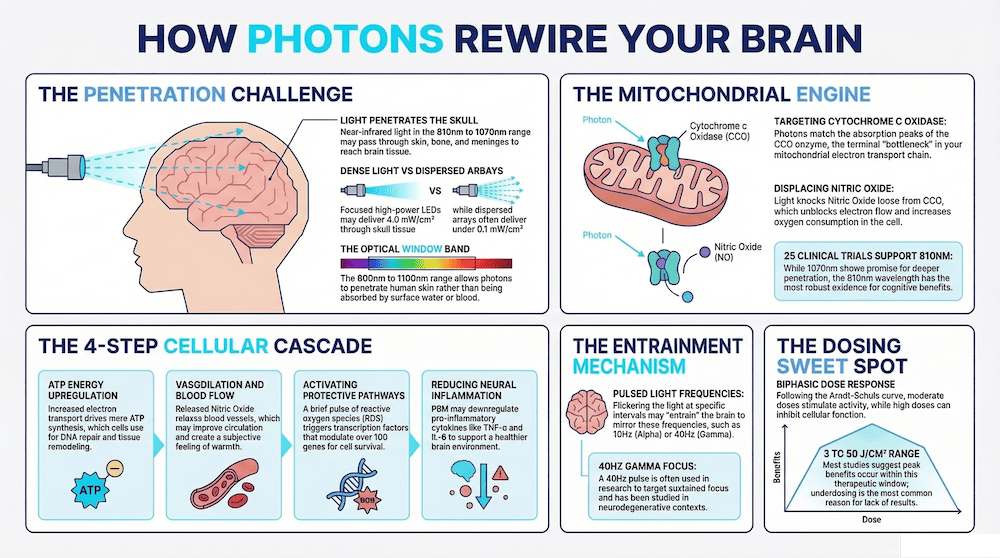
Transcranial photobiomodulation (tPBM) is a non-invasive technique that delivers near-infrared light, typically at 810nm or 1070nm, through the skull to stimulate mitochondria in brain cells. NIR photons interact with cytochrome c oxidase (Complex IV) in the mitochondrial electron transport chain, increasing ATP production, reducing reactive oxygen species, and triggering neuroprotective signaling cascades.
A 2023 systematic review in Ageing Research Reviews analyzed 35 human studies and found 82.9% reported positive cognitive improvements from transcranial PBM. The technique has shown benefits across conditions including mild cognitive impairment, traumatic brain injury, and depression.
In my testing across 100+ sessions with multiple devices, the key differentiator is through-skull irradiance: focused LEDs deliver up to 4.0 mW/cm² through bone, while dispersed arrays deliver under 0.1 mW/cm². Surface specs alone tell you very little about actual brain penetration.
Beyond the primary cytochrome c oxidase pathway, there is more to the story.
A 2022 review in Photobiomodulation, Photomedicine, and Laser Surgery identified three additional chromophore pathways:
- Opsins
- Ion channels
- Nanostructured water clusters
The field is still mapping the full mechanisms.
Why brain PBM is different from body red light therapy
General red light panels works great for skin, joints, and muscle recovery. Brain PBM is a different challenge entirely. NIR light must penetrate skin, fat, bone, meninges, and cerebrospinal fluid before reaching brain tissue.
Surface irradiance (what the spec sheet says) tells you almost nothing about what actually reaches your neurons.
This is where the best red light therapy panels diverge from dedicated brain devices.
Body panels prioritize broad coverage at high surface irradiance. Brain devices prioritize focused delivery through the skull.
Brain-directed devices need different geometry and wavelengths than body panels. Start with the home-device roundup, then use the dosage guide, buyer’s guide, and testing methodology for comparison.
The wavelength debate: 810nm vs 1070nm
Two wavelengths dominate transcranial PBM:
- 810nm is the most studied, with 25+ clinical trials backing its use
- 1070nm is newer, with proponents claiming deeper cortical penetration due to a secondary absorption peak
Here’s the thing.
The peer-reviewed evidence overwhelmingly supports 810nm. Every major clinical trial showing cognitive benefits, including studies on Alzheimer’s, TBI, and depression, used 810nm.
The 1070nm literature is promising but thin. A handful of studies, mostly not device-specific, versus dozens.
That doesn’t make 1070nm ineffective. It means the evidence gap is significant. Both wavelengths interact with cytochrome c oxidase, just at different absorption peaks.
How Do the Best Brain PBM Devices Compare?
Here’s how the four dedicated brain PBM devices stack up on the specs that actually matter.
The comparison table reveals a critical insight: more LEDs doesn’t equal more brain penetration. Vielight uses only 5 focused Vie-LEDs but delivers 50x more through-skull irradiance than 256-LED helmets.
MitoMIND Helmet (Mito Red Light): Best Value 810nm
Mito Red Light built their reputation on body panels. The MitoMIND is their first brain-focused device, and they brought impressive hardware. 256 LEDs at 810nm, the same wavelength backed by the most clinical evidence.

Is Mito Red Light MitoMIND Brain PBM Helmet worth it?
256-LED transcranial helmet at 810nm, the wavelength with the most clinical evidence, plus 6 entrainment presets from 0 to 40Hz and an optional 1070nm intranasal add-on. Best value in brain PBM. Independent testing measured 7 to 10 mW versus the advertised 14.
- LEDs
- 256 at 810nm
- Intranasal Option
- 1070nm add-on
- Presets
- 6 brain entrainment programs
- Frequency Range
- 0-20,000Hz
- Session Length
- 6-15 min (preset dependent)
Best For
- Best value 810nm brain PBM with adjustable frequency presets
Skip If
- You want the most research-backed device (Vielight has 25+ studies)
- You need proven through-skull irradiance data
Pros
- 6 preset brain entrainment programs (0-40Hz)nManual mode up to 20,000Hzn810nm wavelength backed by most clinical evidencenOptional 1070nm intranasal add-on ($200)nLess expensive than Vielight Neuro Duo
Cons
- No device-specific clinical studies yetnIndependent testing measured 7-10 mW/cm² vs advertised 14 mW/cm²nNo through-skull irradiance data published
Your rating helps others choose
Tap to rate
What sets the MitoMIND apart is the brain entrainment software. Six preset programs target specific brainwave frequencies:
- Recharge (0Hz continuous, 100% power, 10 min)
- Sleep (2Hz delta, 50% power, 15 min)
- Meditate (5Hz theta, 50% power, 15 min)
- Relax (10Hz alpha, 75% power, 15 min)
- Concentrate (16Hz beta, 75% power, 12 min)
- Peak Focus (40Hz gamma, 100% power, 6 min)
Manual mode pushes up to 20,000Hz for anyone who wants to experiment beyond presets. The optional 1070nm intranasal attachment ($200 extra) covers both major PBM wavelengths in one system.
At $2,195, the MitoMIND costs less than the Vielight Neuro Duo ($2,399) while offering more user control over frequency and power settings.
Pro Tip: The Peak Focus (40Hz gamma) preset matches the frequency used in Vielight’s Alzheimer’s research. Six minutes at 100% power. Perfect before deep work sessions.
The limitation: no device-specific clinical studies yet. MitoMIND relies on the broader 810nm PBM literature rather than its own trials.
Independent testing measured 7-10 mW/cm² surface irradiance versus the advertised 14 mW/cm². A big discrepancy.
For the price and feature set, the MitoMIND is the strongest value proposition in brain PBM right now (especially if you’re already familiar with Mito Red’s body panels).
Neuronic LIGHT: The 1070nm Pioneer
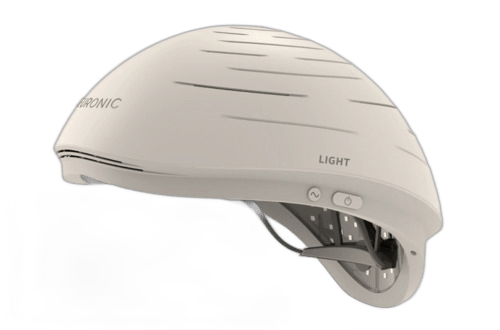
Neuronic took a different path. While everyone else builds 810nm devices, the LIGHT uses 300 LEDs at 1070nm (291 high-power plus 9 ultra-high-power), betting on a secondary absorption window for deeper cortical penetration. I tried one of Neuronic’s helmets at a biohacking conference in 2025, but I can’t say which model, so everything below about the LIGHT comes from Neuronic’s published specs, not my own testing.
- LEDs
- 300 at 1070nm (291 + 9 UHP)
- Coverage
- 670 cm² (full scalp + cerebellum)
- Weight
- 640 g (22.6 oz)
- Presets
- 4 + custom mode
- Pulse
- 0-999 Hz
- Session Length
- 3-30 min
Best For
- You're interested in brain-focused light therapy
- You want a helmet-style device for broader scalp coverage
- You're exploring photobiomodulation for cognitive support
Skip If
- You're looking for body or skin-focused red light therapy
- You want a budget-friendly intro to light therapy
- You prefer devices with extensive published clinical trials
Pros
- Transcranial 1070nm near-infrared light helmet for brain health
- Full scalp plus cerebellum coverage (670 cm²)
- App-controlled with four presets and a custom mode
- Pulse range of 0-999 Hz and intensity of 0-100%
- 90-day home trial and 1-year warranty
Cons
- Premium price
- No LIGHT-specific published trial or independent irradiance measurement
Rate your experience
Tap to rate
URBAN1234235 for $100 offSee every current discount code and sale →
The science behind 1070nm is intriguing. Proponents argue this wavelength reaches deeper brain structures through a different optical window.
A 2023 open-label pilot study in the Journal of Biophotonics gave 14 people with Long COVID brain fog either a 1070nm transcranial helmet or a whole-body light bed, 12 treatments over 4 weeks. Both groups improved on cognitive tests. Neuronic lists the study on its research page, but the paper does not name the LIGHT.
That’s promising. But context matters.
It was an open-label trial with 7 people per group, which limits what it can prove. Compare that to Vielight’s 25+ studies including randomized controlled trials.
The LIGHT is app-controlled, with four presets (Peace, Balance, Focus and Glow) plus a custom mode. Pulse frequency runs from 0 to 999 Hz, intensity from 0 to 100%, and sessions from 3 to 30 minutes.
Now for irradiance. Neuronic lists 97.08 mW/cm² at the 9 ultra-high-power LEDs and 1.53 mW/cm² overall, with about 1,725 mW of total power. Those are vendor figures at the device, not through-skull measurements, and I haven’t measured them.
The 1070nm bet could pay off as more research emerges. Neuronic offers a 90-day home trial and a one-year warranty, and the LIGHT is HSA/FSA eligible, which lowers the risk of trying it. It is one of the few transcranial 1070nm devices you can buy for home use, and there is no LIGHT-specific published trial yet.
Neuronic also sells a separate 256-LED model, the Neuradiant 1070, which I haven’t covered in this guide.
Sens.ai: Best Multi-Modal Option
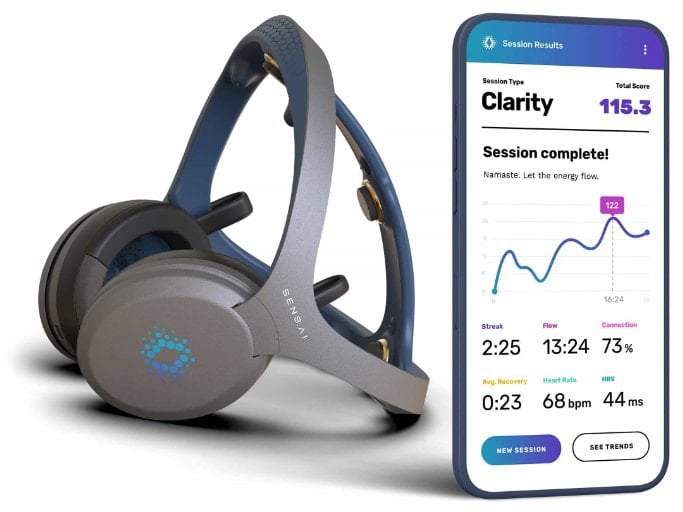
Sens.ai is a 5-in-1 brain training system that includes transcranial PBM alongside EEG neurofeedback, HRV monitoring, event-related potentials (ERP), and their BrainYears cognitive age assessment. This is the one that I use daily.
Is Sens.ai Ultimate Brain Trainer worth it?
Combines five brain technologies (neurofeedback, near-infrared light, HRV, meditation, assessment) into one headset that gives objective brain-state data at home instead of a clinic. The upfront cost is steep, and the hardware locks fully into the Sens.ai app ecosystem.
- PBM LEDs
- 7 at 810nm
- Per-LED Irradiance
- 312 mW/cm²
- Modalities
- PBM + EEG + HRV + ERP + BrainYears
- Adaptive
- Real-time EEG-guided PBM
- Subscription
- 1 year included
Best For
- You want to train your brain for better focus, calm, and sleep
- You're interested in objective neurofeedback data on your brain states
- You want a home-based alternative to expensive neurofeedback clinics
Skip If
- You're not willing to commit to regular training sessions
- You have epilepsy or seizure disorders (consult your neurologist)
- You prefer simpler meditation or mindfulness practices
Pros
- 5-in-1 brain training systemnAdaptive PBM based on real-time EEGnLowest price at $1,500nBrainYears cognitive age assessmentnHRV monitoring for autonomic tracking
Cons
- PBM is one feature among five, not sole focusnFewer PBM-focused LEDs than dedicated helmetsnRequires subscription after first year
Your rating helps others choose
Tap to rate
URBAN for $75 offThe PBM module uses 7 LEDs at 810nm with 312 mW/cm² per LED. That’s high per-LED power density.
The adaptive approach adjusts PBM delivery based on your real-time EEG data rather than using fixed preset frequencies. A combination of your brain’s current state along with your goal determines the stimulation pattern.
The combination is where Sens.ai shines. In a single session you can get brain stimulation (PBM), brain measurement (EEG), and autonomic nervous system training (heart coherence/HRV). No other device on this list integrates all three.
At $1,500 (with 1-year subscription included), it actually costs less than every other option except the entry-level Vielight X-Plus ($449). For the multi-modal capability, that’s impressive value.
The major downside: Sens.ai’s PBM is one feature among five. A dedicated PBM helmet like MitoMIND or Vielight concentrates all engineering effort on light delivery.
Sens.ai spreads that effort across multiple modalities. The PBM component works, but it’s not the device’s sole focus.
You only get 7 LEDs with Sensai.
If your goal is purely “get the most NIR light into my brain,” a dedicated device wins. If your goal is “optimize my brain using multiple modalities in one system,” Sens.ai is unmatched.
Vielight: The Clinical Gold Standard
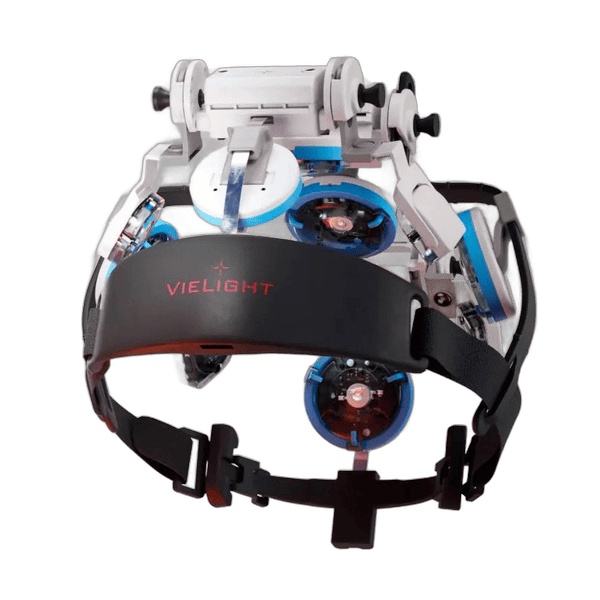
Vielight is the elephant in the room. Twenty-five published clinical studies.
The highest through-skull irradiance of any consumer device. And a price tag to match.
- Models
- Neuro Duo 4 and Gamma 4
- LEDs
- 5 focused Vie-LEDs
- Wavelength
- 810nm
- Surface Irradiance
- 75-125 mW/cm²
- Through-Skull
- ~4.0 mW/cm²
- Delivery
- Transcranial + intranasal
Best For
- You're focused on brain health and cognitive optimization
- You want a research-backed neurological light therapy device
- You're exploring options for neurodegenerative conditions
Skip If
- You're on a tight budget for biohacking tools
- You're looking for general red light therapy for skin or muscles
- You prefer quick, low-commitment wellness routines
Pros
- 25+ published clinical studiesnHighest through-skull irradiance (4.0 mW/cm²)nDual delivery: transcranial + intranasalnBoth 10Hz Alpha and 40Hz Gamma modes (Duo)nIntranasal bypasses thick skull bone
Cons
- Premium pricing ($1,799-2,399)nNo discount availablenNo affiliate relationship (included for honesty)
Your rating helps others choose
Tap to rate
The Neuro Duo 4 ($2,399) offers both 10Hz Alpha mode and 40Hz Gamma mode in one device. Five focused Vie-LEDs deliver 75-125 mW/cm² surface irradiance, and critically, approximately 4.0 mW/cm² through human skull tissue. That’s 50x more than what dispersed LED helmets deliver in tissue penetration tests.
The Neuro Gamma 4 ($1,799) focuses entirely on 40Hz stimulation. If you only want the gamma frequency backed by the most research (especially the Alzheimer’s and cognitive enhancement trials), this is the more affordable entry point.
Both models include Vielight’s signature intranasal pathway. The nasal cavity offers a thin-bone route to the ventral prefrontal cortex, bypassing the thickest parts of the skull. This dual-delivery approach (transcranial + intranasal) is unique to Vielight.
The research speaks for itself. A 2023 systematic review in Ageing Research Reviews analyzed 35 human transcranial PBM studies.
82.9% reported positive cognitive improvements. All 9 studies on MCI and dementia patients showed benefits. Many of those studies used Vielight devices.
Vielight isn’t affiliated with this site. No discount code, no commission. I’m including it because it’s a true pioneer in brain PBM.
Unfortunately, the limitation is premium pricing with no discount available. The X-Plus 4 ($449) exists as a lighter entry point with 633nm intranasal + 810nm body/head modules, but it’s not a full transcranial system like the Duo or Gamma.
Where Do You Land Among Biohackers?
85% of biohackers take magnesium. 66% train for strength. The largest age group is 65+. Answer a few quick questions and get your free Health Optimizer Profile: your stack, spending, data obsession, and longevity focus, scored against the community.
How Do You Choose a Brain PBM Device?
The right device depends on what you’re optimizing for.
Choosing a brain PBM device comes down to five factors: wavelength, pulsing frequency, through-skull irradiance, clinical evidence, and price. The 810nm wavelength has the strongest clinical backing with 25+ published human studies, while 1070nm shows early promise but limited validation.
Pulsing at 40Hz gamma frequency appears in the most cognitive enhancement research. Through-skull irradiance matters more than surface specs because focused Vie-LEDs deliver approximately 4.0 mW/cm² through bone, while dispersed 256-LED arrays deliver under 0.1 mW/cm².
After testing multiple devices across 100+ sessions, I recommend matching your budget to the evidence tier you are comfortable with. Prices range from $1,500 (Sens.ai multi-modal) to $2,399 (Vielight Neuro Duo). More expensive does not always mean more effective for brain penetration.
Budget under $1,800: Vielight Neuro Gamma ($1,799) gives you the most research-backed option at the lowest premium price point. Or Sens.ai ($1,500) if you want multi-modal brain training beyond just PBM.
Best value with flexibility: MitoMIND ($2,195) offers 6 preset programs, adjustable power, and the option to add 1070nm intranasal. The most user control per dollar.
Maximum research backing: Vielight Neuro Duo ($2,399) has 25+ studies and the highest through-skull irradiance.
Multi-modal training: Sens.ai ($1,500) combines PBM with EEG neurofeedback, HRV, and cognitive assessment. Best for people who want brain training, not just brain stimulation.
Exploring 1070nm: the Neuronic LIGHT is the home-use 1070nm option here. Promising research pipeline but limited current evidence.
Pro Tip: You can combine brain PBM with meditation-enhancing devices and sound therapy devices and recovery devices for a comprehensive brain optimization stack. I run PBM alongside neurofeedback and specific frequency protocols daily.
Brain Light Therapy Q&A
These are the most common questions I get about transcranial photobiomodulation devices.
What is transcranial photobiomodulation?
Transcranial photobiomodulation (tPBM) delivers near-infrared light through the skull to stimulate mitochondria in brain cells. The primary wavelength used is 810nm, which interacts with cytochrome c oxidase to increase ATP production, reduce oxidative stress, and trigger neuroprotective pathways. Consumer devices range from $449 to $2,399.
Does red light therapy actually penetrate the skull?
Yes, but penetration varies dramatically by device. Focused high-power LEDs (like Vielight’s Vie-LED modules) deliver approximately 4.0 mW/cm² through human skull tissue. Dispersed LED-array helmets with 256 LEDs deliver under 0.1 mW/cm² in the same tissue penetration tests. Surface irradiance specs alone don’t tell you how much light reaches brain tissue.
What wavelength is best for brain PBM: 810nm or 1070nm?
810nm has the strongest evidence base with 25+ published clinical studies showing benefits for cognitive function, TBI, Alzheimer’s, and depression. 1070nm shows promise in early research (a small number of early studies, including a 2023 Long COVID brain fog study) but has far less clinical validation. Both wavelengths interact with cytochrome c oxidase at different absorption peaks.
What’s the difference between transcranial PBM and regular red light therapy?
Regular red light therapy panels deliver light to skin, joints, and superficial tissue at visible red (630-660nm) and near-infrared (810-850nm) wavelengths. Transcranial PBM specifically targets brain tissue through the skull. This requires different engineering: focused light delivery, specific pulse frequencies for brainwave entrainment, and sometimes intranasal pathways that bypass thick skull bone.
How often should you use a brain PBM device?
Most clinical studies used daily sessions of 12-25 minutes. The Vielight protocol suggests alternating days. I personally use transcranial PBM 5-6 days per week at 40Hz gamma for 6-20 minutes before cognitively demanding work. Starting with 3-4 sessions per week and gradually increasing based on how you respond is a reasonable approach.
Is transcranial PBM safe?
A systematic review of 35 human studies reported no serious adverse events from transcranial PBM. The most common side effect is mild headache, typically resolving within hours. All consumer devices on this list operate well below maximum permissible exposure limits. People with photosensitivity conditions or those taking photosensitizing medications should consult a healthcare provider first.
Start Your Brain PBM Protocol
Transcranial photobiomodulation is one of the few brain optimization tools with actual clinical evidence behind it.
The field is still young, but 25+ human studies and a growing body of neuroimaging data make this more than theoretical.
For most people, I recommend Vielight Neuro Duo as the top overall pick. Its 25+ clinical studies, 4.0 mW/cm² through-skull irradiance, and dual transcranial plus intranasal delivery set it apart from every competitor.
If budget is a constraint, Sens.ai at $1,500 delivers the best value by combining PBM with EEG neurofeedback and HRV monitoring in one headset. MitoMIND is the strongest pure PBM value at $2,195 with six brain entrainment presets and adjustable frequency control.
Neuronic LIGHT suits early adopters willing to bet on 1070nm research before the evidence fully matures. After 100+ personal sessions across multiple devices, I can say the category is legitimate. A 2023 systematic review found 82.9% of transcranial PBM studies reported positive cognitive outcomes.
If you’re new to brain PBM, start with whatever device fits your budget and commit to 3-4 sessions per week for at least 30 days before judging results. Track something measurable: reaction time, sleep quality, focus duration, or cognitive test scores.
If one of these devices is out of your budget, you could theoretically partially benefit by using a targeted wearable light therapy device that includes high doses of near infrared. Just make sure that it’s zero-EMF.
Personally several times per week I run Sens.ai’s 40Hz gamma sessions after brain training and before deep work. I notice a slight subjective difference in sustained focus. Possibly placebo, but time will tell if this works to protect brain health.
Either way, the risk profile is nearly zero and the upside keeps growing with every new study.
Do you use brain PBM? Drop a comment below and let me know!
Comments