

With Dr. Lisa A. Riegel, creator of the NeuroWell Framework, Episode 259




What You’ll Learn
- Your brain runs like a corporation: Dr. Riegel maps the thalamus (“Harold”), amygdala (“Bob”), and prefrontal cortex (your CEO) so you can recognize when the limbic system hijacks decision-making. [02:31]
- The 4 states of awake: Calm, alert (useful stress), alarm (Bob hits the panic button), and fear (hypervigilance that manufactures threats). Most high performers live stuck in alarm. [05:12]
- 30-minute relaxation alarm: One to 2 minutes of breathwork every 30 minutes teaches the body to down-regulate automatically. Bigger stressors are required to push you into alarm. [13:08]
- Why 85% of goals fail by week 2: Dr. Riegel cites the New Year’s resolution drop-off as proof that brain science, not willpower, decides whether change sticks. [16:24]
- 15-second vagus nerve reset: A device-free proprioceptive protocol that signals safety to the vagus nerve in under a minute. [19:06]
- AI is atrophying the part that makes us human: Cognitive offloading weakens the prefrontal cortex, the same region responsible for character, morals, and conscious thought. [31:08]
- Chronic stress causes physical disease: Prolonged activation is inflammatory and can trigger lupus, rheumatoid arthritis, uncontrolled diabetes, and autoimmune flare-ups. [36:32]
- 98.7% of social anxiety is misdiagnosed: Per National Institutes of Health data Dr. Riegel cites, depression is misdiagnosed over 60% of the time. Blood sugar dysregulation often masquerades as mental health disorders. [37:54]
- The 8C Commitment Framework: Dr. Riegel’s 8-pillar system for initiating and sustaining change, where celebration, not willpower, is the dopamine fuel that makes personal change stick. [49:36]
Why It Matters
Most people think failed habits come down to discipline. They don’t. Dr. Lisa A. Riegel, creator of the NeuroWell Framework and author of 2 books on brain-based leadership, shows that 85% of Americans quit their New Year’s resolutions by week 2 because the limbic brain runs the show unless the prefrontal cortex is intentionally in the driver’s seat. She hands you a vocabulary for recognizing dysregulation, a 30-minute relaxation protocol, and the 8C Commitment Framework that makes personal and organizational change actually stick.
Who Should Listen
- High performers who feel constantly “on” and want a practical model for down-regulating their nervous system without expensive biohacking gear.
- Leaders rolling out AI or major change initiatives who keep hitting burnout, absenteeism, and team resistance.
- Anyone who’s tried to change a habit, failed within weeks, and wants to understand the brain science behind why their self-talk isn’t enough.
Inside the NeuroWell Framework for Lasting Change
On the High Performance Longevity podcast, Nick Urban sits down with Dr. Lisa A. Riegel to unpack the NeuroWell Framework — a brain-based model that explains why willpower so often fails and what actually makes habit change stick. Lisa’s approach cuts through the motivation-and-discipline narrative most self-help rests on and replaces it with the neuroscience of context, filters, and nervous system state.
The conversation opens with Lisa’s central metaphor: your brain is a corporation. The thalamus (“Harold”) handles data. The amygdala (“Bob”) runs security. The prefrontal cortex is your CEO. When Bob hits the panic button too often, the C-suite gets sent home and your limbic system runs the company, dragging you into alarm or fear states that quietly corrode performance. Lisa walks through the 4 states of awake, the 30-minute relaxation cadence that trains the vagus nerve to auto-regulate, and a 15-second proprioceptive reset that works without any device.
You’ll also learn why 85% of New Year’s resolutions fail by week 2, why social anxiety is misdiagnosed 98.7% of the time (often a blood sugar issue in disguise), and how cognitive offloading to AI may be shrinking the exact region of the brain that makes us human. Lisa closes with her 8C Commitment Framework for initiating and sustaining change, where celebration turns out to be the most underrated ingredient.
Key Terms Quick Reference
Specialized terms surface throughout this conversation. Here’s a quick reference.
[02:31] Limbic system: The emotional, stress-responsive part of the brain that takes over decision-making when the prefrontal cortex gets overwhelmed. Dysregulation here is why you say or do things you later regret.
[03:05] Thalamus (“Harold”): The brain’s data management department. It pulls in sensory input and output from the vagus nerve, runs it through past-experience filters, then hands a report to the amygdala.
[04:21] Amygdala (“Bob”): The brain’s security monitor. Bob decides whether to tap the panic button (alert) or slam it (alarm), which sends the CEO home and lets the limbic system run the show.
[05:12] Alert, Alarm, Shutdown Framework: Dr. Riegel’s 4 states of awake. Calm and alert are productive. Alarm means Bob and Harold are in charge. Fear means your system is inventing threats that don’t exist.
[07:23] Confirmation bias filters: Context-built screens Harold uses to interpret reality. Two people at the same event experience different realities because their filters distort the raw input.
[30:38] Cognitive offloading: Outsourcing thinking tasks to AI or other tools. Over time, the prefrontal cortex gets weaker, the same region responsible for consciousness, character, and moral reasoning.
[34:10] The Vault: A workplace venting ritual where a trusted colleague (vault partner) asks “do you need to vent or solve something?” and holds space without follow-up, preventing stress buildup without gossip.
[49:42] 8C Commitment Framework: Dr. Riegel’s 8-pillar system: context, clarity, coherence, cadence, coaching, collaboration, celebration, communication. It translates aspirations into sustained operational change.
How Does Your Brain Actually Run Your Life?
The short answer
Your brain isn’t one organ. It’s a corporation with departments. When Bob the security monitor (amygdala) hits the panic button, your CEO (prefrontal cortex) gets sent home and Harold (thalamus) plus Bob run the company until the threat passes. Self-awareness plus self-regulation equals self-control.
What Riegel found
Harold sits in the thalamus, pulls input from the vagus nerve and the 5 senses, then writes a report based on filters built from your lived context. Bob, the amygdala, reads that report and decides whether to alert, alarm, or shut down. Harold doesn’t know time or narrative. He works in sensory associations (“this smells like cookies, I feel good”). So a childhood where a parent was always late can train Harold to associate lateness with lack of love, and the adult you still dysregulates when your partner runs behind.
What to do about it
Build a trigger sheet. Write what stresses you out, then ask “why” until you reach the root association. Dr. Riegel can’t erase the faulty filter, but she can dilute it with positive filters using affirmations, pre-emptive self-talk (“Harold, we’re fine”), and context redesign (leaving 15 minutes early so lateness never happens). Over time, Harold primes for the new pattern and Bob stops reaching for the panic button.
“The solution to pollution is dilution. If you’ve got a polluted set of filters that are negative, that are always protecting you from things you don’t need protected from anymore, then the way to overcome them is you can’t really erase them. But what you can do is you can dilute them with positive filters.” – Dr. Lisa A. Riegel
Why Do 85% of Habits Fail Within 2 Weeks?
The short answer
Your brain craves familiar patterns, even destructive ones, because familiarity reads as safety. Willpower can’t override that bias. Lasting change requires context redesign, dopamine reinforcement through celebration, and a realistic assessment of whether the old behavior is still protecting you.
What Riegel found
Dr. Riegel cites the statistic that 85% of Americans ditch their New Year’s resolutions by week 2. She traces this to 2 problems. First, people set goals shaped by others’ expectations rather than authentic desires. Second, there’s no celebration layer. When you lose 20 pounds and nobody notices, the brain has no dopamine fuel to keep resisting the pizza. She points to Oprah’s school for girls from traumatic backgrounds as proof: a super-calm safe environment actually dysregulated the students because their nervous system baseline was chaos.
What to do about it
Before setting a goal, get honest about what would actually make you happy. Use the “name it, own it, control it” exercise. Answer 3 questions: what does your body feel like in different states, what does your body look like, and what is Harold telling you. Set small incremental goals so celebration happens constantly. Put goals on the bathroom mirror. Tell someone, creating social accountability.
“The most important C for making change is celebration, because we need that little dopamine hit all the time that gives us the energy to keep going.” – Dr. Lisa A. Riegel
Is AI Making Us Less Human?
The short answer
Cognitive offloading atrophies the prefrontal cortex, the exact region responsible for consciousness, character, and moral reasoning. If the CEO never runs the office, the CEO never gets good at the job.
What Riegel found
Most people use AI to complete tasks rather than as a thinking partner. Dr. Riegel calls this a brain-development crisis. She sees it already in kids: lower working memory because they don’t memorize phone numbers or addresses anymore. The concern sharpens at the identity level too. A 20-year company veteran loses their “local expert” status overnight when the machine arrives, and that identity hit is deeply dysregulating.
What to do about it
Use AI as a thought partner, not a task-doer. Prompt it to play devil’s advocate. Struggle productively before accepting the answer. Add anti-TikTok activities back into daily life: puzzles, art, sitting outside for 5 minutes with an empty mind. Leaders should reposition veteran staff around gifts outside what AI replaces, and give a coherent vision of what AI will and won’t do.
“The part that really makes us conscious and aware and thoughtful and have character, morals and all of those things is the part that we’re not using. And so I think there’s a real danger trying to figure out what do people do post AI to remain human.” – Dr. Lisa A. Riegel
The Riegel Self-Regulation Protocol
Use this framework to recognize dysregulation, dilute unhelpful associations, and train the vagus nerve to down-regulate on command. Dr. Riegel built it from 2 decades of work with schools, nonprofits, and organizations.
- Build a trigger sheet: List every situation, tone, fabric, or time pressure that stresses you out. Then ask “why” until you reach the root association.
- Audit each trigger for current relevance: Did that protective filter form in a context you’re no longer in? If yes, it’s a candidate for dilution.
- Set a 30-minute relaxation alarm: Stop for 1 to 2 minutes. Deep breath, neck stretch, stare out the window. The body starts auto-relaxing at the 30-minute mark, keeping Bob from hitting the panic button.
- Run the “name it, own it, control it” check: What does your body feel like. What does it look like. What is Harold telling you. Self-awareness is the prerequisite for self-regulation.
- Dilute negative filters with positive input: Affirmations, pre-emptive self-talk, visualized happy places in the morning. Don’t try to erase the past. Crowd it out.
- Recruit a vault partner: Find 1 person who asks “do you need to vent or solve something?” Vent, close the vault, never reopen it that day.
- Celebrate small wins constantly: Celebration is the dopamine fuel that makes change stick. Set goals small enough that you can celebrate every week.
Common self-regulation mistakes
- Trying to erase protective associations: You can’t delete them. They’re part of who you are. Dilution works. Erasure doesn’t.
- Treating “sit for 5 minutes” as a task: Untask it. The goal is unstructured quiet. People who turn it into a performance get more anxious, not less.
- Assuming “I don’t have stress” means no physiological stress: Your brain runs the safety-scanning system all day regardless. Old injury pain, arthritis flares, and blood sugar swings are the body’s stress tells.
Source: Dr. Riegel’s NeuroWell Framework, NeuroWell
Frequently Asked Questions
What does it mean to be regulated?
Regulated means your prefrontal cortex (your CEO) is making decisions, not your limbic system. You feel calm or productively alert. When Bob the amygdala hits the panic button too hard, the CEO gets sent home and the limbic system runs the show. That’s dysregulation.
What are Harold & Bob in Dr. Riegel’s brain metaphor?
Harold is the thalamus, the data management department that pulls in sensory input and runs it through past-experience filters. Bob is the amygdala, the security monitor who decides whether to raise the alarm. Together they write the report that your prefrontal cortex either acts on or gets pushed aside by.
Can you erase negative associations from childhood?
No. Dr. Riegel says the filters are part of who you are. But you can dilute them with positive filters using affirmations, pre-emptive self-talk, and context redesign. Over time Harold primes for the new pattern and the old one has less influence.
Why do 85% of New Year’s resolutions fail?
The brain craves familiar patterns, even unhealthy ones, because familiarity reads as safety. Willpower can’t override that. What works is celebration (the dopamine fuel), small incremental goals, context redesign, and goals that are authentically yours rather than shaped by others’ expectations.
Is AI actually making people dumber?
It can, if used for cognitive offloading. Dr. Riegel points to kids with lower working memory because they don’t have to memorize phone numbers anymore. The prefrontal cortex weakens without practice, which matters because that’s the part of the brain responsible for consciousness, character, and moral reasoning.
What is the vault technique for workplace stress?
Pair up with a trusted colleague. When you need to vent, ask for a vault. Your partner asks whether you need to vent or solve something. You vent. They close the vault. Neither of you mention it again that day. It prevents stress from accumulating into burnout without becoming workplace gossip.
How can blood sugar issues be misdiagnosed as mental health disorders?
Dr. Riegel cites National Institutes of Health data showing social anxiety is misdiagnosed 98.7% of the time and depression over 60%. Stress releases sugar from muscles, which can drive symptoms that look like anxiety or depression. Roughly 30% of Americans have undiagnosed sugar metabolic issues.
What is the 8C Commitment Framework?
Dr. Riegel’s 8-pillar system for initiating and sustaining change: context, clarity, coherence, cadence, coaching, collaboration, celebration, and communication. Context and the 3 planning Cs build the foundation. Coaching and collaboration drive engagement. Celebration and communication keep the change stuck.
How do I know if my vagus nerve is dysregulated?
Dr. Riegel points to physical tells: tight neck on the drive home, arthritis flares, old injury pain that returns under stress, and poor proprioceptive awareness (not knowing where your body is in space). A 15-second reset (squeeze fingertips, roll wrists and ankles, turn the head) can re-signal safety.
Products, Tools, & Resources Mentioned
Outliyr independently evaluates all recommendations. We may get a small commission if you buy through our links (at no cost to you). Thanks for your support!
Books & references
NeuroWell: Dr. Riegel’s first book. A brain-based approach to behavior, learning, and motivation written for educators and parents, with a framework for building healthier school and home contexts.
Aspirations to Operations: Dr. Riegel’s leadership book built around the 8C Commitment Framework. Each chapter ends with a “Stop and Think” journaling prompt for leaders navigating organizational change.
Frameworks & practices
NeuroWell Framework: Dr. Riegel’s brain-based model mapping the thalamus, amygdala, and prefrontal cortex to a corporate metaphor (Harold, Bob, and the CEO). Used to build self-awareness, self-regulation, and self-control.
8C Commitment Framework: Dr. Riegel’s 8-pillar system for change initiation and sustainability.
30-minute relaxation alarm: Set a timer every 30 minutes. For 1 to 2 minutes, breathe deeply, stretch the neck, and look away from the screen. Trains the vagus nerve to auto-regulate.
15-second vagus nerve reset: Squeeze fingertips together, roll wrists and ankles simultaneously, turn the head side to side. Sends proprioceptive input to the vagus nerve that the body is safe.
Name it, Own it, Control it: A 3-question self-awareness exercise. What does your body feel like. What does your body look like. What is Harold telling you.
The Vault: Workplace venting ritual. A trusted colleague asks whether you need to vent or solve something, holds space while you do, and neither of you reference the vent later that day.
Connect with Dr. Riegel
Amazon author page: Both of Dr. Riegel’s books with full descriptions and reviews.
Dr. Lisa Riegel on LinkedIn: Where to connect with her directly and follow her work on leadership, neuroscience, and organizational change.
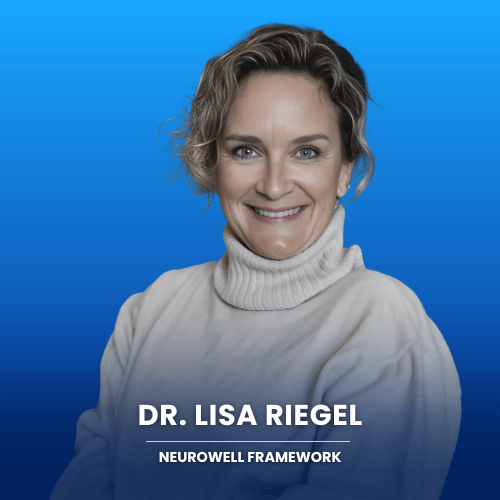
About Dr. Lisa Riegel
Dr. Lisa A. Riegel is a leadership strategist, educator, and author who helps organizations use neuroscience to build cultures of engagement, wellbeing, and sustainable change. She’s the creator of the NeuroWell Framework, a brain-based approach that helps people understand how biology and context shape behavior, learning, and motivation. With over 2 decades of experience working across education, nonprofit, and community-based organizations, Lisa’s known for translating complex brain science into practical tools leaders can actually use. She’s the author of NeuroWell and a frequent speaker on engagement, burnout prevention, and the human side of strategy. Find her on LinkedIn or through her Amazon author page.
Related Episodes & Articles
- Episode: Vagus Nerve Stimulation & Polyvagal Theory
- Episode: Nervous System Healing with Bill McKenna
- Episode: Stress Resilience & Adaptogens
- Episode: Rewire the Brain: Habit Change Neuroscience
- Episode: Burnout Prevention for High Performers
- Article: Vagus Nerve Stimulation Benefits
- Article: Biohacking Stress Management
- Article: Habit Change & Neuroscience
Music by Alexander Tomashevsky
Full Episode Transcript
Nick Urban [00:00:01]:
You’re listening to High Performance Longevity. The show exploring a better path to optimal health for those daring to live as an outlier in a world of averages. I’m your host, Nick Urban, bioharmonizer, performance coach, and lifelong student of both modern science and ancestral wisdom. Each week we decode the tools, tactics and timeless principles to help you optimize your mind, body and performance span things you won’t find on Google or in your AI tool of choice. From cutting edge biohacks to grounded lifestyle practices, you’ll walk away with actionable insights to look, feel and perform at your best across all of life’s domains. Dr. Riegel, welcome to the podcast.
Lisa Riegel [00:00:53]:
Thank you. Thank you so much for having me.
Nick Urban [00:00:55]:
I’m excited. Today we’re going to discuss an area that should be on top of everyone’s mind. Ironically enough, that is the mind and your work around that to help people understand what it is and what they can do to improve it. Let’s explore the neuroscience of context and the environment that actually determines whether the things that we’re doing for our health stick or they are fleeting and fade away.
Lisa Riegel [00:01:22]:
Sure. So I think understanding a little bit about how your brain works can, can help you gain a lot of self aware which helps you self regulate. And when you have self awareness and self regulation, you ultimately have self control. And that’s what you need to make sure that the thinking part of your brain is actually doing the decision making and not the limbic part of the brain that’s really the emotional part of your brain. So the first thing to really understand is that all behavior, whether it’s work behavior, social behaviors, all behavior serves a purpose and all behavior is the intersection of our biology and our context. And this is where the brain science gets exciting. Understanding the biology of your brain can help you to calm your brain down when you’re starting to get stressed out and it’s impacting your ability to think. But even more important, you can set up a context that actually shapes your biology.
Lisa Riegel [00:02:17]:
We can change our biology through the way that we live. And that’s the really exciting part about figuring out how to be happier and healthier and more successful.
Nick Urban [00:02:26]:
Let’s explore that. How does someone know if they are regulated? What even is regulation?
Lisa Riegel [00:02:31]:
Yeah, so basically the way I describe it is that our brain is like a giant company. We think of it as just like one organ, but it’s actually like a huge corporation and it has lots of different departments. And so the departments that are involved with regulation and stress actually start developing when we’re in the womb, we come out with a stress regulation system and it’s part of that limbic system. And there’s a couple departments. The first is the data management department. And that’s your thalamus. And I actually named my data manager Harold. So Harold is responsible for doing two things.
Lisa Riegel [00:03:05]:
He talks to my vagus nerve. So the, the vagus nerve runs down your neck and it goes around your heart and your stomach. And it’s kind of like a systems manager. And so it’s always double checking. Are you, you know, is your heart beating? Is your stomach emptying? Like, is everything working correctly? And it’s also checking, where’s your body in space? Are you safe? Or are you standing on the edge of a cliff and you could fall over any minute? So it’s sending information to Harold. Harold is also looking in the environment, taking in all the sensory information from the environment. And the important thing to remember is your limbic brain cannot tell a story and doesn’t know time. So Harold’s not thinking in stories, Harold is thinking in this smells like cookies.
Lisa Riegel [00:03:50]:
When I smell cookies, I feel good, right? So it’s just sensory associations. He’s writing up a report of what’s going on in your environment. He sends it to Bob. Bob is the amygdala. Bob is your security monitor. And Bob decides, do I tap the panic button? And if he just taps it, then a note comes up to you, the CEO of your brain. And this is the C suite office where the leadership’s supposed to happen. So if Bob just taps it, he sends a note up and says, hey, boss, Harold.
Lisa Riegel [00:04:21]:
And I don’t know how to respond. We’re a little confused. Can you weigh in? And that’s what you want, right? You wanna be in that alert phase where maybe you’ve got a little bit of juice from your sympathetic nervous system, but your CEO is still in the office working hard. If Bob Wales on that button, the message goes up to your boss and says, hey, boss, step out of the building, go get a cup of coffee. We’re in trouble. There’s danger. We’ll call you when the building’s safe again. And that’s when we start to have Bob and Harold take over.
Lisa Riegel [00:04:51]:
And that’s when you’re dysregulated. And that’s when, like, when you calm down later and you’re like, why did I do that? Or why did I say that? It’s because you didn’t. It’s because Bob and Harold sent you away to go have a cup of coffee. And now you’ve got to come back and clean up the mess they made while they were running the company.
Nick Urban [00:05:08]:
Is this related to your alert alarm shutdown framework?
Lisa Riegel [00:05:12]:
Yes. So the body has four states of awake, so we can be calm. And then if we’re alert, that’s actually good stress. Like before a golf match or before a job interview or something, you get that little bit of juice, and that’s where your CEO is focused and has a little bit of extra chemicals from your body to help them really be sharp. The problem is when you get to alarm, that’s when Bob and Harold take over. And if Bob and Harold take over for too long, your body actually goes into a state called fear, where you become hypervigilant and you start to see stressors dangers where they don’t currently exist. And so you’re. You’re having a reaction to everything.
Lisa Riegel [00:05:52]:
And the other thing that’s important with Harold is that those sensory associations that he’s making, those are related to our context. So this is when I was saying you can shape your brain with your context. Everything shapes our sort of biases and beliefs, and these become filters within the thalamus. What he’s. He’s using to determine what’s going on in our environment. So, you know, for example, when I was growing up the media landscape, I watched Little House on the Prairie and I watched Love Boat and shows that were about, like, owning your mistakes and being a good community member, and people come out and they’re together. So Bob had regular inundation of those kinds of messages about what society is. So my confirmation bias that he uses is people are generally kind and people generally help each other out, and you can expect your neighbors to be kind in today’s media landscape.
Lisa Riegel [00:06:46]:
We’ve got, you and I are gonna get together and manipulate that person and vote them off the island. It’s about power and manipulation and being better than other people. It’s definitely not collaborative. So our kids are growing up in an environment between that and then social media as well, that their worldview is very different. And if you think of, like, reality being like a banana, and then Harold’s pulling out all these different filters and screens for that are based on our context and our experiences. He shoves the banana through those screens, and on the other side is his perception of the banana. And so it doesn’t look anything like a banana anymore. Right.
Lisa Riegel [00:07:23]:
So every single person, you and I can be at the exact same event and have a completely different experience based on how our brain has associated what’s happening in the environment now. And all the former associations that we’ve made and some of them are faulty, some of them are bad associations. And so understanding and having some self awareness, then you as the boss of your brain can say, hey Harold, don’t associate those two things. Those two things maybe went together when I was six years old, but they don’t make any sense anymore.
Nick Urban [00:07:53]:
That’s very important. And we don’t want to just discard all of those associations because a lot of them play protective roles and they’ve actually helped us and let us arrive where we currently are. How do we go about ascertaining which are the ones that we that are faulty associations that we want to go about changing?
Lisa Riegel [00:08:11]:
Yeah, that’s a great question. And I think it requires a little bit of introspection into your past. So for example? Well, I start with folks I work with. I start with kind of a trigger sheet. Like what stresses you out? Like, does it stress you out when somebody gives you feedback or if somebody tells you to do something you don’t want to do, or if you’re in a loud space or certain fabrics or like whatever, what are the things that stress you out? But then you have to go a step deeper to figure out whether those associations are realistic or faulty. So, so if you go a step deeper and ask why, like for me, I hate being late. Like time when I was growing up, my parents were divorced. I spent a lot of time on the front stoop waiting for my dad because he was always late.
Lisa Riegel [00:08:57]:
So my brain, my little herald, way back when I was 8 years old, associated time with love and worth and acceptance and those kinds of emotional connections, which doesn’t make any sense. People can be late for a number of reasons that have nothing to do with how they feel about me. But before I understood that, my body would dysregulate because all of this stuff that Harold and Bob is doing is unconscious. So it just happened. So if, if my husband was running late, I would just get anxious and angry and I would just get ramped up and sometimes it would take me a long time to calm down and it could ruin my evening. So once I understood that I had this association, I was able to be more proactive. So like, if I know I’m gonna be late, I self talk. Harold, we’re fine.
Lisa Riegel [00:09:43]:
This is fine. Don’t make that association. Or I proactively. Before Bob hits the panic button and I’m out of the house, I’m talking to my brain, telling it what I want it to do. And it’s the same way that affirmations work. If we tell our brain that we are capable and that we can do these things, then Harold is primed to look for those things in our environment and confirm that that belief and so doing some of that talk. The other thing is I leave early so that I don’t have to face being late. So I’ve made changes to the way I live to prevent putting myself in a context that’s gonna dysregulate me with the body.
Nick Urban [00:10:23]:
A lot of these things are protective mechanisms, and it can seem tempting to want to overcome them, to bypass them, to get around them. If we do that here and we use self talk or some kind of other tool, are we actually addressing the root cause of the disruption or are we just like masking something that the body is trying to protect us from?
Lisa Riegel [00:10:45]:
Well, I think what we’re doing is we are delineating. This is not like that. So dealing with the filters that we have in our past and how they were formed and how they did protect us or helped shape the way that we view the world, I mean, that’s a really noble thing to do. It’s not about not having your past impact your present. It’s about understanding how it does and also being amazed by your own brain that a lot of the protective factors and associations it did, it did that to protect you. So the question is, in your current context, do you still need those protections? So, for example, if you grew up in an abusive home and certain tones of voice set you off, or certain conditions set you off, do you still need to let those set you off today? Is it still important because you’re still in a context where those are protective for you, or are they holding you back because you’ve emerged out of that context into a healthier space? So you don’t need to have your body react that way. It’s like soldiers, you know, they have PTSD and they’ll hear a noise and their body will dysregulate. And that serves a purpose in combat, but they’re not in that context anymore.
Lisa Riegel [00:11:56]:
But there might be other things that your brain’s associated that absolutely protect you from getting hurt physically or emotionally?
Nick Urban [00:12:04]:
So if we use these tools like the self talk you’re mentioning, is there a way of actually addressing the root cause of it so that Harold and Bob aren’t actually even speaking to us about these things anymore because they’re more relaxed?
Lisa Riegel [00:12:15]:
Well, you can relax them, but they never go away. The past and the filters and the associations we made are part of who our brain is and part of who we are. But what I always say is the solution to pollution is dilution, right? So if you’ve got a polluted set of filters that are negative, that are always protecting you from things you don’t need protected from anymore, then the way to overcome them is you can’t really erase them. But what you can do is you can dilute them with positive filters. So that way, if I’m in a situation and Harold’s noticing all of these different kinds of things in my environment and he’s making associations that say, well, gee, some of these are bad and some of these are good, I don’t know what to do. So then he’s going to send a note to Bob. Bob’s going to send that note up to your boss that says, hey, boss, we got some good associations and some bad associations. We need you to weigh in on how we should respond.
Lisa Riegel [00:13:08]:
And that’s where you can keep yourself in some mental control. The other thing I talk a lot about is doing a like, regulating self care routine. So teaching your body to automatically relax so you can set an alarm for every 30 minutes, every 45 minutes when you start out and when the alarm goes off, just stop for one minute, just one or two minutes. It’s not like a huge session. One or two minutes, take a couple deep breaths. You know, when in doubt, blow out, take a breath in and just blow slow. You know, maybe stretch your neck a little bit, massage that vagus nerve a little bit. Maybe, you know, stand up and notice.
Lisa Riegel [00:13:50]:
Notice nature. Just kind of rub your, you know, you can breathe deeply, rub your neck and stare out the window and watch the leaves for one minute and then go back to work. And then the next 30 minutes later, your alarm goes off and you do it again. And what happens is eventually your body starts to respond that every 30 minutes I’m expecting a relaxation. And so it starts to do it naturally. And when you do that, you’re keeping that vagus nerve happy and you’re keeping Bob calm so that if something does come your way, you’re not starting from an already physiological, like, elevated point. So basically the stressors have to be bigger for you to lose control if you’re keeping your body calm.
Nick Urban [00:14:30]:
Lisa, there’ll be a number of people listening to this who will tell you that they have no stress, that they are not governed by it, and that they’re just charging full speed ahead with no obstacles except for the mysterious things they can’t quite put their finger on that seem to affect them in some way, but it’s not stress. How do you help people either view what they might be missing, I.e. stress, or what’s your advice to those who are under the impression that they don’t experience stress?
Lisa Riegel [00:14:59]:
Yeah, well, I think it’s, you know, you say tomato, I say tomato. From a physiological standpoint, it is impossible for us not to experience stress because the purpose of our brain is to keep us safe. And all day long it is playing with that stress management system to say, are we safe? Are we not safe? Are we safe? Are we not safe? So they may not have, like, stressors that they feel are like traumas. You know, trauma and stress is different. Trauma can cause stress, and prolonged stress can cause trauma. Right. And so you, you know, but if they’re thinking of it through the lens of I don’t have social relationship problems, I don’t have work problems, then good for them, that’s great. And, you know, so keep on keeping on.
Lisa Riegel [00:15:45]:
But the other thing they can do, instead of just using the brain science to manage stress, they can use the brain SC to help them understand how to achieve their goals. And so it’s not always about, like, clean up on aisle five. I’ve got stress problems. It can also be proactive. And how do I leverage what I know about the way that the brain develops automatic habits and neural connections so that I can achieve my goals? And I would argue that most your listeners do not have those conditions because, like, 85% of Americans ditch the New Year’s resolution by, like, week too. So it’s hard to change. It’s hard to make changes. So we could go through those if you’re.
Lisa Riegel [00:16:24]:
If you think they would be interested in that.
Nick Urban [00:16:26]:
Yeah, we’ll go through those. Before we do the context here. If you’re trying to accomplish goals or if you’re not as stressed as some of your counterparts, what role does context and making Harold and Bob happy have?
Lisa Riegel [00:16:43]:
Yeah, well, and I think especially in the workplace or even in your family, like when you’re working with other people, recognizing how Harold and Bob function, the biggest thing that it can do is it can help you reframe problems that you’re seeing someone else have. So if somebody’s starting to get really agitated with you or combative with you, to be able to recognize this could have absolutely nothing with the reality of what’s going on right now. This could have everything with how Harold is somehow connecting something that’s going on right now with something that would be dangerous or scary or fearful from that person’s past. So it can give you a little bit of emotional distance so you’re not reacting and escalating a situation. It can also help you understand, like, when you think about change. Change is scary. Like in the world right now, in the workplace, AI is disrupting lots of things, and people are super stressed. There’s been some research about the level of workplace stress and how many billions of dollars it’s costing in absentee and fmla and, you know, and so figuring out, like, how do you address fear? Because, you know, you might say, well, I’m not stressed about things, but everybody has daily fears, like, am I gonna get promoted? Or am I doing this right? Or am I gonna disappoint someone? And so understanding how that plays into our ability to think and perform can be really helpful.
Nick Urban [00:18:09]:
If someone’s in the biohacking realm, they’ve probably heard of vagus nerve stimulators. And you were mentioning taking the break every 30 minutes just to pause, reflect, and massage the vagus nerve. Look out the window down, regulate yourself. Do you think there’s a role for using exogenous devices to stimulate the vagus nerve and help the body shift into that parasympathetic relaxed state?
Lisa Riegel [00:18:32]:
If it works for you, I think that’s great. I don’t know that you can’t do it yourself. But if there’s a device that just seems to really work, and it’s funny. Cause one of the other things you can do is hum. And I like to cook. And what’s funny is I hum while I cook. And I never really noticed that I would. My husband always laughs.
Lisa Riegel [00:18:50]:
He’s like, I know dinner’s on. Cause you start humming. And then I started realizing I don’t even know if I like to cook. I think I’m just humming and it’s relaxing me. And so I feel relaxed. And so it was kind of almost once I figured that out, I was like, huh. I don’t even know if I want to cook anymore. But there’s lots of things you can do.
Lisa Riegel [00:19:06]:
You can put a cold compress, you know, just some stretching. The other thing is, and sometimes, too, I think it can be intimidating to think I have to have a device to help me do this. There’s easy things you can do if you don’t want to call attention to the fact that you’re calming yourself down. And one is you can just squeeze your fingers together. And this alerts your vagus nerve wherever the furthest part of your body is from your core body. If you pay attention to it. The key is that you’re thinking about it. I’m feeling my fingertips.
Lisa Riegel [00:19:40]:
And so what I’m doing for my vagus nerve is saying, here’s my hands, here’s where they belong. And it will map around rest of your body on. So to the point of it’s your systems manager. It’s like, oh, okay, so your hand is not in, you know, in the garbage disposal. That’s good. I know we’re safe, right? So you just kind of squeeze or you can wiggle your toes and push on the carpet and pay attention to your feet. I always do this exercise. You roll your wrists and your ankles at the same time, and then kind of turn your head to one side and turn your head to the other and stretch your neck a little bit.
Lisa Riegel [00:20:13]:
You just do it for, like, I don’t know, 15 seconds. And then when you put your feet back down, you’ll feel your feet like they were always there, but now you notice that they’re there. And that’s sending the message to your vagus nerve that, like, hey, you’re all good. And. And we have really low vestibular and proprioceptive input, which is where your body is in space. Because it’s developed in ways, especially our kids today, it’s developed in ways that we don’t play anymore. You develop this input by rolling down hills and hanging upside down and doing sit and spins and merry go rounds. And we don’t play that way anymore.
Lisa Riegel [00:20:49]:
And so what we see is a lot of kids have elevated levels of anxiety and sensory things because they don’t have that sense of where their body is in space. And their vagus nerve is always agitated.
Nick Urban [00:21:00]:
I interviewed Bill McKenna about this, and he was talking about how even adults can benefit tremendously from this. And so I started doing some of those types of things. And like, the spins, and I hadn’t done those in two decades. I did them like, wow. Actually, I not only feel noticeably different, but after doing it for a while, I felt like I had a little more, like, proprioceptive ability than before. And it’s also something that I still don’t do very often because I just forget about it. But it’s one of those things that seems like it probably has benefit to do because of how much time I am probably like most people spend on computers and very similar postures throughout the day. Every day.
Lisa Riegel [00:21:34]:
Yeah, well, and that’s where setting that alarm can be helpful, because you’re literally just setting stand up and stand by the window and just, you know, stretch your neck one minute, couple deep breaths, you know, and it just kind of resets your body. And then you can sit down and get back to work. We all have one minute that we can do that.
Nick Urban [00:21:49]:
As part of the idea of like shaping your context, are there any other things we should do? Like, for example, I’m imagining it probably is going to be a good idea if you can control your work environment, to not have an environment that stresses you out tremendously when you’re trying to focus and work constantly. Perhaps when you’re trying to perform at your highest, it’s okay to have a little bit of extra stress, but not long term.
Lisa Riegel [00:22:11]:
Well, I think the thing with work that people have to realize is why are they stressed out? So, like, I do a lot of leadership coaching and I find that time management is such a challenge for leaders, especially because they’re bothered all day long. They’re always, you know, interrupted. And so starting to think about if I managed my time better, you know, what are my fears? Are my fears I’m going to underperform or I’m not going to be there for somebody, or I have to, you know, what are the underlying things that are driving my behavior? And then thinking about, do I have some skill deficits, that if I got better at this, I would have less stress? And then the other thing too, just even with time management is, you know, I work from home. And so when I first started working from home, it’s hard because you never leave the office. It’s always there. Right? So setting some rules and, you know, living by them. Like, I do not get on my computer after 6 or when I start to cook dinner and open up a bottle of wine and have a glass of wine, that symbolically means my day is over, my work day is over. I’m gonna clean my mind of it and I’m gonna turn to family time.
Lisa Riegel [00:23:19]:
And I think we live in a world. I used to do some international work and they were like, we always know when we’re working with Americans. Cause you people like email us all hours of the night and if we email you at 11 o’, clock, we don’t expect a response, but we get one right away. And so I think setting some of that work life balance is really, really important.
Nick Urban [00:23:37]:
Yeah, I had a boss once who emailed me at 12:30 in the morning and then followed up on the messages I hadn’t responded to. At six in the morning, I’m like, when did you sleep last night? I’m awake now. But you shouldn’t be sending those emails at that time. I shouldn’t be responding to them. And I think that line is in fact blurring because of work from home culture and the rise of AI. If someone’s stressed about the role of AI, the increasing role of AI and the potential for that to take or augment their job, whatever, what do you recommend they do, aside from perhaps some of these self care, self regulation practices?
Lisa Riegel [00:24:11]:
Well, one thing I would say that I think is super threatening with AI is that there’s a lot of people who are sort of local experts, right? They worked within their company, they were the owner of a process or a protocol or you know, what a department, whatever it was. And so our identity is tied up within that idea of I’m a local expert and I’m respected for the time I’ve been here and the knowledge that I have when all of a sudden the machine walks in and wipes out all that wisdom and experience. I’m now a novice again and that’s really, really uncomfortable. And so starting to figure out, you know, if you’re a leader in a workforce, figuring out how you can redefine some of the gifts and talents of your staff that are outside of the particular thing you’re going to be replacing and so that they can retain that sense of just, you know, professionalism and you know, you’ve worked for this company for 20 years and you feel like you should be respected and honored and you should be more knowledgeable than the guy who just walked in the door. So helping to reposition people, I think, also helping to make sure that you’re, you’re giving a vision of kind of coherence. Like we have this new AI stuff that we’re going to be doing. Here’s how it’s going to be helping us, here’s not what it’s going to be doing, you know, helping them to understand. I’ve worked with companies that like bring in a new software system and it’s good, the new system and it does a lot of things, but it also does a lot of things that other software does.
Lisa Riegel [00:25:43]:
And so now you’ve got competing non coherent initiatives and then you’ve got people like duplicating work and getting burned out and getting frustrated and upset about it. So I actually have, it’s called the 8C Commitment Framework and it walks leaders through how to position change so that you can get the transformation moving and you can get it to be sustainable. And it really starts, it’s a foundation on the brain science because the policies shape change, but people make change. And we’re not really trained very well in the human system. So I think figuring out how to engage the human system in some of these disruptive changes. But at the end of the day, also with AI, I think there’s a lot of legitimate worries out there. I mean, there isn’t anything you can do if your job is gone completely, you know, your whole industry, then what? But I think people, if they can start to practice some ideas of learning, start to practice learning again. Because I think sometimes we get stuck.
Lisa Riegel [00:26:46]:
And as we’re in a job and we’ve been doing it for years, we kind of know it. And so we stop really being curious and learning. And we’re going to all have some pretty big learning curves. So getting comfortable with that will help with stress.
Nick Urban [00:26:58]:
It’s interesting, I hear a lot of pushback that AI makes people stupider and it impairs and hinders learning. But if you know how to use AI properly, you can have it, like, play the devil’s advocate and help you understand the blind spots in your own perspective. It can help you learn things and sequence them more effectively. It just comes down to, like, how you actually go about using it. And if you know how to, like, structure learning in an appropriate way.
Lisa Riegel [00:27:22]:
Yeah, well, and I think that’s the thing that’s tricky with AI is it’s infinitely amazing and infinitely terrifying. Right. So it can go either way. I think when people talk about making you dumber, part of it is that it’s kind of like what we see in kids today. They have lower working memory because they don’t. They don’t have to use that part of their brain. Like, I had to memorize phone numbers, I had to memorize addresses, you know, and so I was practicing. You know, our brain learns through that repetition experience over time, and we’re not having those experiences.
Lisa Riegel [00:27:51]:
So as AI starts to interface with kids earlier and earlier, there are just so many brain functions that we do through unstructured play, through problem solving, through walking to your friend’s house, through all these different things that have changed, change so much for. For students today and for kids growing up and they’re doing studies now of cognitive offloading and the fact that most people are not using AI the way you’re talking about as a thought partner, they’re using AI to do the tasks for them, and then they’re not even reading. I got an email from somebody the other day who clearly had used AI and didn’t take out the I can do this for you next. You know, little thing at the bottom. And so I was like, okay, so do you even know what you just sent me? Like, did you even read it? And so I’ve been even working in schools and talking about, we gotta change the assignments we do. So instead of, you need to write a paper, you need to prompt AI to write the paper and then show how different the paper is depending on how they prompted it, or have AI do a paper, and then you have to go in and investigate whether or not the sources that it picked were actually the sources that you would agree with, because it sometimes pulls some weird sources, you know. So we’re going to have to rethink how school looks as well, because AI is interrupting that. And I think in the workplace, we have to make sure that AI doesn’t derail us from our vision or make us dumber because we’re just plugging it in to get it done.
Lisa Riegel [00:29:20]:
It’s more about just getting it done instead of really using it to improve what we’re doing.
Nick Urban [00:29:25]:
Yeah, I think you’re right. The whole idea of cognitive offloading and, like, the idea of, like, struggling a little bit actually makes me retain things more. If I just have an answer at the snap of a finger, it kind of fades away. But if I have to actually do my own research and, like, dig for a bit and then I find the answer, I’m much more likely to remember that. And I’m wondering if that’s going to be integrated more into, like, daily lifestyle in some way, because we get too far the other way, where there’s no impetus to actually remember anything that we’re doing, because it’s all, like, here for one second we have an answer and we’re on to the next thing.
Lisa Riegel [00:29:57]:
Right. Well, and I think that’s the fear is that from a brain perspective, if you don’t lose it, you know, just like this is your CEO’s office where all those functions of thinking happen. And just like any job, your first day of the job, you’re not as good as you are your 50th day. Right. Because you get better as you practice. If we’re never using the C Suites office to do anything, then the president of our company never gets good at her job. And so we have to find ways that we’re challenging our brain to continue to do that, or we could really run into some trouble with people’s ability to think. And the thing that scares me at an existential level is that this is the part of our brain that makes Us, human.
Lisa Riegel [00:30:38]:
The rest of the brain is really just evolution. It’s our animal brain. It keeps us alive, it keeps our organs running, it keeps our impulses and hunger and things like that. The part that really makes us conscious and aware and thoughtful and have character, morals and all of those things is the part that we’re not using. And so I think there’s a real danger trying to figure out what do people do post AI to remain human and to stay that kind of rational, reasonable person.
Nick Urban [00:31:08]:
It seems like the things that create the opposite of cognitive offloading, the things that actually make you think and struggle with, are going to become more and more important as we outsource more of our thinking towards these tools. For example, like perhaps art, perhaps puzzles, things that make you engage your brain, be present. Kind of like the anti TikTok of, of the modern life.
Lisa Riegel [00:31:29]:
Yeah, yeah, absolutely. And I’ve been talking to schools a lot about like the purpose of school in today’s world shouldn’t be content transmission. That’s old news. And we can get content anywhere. And we can’t really even make the purpose career readiness because jobs are changing so much. We don’t really know what it is, but what we do. Exactly what you just said that we in order to fill the gap between machine and human, we’re going to need to be able to think, we’re going to need to be creative, we’re going to need to be able to discriminate good information from bad information. We’re going to need to be able to understand our reality.
Lisa Riegel [00:32:03]:
And we’re not teaching that right now. So that’s something we need to start doing in schools and in workplaces to get people ready for this shift.
Nick Urban [00:32:13]:
So so far our playbook includes some like self care, nervous system, self care, regulation, tools and practices, and then to do something on a regular basis that challenges you cognitively. What else would you put in that toolkit for people?
Lisa Riegel [00:32:30]:
I would say that it’s about communication and connection with others is another big important thing. We’re seeing people more and more online and yet they’re more and more lonely. And so really figuring out how to communicate with other people. And so, you know, like my husband and I talk a lot. I think we talk more than other couples talk. But like, even if you’re sitting around watching a show, like taking five minutes with your roommate or your friend or your spouse or partner or whatever, just to turn and talk about what did you see, what did you hear, what was interesting to you, how does that relate to you? Like, have A have an actual intellectual discussion about what you’re thinking. We don’t talk enough. And I think also recognize, you know, ask for what you need.
Lisa Riegel [00:33:16]:
So, for example, I’ve had three spine surgeries, so I have a bad back. And when I’m stressed, by the way, stress is inflammatory, so my back will hurt when I’m stressed. So that’s the other thing to pay attention to. For people who say, I don’t have a lot of stress in my life, pay attention to when your arthritis kicks in or when your old injury hurts more. That’s your body telling you that. You may not recognize it, but you’ve got these stress chemicals floating around. But anyways, I. You know, when I’m sick or whatever, I mean, there’s nothing anybody can do, but I.
Lisa Riegel [00:33:48]:
I want somebody to feel sorry for me. So my husband will come up every once in a while, and. And he’ll just be like, do you need a pity party? And I’m like, I do. And then he’ll just be like, I pity you. And then I’m like, I’m so frustrated. And I talk about how frustrated I am about something, and then it’s over, and I get it out. So having somebody that you can just talk to a little bit. And in workplaces, I call it the vault.
Lisa Riegel [00:34:10]:
And so, like, if you and I are vault partners and I’m having a minute, I can come up and first of all, the vault is built off the idea that we love our job, we care about our employee, our employees, our colleagues, whatever. But we are allowed to have a day where we’re ready to throw one of them out the window, or we’re ready to walk out, or we’re ready to just, like, blow up. Right? That happens. And it doesn’t mean we’re a bad employee or bad person. So I would come to you and say, hey, Nick, I need a vault. And your first question is, okay, do you need to vent, or do you want me to help you solve something? And I might just say, I just need to vent. And so you basically open up the vault. I yell into it, and then I close it, and then that’s it.
Lisa Riegel [00:34:50]:
We don’t talk about it. So later in the day, you don’t go, hey, Lisa, how you feeling? You feeling better? Because now everybody’s like, oh, what was wrong with her? Oh, she this. And then the whole thing opens up again. So creating safe spaces with people where you can get your feelings out in an honest way. And you can say things like, I’m absolutely so Angry, I’m homicidal. And they know that you’re not serious, that you’re just really angry. And you can say whatever’s on your mind. And in a safe space.
Lisa Riegel [00:35:17]:
I used to have, when I was at another job, we had wine and wine. So like, once a week, we’d go out and have a glass of wine. And we had a time limit. Like, we are going to complain about what’s going on for a half an hour, and then we’re done. And then we’re gonna move on to happier things. But finding a space to release that. Cause if not, it bubbles up and makes you sick.
Nick Urban [00:35:37]:
Yeah, I was gonna say, what is the consequence of not having that? Cause I don’t think that’s a big part of most work culture.
Lisa Riegel [00:35:43]:
Well, I think you get burnout. You end up with. You have, like, physical illnesses. You get absenteeism. Goes way up. You know, we’ve had, like. It’s an inflammatory process. So, like, prolonged stress can cause lupus.
Lisa Riegel [00:36:01]:
It can cause all kinds of autoimmune diseases. It hurts with chronic pain. It can cause rheumatoid arthritis. If you have employees who have diabetes. Stress messes with our sugar. So when we have a stress reaction, sugar is released from the muscles so that we can run. And so people get uncontrolled diabetes. And there’s actually, in my book, I talk about, there’s like, 30% of the American public has sugar metabolic issues that they don’t even know they have.
Lisa Riegel [00:36:32]:
So how many of us are being treated for mental health disorders such as depression or anxiety? When we really don’t have depression or anxiety, we have blood sugar issues. And now we have some learned behaviors that we’ve created in our mind with responding with feeling sad or responding with anxiety that we’ve started to create that. That pathway for us. But the reality is, if we just monitored our sugar, we’d be better off.
Nick Urban [00:36:56]:
How often does that happen? Where there is a biological imbalance of some kind, say, low blood sugar, the body sees that, or I guess the brain sees that, recognizes an issue, and then creates these correlations and so that we draw false conclusions that, oh, this is just my depression, for example, or anxiety, when it’s really just a blood sugar issue.
Lisa Riegel [00:37:18]:
I think it happens a whole lot more than you would imagine. So one of the statistics I talk about in my book is the National Institute of Health came out with some statistics about misdiagnoses of mental health disorders. Social anxiety is misdiagnosed 98.7% of the time. Depression is misdiagnosed over 60% of the time. So there is a whole lot. And you know, part of it is you go into the doctor and you say, I’m just anxious all the time. And the doctor says, oh, well, you have anxiety. If I went to the doctor and said I have heartburn, the doctor would say, well, let’s figure out what’s going on.
Lisa Riegel [00:37:54]:
It might be that you eat too much tomato or it might be you’re having a heart attack. Like, those are two totally separate treatments. Right. But when we look at like mental health symptoms, we tend to label the symptom as the disease. And then we have medication that masks that. And we don’t get to the root cause. That sometimes can be physical. And it can also go the other way around.
Lisa Riegel [00:38:15]:
You know, like if you’re, if you have chronic stress or chronic mental health issues, it can impact your body as well. So you can end up, you know, creating autoimmune problems for yourself because of that constant inflammation. So it’s all connected, your brain, your body and your mind. But you know, in this country, if you have a question about your mind, you go to a psychiatrist or psychologist. If you have a question about your brain, you go to a neurologist. And if you have a question about your blood, you go to somebody else or pain somebody else. So we don’t have people looking at the whole system and recognizing that the brain impacts the body, the body impacts the mind, the mind impacts the body, the mind is the brain. Right.
Lisa Riegel [00:38:56]:
It’s all part of this interconnected. I mean, we have to pay extra for dental and eye insurance. That’s crazy. They’re in our head, literally those organs. But we don’t look at them as a system.
Nick Urban [00:39:08]:
So, yeah, since our medical system doesn’t currently look at the body as a system or a system of systems, are there any ways that we can go about identifying cause and effect? Essentially, because you mentioned earlier that one of the first things you do with clients is to have them map out their triggers. But that requires them to be able to understand what a trigger is and when they’re feeling a trigger versus just, oh, this is how I am on Monday mornings because I had a long weekend, et cetera, et cetera. And I just naturally am like this.
Lisa Riegel [00:39:38]:
Yeah, well, one thing I think people are not very self aware of how their body feels in different states. And so what I oftentimes do, I call it, name it, own it, control it. So the name it portion is to. There’s three questions. It’s what does your body feel like when you’re angry or stressed or anxious. You know, pick your emotion. What does your body look like and what is Harold telling you? What is your brain telling you? And it’s important to word that way because if you’re in that state you are having coffee somewhere, right? It’s Harold and Bob that are running the thinking and so getting them to actually recognize like oh, I start to feel this way. And it was funny.
Lisa Riegel [00:40:19]:
I was at a employer and we were doing this with teams to help start to strengthen teaming and the one woman said well I don’t know what I look like when I’m stressed. And her partner said I do. She said your eyebrows disappear up into your bangs. And she was like really? So like we’re just not very self aware of how we feel. And that’s why sometimes if you ever driven home and you get home and you’re like man, I’m stiff, my neck is stiff, my like we carry so much stress that we don’t even realize we’re carrying. So creating that connection to understand this is what I feel like when I’m stressed. And then here are relaxation techniques and do they work? And then on the other side I think a lot of us don’t know what we feel like when we’re happy and so we focus on sadness. So like one, one thing I do every morning when I wake up in the morning, I stay in bed for like an extra two, three minutes and I just close my eyes, I breathe a couple times and I visualize the beach because that’s my, that’s my happy place.
Lisa Riegel [00:41:17]:
When I go to the beach, like all stress rolls off my body and so I visualize listen to it, hear it, smell it, I just, I’m there. I do everything I can to try to be there and be present at the beach. And then I take a minute to notice how I feel and notice what my body feels like. And if you become more self aware of that, what you start to have is you notice moments of joy through the day because you feel it. You sit there and all of a sudden you’re like man, my body feels fantastic. And you’re like what’s going on in here? And it’s like, oh, this is the stuff that makes me happy. Because I think a lot of people don’t know. Like you’ll ask somebody what are you going to do when you retire? And they’re like I don’t know.
Lisa Riegel [00:41:56]:
And there’s almost a panic and retirement depression’s a real thing because people don’t know what makes them happy. And so I think understanding both sides of it can be really powerful.
Nick Urban [00:42:08]:
Yeah. And I think even just taking a moment in the morning just to not jump straight into the day, just to let yourself transition between deep delta sleep and then beta dominant tasks, analytical work, that kind of stuff, just having that transition period is so important.
Lisa Riegel [00:42:28]:
Yeah, definitely. Yeah. And I just think that. Well, the other thing too is quieting your mind is so important for creativity. We can’t be creative if we don’t have a quiet mind. Like from a. Not technical terms, but creativity is born out of boredom, Right. Blank.
Lisa Riegel [00:42:46]:
If it’s blankness, your brain starts to be creative about things. And we live in a world where we even take our toilet, we take our phones to the toilet. Like, we can’t be away from entertainment and constant scrolling for even five minutes. So like one challenge I give people is set a timer for five minutes and go outside or go into a room in your house and sit there with an empty mind. And it’s really hard to do, but like just sit, sit with no thoughts. Just sit there and just, you know, look at the tree blowing, look at the cloud rolling by. And what you’ll find is you start to have some, some authentic thinking that pops out of your head because you’ve cleared the clutter out for a minute. But it’s amazing how long five minutes is when you’re not constantly entertained.
Nick Urban [00:43:31]:
I meditate every day for 15, 20 minutes. But that’s like a structured activity in a way. So that seems pretty easy and automatic for me. But the idea of just sitting outside and doing nothing, not walking, just being there, observing for long periods of time, that sounds harder than the dedicated meditation time every day.
Lisa Riegel [00:43:50]:
Yeah, well, because that’s a task, right? What you want to do is untask it and just say, I’m just gonna, I’m gonna have a few moments that I’m just gonna give myself and people. And it’s funny. Cause when people start to try to do this, it actually makes them anxious. They’re like, well, what am I supposed to do for five minutes? And I’m like, just sit. Just sit for five minutes. Let’s just sit quietly and give yourself the freedom to like watch the leaves blow and just enjoy that rhythm a little bit, you know? But it’s. It. We.
Lisa Riegel [00:44:18]:
We just are not wired that way anymore. It’s not good for our body. You know, our brain from an evolutionary psych. Our brain was built for a very different context than the one that we live in. Today and the context we live in today is not good for our brain. And the way that it was structured
Nick Urban [00:44:36]:
is the anxieties people experience from just sitting there and doing nothing. Is that, like, a form of, like, recalibration of the brain to, like, okay, I’m so used to constant stimulation now. Lack of stimulation feels, like, intense and stressful to me. And so, like, if I add more of these in, eventually it’ll feel less and less stressful, and my brain will, in a way, recalibrate down towards, like, a less activated state.
Lisa Riegel [00:45:01]:
Yeah, I think that’s right. Yeah. And I think we’ve. We also, in addition to just that, our lived experience, because remember, your brain is always looking for familiar patterns. So if we are in a go, go, go, go, go all the time, that chaos is our familiar pattern, and so we’re gonna be more comfortable. You know, it’s interesting. Oprah open for. For girls that came from horrendous situations, and she went to great lengths to create this super calm, safe environment for them.
Lisa Riegel [00:45:32]:
And it was a disaster because they got there, and their baseline was chaos. So their stress system was like, this is so weird and different. And so they were having all kinds of problems, and they had to kind of shake up the environment and make it less controlled so that they could calm these girls nervous center down. That’s why people sometimes crave crazy stuff. Like, you’re like, you just got out of this violent relationship. Why are you getting into another one? And it’s like our brain craves what it already knows, even when it knows it’s not good for us.
Nick Urban [00:46:03]:
So how do we hold the tension of those opposites and do what’s the right thing in the situation? Because then you can see if it’s destructive and it’s familiar. The brain might prefer that, as you just mentioned. But also, at the same time, we don’t want to. To continue to expose ourselves to that. We want to be in a more controlled, like, relaxing environment, but not if that relaxing environment makes us more stressed.
Lisa Riegel [00:46:25]:
Right, Right. So I think the first. The first step is to know where to go instead. Right. What would make you. What. What is a better road to be on than the one that you’re on? Right. And to have some clarity around that, because I think we.
Lisa Riegel [00:46:40]:
We assume that people all kind of want the same things, and they don’t. And so figuring out your own path is harder than it sounds like, really figuring out, you know, and it’s funny. I have. When I was, like, 25, I had what I called My quarter life crisis and I had a job, I was making money, all the metrics were there. I was successful and I was miserable. And I realized that like my path was being carved by other people’s expectations and this kind of worldview that we all had to take the same road. And it was about being the first one over the finish line versus finding. So I quit everything, put on a backpack, went and walked around Florida for like two weeks and just thought, and just thought, like, where am I headed? Because I can’t imagine 30 more years of what I’m doing right now.
Lisa Riegel [00:47:28]:
Like, I don’t want to do that. And I think people don’t really take time to think about what, what is the path that would make them happy. You know, when you’re in your 20s, you’re trying to please your parents or get away from your parents or start to carve a life if you have kids in your 30s. Like for me, my 30s was wiping. I was wiping mouths, I was wiping rear ends, I was wiping kitchen counters, I was wiping my car out. It’s just cleaning up messes. Then you get into your 40s and you’re basically so busy running everybody all over the place and you’re working your way in your career that that’s why I think a lot of people get to that midlife crisis because they get to their 50s and all of a sudden the kids are gone and they’re sitting with themselves again, or they’re retired. Maybe they never even get that.
Lisa Riegel [00:48:10]:
They just go, go, go. And all of a sudden it’s like, what would make me happy? And they don’t know. So I think the real first step is figure out what would make you happy. And then having the self awareness to drive past the familiar exit that you know, is easier because you’ve done it before. But you know, it has put you in bad situations. And there’s some tricks to doing that. Like, you know, when you set goals, set goals that are goals that are within your control. Put them on your mirror of your bathroom so they’re there, tell somebody about the goal so that you’re accountable.
Lisa Riegel [00:48:48]:
You know, there’s different ways that you can get some of the support that you need in order to achieve a goal and make it stick. But it takes intentionality and it takes repetition and persistence and it takes the tenacity to forgive yourself when you end up in the bad situation again. Like if you and I were going to eat healthy and we end up back in at some really fattening restaurant, we can either say you know what, that was really fun. But we decided we’re going to be healthier, so this was a bad choice. And we’re going to, you know, and we probably won’t even feel good, right, because we will have been eating healthy and now we’re going to feel like crap because we ate junk. The problem is the other thing that most people say is, oh, dude, here we are again. We were never meant to be healthy anyway, so I’ll just see you here again next week, right? It’s easier to go back to what we know, even if what we know is chaos.
Nick Urban [00:49:36]:
Have anything we’ve touched on so far? Are any of the things part of your 8C framework?
Lisa Riegel [00:49:42]:
Yeah, they’re kind of all embedded. So the 8C framework is really about first it’s about context, about culture. How do we, in a workplace, how do we develop a culture that’s safe and supportive and proactive so that people’s stress systems are remaining calm. Then there’s three planning Cs as you think about change. And so the first one’s clarity. Do we actually know what we want people to do? The second is coherence. And that was like that example I gave where you’ve got two software systems that are competing so now you’ve set people up to fail either way because they’re not sure what to do. And the third is cadence to really think about how fast can we expect change.
Lisa Riegel [00:50:20]:
And I’ve been kind of amazed in the planning seas that the lack of clarity at the leadership level because they look at it at like a 30,000 foot view or a 10,000 foot view, but like, what does this actually mean for my day to day work? And I think, you know, again, back to what we were talking about earlier with AI, it’s going to be really important for leaders who are ushering in the changes that are happening in the workplace to get into those weeds to make sure that they really understand the lived experience that their staff is going to have so that they can support that change. So those three Cs are clarity, coherence and cadence. Then there’s two Cs that are about engagement, how do we get people engaged? And that’s coaching and collaboration. So like I work with leaders sometimes and they’ll be like, oh, my staff hates meetings. And I’m always like, like, no they don’t. They hate dumb meetings. And so if you’re conducting dumb meetings, then they hate it. Right.
Lisa Riegel [00:51:11]:
But if you have really purposeful, effective, productive meetings, people are excited to get together and get Stuff done. So. So it helps the, the leader figure out how to frame collaboration, how to coach. And then the last two Cs are Celebration and communication. And the celebration piece is a piece that we miss. So when we’re trying to, to change a habit or bring a transformation or an initiative into an organization, the celebration is the energy that gives us the fuel to keep persisting as we go through the change. Because change is hard. And like we just said, you want to slide back into what’s comfortable.
Lisa Riegel [00:51:48]:
You know, it’s kind of like if you’ve ever been on a diet and you lose £20 and not one person says you look nice when you go out and they’ve got pizza there, and normally you’re trying to avoid that and you’re like, nobody’s even noticed. Give me a pizza. Right? So giving that celebration in an authentic way so that it builds a sense of collective efficacy in the organization. So the 8C framework is kind of like, how do you move from aspirations to actual operations and so that you’re engaging the human system so that the change will initiate and then stick.
Nick Urban [00:52:21]:
If someone wants to apply the eight Cs to their own health transformation, which of those Cs would you say applies most?
Lisa Riegel [00:52:29]:
I would say for personal development, it would be, well, first of all, clarity. Like, you gotta know where to go. Instead, if you pick the wrong goal, you’re dead from the start. But I think the most important C for making change is celebration, because we need that little dopamine hit all the time that gives us the energy to keep going. Cause you think about, even if you’ve tried to eat healthy and you’re food prepping, you’re doing all this stuff, and then you’ve got a week where you’re exhausted and you’re just like, I just don’t have it in me. I’m just gonna go, go through the drive through. Right. So I think the most difficult part of personal change is keeping the energy up to continue to make that effort until it becomes automatic.
Lisa Riegel [00:53:14]:
And so having others celebrate you, celebrate yourself, toot your own horn, you know, set small incremental goals so that you can achieve them along the way so that you always have something to celebrate.
Nick Urban [00:53:25]:
Well, Lisa, if people want to connect with you to grab your books, please let them know where they can and what they will get inside your books.
Lisa Riegel [00:53:34]:
Sure. So you can go. If you go to Amazon and just type my name in, I have an author page with my books linked in there. I’m also on LinkedIn. So if people are interested in continuing a conversation, just look me up there and I can make sure I give you my website addresses and you can put them in the show notes. The books themselves. The first book is called Neuro well and it’s really geared more towards a school setting. So it goes through why our kids are struggling so much.
Lisa Riegel [00:54:01]:
The brain science, behind the behavior kind of things we talked about, but in much more detail. It proposes a framework for schools to create a better context within the school. And then the last part’s for parents and how do you create a better context in the home? So if you’re a parent or educator, that book would be useful for you. If you’re a leader trying to lead your own life or trying to lead within an organization or grow into a leadership role, aspiration operations to operations will be very valuable for you. And each chapter has like a section called Stop and think for and so I recommend people like create a journal and like really do some introspection and self awareness work as you’re working through the different Cs and the leadership portion. And then it will give you all the tools you need. And so it’s very actionable, operational like the title says. So at the end of that you have everything you need to lead a transformative change and make it stay.
Lisa Riegel [00:54:57]:
Yeah.
Nick Urban [00:54:58]:
And I love that you emphasize that leadership isn’t always just about getting other people to do certain things, but it’s also personal, like your own transformation, your own leadership as well.
Lisa Riegel [00:55:09]:
Yeah. And I think at the end of the day, you know, I always talk about we want to be self aware, self regulated and in self control. And so really leading yourself is about self control. That I’m being strategic and I’m making choices. My CEO is making the choices for me so that they match who I am and what I believe and my values and purposes. This versus letting Harold and Bob run the joint.
Nick Urban [00:55:31]:
Beautiful. Well, thank you so much for joining the podcast today. Everything we discuss will be in the links for this episode in the show Notes Until Next time, Beat an Outlier thanks for tuning in to high performance longevity. If you got value today, the best way to support the show is to leave a review or share it with someone who’s ready to upgrade their health span. You can find all that episodes show notes and resources mentioned@outlier.com until next time, stay energized, stay bioharmonized and be an outlier.

Comments