
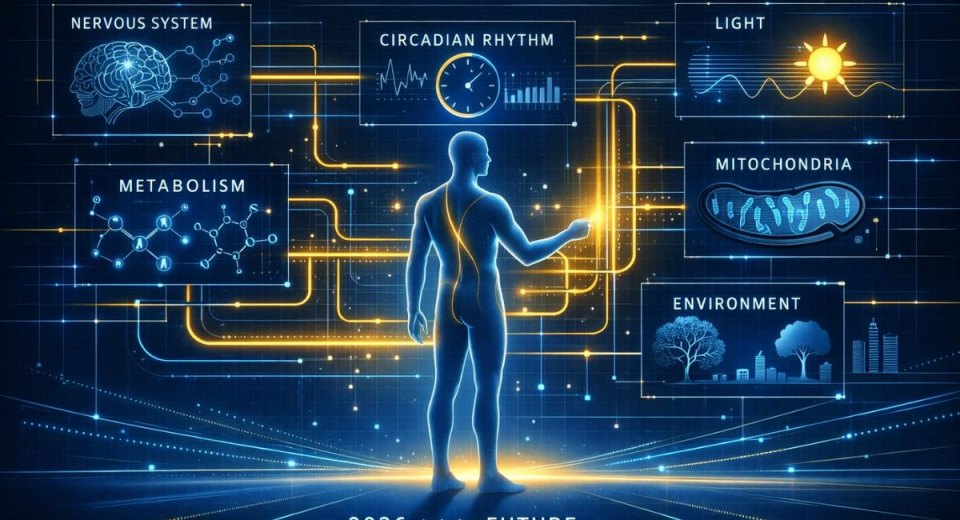
Solo Episode with Nick Urban of Outliyr, Episode 245




What You’ll Learn
- Track trends with systems thinking: Nick distinguishes moonshot predictions (3-10 years out) from incremental improvements that compound year-over-year. Both matter, but leverage points beat surface hacks. [1:23]
- Wearables shift from passive to active: Tracking-only devices are dead. The 2026 trend is sensors that also nudge state: vagus nerve stimulators, sleep regulation beds, and biofeedback wearables. [2:29]
- Water & air are the most overlooked inputs: 99% of molecules in your body are water. The quality of water and indoor air is a bigger lever than 90% of the supplements biohackers are chasing. [5:39]
- Multi-sensor intelligence & digital twins: Single-metric tracking is obsolete. Combining glucose, HRV, sleep, and movement data into a digital twin lets you simulate outcomes before you change anything. [9:17]
- Mental fitness is the new physical fitness: Public perception of mental fitness training is where physical fitness was in the 1970s. Breathwork, biofeedback, and nervous system training become mainstream. [12:32]
- Recovery becomes a social event: Sauna ceremonies, group breathwork, eventized cold plunges. Nick predicts recovery emerges as a social/community layer, not just a private protocol. [21:02]
- Light therapy goes full-spectrum: 2026’s trend: moving beyond red light panels into full-spectrum signaling tools that replicate more of sunlight’s information content. [25:00]
- Peptides become more accessible: Oral delivery improvements and regulatory clarity push peptides from injectable-only into broader use, responsibly. [27:00]
- Women’s health gets precision tools: Cycle tracking becomes hormone profiling becomes personalized protocol design. The biggest under-researched area gets its decade. [29:00]
Why It Matters
Every January, predictions flood the health optimization space. Most are hype. In this solo episode, Nick Urban cuts through to the specific trends already surfacing in 2026 that have real leverage: active-regulation wearables replacing passive trackers, water and air quality as the overlooked foundational inputs, multi-sensor intelligence and digital twins, mental fitness becoming mainstream, and recovery evolving into a social event. This is the biohacker’s roadmap for where to focus attention and where to stop.
Who Should Listen
- Biohackers planning their 2026 experimentation budget who want to focus on leverage points instead of chasing every shiny new gadget.
- Anyone who has a drawer full of wearables but feels tracked-to-death without a clear intervention layer.
- Health coaches, content creators, and product builders who need to know where the market is heading this year.
The 2026 Biohacking Trends Worth Your Attention
On the High Performance Longevity podcast, Nick Urban delivers a solo rundown of the trends already surfacing in early 2026 that have real compounding leverage. This isn’t speculation about a decade out. It’s the incremental upgrades that matter now, identified by the framework Nick uses to evaluate every biohacking wave that sweeps through the space.
The episode covers 9 trends in total: the shift from passive wearables to active regulation devices (Apollo Neuro, vagus nerve stimulators, Eight Sleep), why water and air rank ahead of most supplements, the digital twin concept applied to personal biology, multi-sensor continuous monitoring replacing single-metric tracking, mental fitness moving from fringe to mainstream, recovery as a social event, full-spectrum light therapy advancing beyond red panels, peptide accessibility improvements, and the start of women’s health’s well-deserved decade of precision research.
Nick also names specific products to watch (with affiliate codes where applicable), the 6-trend framework for evaluating what’s noise versus signal, and the questions to ask before adding anything new to your stack in 2026.
Key Terms Quick Reference
Specialized terms surface throughout this conversation. Here’s a quick reference.
[1:23] Systems Thinking for Trends: Nick’s framework for evaluating health trends. Distinguishes moonshot predictions (3 to 10 years) from incremental gains that compound year-over-year. Both matter, but leverage points beat surface hacks.
[2:29] Active Regulation Wearables: Devices that both measure and modulate state. Distinct from passive trackers that only collect data. Includes Apollo Neuro, Muse Athena, vagus nerve stimulators, and active sleep systems like Eight Sleep.
[7:30] Remineralized Water: Water that has had minerals added back after filtration (especially reverse osmosis). Prevents the trace-mineral depletion that demineralized water can cause when consumed long term.
[9:17] Digital Twin: A connected digital copy of a system or biological entity that stays in sync with its real-world counterpart. Applied to humans, it lets you simulate an intervention’s likely outcome before actually trying it.
[10:30] Multi-Sensor Intelligence: The combination of continuous signals (glucose, HRV, sleep, activity, hormones) into a unified model that’s actionable, versus watching each metric in isolation.
[12:32] Mental Fitness: Treating attention, emotional regulation, and stress adaptability like physical conditioning. Requires deliberate training, progressive overload, and recovery just as physical fitness does.
[21:02] Social Recovery: Nick’s 2026 prediction: recovery protocols (sauna, breathwork, cold exposure) become communal events rather than solo practices. Sauna ceremonies, group breathwork, eventized cold plunges.
[27:00] Oral Peptide Delivery: The shift of previously-injectable peptides (BPC-157, KPV, lorazotide) into orally bioavailable forms like BPC-157 arginate. Makes peptide therapy more accessible responsibly.
Why Passive Tracking Is Dead & Active Regulation Wins
The short answer
The first generation of wearables collected data and left you to make the changes yourself. It fails on 3 fronts: you have to check the data, interpret it, then change your behavior. The 2026 generation closes the loop by regulating state directly through the device.
What Nick tracked
Apollo Neuro vibrates in specific frequencies that shift the autonomic nervous system toward calm or focus. Vagus nerve stimulators deliver gentle electrical pulses behind the ear to trigger parasympathetic response. Muse Athena uses EEG to reward meditative brain states in real time. Eight Sleep modulates mattress temperature throughout the night based on your sleep stages. None of these require you to look at data to benefit. The device does the regulation.
What to do about it
Audit your wearable drawer. If a device only tracks without regulating, evaluate whether the data actually changes your behavior. If not, consider replacing it with an active-regulation alternative. The behavioral friction is where most biohacking fails.
“It would collect data passively and then display it for you. Then it was up to you to actually make the changes. That’s helpful, but it fails on several fronts. First, you have to actually check the data. Then interpret it. And the most cumbersome part is make those lifestyle changes yourself.” – Nick Urban
Related: Muse Athena Review
Why Water & Air Are Your Biggest Hidden Levers
The short answer
99% of the molecules in your body are water. The air you breathe cycles through your lungs thousands of times a day. Both are under-optimized in most biohacking stacks while people chase supplements that account for a fraction of the biological load.
What Nick tracked
Tap water contains chlorine, fluoride, microplastics, pharmaceutical residues, and trace contaminants. Reverse osmosis filters remove most but also strip minerals, which is why remineralization matters. Indoor air adds another layer: PM2.5 from cooking, off-gassing from furniture, mycotoxins from hidden mold, and CO2 buildup that directly impairs cognition. Air filtration and mold-aware sourcing of materials are growing biohacks that hit above their perceived weight.
What to do about it
Install a reverse osmosis filter with a remineralization stage, or add mineral drops to RO water. Add a HEPA air filter to your primary living and sleeping spaces. Check your home for mold with a simple moisture meter and test kit. These are 3 one-time decisions that compound every day for years.
“Two of the most important biological inputs we’re all getting every single day that fly under the radar are not food, but water and the air we inhale. Over 99% of the molecules in your body are water.” – Nick Urban
Mental Fitness Becomes the New Physical Fitness
The short answer
The idea of working out for fun and health is barely a century old. In 2026, mental fitness (attention, emotional regulation, stress adaptability) enters the same curve. Nick sees it hitting mainstream the way physical fitness did in the 1970s.
What Nick tracked
Breathwork, biofeedback, neurofeedback, cognitive challenges, and nervous system training are all migrating from fringe biohacking into everyday wellness routines. Consumer devices like Muse Athena make EEG-based meditation trackable. Apps like Othership and Breathwrk scale guided breathwork. Clinical tools are entering the home (vagus nerve stimulators, HRV wearables). The category will have the same look in 5 years that gym culture has today.
What to do about it
Pick one mental fitness anchor to commit to for 90 days. Nick’s top picks: daily breathwork (5 to 10 minutes), weekly neurofeedback session, or a regular 5-minute mindfulness window. Layer in one active-regulation device if budget permits. Recovery (sleep, sauna, breathwork) is the multiplier that makes the training stick.
“The pop culture idea of engaging in fitness for fun and for health purposes is actually fairly new. We’ll see mental fitness follow the same curve over the next decade.” – Nick Urban
Related: The Neuro-Energetic Loop Framework
The Urban 2026 Biohacking Priority Stack
Nick’s order of operations for actually moving the needle in 2026. Start at step 1 and don’t skip. Each layer unlocks the next.
- Fix foundational inputs first: Water filtered and remineralized, air filtered, mold audited. These compound every day for years from a one-time decision.
- Upgrade wearables from tracking to regulating: Apollo Neuro, Muse Athena, vagus nerve stimulator, Eight Sleep. If a device doesn’t change your state, replace it.
- Add continuous multi-sensor tracking: CGM, HRV wearable, sleep tracker. Look for patterns across metrics, not single-number obsession.
- Train mental fitness daily: Breathwork, biofeedback, cognitive challenges, meditation. Treat it like workouts: progression + recovery.
- Normalize recovery as a social event: Sauna ceremonies, breathwork groups, cold plunge gatherings. Community compounds the practice.
- Layer in peptides carefully: Start with oral BPC-157 arginate for gut work. Work with a practitioner for injectables if you’re going deeper.
- Track what actually moves numbers: Tag every intervention against your neural or HRV data. Drop what doesn’t produce measurable change after 30 days.
Common 2026 biohacking mistakes
- Chasing moonshot trends (3 to 10 year predictions) while neglecting incremental gains that compound now.
- Stacking wearables without interventions. Data without action is just data fatigue.
- Obsessing over a single metric (HRV, sleep score, glucose) without the context of the others.
Source: Urban’s 2026 Trend Framework, Outliyr
Frequently Asked Questions
What’s the difference between a moonshot trend & an incremental trend?
Moonshot trends are 3 to 10 year predictions. Incremental trends compound year over year. Nick’s framework: both matter, but for your 2026 planning focus on incremental upgrades that have already started showing up.
Which wearables count as active regulation?
Apollo Neuro (autonomic nervous system vibrations), Muse Athena (EEG-based meditation rewards), vagus nerve stimulators (electrical pulses behind the ear), Eight Sleep (mattress temperature modulation). Active means the device changes your state, not just measures it.
Why does water remineralization matter?
Reverse osmosis filtration removes contaminants but also minerals. Long-term consumption of demineralized water can deplete trace minerals. Add a remineralization stage to your filter or add mineral drops to the output water.
What is a digital twin in the biohacking context?
A connected digital copy of you that stays in sync with your real biology through sensor data. Applied to health, it lets you simulate the likely outcome of an intervention before actually doing it.
Is mental fitness really becoming mainstream?
Nick’s prediction: yes, in 5 to 10 years it’ll look the way physical fitness does now. Consumer devices like Muse Athena, apps like Othership and Breathwrk, clinical tools entering the home, and neurofeedback practices are all moving the category forward in 2026.
What’s "social recovery" as a trend?
The shift from private recovery protocols (solo sauna, solo breathwork) to community-based versions: sauna ceremonies, group breathwork classes, eventized cold plunges. Nick predicts this becomes a defining 2026 cultural trend, especially in places like Austin.
Are oral peptides actually as effective as injections?
For gut-focused work like BPC-157 arginate, yes, oral delivery works well because the peptide acts on the GI tract first. For distal injuries or systemic effects, injection near the injury site still outperforms oral. The 2026 trend is the expansion of what’s possible orally.
What should a biohacker cut from their stack for 2026?
Nick’s advice: cut any wearable that only tracks without changing behavior, any supplement you can’t show a measurable effect from in 4 weeks of tagged tracking, and any protocol you’re following because of social pressure rather than personal evidence.
How should I evaluate a new biohack before buying?
Apply Nick’s framework: is this a moonshot or an incremental gain? Does it address a foundational input (water, air, sleep, mental fitness) or a fringe metric? Does it produce measurable change within 30 days? If not, skip it.
Products, Tools, & Resources Mentioned
Outliyr independently evaluates all recommendations. We may get a small commission if you buy through our links (at no cost to you). Thanks for your support!
Active regulation wearables
Apollo Neuro: Autonomic nervous system modulation through touch vibrations. Code URBAN saves $60.
Eight Sleep: Temperature-modulating mattress that adjusts through the night based on sleep stages.
Muse Athena: EEG-based meditation headband with real-time feedback. Code URBAN saves 15%.
Vagus Nerve Stimulation Device: Hoolest VeRelief for quick parasympathetic activation. Code OUTLIYR10 saves 10%.
Foundational inputs
AquaTru Water Filter: Reverse osmosis countertop filtration system. Code URBAN saves 10%.
Nutrisense CGM: Continuous glucose monitor with coaching support. Code URBAN saves $25.
Related Outliyr articles & guides
The Neuro-Energetic Loop Framework: Nick’s model for understanding how energy, behavior, and biology interact.
Hoolest VeRelief Prime Review: Deep-dive review of the vagus nerve stimulator Nick uses daily.
Muse Athena Review: Full review of the EEG meditation headband.
Light Therapy Dosing Guide: How to dose red, near-infrared, and full-spectrum light therapy for specific outcomes.
Biohack Your Diet: Outliyr’s full diet optimization content library.
Best Therapeutic Peptides Alternatives 2026: Guide to the peptide landscape including BPC-157, GHK-Cu, Retatrutide, and more.
Latest Health Optimization Events: Upcoming biohacking summits, conferences, and masterclasses.
Peptide Mastery Cheat Sheet: Free downloadable reference for common therapeutic peptides.
About Your Host
Nick Urban is a BioHarmonizer, athlete, and founder of Outliyr.com, as well as the host of the High Performance Longevity podcast (formerly Mind Body Peak Performance). A CHEK Holistic Lifestyle Coach Level 2 and School of Biohacking Instructor, he bridges the gap between ancient medical systems like Ayurveda and Traditional Chinese Medicine and cutting-edge modern science. Nick is dedicated to distilling the wisdom of the world’s top performers into practical strategies, helping others transition from merely surviving to truly thriving.
Related Episodes & Articles
- Episode 224: Nervous System Connection & the Longevity Framework
- Episode 234: How AI, Genetics & Prevention Are Transforming Longevity Medicine
- Episode 240: Quantum Biology & Circadian Rhythm for Better Sleep & Energy
- Episode 243: Improve Gut Health to Protect Your Brain, Metabolism & Longevity
- Episode 244: How Reaction Time Supports Brain Performance & Clarity
- Article: Best Therapeutic Peptides Alternatives 2026
- Article: Hoolest VeRelief Prime Review
- Article: Full-Spectrum Infrared Sauna Benefits
Music by Alexander Tomashevsky
Full Episode Transcript
Nick Urban [00:00:01]:
You’re listening to High Performance Longevity, the show exploring a better path to optimal health for those daring to live as an outlier in a world of averages. I’m your host Nick Urban, bioharmonizer, performance coach, and lifelong student of both modern science and ancestral wisdom. Each week we decode the tools, tactics and timeless principles to help you optimize your mind, body and and performance span things you won’t find on Google or in your AI tool of choice. From cutting edge biohacks to grounded lifestyle practices, you’ll walk away with actionable insights to look, feel and perform at your best across all of life’s domains. Hello and welcome to the podcast. I’m your host Nick Urban and I hope your 2026 is off to an incredible start so far. Wherever you are tuning in from in the world today, we’re going to take a brief departure in this episode from the usual programming where I host and interview guests on this podcast to discuss some of the trends that I’ve seen come across my desk and that I’ve started seeing echoed on social media and in the medical research these days. I started compiling this list back in December.
Nick Urban [00:01:23]:
It is now currently late January, and some of these trends have already started surfacing. Now a quick note on these trends. Specifically, I could either go for the moonshots and tell you what I think is going to happen in 3, 5, 10 years time, or tell you about the things that have incrementally improved year after year, which will obviously continue in 2026 and again next year. Both are important. Both provide different value, so so I figured I would mix and match a little of each in this episode and if you have any comments you agree you disagree, I’d love to hear from you. Drop a comment below and let me know your thoughts on what the 2026 Biohacking, longevity, performance and overall health optimization trends will be. Okay, with that out of the way, let’s dive right into trend number one and that is the emergence and growth of the active wearable market. Most wearables started out as devices that would tell you your data, in hindsight how well you slept the previous night.
Nick Urban [00:02:29]:
It would collect it passively and then display it for you. And then it was up to you to actually make the changes to improve your health and performance. That’s helpful, but it fails on several fronts. First of all, you have to be able to actually go in and check the data. Then you must interpret the data. And the most cumbersome part is you have to make those lifestyle changes yourself. Then came along the idea of wearables, 3.0 or active wearables. Instead of merely passively telling you what’s going on in your body, these intervene and actually do things to help modulate, to help change your state.
Nick Urban [00:03:07]:
Now that might seem a little bit abstract in and I don’t like to just go off theory alone, so I’ll give you some real life examples. I’m currently wearing a device called the Apollo Neuro. You simply put it on and then load the app and choose a state that you want to be. Perhaps energy to replace that morning cup of coffee, focus to get more work done, meditation to deepen the experience, sleep to deepen your sleep or recovery after workout. A lot of different states. But instead of merely telling you what’s going on with your nervous system, this wearable helps shift your state towards that goal. Other examples might be a smart mattress, A mattress topper that cools your body temperature to a level that will either support REM sleep or deep sleep. It doesn’t just track your sleep, but actually based on your patterns, helps you reach and maintain deeper levels of sleep.
Nick Urban [00:04:01]:
There are several different companies that create these. There’s one called the Bedjet, which is good and affordable. And there’s another called 8Slee, I personally have that dynamically adjust your sleeping experience to help you get more return on your time in bed. Another device that has active wearable technology built into it is the Muse Athena headband. Now that’s a neurofeedback device that uses EEG sensors When you wear it to sleep. There is a special mode called digital sleeping pill that plays special frequencies while you’re sleeping. The band is reading your brain waves using EEG technology to help you fall back asleep and hopefully stay asleep. Another example would be vagus nerve stimulators.
Nick Urban [00:04:45]:
These are devices you put on your vagus nerve and it provides a small amount of stimulation which can help with recovery and balance of your overall nervous system. They don’t just measure your heart rate variability, they actively help you optimize it or other parameters that you might want to focus on instead. One of the ones I use is called Coolit Vrelief, I think. And they have different modes for panic, one for performance, one for stress and unwinding. And these deliver different signals via the vagus nerve like the other technologies actually shift your biology. So in 2026 and beyond, I think we will start to see more wearables that are providing more than just your passive data that’s being collected. They’re still collecting that data. A Lot of times, but then they’re actually utilizing it to give you a better experience without you having to expend additional effort.
Nick Urban [00:05:39]:
Number two, this is one of the most important, or really two of the most important biological inputs that we’re all getting every single day that fly under the radar for the most part, not food, but water and the air that we inhale. You probably know that the body is mostly water, and if you go by the molecular count, over 99% of the molecules in your body are water. It’s the interaction of that water with the non water molecules that is the basis of life. And it is one of the uncharted and little explored facets of human biology. Then there’s the other side of the equation, and that is air. We each breathe thousands of breaths every single day. The quality of that air matters. There are things like particulate matter, PM2,5, mycotoxins, endocrine disrupting chemicals, all kinds of stuff in the air, and that alone can cause biological shifts.
Nick Urban [00:06:40]:
The air itself is one of those overlooked factors that can silently bring your health up or down. Simply installing a high quality air filter in their bedroom can dramatically improve the symptoms of those conditions as well as their sleep and recovery scores. Things like how long it takes them to fall asleep, the number of times they wake up throughout the night, their minimum resting heart rate, their heart rate variability. Simply changing the air or cleaning the air can improve each of those and many others. That alone has become clear from all of the unfortunate natural disasters that have stricken different parts of the world over the last couple years. Wildfire, smoke and exposure to the chemicals in unhealthy air don’t just increase risk of long term disease, but also have midterm effects and even immediate effects such as decreasing cognition and increasing stress load. On the air side, the place I recommend starting, if you have a whole home filtration system or H Vac, if you use air conditioning or heat to get high quality filters that are rated for whatever system you have in your house or apartment, and to change those regularly. Before I got some fancy flashy air purifier or air scrubber, I would focus there because it’s much less expensive and has a very high return on that investment from there.
Nick Urban [00:08:05]:
Once you do that, then I would look at the air scrubber. The one I use is called Jasper and I would put that in the area where you sleep because that’s when you’re in the deepest state of recovery and it’ll make the biggest difference. On the water side, if you have access To a high quality contaminant, free or very low contaminant stream, a natural stream, that will be best because you’ll get things that you won’t get when the water has gone through miles and miles of corroded piping and been treated with a bunch of harsh chemicals. But certainly verify that it’s an uncontaminated source. If you don’t have that or you don’t want to go out of your way to gather that, the next best is to get something like a reverse osmosis system and to use that and then add back in minerals to replete the water that’s been stripped of everything or next to everything. Yes, water is not the best source of minerals to begin with, but water that’s been stripped of everything inside of it works more aggressively. And when you expose it to other things such as plastic, so you put it in a plastic bottle. Hopefully you don’t, but if you were to, then you’d leach more microplastics from the plastic bottle.
Nick Urban [00:09:17]:
So in general it’s better to remineralize reverse osmosis or heavily filtered water in general if the minerals and other substances have been all pulled out of it. We’ve got a lot to go through today, so I’m going to make these next ones a bit faster. This next one is the concept of digital twins. A digital twin is a copy of a real world object, system, process or human that stays connected to it using data. The digital version updates as the real one changes so that you can monitor, simulate and most importantly predict behavior without ever touching or modifying the physical version. And then I can model what would this behavior look like if I do it every single day for 10 years? If I picked up a drinking habit, I had that so called healthy glass of wine every single night, what would that do to me? Specifically? The digital twin would make that clear. So it’s a way of personalizing interventions across any domain and seeing what they do in the short, mid and long term. It sounds a bit sci fi, but it’s actually already used for healthcare, for some smart cities, in the automotive and aerospace industries, for building and industry and manufacturing.
Nick Urban [00:10:41]:
It’s used in a lot of different sectors already. The improvements in AI and technology will soon make this accessible to the average person without a massive budget. What I find most interesting about this is it helps us take the hypotheses, the latest findings of research papers, and go from that abstract theory behind them into direct behavior change and a good source of motivation. Okay, after that one we have the Rise of multi sensor continuous monitoring. You might have heard of continuous glucose monitors. They started becoming popular in the biohacking world in about 2017, 2018, as non diabetics got their hands on them and started using them to understand how their body responds uniquely to different foods and food combinations and lifestyle habits. There were just three main issues with them. First of all, they were fairly expensive when they were introduced.
Nick Urban [00:11:43]:
The cost has now gone down significantly, so that’s less of a barrier. They also only measured blood glucose specifically. Well, technically interstitial glucose, but essentially blood glucose. And that would cause you to over index on your glucose response to meals and lifestyle interventions. Glucose is one piece of the pie, but there’s a lot more to health than just blood sugar. The reason this is a trend now is that they’re able to incorporate data from multiple different sensor types and overlay it all into one. So instead of just seeing your blood sugar on a graph, you can see a graph that contains other things like your blood ketone levels. And soon there will probably be blood insulin monitors and perhaps down the line, blood testosterone and other hormone monitors as well.
Nick Urban [00:12:32]:
When you have multiple continuous sensors, you get a much better, cleaner, clear and more actionable picture of what’s going on. So these continuous monitoring technologies are only getting more useful over time. After that, we have the concept of mental fitness. The pop culture idea of engaging in fitness for fun and for health purposes is actually fairly new. Of course, the roots of it go way back to the ancient Egyptian and ancient Greek days. But then modern gym culture really only began in the 20th century, and now it’s generally recognized as a crucial staple in any health and wellness program. So how does this relate? Well, in the 21st century, now the idea of mental fitness is becoming the correlate of physical fitness. As we’re inundated by more algorithms, more short form viral content, everything in the world becomes faster and more fragmented, and the threat of AI looms ever larger.
Nick Urban [00:13:34]:
There’s now increasing interest in the whole concept of mental fitness. How can you train your cognition, your attention, your emotional regulation, and Overall resilience? Beyond 2026, mental fitness will become as normalized as cardio has become for physical fitness. There are lots of ways to train mental fitness, including something as simple as meditation, which I’ve also heard referred to as the bicep curl of the brain, other forms of biofeedback, and even things like doing challenging mental tasks that require complete focus. After that, we have a topic that has taken the world by storm over the last few years. And that is the concept of photo biomodulation, or to make it simple, light therapy, but not just any light therapy, multi wavelength light therapy. Until about 2024, manufacturers of light therapy panels were relying specifically on only a few different bands of light. These are called light wavelengths. And specifically we’re talking red light at about 60 nanometers, but really ranging from 30 to 660 nanometers, and most commonly at 30 nanometers and 50 nanometers.
Nick Urban [00:14:56]:
That’s the way it used to be. And there’s emerging research and scientists speculating that increasing the range, getting more different parts of the spectrum in the panels will provide more therapeutic benefits than having just very narrow windows of isolated light where you used to see two, maybe three maximum different light wavelengths in one panel. Now the higher end panels often have 4, 5, sometimes even 6 different wavelengths all in one device. Anyone with one of these, a light spectrometer, will tell you that natural sunlight has a lot more than just one or two or even three isolated wavelengths. It seems likely that recreating that as close as possible and even allowing users to dynamically change the wavelengths that the device is emitting will cause the greatest benefits. I envision. Devices of the future will let you dynamically adjust the program so you can dial up the red light in the morning. You can dial down the blue light at certain times.
Nick Urban [00:16:02]:
You could even add a little bit of UVB and UVA to get extra nitric oxide release and to stimulate the production of vitamin D. Or perhaps you want to blast yourself with blue light in the morning. Now, it’s often villainized as a really bad wavelength of light that has all kinds of detrimental health effects in isolation. But blue light is also important to entrain circadian rhythm. It’s important for a proper morning cortisol response. It’s all about context. So the light therapy devices of the future will have more context built into them and let you mimic different parts of the sun that you want to chase. Particular benefits.
Nick Urban [00:16:42]:
Okay, moving on. There is widespread concern that therapeutic peptides will become inaccessible due to products like Ozempic, Manjaro, and now Retatrutide. There’s been an explosion in research around these and specifically novel delivery mechanisms, unique formulations, and small molecules. In 2025, I saw certain companies selling these peptides in forms such as your traditional oral capsule, of course, the injectable, but then the transdermal nasal spray, and even peptide strips that you can theoretically put on your tongue and let them dissolve. Some of these technologies are still in their infancy, but they will only continue to grow as the injectables become harder to procure. I also foresee peptide mimetics or other molecules that are like the classic peptides becoming a thing. There are a couple currently in development, but it’s a little bit too new to talk much about, although if things go the way they might, you’ll be hearing more about those. Probably not much this year, but perhaps next year.
Nick Urban [00:17:46]:
Okay, on to the topic that is the most divisive, that is diet. When I was preparing this back in December, it seemed clear that there would be some reforms to the food system. Whether you love or hate the current administration, just recently, a couple weeks ago, they did release the updated food pyramid. So the government recommendations on what you should eat and how much have been modified, and this administration seems likely to continue along that path and to increase the regulations around ultra processed foods. Even just the name ultra processed has sparked debate in the scientific community about what qualifies as ultra processed versus normal processed. The current administration seems to be targeting particularly hyper palatable food engineering. So in case you aren’t aware, the big food companies have entire teams tasked with finding the most profitable combinations of food ingredients to keep you hooked on their product because economically it makes the most sense. That’s why some of their marketing will brazenly tell you you can’t have just one because it’s that addictive.
Nick Urban [00:18:58]:
It’s literally biochemically addictive. That type of thing seems to be under fire currently in the name of metabolic hell. A simple way of thinking of metabolism, how effectively your body’s able to take the inputs such as food and drink and turn that into biological substrates, energy, ATP and others. The goal in this regulation is to reduce the incidence of metabolic disease, which could also reduce the incidence of related conditions such as type 2 diabetes. If you read any of the media tabloids in 2025 related to diet, you probably came across the viral topic of the sugar diet. And that is another diet that doesn’t really have an accepted universal definition, aside from the fact that it’s a low protein, low fat diet and ultra high carbohydrate, like simple carbohydrates. So that one broke about every rule in every nutrition textbook. But something strange happened.
Nick Urban [00:20:01]:
People lost weight, they became more insulin sensitive, which isn’t supposed to happen, and they had other benefits when they ran the sugar diet, at least in the short and medium term. Many sugar dieters also reported improved performance in the gym. This is all hypothesized to be through the action of something called FGF21. Now, the details of that Alphabet soup aren’t all that important. What is interesting about this is that scientists look at the mechanism that this diet targets and then they started wondering, can we design things that will target this same mechanism? Sure enough, there are now substances that activate FGF21 called FGF21 agonists that are showing potential to improve liver fat, triglycerides, insulin resistance and cardiovascular disease risk. Personally, I do not advocate the sugar diet. Proceed at your own risk there. Now we’ve got some of the trends that sit more on the social side of things than technological breakthroughs.
Nick Urban [00:21:02]:
We’ll start with one that I’m pretty excited about, and that is the idea of recovery becoming something that people now gather around as a social event. Perhaps it’s just because I live in Austin and there’s an abundance of alternative health and wellness related stuff here, but I’ve noticed more and more sauna ceremonies, guided recovery sessions, group breathwork practices, and eventized hot cold contrast therapy. Part of the club and night scene here has been replaced by massive gatherings of 100 plus people all coming together to do a bunch of rounds of breathwork, sauna, ice bath and hanging out. And they’re kind of fun. A lot of the technologies in biohacking are less about performance and more about recovery because recovery is the root of performance and the root of health. You look at a lot of the top professionals across sports, business, people in the military, and recovery becomes a huge topic. In fact, there are some gyms here that will use AI to personalize workouts with adaptive resistance for about 10 minutes, maybe 12 minutes of total work time. And then they’ll spend the next 20 minutes or so, 25 minutes, prioritizing post workout recovery.
Nick Urban [00:22:24]:
It’s not the session itself that’s causing the muscle growth, it’s the recovery, repair and regeneration that occur afterward. In fact, some of the other technologies in this very list actually work by improving recovery. From the multi wavelength light panels to improving water and air filtration to sleep to vagus nerve stimulators to neurofeedback and biofeedback to a lot of the popular peptides, many of these are first and foremost recovery tools, and recovery is often the pillar that’s most deficient in people’s lives. Related to recovery is the next trend, and it’s also one that my email newsletter subscribers were recently reading about. When it comes to nervous system health, you’ve probably heard at some point about the autonomic nervous system, which regulates the automatic bodily responses, perhaps the two branches, the sympathetic fight or flight branch, and perhaps also the parasympathetic rest and digest branch, maybe even the third and final branch, the enteric nervous system. What most people don’t realize about the nervous system is that it directs and shapes your life perception. That’s right, your entire experience of life depends on your nervous system more than anything else. It’s the reason why some people watch fireworks and they say it was the highlight of their night.
Nick Urban [00:23:49]:
Conversely, someone else watches those same fireworks and it causes a panic attack. Same stimulus, two totally different responses. Now that’s the extreme example, but it applies equally to the big and small things going on throughout every day. The nervous system also shapes immune responses, inflammation, and stress responses. So if you’ve heard that stress is the root of all disease, stress actually depends on the state of the nervous system. When I reviewed all of the podcast interviews I conducted in 2025, the most common theme across all domains of health was the role the nervous system played in that domain. For example, I interviewed Blair Lacourt of the Prestigious, where they conduct longevity research. And he explained how even simple everyday things, such as when you’re walking down the sidewalk peacefully and you look over and see a car whiz by you, your nervous system, because of the proximity, the speed at which it passes through your field of vision, the size of the car relative to the other things in your surroundings, those all create micro stress responses.
Nick Urban [00:25:01]:
And with those micro stress responses, by necessity your body is deprived of resources that it could be using in better ways elsewhere. So you might not consciously perceive that walking down the sidewalk in a city or even a town with lots of traffic is stressful, but to your subconscious, it is. What makes this worthy of discussion is that the nervous system is also one of the few bodily systems that we have direct access to, we can directly modulate it. In part, that’s why tools such as vagus nerve training, HRV training, vagus nerve stimulation, somatic work, hot cold contrast therapy, breath work, certain forms of meditation have all taken off in popularity. Each of these help train nervous system regulation. When you build nervous system regulation, everything you do in life becomes either easier, more effective, or both. If you’ve seen my article explaining the framework that I call the neuro energetic loop, the very first stage of that is state. It’s the baseline orientation of your nervous system.
Nick Urban [00:26:11]:
You want to break a habit, start there. Issues with sleep, anxiety, burnout, low energy, lack of happiness. Nervous system orientation is the perfect place to start. And there are simple regulation practices that make it a lot easier. So if you take away nothing else but this from this podcast, work on your nervous system first and foremost, and everything else is more likely to fall into place easier. Next one is Women’s health optimization is finally getting recognition. It’s getting the seat at the table that it’s long since deserved. It’s tragic that women were excluded from scientific research for so long and that many of the recommendations, the dosing, the protocols, the adverse effects were modeled on primarily males.
Nick Urban [00:27:01]:
So there are a lot of black boxes out there around how these same interventions impact male and female physiology differently. Luckily, that’s now finally starting to change, and the tech ecosystem around women’s health tools and platforms and technologies is growing very rapidly. The market is finally experiencing a correction and all of this will translate into better, more consistent, more reliable health optimization information for women. So topics like infradian rhythms, different biological cycles, hormonal and neuroendocrine changes will become better understood in 2026 and beyond. Another change that has been steadily growing over time is the emergence of travel. Not for a booze filled pina coladas on the beach type of experience, and instead more of a structured bio optimization immersion experience. The idea of going abroad overseas to get different medical interventions that either are not available or cost prohibitive in the US has existed for a while, but it’s now becoming more accessible and less reactionary. People are going abroad for biological resets, for physiological training, for recovery intensives, and for comprehensive, thorough diagnostics.
Nick Urban [00:28:30]:
It’s still tourism, it’s still a vacation, although the definition of that has changed. This side of experience optimization is also growing very rapidly because it’s part of a cultural shift, moving from health and wellness being a solo endeavor, to a more structured thing that is universally recognized as important. Important instead of piecing together different tools and tactics and protocols from information sources as you compile them that may or may not conflict with the things that you’re already doing. The new paradigm is combining baseline diagnostics with interventions and then the layer on top of that being modeling and iterating. That way you’re optimizing at the system level versus trying to focus on one particular part of that and doing things that may or may not work out the way you expect. When you take the systems level optimization approach, you find the redundancies, you find what has the entourage effect, where the things that you do complement each other and work better together than they would individually. And you also make sure you’re moving towards the right endpoints, you’re going towards the right goals and that your lifestyle, your routine, your stacks, they don’t get too bloated with things that cost you time, energy, resources, and don’t provide a very large return on those. There are now a number of startups working on this because the technology is much more accessible than it has ever been before.
Nick Urban [00:30:09]:
Simply put, better decisions, better life. Okay, that’s all I’ve got for you today. Thank you so much for tuning in and spending your time and your energy with me and making me a part of your day. I don’t take this lightly. I’m also curious your thoughts on these trends. There are a lot of smart people in this community, so if I’m missing anything or you disagree, I want to hear from you. Go ahead and leave a comment below this video or if you’re tuning into the audio version of this, you can find the comments on the YouTube version of this podcast. Until next time, Be an Outlier thanks for tuning in to high performance longevity.
Nick Urban [00:30:46]:
If you got value today, the best way to support the show is to leave a review or share it with someone who’s ready to upgrade their healthspan. You can find all the episodes, show notes and resources mentioned@outlier.com until next time, stay energized, stay bioharmonized, and be an outlier.

Comments