





Episode Highlights
Podcast Sponsor Banner
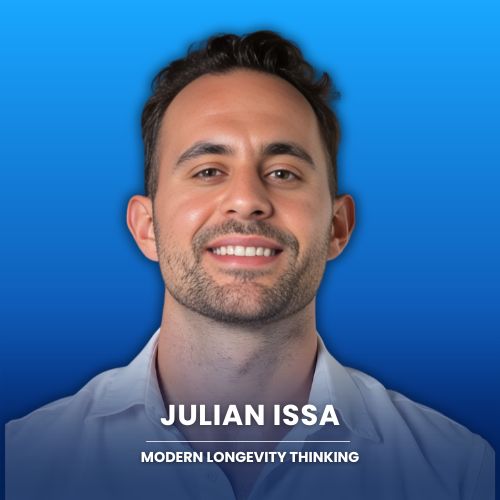
About Julian Issa
Julian Issa is the host of The Beyond Tomorrow Podcast, exploring longevity, mindset & human potential while helping people navigate change with clarity & agency. An exited tech founder, investor & former Newsweek journalist who conducted over 1,500 interviews worldwide, his perspective spans media, business & global leadership. Today, he is a sought-after moderator & speaker at major longevity events, driven by a mission of human flourishing for all.
Top Things You’ll Learn From Julian Issa
[01:23] Build Longevity On Community, Purpose & Bioharmony
- Prioritize connection gratitude & meaning over supplements
- Shift from extreme biohacking toward ancestral basics
- Recognize community as a top predictor of lifespan
- Cultivate purpose as a daily driver of resilience
- Balance ambition with alignment instead of chasing escape velocity
[02:45] Master Fundamentals Before Chasing Advanced Therapies
- Optimize sleep resistance training VO2 max & balance
- Personalize diet instead of following carnivore vs vegan dogma
- Rotate foods seasonally & monitor individual response
- Track recovery stress & lifestyle inputs consistently
- View peptides stem cells & gene therapies as secondary layers
[07:55] Personalize Every Domain Of Health
- Match sleep duration to genetic & nervous system needs
- Train according to fiber type endurance vs explosive bias
- Adjust nutrition based on feedback instead of ideology
- Combine data with intuition for decision making
- Reject one size fits all longevity blueprints
[08:35] Use Data Wisely Without Outsourcing Self-Awareness
- Establish personal baselines before interpreting trends
- Compare intra individual change instead of population averages
- Pair wearables with subjective biofeedback
- Recognize limits of research funding bias & evolving science
- Favor practitioners who contextualize data for you
[15:14] Transform Suffering Into Agency & Growth
- Reframe trauma as catalyst for purpose
- Replace victim narratives with responsibility & choice
- Build spiritual grounding alongside practical discipline
- Regulate the nervous system through nature breath & ritual
- Hold both surrender & action in tension
[44:14] Redefine Performance, Success & Experimentation
- Question tying self worth to productivity
- Balance high performance with self kindness
- Experiment cautiously based on risk tolerance
- Test IHHT plant medicines or therapies deliberately
- Evaluate rapamycin metformin or novel tools carefully
- Prioritize diagnostics prevention & long term trends
- Anchor life around family friendship & shared meals
Resources Mentioned
- Article: Best Home Neurofeedback Devices
- Article: Best Magnesium Supplements
- Article: How to Increase Your Stem Cells Naturally: Supplements, Foods, & Biohacks
- Article: Best Epigenetic Age Tests
- Article: Is Gene Editing Safe & Worth It? Decoding Follistatin & Klotho Gene Therapies
- Product: Curcumin (save 15%)
Related Episodes
- Episode 233: Stem Cells & Longevity: How to Rebuild Your Body from the Inside Out With Dr. Dan Pardi
- Episode 228: 20x Oxygen: How Hyperbaric Therapy Supercharges Healing & Longevity With Dr. Jason Sonners
- Episode 224: 10X Your Longevity Strategy by Saying NO to Over-Optimization With Blair LaCorte
- Episode 221: Inside The Revolutionary Epigenetic Cellular Health Test With Ryan Smith
- Episode 220: 5 Longevity Drivers That Actually Increase Lifespan by 500% With Dr. Zain Hakeem
- Episode 214: Take Charge of Your Healthspan With This Regeneration Protocol: Shockwave, Stem Cell, Ketamine Therapy, Peptides & Advanced Biologics With Dr. Khoshal Latifzai
- Episode 175: Use Younger Cells to Heal Your Older Body with Regenerative Medicine (Stem Cells, PRP, Exosomes & Prolotherapy) With Dr. Jeff Gross
Episode Transcript
Click here
Nick Urban [00:00:01]:
You’re listening to High Performance Longevity, the show exploring a better path to optimal health for those daring to live as an outlier in a world of averages. I’m your host, Nick Urban, bioharmonizer, performance coach, and lifelong student of both modern science and ancestral wisdom. Each week we decode the tools, tactics, and timeless principles to help you optimize your mind, body, and performance span, things you won’t find on Google or in your AI tool of choice. From cutting-edge biohacks to grounded lifestyle practices, you’ll walk away with actionable insights to look, feel, and perform at your best across all of life’s domains. Julian, welcome to the podcast.
Julian Issa [00:00:52]:
Hey, it’s a pleasure to be here. Really excited.
Nick Urban [00:00:54]:
Yeah, I’ve been looking forward to this one since we first met about a month ago, and we’re going to be diving into the world that is your world, that is all things longevity and more. And also, since you are in the epicenter of everything, you understand what’s going on. You have all these conversations with experts across different domains in the field. I’m curious to hear what has you most excited in the longevity world right now, whether it’s a technological breakthrough or it’s a reversion to something old, whatever it is.
Julian Issa [00:01:23]:
Wow, that’s a great question. I think it’s funny, when I came into the longevity space, it was all about biohacking. And optimizing and how can we make these gains. And it’s funny how the needle moves so quickly, right? Like a couple of years ago, it was all about WOOP or all this stuff. And now we’re getting back to this idea of bioharmony. It’s looking at the other things, the important things, the things that we somehow left behind, the importance of community and purpose and togetherness and gratitude and all these amazing things that have held communities and tribes together for millennia, right? And so it’s coming back to the basics. I get it. People want to schlep their products, they want to sell whatever, but the basics are like 90% of it.
Julian Issa [00:02:07]:
Having said that, I am excited by the fact that longevity is really entering the mainstream and not just longevity, but the kind of ideas around longevity, escape velocity in the best sort of way. The idea that we can very soon help all our loved ones to live healthier and happier well into their 90s and 100. I think that’s a key thing. Apart from that, it’s still a bit of a waiting game when it comes to other peptides and stem cells, definitely working for some people. But yeah, it’s in terms of gene therapies and RAPA and all these other things, we need a few more years.
Nick Urban [00:02:45]:
Yeah. So let’s go into some of the things you view as the staples then, because I’m sure some of them will be obvious to everyone who’s listened to anything about health. Some of them might be less obvious, and then why you weight those as being important places to focus if they’re not intuitively obvious.
Julian Issa [00:03:00]:
Yeah. So look, Eric Verdin, CEO, president, whatever his title is at the Buck Institute, but he said the two greatest indicators of long life are purpose and the quality of your community. And so I think from my end, so my heritage, Mediterranean, my parents are Christian Lebanese. And when I look at what’s held those communities together for so long. It’s 100% community, the quality of those connections every single day. I’m sounding like a broken record. I’m sure most of your listeners know this, right? And it’s funny because I know there’s been a few revelations recently about a man who focuses a lot on VO2 max. But I have had an interesting journey with VO2 max because my VO2 max was 51 about a year and a half ago.
Julian Issa [00:03:45]:
And actually now it’s almost embarrassing to say it’s 35. Actually massively dropped. It’s because I’ve been sedentary. I’ve been doing a lot of podcasting and all that and been traveling. I’m interested to see how more data comes out and either prove that’s right or wrong. Because I’m pretty sure my family, I don’t know if any of their VO2 max is higher than mine. And many of them live into their 80s and 90s. And sure, healthspan might be affected by that.
Julian Issa [00:04:12]:
So yeah, quality of your connections and community is so important. And then purpose, yeah, really important. Peter Diamandis, who’s been on my podcast a couple of times, talks a lot about the abundance mindset. And he mentioned to me around optimism, this idea that we can live for 15% longer if we’re optimists as well. So mindset and purpose being in that as well. And then yeah, we get into more of the, what I call Type A longevity metrics. So sleep and exercise and diet and everything. And like, I’m not again a doctor to say this, but For me, I’ll speak anecdotally about my experience with sleep and just how over the last couple of weeks I’ve just started this amazing longevity protocol, getting back on my 7+ hours and just the difference it makes.
Julian Issa [00:04:59]:
Exercise varies, but I would say what I hear from the longevity doctors, it’s variety. It’s variety of resistance training, of VO2 max training as well. And that’s what I’m implementing. And then obviously the, anything that helps with balance and all that. So I do Pilates, hot Pilates and stretching. I’m a former opera singer, so I love all of that. And then of course the final one is diet. And like I’ve had pro carnivores, pro vegan, fiber, etc., the whole gamut on the podcast.
Julian Issa [00:05:32]:
And I’ve just got to say that, you know, end of one, it really pisses me off now that we’re still in this kind of having this, this conversation around whether everyone should be pro-carnivore, everyone should be pro-vegan. For me personally, if I eat too much meat, my inflammation goes through the roof. So it’s okay to be pro-carnivore and realize that maybe it benefits you and it might not benefit others. And again, that’s been validated by the studies. People like William Lee, again, who told me exactly this. Maybe 5, 10, 15% of people will benefit from a, from a pure carnivore diet, but it’s not just saying that that’s going to benefit everyone.
Nick Urban [00:06:07]:
Yeah. There’s also the whole variable, the layer of context, like, okay, yes, this works great for you in the short term, in the moderate term, maybe 6 months, a year. But then after a while, if you continue doing the same thing, the body likes seasonality, it likes changes. As we are in sync with the natural world and across so many different levels, perhaps eventually it stops working as well. And that’s why a lot of people do better when they change their protocols over time. Perhaps you resolve an issue, an underlying infection, whatever it is, and then all of a sudden your needs change.
Julian Issa [00:06:37]:
Yeah, absolutely. It’s the same with like cycling with any sort of peptide as well. It’s like, yeah, but talking about seasonality, this is the time where I really crave good meat, mincemeat, because it’s effing cold in Northern Europe right now.
Nick Urban [00:06:50]:
Yeah. And I’m not sure if you’re aware of this, but a lot of the old medical systems like Ayurveda is the one I’m the most familiar with. They actually advocate personalizing diet to the individual and they look at a bunch of different qualities and characteristics of the person and then they say, okay, based on this, based on the season, based on these different factors, You’re going to do best with these types of things and avoiding these things. And people find in general that when they follow those, they do pretty well.
Julian Issa [00:07:12]:
And again, this is something that’s been— it’s stood the test of time, these traditions for many, many millennia. I love longevity. I love the health space. But it is quite funny how people do package something that has been around for thousands of years and then try and sell it. And, you know, but now nowadays you have a few biohackers, well-known biohackers that all of a sudden are saying, yes, actually the basics are the things that.
Nick Urban [00:07:38]:
You should do well.
Julian Issa [00:07:38]:
Health when they’ve been selling all their products and all that for the last couple of years. But I get it, you know, we live in capitalistic worlds where people are trying to make money. I’m not someone who’s saying that we need to get back, go back fully to our ancestral roots and live in, you know, tribes and all that. But I think we can definitely lean on that for sure.
Nick Urban [00:07:55]:
And there’s the personalization around diet, which I guess of the personalizations, that’s the most popular, that’s the most common. People understand and they grasp it like, okay, yeah, this makes sense to personalize. But it also extends to other areas as well. Like sleeping situation varies from one person to the next. Like also if you have a certain, I forget what gene it is that lets you get by on very little sleep, it’s rare, but it does exist. Then there’s a per, the training personalization around like, do you do better with endurance? Do you have the muscle fibers for endurance or for short explosive movements? And you’ll see those like at the top levels, people who are really good at Olympic lifting are not good at long endurance ultra marathons and Vice versa.
Julian Issa [00:08:35]:
Yeah. I think in the next 10, 15 years, we’re going to look back and think, how did we kind of live for so long without the actual data to prove whether something is right or wrong? And just again, like the fad diets of like 15, 20 years ago, the low-fat yogurts and whatever it was that gained traction because I forgot on the the seller beware, kind of buyer beware. I’m saying in Latin, but it’s this idea that now we have so much data and we’re getting more data on actually what works for the individual. Again, as an example, I put on muscle super easily, but I also put fat on super easily. Again, I’m being quite public about my protocol right now, but I’m 108 kilos. I think it’s like 240 pounds. I’m 24% body fat and now was like 15%. So I’m someone who just, for whatever reason.
Julian Issa [00:09:30]:
Yeah, my ancestors might have been famine, there might be cold winters, but my body works that I just put on fat easily and I take it off easily. So, um, I’m sure it helped them back when, but right now for me it’s a bit annoying. Yeah.
Nick Urban [00:09:44]:
And you mentioned the importance of community and like social support, that whole realm. And I think I’ve seen research around that specifically, that it’s not actually the sheer number of connections, it’s— I mean, same with stress too, it’s not just about the absolute level of these things, it’s about your relative perception of them. It’s your perception of them. Do you have a really close community in your perception versus like, do you have 50 really close friends? Probably, maybe, maybe not.
Julian Issa [00:10:11]:
You know what, I went on a journey with this because my— I had a startup that was all about human meaningful connection. So how can we really reduce, alleviate the ideas around social isolation, especially during COVID and all that. But it’s, it’s amazing how we’re still unable at times to realize whether someone is energy-giving or an energy vampire to us. And so it’s, yeah, like, do you feel energized around the people that you call your friends? Are they people that give life energy to you? I think that’s a pretty good signal. It’s like, again, it took me a while to realize this. It’s weird as we become more aware and give space for that awareness to come in, how unaware we used to be. And so maybe until I was 30, 31, a couple of years ago, I just wasn’t very aware of the people that were giving me energy or not. And actually some people were just really nasty.
Julian Issa [00:11:07]:
And I know it’s very clear who in my life gives me energy and who takes it away. And I think that’s a pretty good indicator of what quality connection really means. Is this person really making you feel energized about life? Sometimes you can feel the most lonely, loneliest when you are literally in the middle of a big crowd. And you can feel very connected when you’re by yourself as well. So that is a really important thing. And it’s interesting.
Nick Urban [00:11:34]:
I wonder if there is a biomarker to merge the subjective and objective realms of like, okay, you feel good around people. Is that going to be reflected by a lower resting heart rate? Is that going to be reflected by a higher heart rate variability perhaps? Or like if you actually measure brainwaves, you’ll see like a coherence, like brain-heart coherence. There’s probably something there.
Julian Issa [00:11:56]:
I love that question. I had Ramses Al-Khaida, the founder of, um, Neurable, on the podcast. The brain computer interface that kind of reads basically the brain, like different brain signals and dopamine and cortisol and all that. And I said to him, I— at the moment we’re rewarded by getting better recovery scores or sleep scores or whatever. I can’t wait until you score our, for example, our gratitude levels on a given day. Like how many times are we being kind to the person on the bus or whatever? Because these things really affect your longevity, incredibly tied to nervous system regulation. I think that has a pretty strong indicator on a number of things as well.
Nick Urban [00:12:36]:
With heart rate variability specifically, there’s a way of training it, and that’s literally training heart-brain coherence, and that is like biofeedback. And when I was looking into this and I actually have a device that does this, the most effective way to reliably increase my score is to actually sit back and go into a state of gratitude. It doesn’t matter how big or small the thing is, just to feel that that is like the best way to actually increase my score. And it is reflected in like a better session score from feeling and sustaining gratitude than it is from like just thinking about something or just focusing solely on the breath.
Julian Issa [00:13:10]:
Super interesting. So, me, HRV, zone 4 and 5 exercise, then sleep are just, yeah, weirdly enough, zone 4 and 5, big indicators.
Nick Urban [00:13:24]:
You mean zone 4 and 5, like when you’re training specifically?
Julian Issa [00:13:27]:
Yeah, exactly.
Nick Urban [00:13:29]:
Got it. Tell me about like how you came to realize that purpose is so big and such an important variable to consider because I know you had your own experience at, I think it was age 21.
Julian Issa [00:13:41]:
Yeah, my life came crashing down at 21. I was living what I thought was just the high life at college in the UK, and just one night just went completely wrong. And I ended up— I was a bit of a party animal at that age, just really distracting myself with whatever fun I could find. And I was starting to quiet down a bit, but basically my best friend’s 21st birthday just went completely wrong. And I ended up coming to completely out of my face on a bunch of substances with 3 paramedics over me saying it was the worst thing they’d seen in 5 years. And I looked down and my leg was basically open. My 3 quadriceps had been cut, severed in half. And my friend, who was fortunately sober, was reputing my leg together.
Julian Issa [00:14:33]:
And I’d missed, luckily, an artery by a few centimetres, otherwise I wouldn’t be here with you. And I was rushed to hospital that day and operation the next day. My friend came into hospital, two of them. They basically told me what had happened. And at this time I had no idea because I was again completely nowhere to be found in terms of where my head was at. And I got back to my house that day at university and started this journey, and then the PTSD hit me. I thought everyone would just— everything would be fine. And yeah, my entire life just came crashing down.
Julian Issa [00:15:14]:
The PTSD was so bad, the anxiety, and I just went on a— I went down, sorry, just went up. I just had a massive spiral and went into deep depression, anxiety, and finally realized that that was my Phoenix moment, and that was the wake-up I needed. And the gratitude that I have now that at 21 I had something that basically slammed me to the ground and made me think about how precious life is, um, that was such a blessing. Because I was going to have a completely different life. But the reason why I’m so into this space is that at the time, the NHS, the National Health Service in the UK, just had no idea what was wrong with me. So it was, again, I had severe PTSD in my body and no amount of kind of group therapy or whatever was going to be able to get me out of the mess that I was in. And so I basically tried every single modality under the sun to try and heal myself. But I suffered so much.
Julian Issa [00:16:26]:
And there was just times throughout the journey where the light was just so thin in that tunnel. And for whatever reason, I felt like I needed to still carry on, you know, suicidal ideation, all that stuff, because I was having such constant panic attacks and I definitely made a promise to myself as I recovered that, and realizing that there were other people out there that were suffering, that I wanted to help those people. And that’s like the purpose, knowing how dark it got for me. And yeah, it wasn’t the only incident of suffering that I’ve seen and been through, but I think what it created was an incredible level of compassion for others that suffer. And that purpose now is just this kind of maniacal purpose to help others. Because life is tough and it’s really tough if you’re going through stuff. And I think people just need to be understood and seen. And so again, what I do now with Beyond Tomorrow, it’s so mission-driven and mission-aligned.
Julian Issa [00:17:31]:
And that purpose, the fire in that purpose is so driven by the suffering that I went through in my early 20s. And so to go back to your question, this whole idea of purpose and Having that spring when you wake up on a Monday morning and when you go to sleep on a Sunday evening, I think it’s something that I feel very blessed to have. And again, PC Amanda is talking about massive transformative purpose. Your purpose, if you don’t have that massive transformative purpose, is to find that massive transformative purpose. And it might be just having, not just, but it might be being the best father or the best mother or best brother, or to give back to your local community, your church, whatever. So it’s, um, it doesn’t have to be an Elon Musk idea of the world. No.
Nick Urban [00:18:17]:
I’ve heard you say something along the same lines, a little more provocative, and that is that suffering is a privilege. How do you advocate people step into that and they actually like let themselves find purpose if it’s through suffering? Without falling into the trap of, like, the type of suffering that ultimately can break people.
Julian Issa [00:18:41]:
Yeah, and I think that’s part of the journey because I was so stuck in that victim mindset. Why is this happening to me? This is so unfair. My friends are going off doing this, going to university, going on the ski trip, whatever it was, and I was stuck in this victim mindset. I need to caveat this and say, but I’m so utterly privileged because I have a loving mother and amazing sisters. That is something that is not afforded to everyone. And I recognize, you know, I’ve been through war, I’ve been through a lot. My family, my parents have gone through civil war. My mom’s got scars all over her body and my grandparents went through civil war and famine.
Julian Issa [00:19:23]:
So it’s generational for what we hold as well from being Lebanese.. But I recognize that it can be much worse for others. It can be financial constraints, all that stuff. You know, it’s really, really tough for many, many people. I think what really stops people from being able to get out of that suffering is the mindset issue. It’s this whole idea of staying in a victim mindset. It doesn’t matter how small or large your problems are. Because you see that gratitude, you see that not necessarily abundance, but definitely that move away from victim mindset, the victim mindset from the poorest people in the world.
Julian Issa [00:20:05]:
And so it’s that mindset shift is the most important thing. And you get away— can you reframe your life away from why me to this is happening to me and I’m going to learn as much from this and I’m going to use every moment as a teacher and as a driver to reach the next stage and then to trust the process. I grew up as a Catholic and then I lost touch with God and recently have become more spiritual through plant medicine journeys and just the fact that there’s just too much synchronicity and serendipity happening in the world for there not to be something out there. But having now trust in that it’s all going to be okay. Oh, what a, what a guide. What a guide there.
Nick Urban [00:20:58]:
When I think through this and I think through some of the harder times in my own life, it seems clear to me that if you’re able to actually do that, you’re able to zoom out and see how this is going to benefit you in the larger picture, it becomes easier. But really the main obstacle that I’ve experienced in that is thinking through, oh, if this happens, then what about this situation down the line? What about that? I won’t be able to do this the same way. And then just like creating all of these like branches of like how things are going to change and then thinking and like feeling into those branches. And that makes it nearly impossible to actually zoom out and get the higher perspective.
Julian Issa [00:21:34]:
Yeah, it’s a really good point. And I definitely used to be very much stuck in that way. My coach gives a really good His sentence for me, this is the sentence to lead by, it’s just so perfect for what you just said, which is, it’s already done. Everything is already done. It’s already set in motion. And so you almost just need to jump on the roller coaster and really enjoy the ride. And life will take you in whatever direction. It’s already done.
Julian Issa [00:22:07]:
It’s going to be okay. And by living in that way, I think especially if you’re a high agency person, I think then you can relax and enjoy the journey. Again, there’s a great Sufi saying, which is, trust in God, but tie the camel up. It’s the idea that you should trust the process, but you should also do the work. So you should tie the camel up and then go into the desert. And so if you’re someone who tends to do the work, great, just trust the process. If you’re someone who leans back and doesn’t necessarily do the work, then it might be a different kind of reframe.
Nick Urban [00:22:39]:
But yeah. Yeah, it seems to me that there’s often the two polar opposite camps. The one group, the Type A, it’s like, I’m just going to push harder and make this happen. It’s going to force the outcome and it’s going to work because I’m going to put more effort into it. Then the other side who says, okay, I’m just going to sit back. Everything is already done. Like it’s all like a mental construct kind of thing. Like everything is great the way it is.
Nick Urban [00:22:59]:
And like, I don’t need to do anything because it’s gonna just materialize in front of me. Some degree of each of those, and they are in their own camps. And it sounds like what you’re advocating is literally the intersection of the two where it’s like, yes, put work into it, make it happen, and then also trust the process that it’s going to.
Julian Issa [00:23:15]:
Happen the way it should happen. I was somewhat a couple of years ago, if you told me about astrology or any of this kind of what we call woo-woo stuff, I would’ve been like, what are you talking about? But actually, look, it’s— I’m again, I’ve become much more spiritual. And it’s also the idea that we’re all different. Every human being is different for many reasons. And so it’s like leaning on that. If you’re into human design, whether it’s science-based or not, but there is this idea that we all fit into different camps. And there might be some people that are just— that things just naturally come to them. And so they need to just lean back and just allow things to come to them.
Julian Issa [00:23:52]:
People that their natural default and they succeed when they’re just running through brick walls. So again, the whole idea of N of 1, I think it’s something that we just need to give more credit to and for. And I know a lot of people make a lot of money in the health industry vouching for their way of doing things, but we’re all different and that’s the beauty of it.
Nick Urban [00:24:11]:
How do you define science-based? You mentioned that term a minute ago and I have a feeling I know what that means, but in general, that’s another one of those terms that can mean a lot of different things to.
Julian Issa [00:24:20]:
A lot of different people. So Jordan Schleen has a great idea, a great theory that he talks about, which is the pessimistic meta-induction theory. And it’s the idea that science is the most accurate version of the truth today, but it doesn’t mean it’s going to be the most accurate version of the truth tomorrow. Science changes so fast. And so based on my own assumption and not reading off ChatGPT or Wikipedia, I think it’s just the most accurate version of the data, interpretation of the data that we have today, the most robust dataset afforded to us. And I, again, I’m not going to quote the exact size of the data because I’m not a scientist, but I think that for me is probably— and then again, trusting people that I would say are what you would call kind of leaders and from leading institutions as well and do not have vested interest in said company that is making money for them.
Nick Urban [00:25:25]:
Yeah, the reason I ask is because if you look at the data available to us, and longevity is the perfect example, there might be all kinds of cool studies out there that show, okay, rapamycin for longevity is great at this dose and it generally works for people, yet you might have either a really bad reaction to it. You might not process the drug well, whatever it is. And the data, the scientific data that’s published, that most, most quote unquote experts in the field agree upon would actually be backwards for you. It could make you worse than if you were to actually just like know that you didn’t respond well to it from looking at your genetics or your other testing, or just to take it and notice how you feel instead of just pushing through it, taking it, getting symptoms, and then deciding Oh, you know what? This isn’t for me. But the data looks so compelling. So it’s like, how do you even choose which data to look at? Because we’re getting data from our bodies at all times, the original biofeedback. And then we’re also able to look at data that’s conducted from in studies of people across population averages, essentially.
Julian Issa [00:26:30]:
Brian Kennedy, who is an amazing longevity scientist, he said to me on on the podcast and a few other scientists as well, that at this point, if you are someone who is healthy and is, let’s say, below the age of 45, you should probably avoid taking or even experimenting with something like rapamycin, or in the past metformin, or whatever it is that’s coming up. And that’s something that one should kind of look into if they’re maybe a bit older. Harvard— I said this in a panel at Davos just a few weeks ago, and a Harvard physician came up to me afterwards and said, look, The problem is there’s influencers and journalists, people like you on stage that are saying this when actually I know many 30-year-olds, 20-something that should be taking stem cells because of X, Y, and Z. And look, obviously she’s right because she’s the physician. It’s this crazy thing of N of 1 and realizing that we’re just, again, all individual, as you said. It’s like, how do you— so I think the Hevolution Foundation, the premise of what they’re trying to do is great. They’re looking at expanding the data around communities in Asia and in Africa, in the Middle East, because at the moment a lot of the data is just focused on the US, in Europe, and again, just such a small sample size, not just white Caucasian people. Again, it’s like it might be just a few hundred or a few thousand.
Julian Issa [00:27:56]:
And so we definitely need more data. I’m really excited to see how wearables become just better in general. And then we start getting much more data from a far larger subset of the population. But it’s exciting.
Nick Urban [00:28:06]:
Yeah, like you can take the same logic and you can apply it across the board, whether we’re talking about risk, more like risky experimental substances, or you’re talking about like the trendier biohacks, like say these days cold therapy, cold water immersion, like that kind of thing. What’s the right dose? Should you even be doing it at all? And you can read the research and say, okay, yeah, 250% dopamine increase. For X number of hours afterward, but you’re also missing the nuance there. And if you respond poorly to it, regardless of how great the evidence is, it’s published in all the peer-reviewed research.
Julian Issa [00:28:36]:
It’S not for you. It’s hard. I think we need to be more discerning as a society. And so there are just a bit more regulation there. But it’s the beauty of biohacking is there is a lot of freedom for people to do whatever the hell they want to do. And a lot of people in the space have come to the space because the traditional setup hadn’t served their needs and their suffering. And so they had to go and explore different modalities. And that’s how I got into the space and how many people did.
Julian Issa [00:29:06]:
So it’s— we’ve got to become our own scientists and figure out what’s working for us. And that’s the best way, I think. Yeah.
Nick Urban [00:29:11]:
The reason I keep circling back on this idea of data in general is because when I was in college, I was looking at my supplement stack I was taking across different domains for athletic performance, for cognitive performance, for overall health. And I realized I’m the first person in history and the only person in history that will take this exact combination of things at these doses with this, these genetics and essentially the complete picture of what’s going on inside my body. Every time I do these, take these, I’m exposed to things around me, all of that. And then I started realizing, well, there’s no data on this combination. There’s literally none. It doesn’t exist. I’m the first person to do this. So then I’m curious about when you’re looking at new interventions or things to take or things to do, whatever it is, how you decide, how you weigh like what’s out there in the peer-reviewed research versus like what’s going on internally and like how you make an informed decision about what you’re going to try.
Julian Issa [00:30:07]:
So I would say I am very much the normal guy longevity person. So I’m not trying to go to the Bahamas or Roatan, Honduras and do the latest round of felicitan or whatever. I’m really doing what I feel is— I’m pretty risk-averse, I would say. So I’m just waiting for there to be enough data. What does that look like? It’s probably the longevity doctors around me in London because they’re slightly more conservative than the ones in Austin in the US. Saying, yeah, we’re doing this regularly now for our patients. I haven’t yet explored peptides, and that’s something that I really want to do because I do have some brain inflammation from my accident. But I would say definitely on the spectrum, because of my accident and because it was actually related to putting something in my body, ingesting something, I am just more risk-averse now to experimentation, whilst before I was.
Julian Issa [00:31:13]:
Again, it comes down— for me, it’s less about the research, it’s actually more about the practitioner. It’s really about trusting the practitioner. So I’ve done San Pedro and psilocybin therapy, and I’ve explored doing MDMA-assisted therapy and potentially even ibogaine as well. And that’s because I have an amazing therapist who I fully trust with my life. I’ve done some IHHT, which actually is pretty traumatic for me because of What is that? It’s like hypoxia. So it’s normoxia-hypoxia training. So like basically changing the— it’s as if you’re going from low altitude to incredibly high altitude in a very short space of time. And it really sends you into this super relaxed state.
Julian Issa [00:32:00]:
And the first time I did it, I basically had a full panic attack. And actually there’s very little data on it, but there’s been a bit of anecdotal information to suggest that Jews and Lebanese, so a few people that I know, had a very similar reaction to me. And I can assume, based on no evidence apart from this, these small people, that what happened was because of ancestral trauma, this whole idea of feeling relaxed feels very uncomfortable because we’ve naturally never been able to feel fully relaxed. And so it’s It’s interesting going that deep on something like HHT. And then, but in terms of peptides, I think I just need to find someone I really trust. And there’s some amazing peptide specialists. I’ve had a few of them on the podcast, but it’s about spending enough time with these individuals to say, look, I trust you. This is going to have serious benefit on me long-term.
Julian Issa [00:32:58]:
But yeah, I’m just more of a risk-averse person. And I would say I’m just, which is fine. I think we need people in the longevity space that represent more of the broader population than the ones that are going all in on the different advanced therapeutics at this point.
Nick Urban [00:33:10]:
It’s nice to have a mixture of the two.
Julian Issa [00:33:13]:
Yeah, for sure.
Nick Urban [00:33:13]:
So what would you say are some of the staples outside of the basics that fit into your risk-averse framework? And these can be just for you. They don’t have to be for the broad population. We’re talking a lot about N of 1 here, not just generic things that help every single person.
Julian Issa [00:33:28]:
Apart from the basics, like again, I have a basic supplement stack. I take curcumerone, which really helps with my inflammation, like super strong curcumin. I think it’s like 100 times stronger than curcumin. Which has really helped with inflammation. I see an amazing cranial osteopath who again is super helpful for reducing inflammation and for just better alignment in general. But apart from that, I’m like really not doing much. I’m visiting more and more longevity clinics. So I spent time in at Expand Health in Cape Town.
Julian Issa [00:33:59]:
I’m going to Years in Berlin and La Prairie, La Clinique Prairie in Dubai actually next week. And so I’m at the kind of the— I’m now at that stage where I’m starting to do a bit more experimentation, but it’s like I’ve done a bit of HBOT, done a bit of quite a bit of red light, but it’s— I’m still pretty basic in the grand scheme of things. I’m 34 and I just feel still that doing the basics really well are just going to serve me in the long run. So I’ve taken a few longevity supplements here and there, but I just haven’t seen that kind of shift. That would suggest that something worth taking.
Nick Urban [00:34:35]:
In the long run. When you say that kind of shift, are you referring to like a subjective experience shift or like would you see it in some kind of biomarkers? What were you looking for to know if it actually works or not?
Julian Issa [00:34:45]:
Yeah, again, like Brian Kennedy talks about two things like looking at biomarkers, definitely test yourself, stack gradually for sure. And then secondly, do you feel good while taking it? I feel really good taking Heights magnesium. And their kind of multivitamin. I feel absolutely great. I feel great taking the curcumin. With Bryan Johnson’s stack, I didn’t feel good. Actually, I felt worse. And then the data suggested that as well.
Julian Issa [00:35:09]:
My creatinine levels were through the roof. That might have again just been the data, the test that I’d taken, but it would’ve suggested there was something going on with my kidneys. Yeah.
Nick Urban [00:35:18]:
So when you go to those clinics, if you’re not doing like the cutting-edge experimental things, what is it that you’re doing? Are you just going there for more like comprehensive diagnostics or for like second opinions, third opinions, or?
Julian Issa [00:35:30]:
What exactly? I would say a lot of clinics right now, especially away from the major longevity hubs like LA and Austin and even London now, are really over-indexing on diagnostics. So they will do the— they’ll have the full body MRI, they’ll do the VO2 max, the DEXAs, all that. And then the second thing, which is actually really important, is the accountability piece, which often charges a lot. But I did do a biokinetics test in Cape Town, which was super interesting. It made me realize that there’s certain muscle groups that are super weak in my body and others that I just massively over-index. I’m just like top 1%, 2%. My grip strength has always been pretty weak, surprisingly, because I’ve got quite big arms, but it’s just maybe just being on my laptop all the time. And so that was Again, super useful.
Nick Urban [00:36:26]:
But in terms of— So the Biokinetic Scan, like, I don’t know if you’re walking, there’s like a gait analysis or what there is specifically, but it’s just telling you which muscles are underdeveloped and which are imbalanced, which are overdeveloped and relative to the other ones.
Julian Issa [00:36:39]:
You have a biokinetic specialist with you that has this machine and she’s basically testing you, pushing often your body weight against this machine. And so it could be that you’re lifting your leg your knee or your adductors or your hand or whatever, or punching it. It could be a wall sit, it could be a— then doing a number of push-ups, pull-ups, or whatever, and getting really a baseline of what’s going on. And what’s interesting for me is that because of my build, it’s, it’s really easy for me to keep on my— to keep hold of my strength and my muscle mass, but my VO2 max just will sink very quickly. I think that’s just the natural thing. And so with a lot of these clinics, apart from the diagnostics, they’ll always have the H-bot because of the nature of the margins they can get from the H-bot. A lot of— I don’t know if you have an H-bot in the clinic that you go to, but it’s just such a moneymaker. And then the classic kind of the red lights and all that.
Nick Urban [00:37:43]:
Yeah, you mentioned the bio kinetics and that seems like that’s more of like an optimization diagnostic versus a disease diagnostic because there is a lot of disease diagnostics these days. And I think also that they’re overdone for a lot of different reasons. And you can look at blood testing and yeah, it’s helpful, but there’s a lot of different issues with that and it can provide a false sense of security when there’s actually things going on. But you get a clean bill of blood and that’s not actually indicative of what’s going on in the body. But then are you more of a fan of these types of more functional diagnostics that tell you, okay, here’s where you are, here’s where you can optimize to?
Julian Issa [00:38:20]:
It’s interesting. So you have, I think, a real split right now between the preventative health companies and then the longevity clinics. And I would see, again, Neko Health and Prenuvo and a lot of these quite scalable kind of $500, $2,000 yearly companies are very much specializing in the preventative health, and they’re pretty good. Although Neko is an interesting one because it doesn’t do the full body MRI. So I think it misses on giving its customers the whole dataset that’s available. And then with the longevity clinics, again, a lot of it is preventable still because it’s— I think someone that is not very educated on the space will assume that that is the thing that they’re going to get. But I think when they get the extra, like the advice on what to do for their living for a long life, then it’s such a nice like addition. But I still think when you’re away from like the major longevity hubs like Austin, LA, it’s New York and London, I think it’s rare to find these sort of doctors that will know a lot about peptides or know about stem cells, to be able to send you to the right stem cell center, or again, the kind of extra stuff that’s, yeah, HRT, TRT, whatever it might be as well.
Nick Urban [00:39:49]:
What is like on the spiritual end, like where do you see that intersecting with longevity and like optimal health?
Julian Issa [00:39:55]:
If you want to be immortal, go to church. And there’s, yeah, real truth in that. I think it really begs the question, what is the meaning of all of this? Why are we wanting to optimize and live longer? How much of that is fear-based? How much of that is actually because we want to do good in the world and we want to live for longer? And so it’s interesting. I think psychedelics will play an interesting role in that. It’s been interesting to see people like Bryan Johnson experimenting with psilocybin and doing a hero’s dose and seeing how his kind of idea of longevity has evolved, hasn’t shifted as much as people might have thought. But I think spirituality is such an important tenet, I think, in longevity because it’s so tied to gratitude and abundance and purpose and meaning and all these things that help you live longer as well. It’s interesting. Can you wed the two together? Can spirituality and longevity become like one? Like, 100%.
Julian Issa [00:41:00]:
And I see that intersection all the time. There’s a lot of people that are super into longevity. I think they intersect perfectly. And you’re going to get the, the kind of vitalists, the immortalists, who are staunchly maybe absent from the spiritual realm. And you’re going to get the people that are very much how to say this in the most PC way, but let’s say living in communes or whatever, that just the idea of, you know, the selfishness of people wanting to live forever and to like take from the lands or whatever. But I think there’s a fine balance of the two. And that’s really where I sit, where we can live long lives and give to many people, but also to, yeah, to realize that there might be something afterlife. And I I believe in that for sure.
Nick Urban [00:41:47]:
The word spirituality in itself has some baggage around it to certain people, and it’s fine just to take that word out, replace it with something else, and like it means different things to different people. But then essentially, like I often hear referred to as like just the belief in something larger than oneself as a simple, really easy way to put it. And I think that you’re right, there’s a lot of overlap there. And I mean, personal purpose, that can be in that realm as well, and it can shift and change entire behaviors.
Julian Issa [00:42:19]:
Yeah, I’m, I’m convinced, weirdly enough, and maybe your listeners will think I’m batshit crazy for thinking this, but I think there’s going to be some pretty crazy spiritual awakenings coming together in the next 50 years. And I don’t know what AI is playing in this, like ASI, AGI, but I think something is going to happen. And it’s this whole idea that we’re always challenged on our notions of our belief systems. Like, Nick, what do you believe in? Like, what is some belief that you’ve always had that you’ve never questioned? And then if you believe in God, then you’re going to think you’re going into heaven. If you don’t, then you think that’s the end. There are so many things that could happen in the next 30, 40 years. But I think our notion, our ideas of what it means to be human and what it means to exist in this world is going to shift quite a bit. And luckily, we are, like, as human beings, we’re incredibly malleable.
Julian Issa [00:43:21]:
You just see how much the world is changing, how our lives are changing. We’ve got these devices in front of us that are, like, completely over our nervous system. Let’s talk a lot about nervous system regulation. Posted about it today, you know, birdsong. It’s an amazing way to regulate your nervous system because tens of thousands of years ago, birdsong would be the absence of a predator. And so we would relax, we would reduce our cortisol, lower our blood pressure. It’s the idea that we’re still living now with that mode, that default mode. The one thing that would relax us is the fact there’s no tiger around us.
Julian Issa [00:44:00]:
It’s like, it’s bizarre, isn’t it? It’s like, but it’s so— I’m super intrigued to see how— and maybe there’s a bit of fear in that in me that I want— I want— I need something more to convince myself that there’s more out there.
Nick Urban [00:44:14]:
You mentioned something earlier, Julian, I want to double-click into, and that is the idea of like the post-optimization world. I mean, I named this podcast, I renamed it High Performance Longevity, and there’s literally performance in the title of it. And like, there’s— even when I named it that, I was wondering, okay, I recognize this. And I also recognize that performance isn’t everything. There’s a lot more to life. And where is the desire for performing even coming from? Someone asked me that, like, why do you even care if you perform? And I was like, oh, that’s such an obvious answer. And I just thought about it. And that’s because I guess like there’s some self-worth tied up in like, how well do I perform? And then how well do I perform compared to others? All these types of things.
Nick Urban [00:44:57]:
Sports exacerbates that. Like, The workforce and promotion ladders exacerbate that, and it just seems like tied into a lot of modern culture, but it doesn’t have to be that way. And I don’t necessarily think that just performing at your highest is like the sole purpose of life. I think that happiness doesn’t even require high performance. It can, and happiness can be tied to it, but it doesn’t necessarily need to be.
Julian Issa [00:45:21]:
What are your thoughts on that? So I would say we again, I think it’s for all humans, but especially for men, I think for women as well, is that we definitely gain happiness by seeing progress and by putting our best foot forward. And I think it’s a great— you’re getting that direct feedback to say that I’m on the right path and I’m moving forward. And I’m not going to sit here and say and lie that I’m someone who’s not driven by performance. As much as I feel grounded and grateful, and I try and be grateful for every day, I’ve got this higher purpose and this mission that I want to fulfill. And if I’m not inching towards that every day, then I feel disappointed. But I think it’s very much tied into the kind of life energy and that need to move forward. I think as human beings, we’ve just been constantly putting our best foot forward. And so it’s, I think, that slow drudge or that slow ascent to our— not to our deathbeds, but ascent to heaven that keeps us happy.
Julian Issa [00:46:32]:
But I would say there is a— so the finer detail here is how can you be performative and also incredibly kind to yourself? So from my end, what performance used to be was I would beat the shit out of myself. The unkindness to myself to be the best I could be. Whether it was the high-intensity class, making sure I was always ahead of everyone else, making sure the people around me were like, “Oh, he’s so fast.” Because I used to be slightly that fat kid. Or it was the fact that I would beat myself up about the failures of my startup and never celebrate the small wins. I have found that converting performance into kindness to myself real kindness and saying, dude, you’re doing the best. You are doing the absolute best that you could be doing. And also setting goals and moving forward, I think is really important. There’s no, like, you can’t argue against it.
Julian Issa [00:47:27]:
I know Chris Williamson and all these kind of more bro-y podcasts talk about it. It’s like, two ways a guy can get, you know, all the ladies is by getting jacked and getting rich. And I’m not saying that’s like fully true, but what I am saying is that looking after yourself, feeling good in yourself. Something these guys always miss out is like the mindset piece. Like, if you feel confident and great in yourself, you turn up every single day putting your best foot forward with the massive transformative purpose. Sure, then performance is a really important part of it all, and you’re going to be moving into an incredible place where you’re well respected by your peers. So I think it varies per person, but I’m yet to meet a human that doesn’t want to feel respected by the people around them.
Nick Urban [00:48:13]:
You know, I’m with you on that. And I see a beautiful through line here between where we are now and what we were talking about at the very beginning of this interview as well. Like, if you are not performing well and perhaps you’re suffering as a result of it, that can also be a data point. That can be a data point that, okay, I’m on a path that I don’t like and I’m going to look for a different purpose, a more refined purpose, whatever it is. And I’m going to adjust because I fundamentally believe that every human on earth can be high performance, elite performance at something. I think it just is a matter of uncovering what that is for each person, and they can choose to spend a little bit of their time there or more of their time there. And of course, there’s like the circumstances everyone has, but like everyone has something that they’re uniquely gifted at.
Julian Issa [00:49:01]:
Yeah, absolutely. And I think the whole idea of following your talent as well as a passion, but really making it your talent, like being super discerning, thinking, what is my God-given talent? What makes me, what differentiates me against anyone? Like, what is the one or two things that we are all unique? It might be something so small, but like really identifying that, I think will really help that person to not only find their purpose, but will succeed at it as well. Because you want to be succeeding at whatever you’re doing as well. So it’s— and I think for me, plant medicine, doing San Pedro was an amazing way to uncover a lot of the bullshit that was kind of covering up deep down what I felt was my kind of life’s purpose, which was really to help others that have gone through the challenges that I went through, especially people in their 20s. It’s so difficult to find that for.
Nick Urban [00:49:55]:
People, especially earlier in their lives at this point. There’s a lot of changes that are currently happening, a lot of innovations. It seems that like I’m aware that every generation thinks that there is a generation that has the most uncertainty, the most like volatility, the most difference. What would you say has helped you navigate the changing times and some, some things that other people could look to, to, I guess, feel more settled or comfortable or as you said it earlier, grounded throughout the process?
Julian Issa [00:50:24]:
Yeah, I think the only thing we know, the only constant is that there will be change. And I think just accepting that things are going to be changing and that staying, having a fixed, stuck mindset is the worst thing you can do for that. So being malleable, being abundant, like really keeping ahead of what’s coming. My podcast is all about preparing our listeners, our community for what is coming next, whether it’s in AI or brain-computer interface or longevity. And realizing that the world will change and it’s going to change faster and being aware that the powers that be are wanting that change to happen as well. So when you look at this Overton window, the shifting of what is perceived as the norm, think back like 6 years ago or 10 years ago of what was deemed to be normal. It was okay. Well, what was deemed to be extreme 10 years ago is the norm now.
Julian Issa [00:51:18]:
And what we perceive to be the norm— sorry, the extreme today Think of a really extreme scenario, it could be the norm in 5 years’ time. So I think getting comfortable with the fact that the world is changing, it doesn’t have to change for the worse, it can change for the better. I think it’s really important. But I think the absolute— the worst thing someone can do is just stay stuck and think this is the way that things are and the world needs to change around me. Yeah, I think that’s a really important first step. I would say, I think the second thing is that the most important things for the most important part of being human will always remain. It’s about going back to what really matters. My sister recently, she started a relationship with a lovely guy who I haven’t met yet, and it’s her first relationship.
Julian Issa [00:52:17]:
And she’s my twin sister. And the happiness that I had just seeing her radiate, it’s like it just made me realize that nothing else matters than my— the people that I love in my life being happy. And I think that’s just with the change that’s coming, I think just remembering what’s important. And Queen Elizabeth, before she passed, She said that in one of her Christmas speeches she does every year. And she said that, look, so much has changed since her inauguration in 1952, but again, so little has changed. Still family and friends who break bread with one another. We’re still human beings. The vast majority of us really have a seat at the table for a stranger, look after people that are suffering.
Julian Issa [00:53:05]:
And that will always be true to us as humans. And I think as the world changes, it’s really to be curious of our individuality. Because AI, social media will probably do quite a lot of things to make us kind of warp into just one. To really understanding what is your uniqueness, what is your individuality all about. Susan Greenfield, neuroscientist, talked a lot about this and tapping into it.
Nick Urban [00:53:32]:
Julian, if people want to connect with you, to check out your podcast, Where.
Julian Issa [00:53:36]:
Do you want to send them? Yeah, please do come to the Beyond Tomorrow podcast with Julian Isa. You can check us out on all your favorite streaming platforms, YouTube, and you can check me out on Instagram at Julian K Isa.
Nick Urban [00:53:49]:
And perhaps next time we’ll see you, we’ll be in either Austin or London or somewhere else in the world.
Julian Issa [00:53:54]:
I’ll wait for it, mate. Thank you so much for having me on.
Nick Urban [00:53:56]:
Thanks for joining. Until next time, be an outlier. Thanks for tuning in to High Performance Longevity. If you got value today, the best way to support the show is to leave a review or share it with someone who’s ready to upgrade their healthspan. You can find all the episodes, show notes, and resources mentioned at outlier.com. Until next time, stay energized, stay bioharmonized, and be an outlier.
Connect with Julian Issa @ Beyond Tomorrow
This Podcast Is Brought to You By
Music by Alexander Tomashevsky
Nick Urban is a Biohacker, Data Scientist, Athlete, Founder of Outliyr, and the Host of the High Performance Longevity Podcast. He is a CHEK Holistic Lifestyle Coach Level 2 and a School of Biohacking Instructor. Nick is driven by curiosity which has led him to study ancient medical systems (Ayurveda, Traditional Chinese Medicine, Hermetic Principles, German New Medicine, etc), and modern science.

Subscribe to HPLP!



What did you think about this episode? Drop a comment below or leave a review on Apple Music to let me know. I use your feedback to bring you the most helpful guests and content.

Comments