

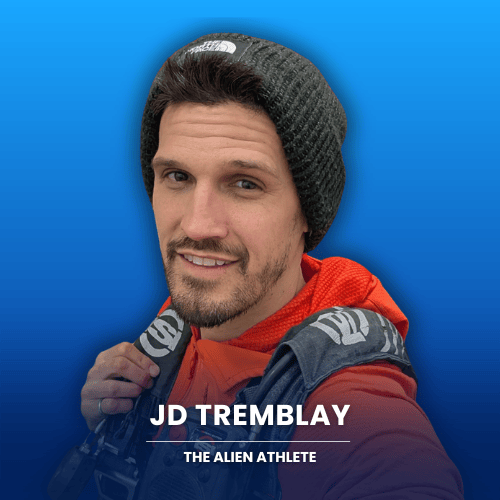
With JD Tremblay of Hungry Warrior Academy, Episode 261




What You’ll Learn
- The Alien nickname origin: JD earned the label not from raw talent but from following systems most people only talk about following. Discipline beats novelty. [01:35]
- The BRAIN framework introduction: JD names the 5-letter system he built across his military, naturopathic, and ultra-endurance careers as the diagnostic he runs with every Hungry Warrior Academy client. [04:03]
- Smoothies are context-dependent: A morning smoothie spikes cortisol and works fine pre-workout, but creates problems if you’re heading to a desk job. Match fuel to your actual workload. [06:26]
- 12-minute nap beats Coca-Cola at 2am: JD coached a client out of energy drinks and into 12-minute micro-recovery, citing better cognition without the cortisol rebound. [10:31]
- Elite Kenyan runners train slow most days: JD trained at altitude with paid Eaton runners. Most workouts run 5-6 minutes per kilometer, not the social-media-fast 2:30 pace. Hard effort is reserved for race day. [16:27]
- Three rest categories: Active rest, passive rest, and total rest. Phone scrolling is physical rest only; the mind stays in sympathetic mode and never recovers. [20:24]
- Pain vs injury distinction: Pain is expected during training. Injury is a different signal entirely. JD argues most athletes blur the two and lose years to chronic damage they could have caught. [24:35]
- Multitasking is a myth: Studies confirm humans cannot truly multitask. What feels like multitasking is rapid context switching, costly even for self-described pros. [30:24]
- 10 Ironmans engineered through scientific method: Plan, 29-page strategy doc, prototype every dependency (bike build, wetsuit), then execute. JD argues most people fail at execution, not planning. [47:03]
Why It Matters
Most people read endurance content as a license to push harder. The result is a culture of constant intensity, cortisol burnout, and a recovery debt nobody tracks. JD Tremblay, an ultra-endurance triathlete and Director of High Performance at Hungry Warrior Academy who completed 10 Ironmans in 10 consecutive days during the Epic Deca, argues that elite performance is a recovery game first and an intensity game second. He breaks down the 5-letter BRAIN framework his team uses with clients across 5 countries, plus the engineering method behind the 29-page strategy document that got him to the finish line.
Who Should Listen
- Endurance athletes and weekend warriors who keep stacking volume but feel slower, foggier, or sicker over time.
- High-output professionals who treat sleep and recovery as optional and want a framework that actually scales with their workload.
- Anyone curious about the systems thinking behind extreme feats like 10 Ironmans in 10 days who wants to apply the same engineering method to their own goals.
Inside JD Tremblay’s BRAIN Recovery System
In this episode of the High Performance Longevity podcast, Nick Urban sits down with JD Tremblay, an ultra-endurance triathlete, former military member with over a decade of service, naturopathic practitioner, and Director of High Performance at Hungry Warrior Academy. JD is one of only 3 people to complete the Epic Deca, a 10-Ironmans-in-10-days event in Hawaii, and a world record holder in firefighting gear who runs philanthropic programs supporting children across 5 countries.
The conversation breaks down the BRAIN framework JD’s team uses with clients: B for Blood chemistry stability (matching glucose, electrolytes, and hydration to actual workload), R for Recovery windows (active, passive, and total rest), A for Attention allocation (single-tasking on purpose), I for Inflammation and input load (audit screens, news, and indirect stress alongside food), and N for Nervous system regulation (parasympathetic vs sympathetic). JD also walks through the 4-step engineering method behind the Epic Deca: Define, Engineer (a 29-page strategy document), Calibrate (prototype the wetsuit and bike), and Action (where he says most people fail).
You’ll walk away with a framework for matching recovery to demand, a 12-minute micro-nap protocol that beat 2am Coca-Cola for one of his clients, and a clearer line between pain (normal during training) and injury (the only signal that should stop you). The episode closes with a candid story about JD’s $40,000 Ultraman DNF and why a DNS hurts more than a DNF.
Key Terms Quick Reference
Several specialized terms come up throughout this conversation. Here’s a quick reference.
[04:03] BRAIN system: JD’s diagnostic framework at Hungry Warrior Academy for matching training load, recovery, and daily inputs to a person’s actual demand. Scales from sedentary professionals to ultra-endurance athletes; used with clients across 5 countries.
[09:36] Active rest: Movement at intensity below your usual baseline (a walk after a hard run, for example). The body recovers while still in motion, with the mind ideally also unwinding.
[19:00] Total rest: Eyes-closed sleep. Distinct from passive rest (laying still while awake) and active rest. The deepest recovery state.
[27:13] Sympathetic survival mode: Chronic fight-or-flight activation driven by caffeine, push-harder culture, and constant stimulation. Predisposes to illness and burnout.
[39:59] Input under-load: Insufficient meaningful stress in life. Triggers fake-victim cycles where people manufacture stressors instead of pursuing real challenge.
[46:18] Indirect input stress: Stress absorbed from media, news, and social platforms about events that don’t directly affect you. Can be purged through prayer, meditation, or releasing the concern.
[47:03] Engineering prototype phase: Testing every dependency of your plan before the real event. JD discovered a missing wetsuit during prototype testing, not on race day.
[51:32] Symptom-based pacing: Adjusting effort based on body signals (fatigue type, pinching sensation in liver from sugar overload) rather than just heart rate or watts. Better fit for ultra-endurance than short races.
Why Does Pushing Harder Break Most Athletes?
The short answer
Most people interpret high performance as constant intensity. JD argues elite endurance is a recovery game. Match recovery to the load you put on the body, or the body breaks down at high cortisol over time.
What Tremblay found
JD trained at altitude in Eaton, Kenya with elite paid runners. Their workouts were not consistently fast: most sessions ran 5-6 minutes per kilometer, not 2:30 per kilometer. Hard efforts come on race day; the rest is recovery and biomechanical conditioning. Influencers showcasing constant intensity rarely log naps publicly because it would dent the brand.
What to do about it
Treat recovery as part of the workout, not a reward. Sleep, naps, and active rest (walking, low-intensity movement) restore HRV and clarity. JD slept on airport floors during the Epic Deca and got better sleep than with melatonin or magnesium.
“It’s kind of similar to the first part where you match your recovery to how much demand, how much strain you’re putting on your body.” – JD Tremblay
Related: Nervous System Optimization
Can Humans Actually Multitask, Or Is It a Myth?
The short answer
No. Studies show humans cannot truly multitask. What feels like multitasking is rapid context switching, and it’s costly even for people who think they’re good at it.
What Tremblay found
JD splits attention into rare valid pairs (chewing gum and walking, biking and drinking water) versus what most people mean by multitasking: talking to one person while writing an email, or being on a date while texting someone else. He flags an emergency caller before recording the podcast and explicitly drops it before the conversation, rather than splitting attention.
What to do about it
Single-task on purpose. Use phone-free workouts. Read long-form books to retrain attention. Be physically and mentally present in the room: kids and partners feel the difference between presence and presence-with-a-phone.
“Are we really able to multitask? Are we really able to focus completely on one particular person? It’s been showed in studies that humans are not able to multitask. It’s not a thing.” – JD Tremblay
Related: Flow State for Deep Work
How Did JD Engineer 10 Ironmans in 10 Days?
The short answer
JD treats endurance like an engineering problem. Plan, strategy, prototype, execution. He wrote a 29-page strategy document, built a custom bike, tested every component, and went all-in.
What Tremblay found
Most people stop at the planning step. Libraries of self-help books with no execution. JD’s prototype phase caught a missing wetsuit before race day in Texas. He swapped disc brakes for pads to handle island travel, custom-built wheels and handlebars, and carried spare parts. During the race itself he tracked symptoms (fatigue type) over data, knowing fatigue could be either electrolytes or sugar.
What to do about it
Run the scientific method on your goal. Define, build a strategy with named contingencies, prototype every dependency, then execute. Track symptoms during execution rather than data points unless you’re competing at a 1-2 hour Olympic distance.
“I prepared so much. We had that strategy. Then I created a prototype. And that prototype was created for every step of the way.” – JD Tremblay
Related: The CONTEXT Framework
The Tremblay BRAIN Recovery System
JD built this 5-letter framework over years of military service, naturopathic practice, and ultra-endurance racing. Use it to evaluate whether your training, work, and recovery are actually balanced.
- Stabilize blood chemistry first: Match glucose, electrolytes, and hydration to your day’s actual workload. A morning smoothie is fine pre-workout but spikes cortisol if you’re heading to a desk job.
- Engineer recovery windows that match your load: Demand and recovery scale together. Ultra-endurance days need extra sleep, naps, and total rest. JD’s teenage son sleeps 12 hours; sedentary office workers don’t need that, but they often need more than they take.
- Allocate attention deliberately: Single-task on purpose. Phone away during workouts, dinners, and conversations. Multitasking is rapid context switching and costs more than you think.
- Audit input load, not just nutrition: Inflammation comes from screens, noise frequencies, indirect stress, and graphic media as much as from food. Cut media inputs the same way you cut inflammatory foods.
- Calibrate stress level both directions: Some people need MORE stress (purposeful challenge). Others need to drop sympathetic load and shift parasympathetic. Match the dose to the person.
- Distinguish pain from injury: Pain is normal during training; injury should stop you. The line is location and persistence. Diffuse fatigue is pain. Sharp, localized, lingering signal is injury.
Common recovery mistakes
- Treating recovery as optional or weak
- Confusing physical rest with mental rest (phone scrolling on the couch)
- Planning extensively without ever executing
Source: Tremblay’s BRAIN Recovery System, Hungry Warrior Academy
Frequently Asked Questions
How do you actually use the BRAIN system?
Walk it as a diagnostic when something feels off. Is your blood chemistry matched to today’s workload? Are your recovery windows scaling with demand? Where is your attention going? What’s your input load between screens, news, and indirect stress? And is your nervous system stuck in sympathetic survival mode? Whichever letter fails the check is your leverage point.
How did JD recover between back-to-back Ironmans during the Epic Deca?
Sleep wherever sleep was available. JD slept on the airport floor between flights, curled up on planes, and once in the back of a car wedged between gear and supplements. He says it was the best sleep of his life, with no melatonin or magnesium needed. The body produces its own deep recovery when total stimulus drops to zero. Recovery between days came down to removing every input, not adding more supplements.
What’s the actual cost of context switching, even when I’m good at it?
A measurable cognitive tax that compounds across the day. Every switch costs attention, working memory, and decision quality. People who self-identify as great multitaskers tend to perform worst on attention tests. The fix is single-tasking on purpose: phone-free workouts, full presence with the person in the room, and long-form reading to retrain your attention span back from scroll length.
How long should you nap for energy without disrupting sleep?
JD recommends 12 minutes as a default micro-recovery window. He coached a client out of 2am Coca-Cola and energy drinks toward 12-minute naps and reported better mental sharpness without the cortisol rebound.
What’s the difference between active rest and total rest?
Total rest is eyes-closed sleep. Active rest is low-intensity movement like a walk that lets the body and ideally the mind unwind. Passive rest is laying still while awake. Phone scrolling on the couch is physical rest only because the mind stays in sympathetic mode.
When is post-workout discomfort pain you push through versus injury you stop for?
Pain is diffuse, fatigue-related, and shows up no matter what during training. Injury feels different: sharp, localized, persistent past 48 to 72 hours, and it gets worse with continued use rather than better. JD’s rule is simple. If it’s pain, train through. If it’s injury, stop. He reserves ibuprofen and acetaminophen for situations where activation is required, like a firefighter mid-emergency, not as a default post-workout move that masks the signal your body is sending.
Why do some people need more stress, not less?
Input under-load triggers fake-victim cycles. People without meaningful challenge often manufacture stressors. JD recommends purposeful challenge, like training, work that builds, or service to others, instead of synthetic drama.
Products, Tools, & Resources Mentioned
Outliyr independently evaluates all recommendations. We may get a small commission if you buy through our links (at no cost to you). Thanks for your support!
Coaching & protocols
Hungry Warrior Academy: JD’s high-performance and mental resilience coaching practice, working with clients across 5 countries with a philanthropy arm supporting children in underserved regions.
Supplements & recovery aids
Turmeric: Mentioned as anti-inflammatory support post-workout. JD prefers food and movement before pharmaceuticals like ibuprofen.
Electrolyte drinks: Plain water alone can stress the kidneys during heavy training. JD recommends electrolyte hydration matched to actual sweat losses, not blanket protocols.
Books & references
Self-help and the Bible: JD’s primary post-workout mind-recovery practice. Reading retrains attention and resists context switching better than scrolling.
Practices
Cold water exposure and cold showers: Helpful for inflammation and hormonal regulation post heavy workout. JD frames this as a tool, not a moral test.
Prayer and meditation: JD (a Christian) uses prayer to externalize indirect stress (events affecting other people that get internalized via media). The same mechanism applies in any tradition.
About JD Tremblay
JD Tremblay is a former military member with over a decade of service, an ultra-endurance triathlete, naturopathic practitioner, and Integrated Performance Engineer. He serves as Director of High Performance & Mental Resilience Advisor at Hungry Warrior Academy, where he helps individuals build physical capacity, mental clarity, and biological resilience under pressure. JD is one of only 3 people to complete the Epic Deca (10 Ironmans in 10 consecutive days in Hawaii) and a world record holder in firefighting gear. His coaching practice extends across 5 countries with a philanthropic arm supporting children in underserved regions, including newly opened programs in Pakistan.
Connect with JD: Website | LinkedIn | Facebook | Instagram | TikTok
Related Episodes & Articles
- Episode 178: Fight Pain, Boost Dopamine & How Ironmen Athletes Recover With Cold Therapy
- Episode 255: How to Recover from System Failure in 90 Days
- Episode 259: Neuroscience of Self-Regulation, Stress & Lasting Change
- Episode 225: How to Beat Burnout & Stress with Clinical Hypnotherapy
- Episode 256: Flow State Secrets for Focus, Deep Work & Peak Performance
- Article: Nervous System Optimization: Biohacker’s Secret to High Performance
- Article: The CONTEXT Framework: Why Health Interventions Fail Without Context
- Article: Free Alternatives to Expensive Biohacks
Full Episode Transcript
Nick Urban [00:00:01]:
You’re listening to High Performance Longevity. The show exploring a better path to optimal health for those daring to live as an outlier in a world of averages. I’m your host, Nick Urban, bioharmonizer, performance coach, and lifelong student of both modern science and ancestral wisdom. Each week we decode the tools, tactics and timeless principles to help you optimize your mind, body and performance span things you won’t find on Google or in your AI tool of choice. From cutting edge biohacks to grounded lifestyle practices, you’ll walk away with actionable insights to look, feel and perform at your best across all of life’s domains.
Nick Urban [00:00:50]:
JD welcome to the podcast.
JD Tremblay [00:00:52]:
Hello, Nick. I’m excited to be here.
Nick Urban [00:00:54]:
So you’re called the Alien. I have to know, is that because you showed up to your first Ironman with zero training and just survived it, or is it because your body runs on different physics and different fuel than the rest of us?
JD Tremblay [00:01:10]:
It was neither, I would say neither. Because I. I run on systems. There’s nothing special about me, but because of everything that I have accomplished. One other guy called me the Alien. And that’s how it started. Because for many people, it takes them years to achieve this. And then for me, it just, it becomes natural.
JD Tremblay [00:01:35]:
That’s just because I follow certain systems that are accessible to everybody. But a lot of people, they talk about it and they’re not really working. For example, how many people are going to the gym and then saying they are going, but then after the second or third time, they’re falling through the crags, they’re not really going, but they’re still posting online. I have a friend like this and he posts pictures of him on his bike and him saying, oh, I just did 100 kilometer of, of bike ride and he’s not really doing it. And everybody knows those are fake workouts. He just goes out for like 5, 10 minutes and goes back in. And so we all have these people and I think we’re all doing this to a certain degree. But then again, the name came out of me following these systems.
Nick Urban [00:02:33]:
Well, let’s talk about those systems. But before we do, there are a lot of people online who talk about how they broke both of their legs and they continue to run a double marathon after that. And they’re like these just ridiculous feats and it’s like they’re. They take, they never take the signals. The body is getting them for an answer. And it seems that you have found like a groove that is not just pushing past into the areas where you’re causing Potentially long term deleterious consequences. But like you work with your body and you figure out what works and you take it to the limits without doing long term like serious harm.
JD Tremblay [00:03:09]:
Yes, to me I’m pushing 40 in a couple of months. I’m still going strong. I did the entire circumference of the capital of Kenya against Kenyans just a few months ago. I swam between two provinces. 17 kilometer of swimming, which is for you guys, about 12 miles of give or take of swimming non stop. Seven and a half hours of swimming non stop. Again, it comes down to biology, it comes down to what your capacity is. Are you built for this or and do you even have the discipline for it?
Nick Urban [00:03:53]:
So what are your systems? How are you able to go from no training to competing at the highest level? Obviously you’re doing something differently than everyone else.
JD Tremblay [00:04:03]:
Well, that’s different. I think that a lot of people definitely have their attention span decrease and they’re definitely not following systems. They are saying they are. For us, we use internally a system that is doing the word brain, so it forms an acronym. And if you look at the basic of brain then B stands for blood chemistry stability. So for example, if your intake of glucose is high in the morning then it will spike your cortisol level which again the cortisol level is the stress hormone. So then again you will be even more stressed. And now you’re just starting the day.
JD Tremblay [00:05:01]:
So that’s just one factor and we’re not even at the other ones yet. And many people, and you see it on social media, all of these biohackers, influencer waking up with the, by the beach with a nice little smoothie. Well if you are on the beach it is highly unlikely that you will be really stressed unless you are on a Navy SEAL boot camp. And at that point those guys don’t really have a smoothie in their hand. They more, they more likely have a, have a boat or So a lot of influencers, a lot of biohackers will say we’ll have a nice smoothie in the morning which again spikes your cortisol level. Is it the right approach? Well for them if their entire day revolves around less stress than yes, it might be if you are there for short term gains. So using your, using your carbohydrates as opposed to your fat for fuel, then again that smoothie might be right for you. For me, during the epic deca I did, I was drinking smoothies in the morning.
JD Tremblay [00:06:26]:
I was drinking smoothies all the time. It was refreshing, it was cold and I Mean, I was in Hawaii and, and I did not want anything to be in my digestive tract, so I needed something that would go through my digestive tract rapidly and I needed that energy fast because I was using it. So again, if you’re using that energy, which again, a lot of those biohack, that’s what they will be doing. They will be taking in their smoothie and then going to the gym. But for the majority of people, they’re going to work at a computer. So drinking a smoothie might not be the right call for their. Right for their fitness level or their agenda or schedule. So again, blood chemistry is extremely important.
JD Tremblay [00:07:22]:
We’re talking about glucose swings, hydration, hydration levels, not just drinking water, just water will hurt your kidneys. If you’re just drinking water for that is just the main liquid that you intake. There are some others I’m not advertising for, for any brand or anything. There are some electrolyte brands, there are some, even some glucose one. So vitamin water, what is all that about? And yes, there’s a ton of sugar. But if you’re going to use the sugar, then it’s. Then it might be good for your situation. But if you’re not going to use that as your fuel, then.
JD Tremblay [00:08:08]:
Then it’s not good for you because then again it will just get stored as fat after your glycogen level will get in excess. So you need to be hydrating properly, what type of hydration you need, what are your cells absorbing? So we’re talking about. Then we’ll move to R, which R is for recovery before we can go
Nick Urban [00:08:36]:
into R. So it sounds like the goal with the B is just to match your blood chemistry and specifically the amount of glucose or carbohydrates you’re intaking and the water or electrolytes you’re consuming. With your lifestyle, if you’re highly active, you probably can handle a lot more. If you’re not active, you’re sedentary, probably dial it back a little bit.
JD Tremblay [00:08:56]:
Exactly. I love the way you’re putting it and it’s very concise and I think if you’re understanding it, everybody’s going to understand it. So I love it. Yeah. Now we go into R. All right, so R is recovery windows, which I don’t want to name any specific athlete, but there are some athletes out there that are overdoing it. They are showcasing an image of again, doing a lot of races, being invincible, just staying hard all the time. So again, I’m not naming any specific individual.
JD Tremblay [00:09:36]:
However, if they don’t have any recovery period. Their body is going to break down at too much of a high cortisol level for too long will break your body. The people are looking at more testosterone, more drive, more, more, more of those energy drinks, more work. I had a client yesterday asking me about how do I get my drive at 3 in the morning. First off, what are you doing at 3 in the morning? And some people, they take in a Coca Cola at two in the morning to get them going. It’s cheap, it gets the job done. And I agree with them in that sense. It gets the job done.
JD Tremblay [00:10:31]:
You will be more active mentally, you will be sharp because you’re intaking a serious amount of sugar in such a short amount of time. My recommendation was how about a 12 minute nap? And it sounds so silly but how many times have even I have to do it? We’re juggling now between four different countries with just our philanthropic side with people, clients that are all over the globe. We’re talking about individuals that have, that don’t even have a schedule or they’re always on their phone. And very often it’s just about removing yourself from all of the chaos and then just recover. So that can go with sleep cycles, naps, even, even those, those micro recovery during the day can change all of your chemistry. It can change, alter your mind because it might even give you that, that clarity. And during the epideka that is what that was. My main factor was recovery.
JD Tremblay [00:11:57]:
I would be sleeping at the airport on the floor. I would be sleeping on an airplane all curled up. I would be. There was, there were times, there’s a picture in my book where we popped open the trunk, we pushed aside all the equipment and I just laid right in between all the equipment in the back of the car and I had the best sleep of my life. No needs of melatonin and magnesium. I just had the best sleep in between all my gear and supplements. And so with that recovery, this, your body is an 8. Ability to recover will kick in and then your heart rate variability will shift you, you will have more clarity and you might just have, you might just have that point of an epiphany.
JD Tremblay [00:12:59]:
For me it was highly helpful to recover. So again, based on what I have lived I would say recovery is one of the most important one for my son. I know that he needs 12 hours. He’s in the teenage years and when he was a child it was 12 hours. He’s been homeschool. I said you need to sleep and I would not wake him up. He would wake up every day at the same time and he would have 12 hours of sleep. And there were some parents that were telling me this is way too much.
JD Tremblay [00:13:42]:
And I said, if this kid sleeps below 12, sometimes he wake up and it’s 10 hours of sleep. I can’t send him back to sleep. But I understand that during the day I have to be more careful because he will be agitated. And that’s because his system is now conditioned to sleep that 12 hours. Now is it good for a long period? Your body will adjust regardless. Your body can stay up all the time, but your body will break down if you don’t sleep. And the main driver, they found in studies that the main, you could, you could die for nose for, for from not sleeping. So if you don’t sleep, then you’re not allowing your body to recover, which again is a long explanation.
JD Tremblay [00:14:31]:
Maybe you can do a better job in concising it with the R. Well,
Nick Urban [00:14:35]:
I think it’s, it’s kind of similar to the first part where it’s like you match your recovery to how much demand, how much strain you’re putting on your body. Again, if you’re not doing, you’re not taxing yourself, you’re just working behind a computer. You probably don’t need as much recovery as someone who’s doing multiple Ironmans in a row or other like military deployments, things like that, that it’s going to put a lot more strain in the body where you need to recover that deficit over time.
JD Tremblay [00:14:59]:
There you go. Right? That’s a perfect analysis. There you go.
Nick Urban [00:15:04]:
Because like the, the whole culture on social media is about pushing harder. People don’t, most people don’t record their recovery routines. They just show how hard they’re pushing it all the time. And I’m assuming that some of the big names who are doing that, we don’t need to name any of them. But are they still doing these recovery tactics also or are they just like putting themselves at risk of burnout or like serious injury?
JD Tremblay [00:15:26]:
Yeah, and I trained with Olympians. I trained, I even trained one time in Eaton with some of the best runners in the world at altitude in Eaton, Kenya. And all of them run in the morning. Then they go. And for, for the elite runners, they go, they, okay, some of them have to work because of the, of their finances. But the elite runners that are paid by big large companies to, to run, that’s their job. And they, they have big clubs, they, they work out, they go and sleep and they rest and then they go back and then they do another hard workout. But their hard workout are yes, at a higher pace than most of us, but they’re for a long duration and that’s because they’ve trained their body to be in these conditions.
JD Tremblay [00:16:27]:
So it’s not necessarily that they are faster because they’re, they’re training, a lot of them, they’re not training at 2:30 minute per kilometer. They’re not training extremely fast all the time. But that’s what we see on social media, is that those Kenyans are extremely fast. They, they, they are, they are, don’t, don’t get me wrong, it’s very difficult for me to follow any of them because I’m an ultra endurance athlete. However, most of their workout, yeah, five, six minute per kilometer, most of them are going at a slower pace for long and then training the biomechanics to handle all of that load. And then when it’s time for the race, that’s when they push really, really hard. So definitely the recovery for me is, is, it’s huge. It needs to be in place.
JD Tremblay [00:17:23]:
And how many people, like you said, how many people just go, oh yeah, today I took a 20 minute nap in between the middle of the day. As an influencer, you would be cut.
Nick Urban [00:17:36]:
Yeah. You’re describing the difference between active rest, passive rest and then total rest too. Like total rest is when you’re actually sleeping, when you have your eyes closed. And then passive rest is when you’re doing something at a much lower, I guess active rest would be you’re doing something at a much lower intensity than usual. Like the same thing as you usually do but just at a dial down like intensity.
JD Tremblay [00:17:57]:
Yeah. You have different levels of sleep and one of them can be achieved with active rest. So there are some swimmers, long distance swimmers that do this. There was one last year, he put some rows with lights and the guy was swimming and at the same time he has his eyes closed and he keep moving and you can see his body moving, you can see he’s swimming. But he even said it to everyone, I am sleeping. So you are able to achieve that in terms of active resting because you’re able to move your body but at the same time you are still resting. Now active rest can be also in terms of just going for a walk, that, that’s rest that your body. Okay.
JD Tremblay [00:19:00]:
And I’m, I’m not talking about the guy who is maybe 500 pound and hasn’t ran or walked in a very long time. Okay. We’re talking about majority of society that is able to walk without A wheelchair. We’re talking about people who are able to be active. Okay. So for the majority of people, you go for a walk, that’s still active rest. Like you are resting your body, but you’re active by doing it. So it’s not necessarily to be completely resting and just laying on the bed and looking at a ceiling and just waiting.
JD Tremblay [00:19:40]:
And you also have an active rest, something that a lot of people tend to forget and is. And that’s how you use your brain during the activity that you’re doing. So for example, a lot of people say, well, I just ran a big workout and now I’m going to go do. And now I’m going to go rest. So they grab their phone, they sit on the couch. So their body is at rest. And I, and I agree with them, their body is at rest. However, their mind is, is going insane at the moment.
JD Tremblay [00:20:24]:
It’s being overly stimulated on top of having the stimulation and trying to recover from the large workout that you just did. So active workout or active rest or resting completely can be in different forms. And people must be conscious of how they trigger their nervous system, which again, you might have alluded that the N in brain is nervous system regulation.
Nick Urban [00:20:56]:
But yeah, yeah, we’ll get there. But. So if you’re not sleeping when you’re going to recover, you’ve already taxed your body and your mind to some extent and then you’re not going to go back and do something that’s going to stimulate you or engage, you know, put keep your nervous system in the sympathetic state. What is it you’re doing to let your mind unwind after physically taxing yourself?
JD Tremblay [00:21:17]:
I love reading books. I would say read the genre that you prefer. I prefer self help books. The Bible is a big one for me. But pick a type of book that is, that is fitting your demand if it’s animating for me, I love to just take notes and learn more about myself, about others, about the mistakes of others. And that usually comes with self help. If you like more romance or any type of novel, then that’s fair. Go and get those books and really stimulate your brain.
JD Tremblay [00:22:04]:
Have fun with it because your brain will try to create certain stories and you are to be more creative. So reading books is definitely engaging and relaxing if you want to go further. Yes, cold water can definitely help. It helps with inflammation. It helps with the hormonal regulation because you just had a large workout. So your, your hormonal imbalance is, is at stake. So definitely cold water. If you can’t do cold water Cold showers, definitely.
JD Tremblay [00:22:51]:
And it will also help with the inflammation. There are certain supplements that might help, such as turmeric, that helps with the inflammation of your. Of your system. I prefer to stay away unless there’s a real injury from certain types of medication that might allow your system to trigger the pain response, such as ibuprofen, acetaminophen. Those are, uh, those are good for certain cases. I. I take those in some instances, but I would take them more. Not after a long workout, unless you.
JD Tremblay [00:23:37]:
Your body needs to activate immediately. So if you are a firefighter and you’re hurt after a workout, then maybe taking an ibuprofen because it’s your work, and now you have to be into an emergency, then. Then that would constitute some form of emergency where you need those types of pills. But try to use. The idea is to try to use the innate ability of the body to recover well instead of going straight with the pharmaceutical and trying to go back into another workout. Now, the one thing that I can say has helped me a lot is the listening to your body between the idea between pain and injury. So pain is normal. It will come no matter what.
JD Tremblay [00:24:35]:
Physically, you will be in a lot of pain. You go for a run. Even now, I go for a run. I’m still in pain. And then you have to understand the difference between pain and injury. Injury. It. It should stop you, and it should stop a lot of people.
JD Tremblay [00:24:52]:
And some people are not stopping. And some people just don’t have this pain response. So that’s understandable. And then there is the pain response. And the pain response is only to tell you there is an emergency. Here’s what’s happening. How can we correct it? So it’s up to you to make those decision based on those symptoms, and that is for yourself to discover your limits. So for me, for the epic deca, I knew that I was willing to.
JD Tremblay [00:25:25]:
I was willing to die. For me, I was willing to go all the way to. Yeah, this was. This was my life. Like, I wanted to finish that event at no matter the cost. I was all in on that event. Was it the right choice? Definitely. I think it was the right choice.
JD Tremblay [00:25:46]:
But was I all in for certain races? There’s. There. There are races that I was not all in. And I slowed down a lot. Some of my friends are still laughing at it. We did a. I did a speaking engagement, and he was laughing because I took over half an hour. It was a half an hour or it was my transition between the bike and the run took me over half an Hour I was talking and chilling.
JD Tremblay [00:26:14]:
Just yeah, I went swimming. Swimming went fine. Really fast transition. I do my bike. I finished 100. It was during Canada Men, part of the extreme endurance. It’s part of the extreme league of of triathlon. The world championship is the Norseman.
JD Tremblay [00:26:38]:
So I did the Canada man to qualify for the Norseman. And when I did that one, I finished the bike ride and I just knew that I would finish, but I just did not want to hurt my body. And that’s what’s happening with a lot of people. They think that they’re going to achieve more by pushing harder. You’re not going to beat AI with the amount of creation that you will get. The amount of knowledge. You will never have more knowledge than AI So you cannot beat AI at its game. And I’m using AI because it’s in everybody’s mind right now.
JD Tremblay [00:27:13]:
The way to beat AI is to be smart about it. If you are smart about it by having a proper way of using AI and that comes with having these form of epiphany which again comes when you are recovered. When you are well recovered, you know where you want the business to be driven. When you decide where you want to go is almost often in a. And you mentioned it earlier, the sympathetic system and the parasympathetic system. And that’s usually people operate into a survival mode. That’s usually the sympathetic system activating into fight or flight response. And then people just operate on survival mode.
JD Tremblay [00:28:03]:
More caffeine, more, more and more push harder. When really if they switch to a more parasympathetic system where they’re able to, they’re able to digest better, they would have less illnesses, they would be in much better health. And that’s for the majority of people. Not everybody is called to do an epic deca and all of these races around the world. But if they understood the recovery process and how to do it and that it’s crucial and it’s important, CEOs of companies would, would make it mandatory. And you look at certain companies that do that. Even you look at Google, Google has some, some pods for people to sleep in, to take naps during, during their, their working hours. Now are they used properly? That’s a complete story.
JD Tremblay [00:29:01]:
But they are present. People have access to them and they should be taking some breaks during the day and recovering well depending on the task that they have.
Nick Urban [00:29:12]:
Was that A in the R?
JD Tremblay [00:29:14]:
Yes. A. Yeah. A is attention allocation. That’s a big one. In today’s society, we look at the psychology of how the society has moved from being workers in a factory, having tools, and then when you go home, the tools stay at the work. Everything stays at the workplace. So you might talk about work with your body, you might talk about work with your family.
JD Tremblay [00:29:46]:
You might. But again, all your work is at. Is at that place of work. That’s it. But nowadays. Yeah, exactly. Now I’m on a podcast for one hour, and I guarantee you, I’m sure of it, I will reopen my phone and as soon as I’m done this podcast, I got 20 emails, at least 10, 20 emails, and all about people trying to message me and get your attention. And so are we really able to.
JD Tremblay [00:30:24]:
A multitask? Are we really able to focus completely on one particular person? So I would advise people to. And as funny as it is, it happened right before the podcast, and I knew that my bandwidth would not be completely with you, Nick, if I did not deal with this emergency. And an emergency happened right before this podcast, which, again, is. Is a blessing in disguise. I answered it, we took the time, and I said, I won’t be able to fully commit to you, Nick. And that’s exactly the process that I did, Nick, I want to be with you. I want to spend time with you. Okay? However, there’s an emergency.
JD Tremblay [00:31:17]:
I’m going to take two minutes, I’ll answer this, I’ll shut off my phone, and I will completely focus on you. Now, I am able to convey the message that I am completely with you. I am bringing it up as an example. However, I’m not thinking about that emergency. I’m able to make a rational decision thinking about this podcast and focus completely on the message that we have to deliver to all of these people that are. That might not be allocating their attention properly. We’re looking at. How many times have you been on a date with a girl, Nick? And then you go on a date with a girl, you’re trying to connect with her, then she pulls off her phone.
JD Tremblay [00:31:59]:
Or even worse, you look at these couples, sometimes it’s almost like the life is out of them. They’re just both on their phone and they’re at a nice restaurant. And restaurants are costing a lot nowadays. Why would you even go out, spend all of that money, and not even spend time with the person that is in front of you? Cook at home. Why? Or order. How about this? Order your food and watch whatever at the house. It’s not against the restaurant industry. It’s more about the attention that we do not allocate.
JD Tremblay [00:32:39]:
The amount of kids that are without parents, not because they’re not present, but because they don’t have a presence. So they’re not. They are in the room physically, but mentally, they are elsewhere. They’re thinking about their work. They might be thinking about different. Different people. And sometimes they get even worse where you’re on a date and then the person in front of you is texting other people. And if.
JD Tremblay [00:33:13]:
If you wanted to have a date with them, how about you go have a date with them? There you go. Right? So it can go into the dating world, it can go into your. Your marriage, it can go into with your kids, and even with your. With your. Your work. How much attention are we allocating to activities that are not conducive to our growth? And that is quite important in today’s age because, again, we have the rise of AI which is a great and fantastic tool. However, if misused, that tool can provide you with an enormous amount of information that is not allowing you to. To grow properly.
JD Tremblay [00:34:01]:
So if you do not have that proper allocation, then you will digress. You will. You will get split into two. And it’s been showed in studies that humans are not able to multitask. It’s not a thing. You cannot multitask unless it is. Okay. And we’re not talking about chewing gum and walking.
JD Tremblay [00:34:27]:
Okay. And we’re not talking about riding a bike and drinking water. Okay, I can do that. Okay. But we’re talking about multitasking in terms of. I’m talking with Nick, and I am also focusing on writing an email. This is not a thing. This is not something that people can do.
JD Tremblay [00:34:47]:
You cannot multitask. And so get that out of your brain. This is not a thing. You should not be multitasking. You should be allocating the right amount of time with the right amount of people with the right people as well, because there are lots of people that are trying to get your attention and not really saying anything. They’re not really saying anything. They’re just talking to talk. Like these girls on a podcast that said, you know, it’s like a meme now, right? This girl that said, why is there two seats on a Lamborghini and many seats on a.
JD Tremblay [00:35:30]:
Or don’t job your love. Love your job. Like what? And everybody’s laughing at it. So everybody knows about these. These things. But again, if you are allocating your attention properly, then you can accomplish so much more when you. When I’m in a workout, I’m in a workout. I understand that this is the.
JD Tremblay [00:35:49]:
The workout that I am. That. That is conducive to my growth, to my brand, to, to my work. So I must work out. Therefore I will focus on that and then I will focus on emails and other things that I have to do. Right. Your, your brain is not dealt for constant like context building. Like you’re not building anything by just.
Nick Urban [00:36:16]:
Yeah, context switching. Balancing from one thing to the next is costly and ineffective even for the people who think that they’re really good at it. And I agree. It becomes more and more important the more things vie for our intention, whether it’s social media, text messages, having a bunch of different AI tabs open, everything that causes us to seek more like more different tasks. The things that we do to counter that, like the single attention focus, whether it’s working out with no phone, it’s reading a book, which is becoming increasingly rare these days. These types of things where you can’t multitask, they help us train that ability and become more effective at other things we do as well.
JD Tremblay [00:36:55]:
And it’s through those connections that you will gain the connections of being with individuals. Right now we were able to connect. You’re in a completely different country. We are able to connect at a certain time and have that sharing of knowledge. So it’s not just in terms of. Between a computer and you. We’re talking about human connection. And this might lead to more opportunities for growth for my business, for your business.
JD Tremblay [00:37:27]:
It might open up another connection that we have in common. So we don’t know where all of this will lead. So AI can do so much and really we have to go back to its root of human connection. The root of human connection is where we need to be. We need to connect with one another and have more attention, just one on one or even as a group. That’s, that’s what I am. Anyway. It’s a recommendation.
Nick Urban [00:38:02]:
Do it. Do what you are with it. Yeah. So the eye is inflammation and input. Yeah. So inflammation and input. I would, I would go with an input load because many people look at it as well. The inflammation can come from your food or your stress screens, noise frequencies.
JD Tremblay [00:38:29]:
But again it’s a, it can be. The reason why I like the word load attached to, to it is because it can be an overload and you can also have a underload where you are. You do not have enough of human connection. That’s an input that you have, but you do not have enough human connection. You’re connected too much with say robots. Right. So you might not have your, your level of oxytocin might not be as increased as another person that is interacting with other humans. Input low.
JD Tremblay [00:39:11]:
We’re looking at stress. What is your stress level? Some people do not have enough stress in their life. That’s it. Yes, it’s true. A lot of people do not have enough stress. So what they do, and as sad as it is, they create a victim cycle where they just add on fake stress to their lives and then they play into this victim cycle where this is an under, this is below the load required. You are to go out there and hunt an animal. You are to go out there and go hunt dragons without the psychedelics.
JD Tremblay [00:39:59]:
You are to. You are to go and work and do something constructive for society. That stress. There are some people that are overly stressed and we talked about it earlier, sometimes with screens, noise, frequenc, and not the right type of video they’re watching. And even though they’re thinking they are having the right input, it’s creating certain inflammation into their system. So for example, one guy was telling me, I really like to watch videos of guys. There’s a false army. And you might know about it like a.
JD Tremblay [00:40:43]:
It’s like videos of guys that swim, like they do extreme things and then they fall down and, and it’s funny, okay? But to some degree, if that’s all you’re watching, you’re watching other people get injured. So when it happens in real life, your reaction will be to laugh at those people. And if they are people that are close to you, the reaction might not be what they’re looking for. So that might create certain inflammation. And those are, inflammation is not necessarily from the food you intake or inflammation from the workouts that you have. So for me, during the epic deca, I cut down all social media. I cut down, I shut down everything for the epic deca. For me, I knew that certain types of food would create certain inflammation.
JD Tremblay [00:41:40]:
I knew that if I, if I took in meat, meat was, is meat can stay in your system for hours and sometimes some residue can even stay there for weeks. And so I knew that my system did not even have time to digest it. So I understood that inflammation could be caused by meat intake. Therefore, there was no meat intake during the epic deca or even prior to the epic deca in order to clean my system completely of these residue. So again, I understood that. Do I eat meat now? Definitely. I had a beautiful roast before this podcast. But for that race, I understood that this was not what was necessary for me to complete the epideca.
JD Tremblay [00:42:38]:
So again, inflammation should not just be looked at A physical stressor and a inflammation from your nutrition. But it should also be seen as screens, noise frequencies. Certain temperatures can create some inflammation. Temperature is a big. It’s a huge one. But also the stress that you’re adding to your. So the load that you’re adding to
Nick Urban [00:43:11]:
all your systems and for the inputs, part of it. Inflammation and inputs is the main input you’re referring to specifically, like relational or are there a bunch of other inputs that are important to consider as well?
JD Tremblay [00:43:23]:
Well, the input can be direct or indirect. So for example, something happened to your neighbor and you’re really close to your neighbor, it happened to your neighbor, it has nothing to do with you. Then you might get some form of empathy where you’re affected by it. Or we see sometimes soldiers that go to war and you’re seeing them on tv and some people have this stress and their stress and almost as if it happened to them. So again, the type of input that you have that sometime is direct, such as the stress that you’re having, the food that you’re ingesting, but also the stress that is indirect from other sources, like the ones that are on TV very often where you see other people in other countries that are in horrible situations and you think, wow, this could happen to me. Or, or you even feel so bad for them that you create that stress and internalize it instead of doing some form of purge and release from these input, which then again, the purge of these input indirectly and directly can come from meditation, can come from prayer. We look at Christians who sometimes see horrible situations happening in other countries. And instead of internalizing it, they’re saying, God, please take care of this situation.
JD Tremblay [00:45:07]:
And so they’re releasing this to a deity, they’re releasing it to. To God or Jesus for that instance. So in meditation it would work the same where you’re processing all of the information or trying and trying to not have a severe reaction out of it. So meditation can work in all forms of faith and religions. You look at prayer. Prayer is widely used for many of the main religions and it’s sometimes even mandatory. In Islam it’s mandatory. And Christianity is highly recommended.
JD Tremblay [00:45:51]:
Well, it’s a command from God, but highly recommended by everybody else. You do what you want. So I’m a Christian, so I do pray. So this would come from your input. What type of. And we talked about books. Books are amazing. And that is coming from your taking responsibility of what you should do and what you understand has to be an input.
Nick Urban [00:46:18]:
I think you’re one of only three people to complete that race. You’re also a biomedical systems engineer. When you’re on race number six of ten consecutive Ironmans, what’s the engineer in your brain saying about what’s happening inside your body? After all this stress is going on
JD Tremblay [00:46:36]:
around you, just follow the system. So I break it down into again another structure. That’s the way I operate is I look at the scientific method. And the scientific method is that you need a plan. I had a plan. I wanted to do the epic deca. I did not know how I would do it. But that comes in the second step, which is the strategy.
JD Tremblay [00:47:03]:
So you build a strategy. And I did. It was 29 pages. I created this giant document. It was elaborate as to what to do if JD Overreacts on this or how fast do you think JD will finish this. This portion of the Ironman Ray or the epic deca? What, What. Who is going to crew for that island at that specific time? What are the. Not just what are the hotels where are like.
JD Tremblay [00:47:39]:
We had everything in that document. So I prepared so much. We had that strategy. Then I created a prototype. And that prototype was created for every step of the way. I, I tested that prototype later on all of these because I needed to. I went to Texas. And that’s when I realized I forgot my wetsuit.
JD Tremblay [00:48:07]:
So I did not even have a wetsuit because I thought, well, I’m going to Hawaii. I’m not going to need that. And then I realized, no, this. If I’m allowed to it and it’s creating some buoyancy, then I should. I look at buoyancy or temperature control. And then I went with buoyancy. And it, it helped me. I.
JD Tremblay [00:48:30]:
I was floating. I. Yeah, it was better to use the, the, the. The wetsuit. So again, testing your wetsuit, testing your bicycle. Because I built a bicycle just for that event. You. With the parts that I knew would fit better.
JD Tremblay [00:48:46]:
I knew that disc brake with my bend between islands. So I did not use disc brake because that could hinder my race. So I picked pads. So I bought an old bike. And then I changed. I changed the wheels. So I had two sets of wheels. Had to test those, had to test the computer.
JD Tremblay [00:49:08]:
Had to. I changed the handlebars. I made sure the bike fit. I changed. So I changed everything on the bike beside the frame. And I. And then I had spare parts. So again, if you follow that system all the way down to.
JD Tremblay [00:49:23]:
To what? To execution. That’s the final step of the scientific method execution. And I would say that’s where the majority of people fail. They read all the self help books I knew, oh, I knew this person, that person had libraries full filled with all the best self help books and had no execution whatsoever. It was, it was hurting me because I thought there’s so much knowledge into that person and meanwhile they’re not putting it into practice. So the execution part is definitely by far for me the most important part. That’s why in the DECA system the, the A stands for action. Why? Because that’s, that’s the last call.
JD Tremblay [00:50:15]:
You, you must, even if you make the best plan, if you’re not going to execute, it’s not going to serve you any good and it’s not going to serve anyone either.
Nick Urban [00:50:25]:
When you’re executing, are there any particular signals that you’re tracking? Whether it’s respiratory rate, your heart rate, heart rate, variability, cognition, mood, anything in particular?
JD Tremblay [00:50:35]:
So during, during that race, I was going with heart rate and I was going with watts. When I’m on the, the bike, the amount of watts that I was pushing, but then it was just decreasing as I went on. So I just went with heart rate. Which heart rate usually would dictate what type of, how you’re regulating temperature. So if it was high, I would go more with, so that it can be used for everybody that is listening. Any type of situation, I would go more with symptoms. So if you have symptoms that are hurting your, your, your, your body, such as, let’s say fatigue. Well, fatigue can be either electrolytes or can be the, the sugar level.
JD Tremblay [00:51:32]:
So I wouldn’t take sugar at first because I understood that, well, if I get too much sugar then my, I understood that my liver would, would tell me immediately you start having this, not a tingling but some form of pinching when you have too much sugar. And not many people have that unless you are taking in sugar. I was taking in about 60 grams minimum per hour for an event that is 14. No way more than 14. Sometimes 20 hours. So we’re looking exactly. Yeah, this is, this is way too much. So you’re taking in a cake full of sugar for 20 hours.
JD Tremblay [00:52:17]:
They eat 20 cakes. Yeah, this is, this is a lot of sugar. So I knew the symptoms and based on the symptoms, I was able to adjust what were my needs. So it’s not necessarily about following specific data. When you are at an Olympic level and you have to compete for say an hour, an hour and a half, then yes, I would understand you have to track your data. You have to track how fast you’re going. But for me, because it’s ultra endurance tracking These data were more about symptoms rather than data points.
Nick Urban [00:52:54]:
After completing 10 Ironmans in 10 days, which is one of the greatest endurance feats in human history, I read that you DNF’d at Ultraman. What did that failure teach you that the ten Ironmans did not.
JD Tremblay [00:53:08]:
It’s always difficult to not accomplish your goal, especially when you spend. Yeah, we spent 30, I think 40 on it. 30 for 30. $40,000 on that trip. Like bringing. Yeah, bringing that bike, flying. Everybody, the whole team, the equipment, like, everything over there. And the flights were really expensive.
JD Tremblay [00:53:28]:
We took them at the last minute. So getting everybody over there and. And the food and the lodging and everything was very expensive. And. And to not finish that race. But I would say I would be hurt. I would be hurt even more because I did it in 2023. If you look at the days I did in 2023, I don’t know if we’re allowed to say it on podcast, but there’s some things that happened in October 2023 in Israel that prevented future races from participating or athletes from participating in these types of events.
JD Tremblay [00:54:11]:
So if I did not participate on that year, I wouldn’t have been able to for the future years. So I think I would have been even more hurt if I did not start, then I did not finish. Like, a DNS would be worse than a dnf. And I think that’s where a lot of people hurt themselves even more. They hurt themselves with the DNS because they’re not starting their journey. They’re saying they’re going to start their health journey. They’re saying they’re going to start. For me, at least, I went there and I started.
JD Tremblay [00:54:51]:
I did not finish. I understand. However, I at least gave it my best, and it just. At that time, it was not enough for the cutoff and. Yep, yep. So that’s. That’s what I learned from. From this race.
JD Tremblay [00:55:09]:
Yep.
Nick Urban [00:55:10]:
Yeah. Okay. We’ve been going for a while, J.D. it’s been pleasure chatting with you. If people want to connect with you, to grab your book, to follow you and your adventures, where do you want to send them?
JD Tremblay [00:55:22]:
Hungrywarrioracademy.com and we’re on all social media under Hungry Warrior Academy. We’d love to connect with people and chat and even people that hate us, it’s okay. We’ll pray for you.
Nick Urban [00:55:39]:
What’s one thing that you’re working on right now that other people don’t know about?
JD Tremblay [00:55:44]:
It happened this week. We are in four. So we are in four different countries, helping thousands of children with our philanthropic side of the company. And just this week we, we opened up Pakistan. So we’re excited to. You’re going to be the first one to know about it, but this is one thing that, yeah, you’re the first one to know about it. So we’re excited to bring our services to offer more opportunities to more children around the world. Because again, some of these children, they grew up in environments that they did not choose, and they are, I don’t even want to call it extreme poverty, because it’s even worse than extreme poverty.
JD Tremblay [00:56:39]:
It’s a level of poverty that we, that I could not even comprehend until I saw it firsthand. And to give a little bit of hope to these individuals, to these kids that we have no idea where they’re going to go, that, to me, is a passion of mine and I’m really excited. So that’s what we’re working on right now.
Nick Urban [00:57:08]:
Beautiful. Well, thanks for doing that. That’s the most important time to intervene in someone’s life and we can actually make a massive difference. Well, jdu, it’s been a pleasure hosting you. Thanks for joining the podcast today.
JD Tremblay [00:57:18]:
Yeah, thank you for having me, Nick.
Nick Urban [00:57:21]:
Thanks for tuning in to high performance longevity. If you got value today, the best way to support the show is to leave a review or share it with someone who’s ready to upgrade their healthspan. You can find all the episodes, show notes and resources mentioned@outlier.com until next time, stay energized, stay bioharmonized, and be an outlier.

Comments