
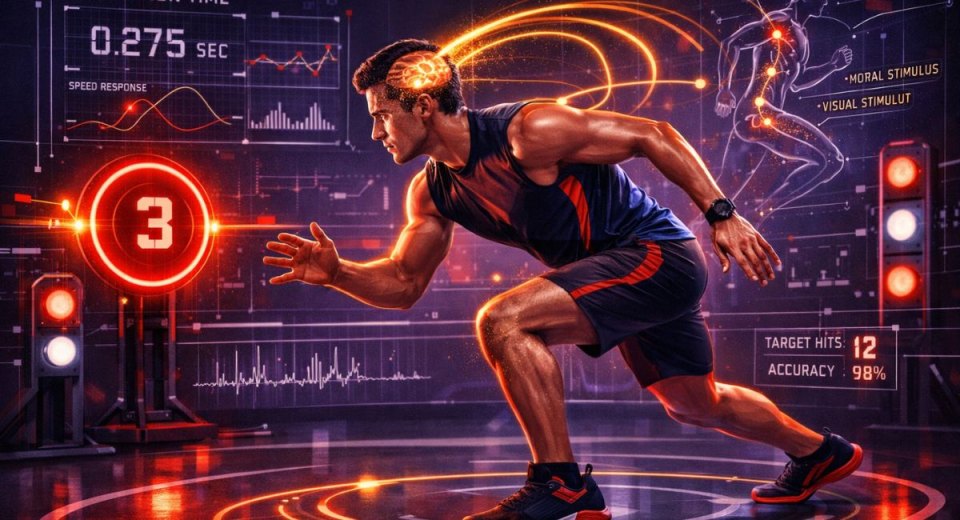
With Dexter Ang, CEO of Pison Technology, Episode 244




What You’ll Learn
- Most people run at 60-70% cognitive capacity: Dexter’s Pison data shows the average person operates well below their actual daily brain optimization without realizing it. [0:00]
- Brain measurement moves from skull to wrist: Pison translates wrist biopotentials (neuromuscular signals) into real-time cognitive data without requiring a headset or lab setup. [3:05]
- Reaction time as a gold-standard biomarker: Used in Olympic athlete testing and military readiness, reaction time correlates with sleep quality, circadian alignment, and subclinical cognitive decline. [3:22]
- Separate 3 cognitive dimensions: Processing speed, inhibition, and decision control each show up differently in reaction time tests. You can train each independently. [7:54]
- 10 minutes a day for 2-3 months: Dexter’s data shows daily reaction time training enters an optimized state at 2-3 months, then transitions to maintenance mode. [14:02]
- Objective signals beat subjective mood: When you’re tired, you underestimate your brain state. When you’re hyped, you overestimate it. Neural data cuts through the feeling layer. [18:00]
- Tag substances, habits, interventions: Pison lets users tag coffee, workouts, nootropics, meditation. You see exactly what’s moving your cognitive needle vs placebo. [25:00]
- Pison PERFORM as public meditation: Dexter frames their reaction time test as the first meditation you can do anywhere without closing your eyes because it demands total present-moment attention. [33:58]
- MIT, ALS, & the origin story: Dexter returned to MIT after his mother’s ALS diagnosis, originally building this technology for people who had lost movement control. [1:20]
Why It Matters
Most biohackers track sleep, HRV, and glucose, but leave cognitive performance as a subjective guess. Dexter Ang, co-founder and CEO of Pison Technology, returned to MIT after his mother’s ALS diagnosis to build neuromuscular wearables that translate wrist biopotentials into quantified brain data. His thesis: reaction time is a gold-standard biomarker used by Olympic committees and military readiness programs, it correlates with everything from circadian alignment to subclinical cognitive decline, and it can be trained in 10 minutes a day. This episode shows why most people live at 60 to 70% of their cognitive capacity and how to close that gap with objective data instead of mood cues.
Who Should Listen
- Biohackers who track sleep and HRV but still rely on subjective mood to judge cognitive readiness and want an objective layer.
- Athletes, executives, and knowledge workers who need to know their brain state before high-stakes meetings, workouts, or decisions.
- Anyone testing nootropics, caffeine strategies, or mental training protocols who wants to see real effects on reaction time rather than guess by feel.
Neural Sensing from Wrist to Cognitive Performance
On the High Performance Longevity podcast, Nick Urban sits down with Dexter Ang, co-founder and CEO of Pison Technology. After his mother’s ALS diagnosis in 2015, Dexter returned to MIT and began developing neuromuscular sensors that translate wrist biopotentials (the nervous system’s electrical signals at the wrist) into digital commands. The technology now bridges assistive devices, robotics, IoT, and defense applications, and with Pison PERFORM has entered consumer biohacking.
The conversation centers on reaction time as a cognitive biomarker that’s been used for decades in Olympic testing and military readiness but was never in civilian hands. Dexter walks through why wrist-based sensing beats EEG headsets for daily use, how to separate processing speed from inhibition from decision control, the 10-minute-daily protocol that produces optimized states in 2 to 3 months, and why tagging habits and substances lets you see which interventions actually move your cognitive needle. He frames Pison PERFORM as the first meditation you can do anywhere because it demands total present-moment attention without closing your eyes.
You’ll walk away with a framework for objective cognitive tracking, an understanding of why subjective mood is a noisy readout, and practical ways to test any nootropic, workout, meditation practice, or sleep change against real neural data.
Key Terms Quick Reference
Specialized terms surface throughout this conversation. Here’s a quick reference.
[0:00] Neuromuscular Sensing: The measurement of electrical signals at the junction between nerves and muscles. At the wrist, these signals carry information about motor intent and cognitive state before visible movement happens.
[3:05] Biopotentials: Electrical potentials generated by biological tissues. Pison’s sensors pick up wrist biopotentials that reflect both motor commands and nervous system arousal.
[3:22] Reaction Time: The interval between a stimulus and a response. Considered a gold-standard cognitive biomarker by Olympic and military readiness programs because it’s objective, repeatable, and correlates with sleep and circadian alignment.
[7:54] Processing Speed, Inhibition, Decision Control: Three independent cognitive dimensions measured by reaction time tests. Speed is raw; inhibition is resisting the wrong response; decision control is choosing between options under pressure.
[14:02] Cognitive Optimization Window: Dexter’s observation: daily 10-minute reaction time work produces measurable improvement that plateaus at 2 to 3 months into an optimized state, then transitions to maintenance.
[18:00] Subjective vs Objective Readout: Mood and energy are noisy proxies. Real neural data shows you’re often wrong about your current brain state. Objective tracking removes the guesswork.
[25:00] Tagged Intervention Tracking: Logging substances, habits, and interventions alongside real-time neural data. Lets you see which coffee, nootropic, workout, or meditation protocol moves your numbers.
[33:58] Reaction-Time Meditation: Dexter’s framing of Pison PERFORM: a present-moment attention practice that requires complete focus without closing your eyes, making it the first publicly-usable meditation.
Why Reaction Time Is the Best Daily Brain Biomarker
The short answer
Reaction time integrates sleep quality, circadian alignment, nutrition, stress, and cognitive training into a single objective number. Olympic committees and military readiness programs have used it for decades. Until wearables like Pison, civilians had no good way to track it daily.
What Ang found
Pison’s enterprise work with athletes and special operations teams confirmed what exists in academic literature: reaction time detects subclinical cognitive issues before symptoms appear, tracks circadian alignment in real time, and correlates with longevity markers. Most people operate at 60 to 70% of their optimal reaction time without realizing. A single bad night of sleep shows up as a 10 to 20% regression. Caffeine, nootropics, exercise, and meditation each produce measurable signatures.
What to do about it
Establish a personal baseline across 7 to 14 days. Track daily with the same conditions (time of day, location, hydration). Layer in tags for sleep score, workouts, substances, and meditation. Within 2 to 3 weeks the patterns reveal which interventions actually move your cognition versus which are placebo.
“Most people are actually operating at 70% or 60% of their actual brain optimization on a daily basis. And they don’t know it because they don’t have the data.” – Dexter Ang
Related: Pison PERFORM Review
Why Wrist Biopotentials Beat EEG Headsets for Daily Use
The short answer
EEG headsets require scalp contact, hair gel, and indoor stillness. Wrist biopotentials capture nervous system signals where action happens (the muscle execution layer) without any of that friction. Dexter’s team engineered sensors sensitive enough to read these at the wrist continuously.
What Ang found
The motor cortex sends signals through the spinal cord and peripheral nerves to the muscles. At the wrist, those signals are concentrated, consistent, and readable with the right amplification. Pison’s breakthrough was building sensors and signal-processing that could extract cognitive intent (not just motor commands) from these biopotentials. The result: a wearable that works during work, workouts, meetings, and sleep, not just clinical sessions.
What to do about it
If you’ve avoided EEG-based tools because of the friction, reconsider wrist-based neural wearables. Continuous passive tracking captures patterns that session-based tools miss. Layer them with HRV and sleep tracking for a full nervous-system picture rather than a single-signal view.
“I got interested in the brain really on accident because my mother was affected by ALS. I was fascinated by the lack of data on this type of condition. We started developing sensors that could pick up nervous system signals at the wrist.” – Dexter Ang
Related: Best Home Neurofeedback Devices
N=1 Experimentation with Neural Data
The short answer
Log every meaningful intervention (coffee, workout, nootropic, meditation) alongside your reaction time data. Over 30 to 60 days, the causal patterns appear. Most placebo-sensitive practices that feel effective actually aren’t, and some unassuming ones move the needle more than you’d expect.
What Ang found
Pison’s enterprise clients (athletes, special operations, executive teams) use this exact workflow. Tag the variable. Track the neural response. Rotate out what doesn’t move numbers. The signal isn’t in a single-day result, it’s in the trend across 30 to 60 days with controlled variables. Dexter’s team sees consistent patterns: caffeine has an acute lift but chronic degradation, meditation compounds slowly, sleep quality dominates everything else.
What to do about it
Pick one variable at a time. Run it for 2 weeks with daily tagged tracking. Compare against your baseline. Keep what moves numbers, drop what doesn’t. This turns biohacking from subjective story into measurable experiment and saves money on supplements that don’t work for your physiology.
“You tap into that and you talk about microdosing and meditation. This is the first public meditation you can do in the entire world. You can do it in a meeting, a flight, anywhere with your eyes open.” – Dexter Ang
Related: Nervous System Regulation Guide
The Ang Cognitive Tracking Protocol
Dexter’s framework for moving from subjective mood cues to objective neural data. Establish baseline, then layer in interventions one at a time.
- Establish a 7 to 14 day baseline: Same time of day, same conditions. No new variables. Just daily reaction time testing to lock in your current norm.
- Track separate dimensions: Note processing speed, inhibition, and decision control individually. They respond to different interventions so averaging them obscures signal.
- Tag every meaningful variable: Sleep score, caffeine, workouts, nootropics, meditation, stress events. Tag at the time, not from memory at end of day.
- Run one intervention at a time: 2 weeks minimum per variable. Compare to baseline. If multiple variables change simultaneously, you can’t assign causation.
- Separate acute from chronic effects: Caffeine lifts today. Nicotine lifts today. Neither compounds. Meditation barely lifts today but compounds over weeks. Track accordingly.
- Build the 10-minute daily ritual: Same time of day, reaction time testing as present-moment attention practice. 10 minutes a day. Plateau hits 2 to 3 months in.
- Drop variables that don’t move numbers: If a nootropic or practice doesn’t produce a measurable reaction-time signature after 4 weeks of tagged tracking, it’s probably placebo for your physiology. Stop spending on it.
Common cognitive-tracking mistakes
- Changing multiple variables at once (new sleep routine + new supplement + new workout). You won’t know what caused the change.
- Testing at wildly different times of day. Reaction time has a circadian curve. Same time daily is essential.
- Giving up after 3 days because you don’t see improvement. Baseline alone takes 7 to 14 days. Real effects appear over weeks.
Source: Ang’s Cognitive Tracking Protocol, Pison Technology
Frequently Asked Questions
What is Pison Technology?
A neuromuscular sensing company founded by Dexter Ang after his mother’s ALS diagnosis. Pison’s wrist-based wearables translate biopotential signals into both digital commands and cognitive data. Applications span assistive tech, robotics, defense, and (with Pison PERFORM) consumer biohacking.
Why is reaction time a good cognitive biomarker?
Because it integrates sleep, circadian alignment, stress, hydration, and training into a single objective number. It’s been used in Olympic and military readiness programs for decades. It’s repeatable, fast to test, and detects subclinical cognitive changes before symptoms appear.
How is wrist sensing different from EEG?
EEG reads brain activity directly at the scalp. Wrist biopotentials read nervous system signals at the muscle execution layer. Wrist sensing is continuous, wearable during daily life, and doesn’t require scalp contact or gel. It trades some signal specificity for usability.
How often should I test my reaction time?
Dexter’s data shows 10 minutes a day for 2 to 3 months produces an optimized state. After that, maintenance mode with lighter testing still works. The key is consistency: same time of day, same conditions.
Can I really improve reaction time with daily practice?
Yes, according to Pison’s enterprise data. Processing speed, inhibition, and decision control all respond to targeted training. Most people can improve measurably within 4 to 8 weeks. The plateau hits around 2 to 3 months, then the game becomes maintenance.
What’s the difference between processing speed, inhibition & decision control?
Processing speed is raw response to a simple stimulus. Inhibition is resisting the wrong response when the stimulus changes. Decision control is choosing between options under pressure. They’re independent cognitive dimensions and different interventions affect each differently.
How do I separate placebo from real effects?
Tag the intervention, run it 2 weeks minimum, compare to your baseline. Only change one variable at a time. If it doesn’t show a measurable reaction-time signature after 4 weeks, it’s probably not moving your cognition. Save your money.
Does caffeine actually help cognition?
Acutely, yes. Chronically, Dexter’s data shows it degrades reaction time as tolerance builds. The short-term lift comes at the cost of long-term baseline shift. Caffeine cycling or mindful dosing can mitigate this.
Who is Pison PERFORM for?
Athletes tracking readiness, executives making high-stakes decisions, knowledge workers optimizing focus, and biohackers testing supplements and protocols. Not for medical use or clinical cognitive assessment. It’s a daily-use consumer tool.
Products, Tools, & Resources Mentioned
Outliyr independently evaluates all recommendations. We may get a small commission if you buy through our links (at no cost to you). Thanks for your support!
Gear & wearables
Pison PERFORM: Dexter’s flagship consumer neural-sensing wearable. Tracks reaction time, cognitive dimensions, and lets you tag interventions for N=1 experimentation.
Frameworks & practices
Tagged intervention tracking: Log every substance, habit, or protocol alongside your neural data. Run one variable at a time for 2 weeks minimum.
10-minute daily reaction time practice: Same time of day, consistent conditions. 2 to 3 months to reach optimized baseline, then maintenance.
3-dimensional cognitive testing: Separate processing speed, inhibition, and decision control in your tracking. Different interventions move each.
Connect with Dexter & Pison
Instagram @pison: Product updates and user data insights.
YouTube @pisontechnology: Deeper technical demos and use case videos.
LinkedIn: Company updates and research partnerships.
About Dexter Ang
Dexter Ang is the co-founder and CEO of Pison Technology, developing wearable neuromuscular sensing and nervous system interfaces. Inspired by caring for his mother after her ALS diagnosis in 2015, he returned to MIT to build sensors that translate wrist biopotentials into digital commands. His work bridges human biology and digital systems across assistive technology, robotics, IoT, and defense. The consumer product Pison PERFORM makes Olympic and military-grade cognitive tracking available daily. Connect with him on Instagram, YouTube, or LinkedIn.

Related Episodes & Articles
- Episode 215: EEG, Neurofeedback, HRV & More with Muse
- Episode 241: Brain Mapping & Neurofeedback for Focus & Peak Performance
- Episode 242: Mind vs Brain: How to Stop Overthinking & Build Mental Resilience
- Episode 248: 7 Principles of Nature: How the Brain Thrives
- Episode 256: Flow State Secrets for Focus, Deep Work & Peak Performance
- Article: Pison PERFORM Review
- Article: Best Home Neurofeedback Devices
- Article: Nervous System Regulation Guide
Music by Alexander Tomashevsky
Full Episode Transcript
Dexter Ang [00:00:00]:
Most people are actually operating at 70% or 60% of their actual, you know, brain optimization on a daily basis.
Nick Urban [00:00:09]:
You’re listening to High Performance Longevity, the show exploring a better path to optimal health for those daring to live as an outlier in a world of averages. I’m your host, Nick Urban, bioharmonizer, performance coach, and lifelong student of both modern science and ancestral wisdom. Each week we decode the tools, tactics and timeless principles to help you optimize your mind, body and performance span things you won’t find on Google or in your AI tool of choice. From cutting edge biohacks to grounded lifestyle practices, you’ll walk away with actionable insights to look, feel and perform at your best across all of life’s domains. Dexter, welcome to the podcast.
Dexter Ang [00:01:00]:
Nick, great to see you.
Nick Urban [00:01:01]:
One place I haven’t encountered very many technical hurdles is in the Python platform, which we’re going to explore today. What you’re building and the technology that hopefully we’ll all be seeing in devices that hit the market around the world. First, tell me what got you interested in the brain.
Dexter Ang [00:01:20]:
That’s a really good question. I got interested in the brain really on accident because my mother was affected by ALS and you know, this is 2015 when she passed away and this is a nervous system issue. It’s central nervous system affecting the motor neurons that die. And really I was fascinated by the lack of data on this type of condition. And my co founder and I, we just started developing the first sensors that would be collecting nerve data, electrical data at the wrist. And, you know, we just were surprised that nobody else had been doing this. And that’s really what led to the genesis of the company at pison.
Nick Urban [00:01:59]:
Nice. And I think you’re going to raise some eyebrows with that right there. You’re collecting nerve data with sensors on the wrist. Most things that detect brain activity are literally physically on the brain or on. On the skull, I should say. How is it that you’re able to actually capture information that’s going on in the brain through the wrist?
Dexter Ang [00:02:18]:
That’s great. So the nervous system has a central nervous system component and then the peripheral nervous system component. And when we think about our wrist, we think about our hands, we think about motions of our fingers, we think about muscles that are localized there, but also there are a lot of signals that are emanating from the brain to keep alive the messages in all of your muscles in your entire body. And also looking at something as generalized as reaction time, which is going to be evidenced in any aspect of the body that is reacting to a stimulus that the central nervous system is responding to. And that’s part of the aspect that we’re working on and have in our features in a product right now to be able to do a very, very fine grained reaction time, as well as integrating the passive neural signals into our data stream.
Nick Urban [00:03:05]:
Interesting. Yeah. So I’m actually wearing your device right here on my wrist right now. And when I open up, I can train multiple different ways. And one of them is the readiness score, I believe it’s called that is essentially your reaction time. Why is reaction time something that we should pay attention to?
Dexter Ang [00:03:22]:
I think, first of all, everybody has a sense of their physical self. This would be like proprioception. We know where our bodies are, our hands are, our feet are, but actually we all have an innate sense of how we feel every day when we wake up out of bed. And what we don’t know is that most people are actually operating at 70% or 60% of their actual, you know, brain optimization on a daily basis. And what do I mean by that? It’s actually over the last 40 years, NASA invented and basically developed the best gold standard method of being able to measure cognition using reaction time. And this goes back to 200 years of cognitive psychology methods. And NASA needed had a pain point of being able to do this for astronauts that are in space where there’s no sense of time and being able to manage circadian rhythm. And then daylight and sleep hours are very challenging.
Dexter Ang [00:04:15]:
So they invented this. And then since that time, that capability of basically a standardized three minute or longer protocol for action time is the way that different industries in the medical community and scientific community utilize to be able to measure cognitive states. And there’s since been other versions of reaction time that actually introduce go no go signals that are more complex than a single stimulus. And then from these tests, any type of clinical condition or subclinical condition, looking at dementia, or looking at just circadian rhythm, or looking at intoxication, all of these types of environments that are affecting people have actually been explored and very well quantified of reaction time.
Nick Urban [00:05:04]:
Interesting. So I realized that there’s a very strong correlation between a lot of different conditions and reaction time as the holy grail biomarker, if you will, of like, okay, we can see how a healthy person looks in terms of reaction time. And then as you start regressing, slowing down the scale, then this is what is correlated with worsening of scores.
Dexter Ang [00:05:26]:
That’s exactly right. Yeah. I think it’s pretty surprising for people, but we all Know that when we go through our daily habits, our body improves in productivity and effectiveness versus decreasing. We just have never thought about measuring this or knowing that it was potentially even trainable and improvable over time. Now that this entire biohacking and longevity movement basically is examining every organ in this single body, it’s really interesting that the brain is obviously still some sort of a black box. And even intraday cognition now is something that’s really examined by people in this industry.
Nick Urban [00:06:03]:
Yeah, so when you say cognition, that can mean a lot of different things. There’s a lot of different facets of cognition. What is it that you’re able to actually quantify and like notice from a reaction time test?
Dexter Ang [00:06:15]:
Great. So one aspect of cognition is processing speed. Processing speed is actually 70% correlated to general fluid intelligence, which we all understand generally as being able to intelligently connect concepts together and be able to produce some sort of answer. So of course we are understanding that this is how AI is able to be so powerful now because it can take disparate information that’s not necessarily trained on. And so processing speed is really just how fast your neurons can be able to connect dots in your brain. And it’s evidence in reaction of how a brain can process a standardized activity like a pre motor reaction time measurement. And through this, for example, it’s really clear to help anybody understand, especially for example athletes, whether they are at their ideal brain flow state or they are a bit off, slower than their average or significantly off of that and then be able to have information to be able to mitigate that and get into some type of improved mental state going into the activity.
Nick Urban [00:07:16]:
Yeah. Okay. I want to explore the world of athletic performance with you. I mean there’s an obvious parallel there or use there. But also before we go into that, like, okay, so you can use this to measure fluid intelligence. Can you also use this not just diagnostically, and let’s not even say diagnostically because that’s a medical word. Can you use this as a barometer of where you are in terms of potential negative health outcomes? Or can you actually use this to overcome and hopefully prevent these things? If you use this, are you able to train it and therefore improve your fluid intelligence?
Dexter Ang [00:07:54]:
I think you’re asking perhaps a three part question. There’s which is, can a person have some type of accurate tracking of where their brain status is? And then secondly, is a person able to improve it? And then also what are all the different implications of that? So tracking is very interesting when we work with a number of enterprises, what we do in Ethan athletes, what we do is we do a neurophysiological assessment, a baseline. Where are they at today? Over this, over the next week? And they’re doing reaction time test in the morning, at night, and then also they’re doing go no go test to be able to test their inhibition control, which is basically being able to mentally decide whether you want to react or whether you should inhibit yourself to doing so.
Nick Urban [00:08:42]:
For those who don’t know what the go no go test actually is, and the readiness test, I’ll just briefly explain it. So maybe you have a device in front of you, people who are watching, but essentially it’s like for the reaction time, there’s a light that flashes on the device and its current iteration. And when the light flashes, you react to it as fast as possible. That’s for reaction time, reaction speed, and then go, no go, as he’s calling it is when you’re able to do that. But then also when you get a signal, a stimulus that says do not react to this, you’re able to inhibit yourself. So if you get the white light, you open your hand, if you get the yellow light, you keep your hand closed and you don’t react to it at all.
Dexter Ang [00:09:20]:
That’s exactly right. That’s exactly right, yeah. So the scientific community has a number of proven methods to be able to present various types of cognitive assessments. And any number of them have been applied to different conditions, which surprisingly are very different. You could think about depression, anxiety, adhd, dementia, also Parkinson’s, and then also of course, concussions. So it’s quite interesting that everything does stem from the brain in a centralized part of the body. And then the responsiveness of the brain to different types of stimuli, whether simple or complex, is quite revealing.
Nick Urban [00:10:00]:
So let’s just make this tangible. I have my baseline and today I did a test actually a few minutes before we recorded, and my test was a reaction time test and it was 126 milliseconds. So you can roast me if you want. Is that a good score? And what can I glean from knowing that this is faster than my baseline, but I’m not necessarily certain of what I can do with that information. Like, does it mean I should push harder today because the score is better than usual?
Dexter Ang [00:10:29]:
Yeah, so good, good point. That’s a pretty good score. That’s an extremely good score actually for, for most people, the average 40 year old person will have a reaction time between 140 to 160 milliseconds on average, meaning that they’re throughout the day, their circadian rhythm, when they are peaking versus when they’re troughing is, is ebbing and flowing up or down from that about 10 to 15 milliseconds. And so you are pretty fast. If that was your average, you would be in the top 5% of all people actually. So let’s just say that that was just a very, very good day today, that you feel good and your average is a bit slower than that typically. Well, that means that actually your brain is optimal. Then compared it to a normal.
Dexter Ang [00:11:11]:
And so what would you do about it? Well, if you have an important meeting coming up, you should know that you’re in your optimal cognitive state. And if you are not in your optical cognitive state, well, that’s where we have a number of people who are utilizing different types of mitigations to be able to bring themselves to it. For example, that’s this entire industry that was created even before pison. You could think about all the meditation apps, you could think about box breathing, you can think about visualization. Mental performance typically historically has involved subjective measures like that that didn’t have a way to measure being able to know, help a person calibrate towards a particular goal. And what Python does is basically close the loop to give that biofeedback. That helps a person to know whether they need that type of intervention and to what extent. It’s commonly called, you know, the concept of a person’s regulation, do they need to upregulate or they need to downregulate to the task that’s at hand.
Dexter Ang [00:12:14]:
So in terms of people who are trying to perform an optimal state, when you think about an event driven profession like a sport, or if you think about, for example, a person in a context where they have a higher risk activity, let’s just say like flying a plane or some sort of heavy machinery, or you think about any regular person just having to make good decisions in an important meeting or a PowerPoint presentation to somebody important to them, then you would really want to be in your ideal mental state. And we all kind of have a concept of this, but we don’t really know that there’s actually a way to be objective about it. And that’s really quite important. And then this concept of being able to understand where you’re at with your neurophysiological state actually increasingly becomes effort for providing feedback to the person. We have a lot of people who have trained so heavily on our technology over the three or four months that they actually can even predict what their score will be before they Take the test itself, which is quite fascinating that that’s happening.
Nick Urban [00:13:21]:
Yeah, yeah, I think that’s part of the purpose or the benefit of neurofeedback and biofeedback, like heart rate, heart coherence training, all that kind of stuff, HIV training. Because then you start to correlate, okay, this is how I’m feeling and this is the score is. So it teaches you like, okay, this is what this means for my body, for my nervous system.
Dexter Ang [00:13:37]:
That’s absolutely correct. There’s, there’s many aspects of benefits that are occurring when people are using our technology. For sure. There’s the feedback aspect because we tell them straight up what their reaction time is in a number, in a very high, you know, fine grained number of a millisecond. And then they can sometimes hit the number on the nose multiple times with sequential 30 second test. But also. Right. There’s a pure aspect of doing this.
Dexter Ang [00:14:02]:
A person is meditating and, and concentrating all their faculties on doing this test. There is a meditative aspect where it’s actually gaining all the benefits from your body overall. We see people generally when they do about 10 minutes of reaction time testing throughout the day for about two, three months, that’s when they enter into a optimized state where then it enters into a maintenance. They don’t need to take it as often as not, but they have elevated sensory, you know, function. We have a NASCAR driver who actually says that, you know, he’s been using our tech for a year and a half. He says that now he can differentiate by the sound of the cars next to him what they’re doing. And you know, we hear a lot of these anecdotes all the time. A lot of people will look at the, our users and then even we have people on D1 teams and pro teams and they go up to the users and they say, you know, why are you using this thing? Does it even work? And then actually it’s the people who are like typically really into tech innovation and willing to try things, then they don’t care what other people say about it.
Dexter Ang [00:15:06]:
They find the value and keep going with it. And it’s just a matter of time until there’s more consensus around this socially. Certainly almost all of our athletes and users can explain tremendous benefits that they’ve experienced already.
Nick Urban [00:15:23]:
So let’s definitely circle back to that because that’s a really fascinating area to explore in itself. Like the people who are using it, what they’re doing, what they’re noticing, what you guys are noticing from the data that you’re collecting on how people are using it and what kind of results they’re getting. But I’m having to ask about why hasn’t this been done? It seems like it’s a pretty simple technology. I mean not simple perhaps in the filtering of all the noise, but it seems that if you’re trying to quantify brain states, why hasn’t anyone looked at other places to measure, such as the wrist, as a potential proxy of a good place to gather data from?
Dexter Ang [00:15:59]:
You ask a really good question about how did we get here as a technology innovation in the world and in this why 2025? Basically the concept of cognitive psychology looking at reaction time, actually it’s over 200 years old and even a long time ago people were doing different types of lights and different types of sounds and then asking people to hit a button, for example. And so those concepts, those are taught in like cognitive psychology, day one of lecture classes. So there just hasn’t been technology that is consumer grade to be able to allow the everyday person to have this. But along the way there have been more refined implementations technologically and of course even there have been specialized devices that just take reaction time measurements in the scientific world. And then we all see in the athletic world the different lights that people try and then on the wall or on the ground. And so that’s the high end sports lab implementation. And it just took the convergence of many things where smartwatches now are only 15 years old, or maybe even only 11 years old. You should think about the Fitbit coming out, you know, 29, 2009, before that timeframe, those were accelerometer based motion sensing.
Dexter Ang [00:17:22]:
And then you throw in the heart rate sensing which came out in 2014 and 15, where Apple and then Fitbit and then now into other companies as well. Those two sensors, motion based sensors and heart rate best sensors have been around and have been maxed out in capability. We’re 15 years into this wearable world and there is a desire to have a ground truth measure of the body, not just a proxy of a heart signal, which provides a signal relating to sleep, which gives a proxy to recovery and strain. People want something, you know, very, very granular and precise. And we’ve seen that the entire smartwatch industry practically is moving towards neural sensing. Pyson actually is working with five different smartwatch companies today that will be launching many different versions of our capability quite soon in the next handful of months. And we’re excited because I think the industry has been looking for this. There just wasn’t a Company totally focused on it with the semiconductor ecosystem to be able to make it practical for these partners.
Nick Urban [00:18:33]:
Yeah, okay, that makes, makes sense. I’m still surprised that like this hasn’t become a bigger focus until until now for the biohackers, the cognitive hackers, maybe some high level athletes. There’s a metric known as P300D that’s sometimes talked about. How does that compare to what we’re talking about here?
Dexter Ang [00:18:54]:
I think P300 is certainly in the family of being able to quantify aspects of the body in an objective manner.
Nick Urban [00:19:03]:
Will you explain what it is? First, for people who haven’t heard of.
Dexter Ang [00:19:05]:
It, P300 is typically a brain based implementation of being able to. A person’s literally doing nothing but sitting and looking at a screen with letters flashing. And if they keep staring at the letter, then what happens is after the letter that they like, flashes, then their brain gets a little bit excited and it happens generally, you know, corresponding to 300 milliseconds of when they saw it. So this aspect of being able to take some type of brain sensing and then turn it into a measurement is, is used. It’s highly noisy. You actually can’t be walking around, you can’t be looking at things, you can’t be thinking about things. You have to be doing it in a very constrained situation. But the concept I think is really exciting for people because people do want to know, passively or non passively, what’s going on in their body to be able to understand if they’re moving in the direction in life.
Dexter Ang [00:20:03]:
Are they getting better, are they getting stronger, are they getting better looking, are they getting healthier, are they getting sharper? And so that’s some aspect of it. We at PISON really believe that the measurement is really one aspect of it. And wearables typically are looking. In the past and wearables typically have been looking at heart rate and motion based data, what we would call a pycine. The neck down. PISON is focused on the neck up the brain. And when we introduce neural signals, we do it in a number of different ways. We utilize it for a very high resolution premotor reaction time measurement, which is really the most precise and convenient way it could possibly be done because it’s a pure neural response.
Dexter Ang [00:20:42]:
The eyes are looking at the stimulus, then the brain is processing it, then the motor neuron is sending a signal and then we’re measuring at the wrist before your fingers even move. There’s no way to do it more precisely and conveniently than in a smartwatch. At the top of the wrist. And then we look at that type of signal passively throughout the day, even in conjunction with sensor fusion with the six other sensors in the watches, motion, skin temperature, electrodermal and heart rate, as well as other sensors on there as well that are able to combine it together to be able to tag and label what’s going on throughout the day for a person. We also have aspects of being able to introduce that neural stream when people are sleeping, because what’s going on when people are sleeping is that the sleep staging of light, deep rem, awake state are all classified on motion and heart rate. When you throw in a tangential sensor like electroneurography eng, then you actually get new information, which is not surprising. And so we use our sensor stream in a number of different ways and we deliver it in a full app experience where we actually show people different categories of capabilities in their body. A mind tab, a body tab, and a sleep tab.
Dexter Ang [00:21:59]:
And therefore a person has information that’s actually not available than any other technology out there.
Nick Urban [00:22:05]:
So you call that the ENG sensor.
Dexter Ang [00:22:08]:
That’s right. That’s right. Electronography eng is a big aspect of a number of our patents. And what we’re doing is basically capturing electrical signals that just happen to be at the top of the wrist. And which is not traditionally where a person is wearing an electrical biopotential sensor. We would typically think about emg, which would be on the belly of a muscle. We would typically think about EKG around your heart, as we’re aware, or EEG or EOG around your eyes. And so when we saw the wrist and the activity there, and it’s more so tendons than muscles at the top of the wrist, then we saw that there required a lot of transformations to the data to make it useful.
Dexter Ang [00:22:50]:
The signal to noise is also very, very low. And then also there’s this aspect that the wrist, the top of the wrist is compartment is very dense and you need to do spatial differentiation using multitudes of electrodes, not just one channel. For example, like if you just put one channel on the head or on the bicep, then you get one channel of amplitude. But when you have spatial differentiation, then that process of being able to put this into a normalization across different people, but even at the top of the wrist, that process is what we call electronography eng.
Nick Urban [00:23:24]:
Got it. Okay, So I think it makes sense to show anyone who’s watching the YouTube version of this how it actually looks. I have that app open here. If you guys listen to audio, you might want to check this out on YouTube. And here is my editor will put the actual stream on the screen. But you can see kind of the way the, the two signals look. And then I have my hand here and when I open my hand, you see that register in the stream and it’s pretty reactive to when I do that, if the device is on properly. And then just to show really briefly like the countdown and how that actually looks when you get an impulse to open your hand.
Nick Urban [00:24:04]:
So it goes like that. So that’s. Anyone who’s watching it on YouTube can see this. If you can’t, you might want to check it out. But that’s the way the testing actually looks. Okay. And so the, the two streams we’re seeing there that are in the watch itself are those two separate ENG sensors that are then like creating like a better state of truth. Because you have, you’re not just using one sensor and you’re able to differentiate the noise from the signal.
Dexter Ang [00:24:33]:
Yeah, that’s right. So our two ENG chips that are in this wearable that is available right now, one of them is closer to your thumb and one of them is closer to your pinky. So that we already are looking at width wise based spatial differentiation. And because of that we actually have a lot of rich information that would otherwise not be available in only a one channel solution. And so with that we can actually understand the different offsets of the different fingers. And then also we are able to have a much finer trigger on being able to differentiate when a person’s activity is being able to spike up for reaction time as well. And we have more confidence in what’s going on there as well. We’re sampling at over 800 hertz per second continuously throughout the day.
Dexter Ang [00:25:19]:
This is nearly 10 times the sampling rate of every other sensor in the watch, actually. So this is a very rich, very powerful tangential signal that smartwatches have never had until now.
Nick Urban [00:25:32]:
Okay, so beyond just taking the ad hoc testing, the agility testing and the readiness testing, you’re actually using those sensors throughout the day to gather more information that can be used to train. Not train, but to inform other metrics in the watch.
Dexter Ang [00:25:49]:
That’s absolutely correct. We have this quite groundbreaking feature called the cognitive performance curve. And it looks like a bell curve. And so where does that come from? It’s actually a, a basically a law called the Yeriks Dotson law, which is being able to understand what we know cognitively as flow state. Right. We know that we’re in the zone. We can do our work better. Whether that’s writing a paper or responding to emails or we are confident in what we’re doing, or in sports, we can actually not even think and just respond.
Dexter Ang [00:26:19]:
And everything is. It slows down in time. Flow state is basically a neurophysiological state, actually. And so what we’re doing is we’re able to take in all the sensor streams across all the different values of information coming at the wrist and we are looking at all of them change throughout the day. And then when people are taking reaction time tests, that is a ground truth label of that combination of signals that we are able to say a person is objectively very fast in their brain and making good decisions or slower in their brain and making less good decisions in terms of the quality of them, the level of inhibition and accuracy. And throughout that day. Then now we have a personalized trained model calibrated to the person’s own physiology and the responses. And therefore we can provide that information to those predictions 24 7, which is what we do in the app today.
Nick Urban [00:27:18]:
Yeah, it’s gonna be a lot more granular than just knowing your sleep chronotype, whether you’re the night owl or the wolf or whatever other animals there are.
Dexter Ang [00:27:26]:
Yeah, I think that makes a lot of sense. I think in general, people do desire information that can help them make a decision in the here and now and into the future. It’s not just about looking at the past. I woke up and my last night of sleep, I was in the red. And so, okay, my whole day shot, right. What do I do about that? And just, you know, I get another bite at the apple the next night. I think that’s kind of challenging. And I think people do want more.
Dexter Ang [00:27:51]:
And, you know, right now, what people want is the ability to, like, actually change their day or improve their day, improve the outcomes in what they’re trying to accomplish, to be more successful in life, whether that is staying healthier or competing better or just being at their best state. And so that’s certainly the case also. The concept of being able to build discipline is something that we all fight against on the individual level. We all want to be more disciplined. We all know what’s healthy for us, what’s good for us, us. But it’s actually sometimes very, very difficult to combat all of the distractions in the world and even the distractions just on a minute by minute basis to be able to focus on the task at hand. And so the concept of being able to build discipline by doing biofeedback and repeatedly and also just doing entrainment where the brain is able to get used to being able to focus on very specific things and respond very crisply. This is called actually probabilistic inference, where a person’s attention may be just split thinking about every single thing.
Dexter Ang [00:28:57]:
You know, the comfort of the room, the sounds, my clothes, our conversation and our attention is just all over the place. It actually causes our ability to make decisions to be more gray than black and white. We just don’t realize it that way. We, we think we see something, we think we see a ball coming in a sport, but really it’s like a probability of all these things happening. And at some point in time the brain makes a decision, oh, I think this is what’s going on. And when we all understand that the world lives in probability, well, certainly you would want your probability to be number one more accurate. And then you want that time to assimilate that information and there and then execute off of it to be compressed. And so that’s what’s going on in our agility test is being able to present an uncertain situation to a person and then help them train to make crisper, faster decisions off of it.
Dexter Ang [00:29:51]:
And it leads to benefits that are beyond just taking this test. It leads to better decision making into multiple domains of life. We have number of athletes who talk about the fact that they’ve been using Python for several months. And not only are they better at locking in for their sport, they realize that outside of the sport, the emotional regulation, their mood control, their overall level of being able to stay disciplined is just like something they’ve never experienced before. And so, you know, we know we’re tapping into something quite large overall, into the general concept of motivation and discipline that no wearable has ever really been able to directly affect until now.
Nick Urban [00:30:31]:
That’s an interesting concept. Like you’re, you can look at life as the summation of all your decisions. And if you’re able to make better decisions and you’re able to constantly improve your decision making multiple times throughout the day every day, that seems like a very high leverage, high value area to focus.
Dexter Ang [00:30:50]:
Yeah, 1% better every day. And, and that’s a concept that, you know, everybody is aware of. People really want to do it all the time. They want to improve every moment of every day. And in the feedback loop is just so crucial. It also comes down to this aspect that we are in the really, unfortunately we’re in the attention economy, right? And money is made by eyeballs being stuck on things or not unstuck on things. And so actually our ability to not just, you know, for us, we’re thinking about our people in general. They’re trying to be productive at the task at hand, but there’s a lot of money at play to take our eyes, to do other things right, and there’s just infinite entertainment that’s highly algorithmically driven to really like, pull us in an addictive manner into other things that we don’t want to be doing.
Dexter Ang [00:31:37]:
And obviously, we all carry this addiction machine in our pockets. So number one, like, while this world is throwing at us more things that are, that we know are unhealthy, especially mentally unhealthy, then it’s important that we put on the armor and to be able to fight against that and to be able to have much more agency about how we want to spend our time and make better decisions. And really the mind is really the important battlefield here. And wearables just have never, ever focused on that. That’s exclusively what Pycin focuses on.
Nick Urban [00:32:10]:
It also seems to me like meditation is a very difficult task for most people because it takes a lot of time, at least in general. The idea is like you need to spend 10 minutes, 20 minutes, and you’re not getting any return on, on your time, you’re spending in it. But then if you’re able to micro dose your meditation throughout the day via a 30 second assessment here, a 45 second assessment here, a three minute assessment there, it seems like a much more approachable way. And instead of having like, okay, here’s my morning block of 15 minutes and then I do this and then go out the rest of my day, you’re able to weave it into your day. And if I had to guess, the same amount of meditation spread throughout, if you’re able to drop into like a flow state and, or like just tune out everything and actually immediately get into it at a deep level, that would be more beneficial than just having one block and then going back, going about the rest of your day without any attention because you already accomplished your one morning block.
Dexter Ang [00:33:02]:
So if meditation, there’s a lot of benefits that have been well proven across, you know, decades in terms of being able to help a person enter into and even change their physiology in that moment. And potentially long term, what’s going on with pycin is actually we tap into that and you talk about microdosing and meditation. This is the first public meditation you can do in the entire world. You could do this for 30 seconds while you’re in an elevator, or talking to people even, or throughout the day while you’re eating in fact, and we have a number of users to do that. And so not only are you getting that, and perhaps it’s accumulated throughout the day, you’re actually, because there’s the biofeedback aspect of it, you actually have what we would call meditation of steroids. The ability to help your body better understand the gains it’s having. And then it really sinks in in a number of different ways and accelerates to be able to gain the benefits. And, you know, really, that’s rewiring your brain when all those things are happening in synchrony.
Nick Urban [00:33:58]:
I use, I’ve probably logged a couple hundred sessions at this point, and I’ve tried in all different types of places, like in the middle of a workout, before a workout, at the end of a workout, when cold plunging, while traveling, people tend to be pretty fascinated by it and curious about what’s going on. But it’s also interesting for me to see how these different things impact my cognition in real time.
Dexter Ang [00:34:19]:
Yeah. What have you seen so far?
Nick Urban [00:34:21]:
Surprisingly, my cognition improves during workouts. I would think that it would, it would suffer, but like, my reaction time at least improves during the workout. I’ve seen that cold plunging does not help my reaction. Time travel doesn’t impact it very much right then, but the day after, there’s a bit of a hit. If I’m changing time zones and I have like all the correlations in the app of like the tags that I’ve added and then the plus minus over baseline as a result, I think that’s huge, isn’t it?
Dexter Ang [00:34:54]:
To be able to see the plus minus quantified for you.
Nick Urban [00:34:57]:
Yeah. And especially certain interventions, like, they have positive impacts on my readiness, my reaction time, but not necessarily my decision making, my agility. It can actually improve my reaction time, but decrease my agility. And that makes me wonder, okay, maybe I should consider this substance, this intervention, differently than I was previously.
Dexter Ang [00:35:17]:
Yeah. Can you give an example? What is that substance?
Nick Urban [00:35:19]:
One of them for me was Modafinil. I don’t know if you know it, but I sometimes use a low dose, about 40, 50 milligrams of it. And that one improved my reaction time, my readiness, but not my agility.
Dexter Ang [00:35:29]:
Oh, that’s so interesting. Yeah. I think what we’re seeing is, yeah, this precision of, you know, something good or, or not good. I think that’s too blunt of, of a label for a lot of these types of things that people are taking. Caffeine is obviously the most common drug and we have a lot of people who have used PYCIN what they’re doing is they’re labeling their scores before taking caffeine, for example, you know, every day for a week. And then 45 minutes after they drink a bit of caffeine, you know, ingredient has actually gotten into their bloodstream a little bit. And yeah, caffeine of course, makes a person more alert, more energized, faster in their single simple reaction time. But actually for many people, it comes at the expense of their decision making time.
Dexter Ang [00:36:17]:
And they just jittery, they’re just hyper, and they will jump at every thing that kind of tempts them, which makes them get penalized in the agility score. We’ve had a number of people say, hey, you know what, maybe that energy is actually net negative because my job is more about using my brain and making good decisions than it is about just pumping weights. So, for example, the way some people use it is like before a workout when you’re just literally lifting weights. Well, that’s, that’s not bad to kind of have pure energy. But then actually for doing any type of job, which is the mass amount of time and also of course, trying to avoid the negative impacts from sleep, then really just kind of abstaining is really the better way to go. So I really appreciate what you’re saying. There’s a nuance. There are different dimensions of cognition and of the brain that have to be individually measured to help a person make the most informed decision.
Dexter Ang [00:37:09]:
Basically.
Nick Urban [00:37:10]:
Yeah, totally. Since I have the app open now in front of me, it’s actually, I’m looking at some of my other insights. A metabolite of caffeine called paraxanthine, interestingly enough, improves both my readiness by 6% and my agility by 8%. So that one actually seems to work pretty well for me. Kava improves my readiness, strangely enough, by 8%, but not my agility. Late, late night measurements, when if I’m up past 11, that improves my readiness after lunch measurements I tend to do plus 3%. So a little bit better. And then on the agility side, the decision making light therapy helps me after lunch.
Nick Urban [00:37:53]:
Again, pretty solid there. And one big thing I noticed across both dimensions is that 80% or greater circadian compliance improves both measures significantly. 18% by far and away the most for agility and 5% for readiness.
Dexter Ang [00:38:12]:
Wow. I think you are the poster child here and I think that we should definitely share your results with other people because those are amazing. And the depth that you have been documenting and experimenting on yourself, which now a lot of people are doing on A daily basis without objective evidence is fascinating.
Nick Urban [00:38:31]:
Yeah, there’s a lot you can dig into and it’s even like the tagging of data and everything. It’s like, do you measure before, like say there’s an intervention, say you want to test caffeine, do you measure pre caffeine and have a tag for pre caffeine and a tag for post caffeine, or do you just have the caffeine tag? So like it requires, requires some experimentation to figure out what works. Are there any best practices around, like designing these types of experiments?
Dexter Ang [00:38:53]:
I think you caffeine’s a good one, right. And, and because the half life is four to six hours for a person, it allows for daily experimentation compared to other things that may take a longer type of impact or, or take like vitamins that take three or more months to have any type of impact. And the signal to noise is just too challenging to discern. The best practices are what you’re doing actually, which is do each experiment several times. If you use each tag more than five times, then you see the result and you see it, whether if it’s significant or non significant, we just show you the actual data from it and then we’re comparing it to all the times that you don’t have any of those tags being used. So I think you’re doing it exactly right. We have a number of people who are using our technology for a combination of three different purposes. You are basically talking about the ideal type of biohacking mindset, which is you think about doing this particular substance for yourself.
Dexter Ang [00:39:50]:
You’ve done some research and you want to experiment about the dosing. You don’t know if it’s worth your time, you don’t know if it’s worth your money, right? You eventually don’t just want to add something into your permanent routine unless you have great conviction about it, right? I think this is the perfect type of mindset for the biohacking. And then you have people who are basically using for what we call readiness, right? Being able to get yourself into the best optimal state for whatever you’re doing, whether it’s your performance of a sport or performance just in a meeting or performance in writing or podcasting. You want to be on, right? And so you want, you don’t want to be off and going into that. And then you also have this aspect of training, right? What I mean is not using it during training, using it as a trainer. So doing reaction time tests, doing speed based brain processing activities has actually been proven to improve the brain significantly. So there’s a 10 year active study where it looked at multiple thousands of people looking at controls versus processing speed based intervention for six weeks as well as compared to memory and reasoning based training. And 10 years later the people who went through six weeks only of processing speed training reduced had reduced likelihood of dementia by 29% and those results actually were even stronger.
Dexter Ang [00:41:13]:
They were dose dependent on people who had done the booster sessions of more training in between there as well. The other types of cognitive training, the memory based and the reasoning based did not show that same or any significant benefit on reduction of dementia. It is really interesting to think about that because it’s like, oh my God, like you know, people want to do brain training. For the people who care about brain training, they want to use it the right way. Like people can choose do I want to do a reaction time or do I want to pay a video game or I want to do sudoku puzzle. People are trying to go at the same thing, but they don’t know which one actually benefits. This one proved it. And there’s a follow on study that showed that that increased that brain training actually increased acetylcholine 2.3% increase and the brain loses acetylcholine by 1% a year.
Dexter Ang [00:42:01]:
And so this like rewound the clock for people. And then also there’s this aspect that like when we think about it physically, when we’re bodies, it’s easy to visualize. When you work out, your muscles get bigger, they visually get bigger, they get heavier and wow, I can lift more weight. All of a sudden. It’s magical. We think about like MCI or dementia and Alzheimer’s as some, you know, far off abstract disease, that it just happens to people, aging just happens to people. Actually it’s quite simplistic. The neurons go away, the brain shrinks in volume and simplistically that’s what’s going on in different parts of the brain.
Dexter Ang [00:42:41]:
The mass just shrinks. So the concept when people think about it, that PISON is like going to the nervous system gym. You’re giving your brain workout and somehow actually through all that process, right, you’re getting the neurons firing, you’re building like neural kind of, you know, muscle, right? Then it kind of becomes simpler that people is like, oh, I just need to hit the gym. Just like it is. There’s no way around it for a physical aspect. There’s no way around it for the mental side either.
Nick Urban [00:43:09]:
It’s fascinating. I didn’t realize that there’s that research and it also Helps bust some of the ideas, like you got to do these certain things for maintaining cognitive sharpness throughout your life. When like there’s, it’s nice to know there’s actually things like Python that can do that more effectively. All right, well, I want to go back actually, before we go, before we go back to the use cases, one of the things that I hear from people who are using wearables, it’s probably the most common complaint or observation is that, okay, cool, I, I’ve been wearing this for a long time. I wake up and I see that I had three minutes of REM sleep last night, which obviously isn’t accurate. But then it’s like a lot of fear and concern over like one night of bad data, bad score. And my usual recommendation is to look at longer term trends for most people because it’s easier to actually spot things that are going on and make use of the data. For Python, are you able to actually make sure you’re capturing like accurate information and like, is this immediately actionable or is it kind of the same thing where it’s like you want to see like over the span of three days or a week that your cognition is trending in a certain way?
Dexter Ang [00:44:15]:
I appreciate that question, which is, you know, everybody wants to know how to interpret and understand information and therefore what decisions to make because of it, right? So we have the concept that is right up front when a person logs into the app, that they need to do an initial calibration. What’s happening in initial calibration? It’s, it’s being able to take three reaction time tests and then each one of those we take an average of your responses and then the average of those three becomes your baseline. And then that baseline is dynamic. It changes up or down over time with you every 90 days. And so what we’re doing is that people are actually get a living rolling baseline. So it is important always to look at a body of information before making any type of decisions. And we think it’s super important. This concept also that you mentioned, which is that some people like really get one night of bad sleep or just woke up on the wrong side of bed, and that day is still important.
Dexter Ang [00:45:10]:
They still have to perform that day, whatever it is, especially if it’s something quite impactful like playing an important game that day, then in that situation, what do you do about that? Is that day shot. And that’s why actually there’s a lot of jadedness towards wearables, because wearables do tell you about yourself. It’s retrospective. It’s past looking. But so what if you’re red, right? Largely that’s associated with a negative emotion, right? It’s like, oh, I just was like told by a coach that I suck, right? Like, why would I keep going back to this coach if it’s just going to tell me I’m going to suck every single day? I want to get better, right? So this is that we actually have a number of athletes, for example, that actually they do the reaction time test. This is like a professional baseball player. He does the reaction time test. As soon as it’s done, he actually looks away.
Dexter Ang [00:45:55]:
He doesn’t even look at the score because he doesn’t want that aspect. He’s just trying to get the workout in, but he’s not trying to actually see the result of it. So that’s just one example of this relationship that people have with, with getting the benefit from wearables, especially something like ours. But also that information may not always be what you need or want at that moment in time. And so, you know, on game day, maybe people don’t want the data the number. They just want to be able to calibrate themselves and know what they need to do to bring themselves their ideal state. The specific number doesn’t matter for most people. It’s more so like helping them be able to improve and get the most out of their day and over time.
Dexter Ang [00:46:39]:
But the numbers are important, especially if you’re looking at many months of time. Then we see people trending in the right direction and that always makes people feel better that they really are seeing the data align up to what they anecdotally experience as well and the benefits they experience in their workplace or professional life.
Nick Urban [00:46:59]:
So if I have a low score right now, I was to test it came back and it said I was 190 milliseconds or say 250 milliseconds. Are there recommendations of the app surfaces of like, what I should be doing to improve that or like, I’m guessing pretty standard, like breath work, maybe a little bit of like light movement, like light exposure. That kind of stuff might generally help people. Maybe meditation. Like, what do you see as like universally, either universally beneficial or like specific things that work for maybe not everyone, but a portion of the population.
Dexter Ang [00:47:30]:
Yeah, that’s a great example. So we have for example, a soccer player, right, who his baseline is around 129. And what happens is that sometimes it gets a really fast score of like 108, 110. And then sometimes it gets a slow score of like 150. And so the soccer player, I mean on game day, he’s looking at the number and if he’s like in the 108, 110, 115 range, he’s like, okay, good, I’m great. I’m where I’m at, right? I checked it, I feel good. It lines up. I’m confident going in the game.
Dexter Ang [00:48:00]:
And if, for example, if he’s like slower than it, but if he’s like 140 or even if he’s at his baseline 130, which, because that’s baseline throughout the entire day for a game, you want to be even better than baseline, then what he’s thinking is that he’s number one. He’s, he’s doing music to be able to kind of up tempo him. He’s trying to upregulate, right? So he’s doing music at a certain, you know, high pace, around, you know, 80 beats per minute. He’s also taking breath work. He might take a little bit of sugar, he might take a little bit of caffeine. He’s also doing box breathing. And then also he’s doing visualization. And when he’s doing visualization, he’s imagining, for example, how he’s going to be, you know, he’s a defender, so how he’s going to like be thinking about anticipating interceptions or being able to pass it or being in a block it.
Dexter Ang [00:48:44]:
And his body is going through those sort of mimicking actions and then, then it actually does a feedback loop to ring his brain. And so that’s how he’s getting himself game day ready. He’s doing the first test around an hour, 45 minutes before the game. So then he’s being able to take the next handful of minutes to be able to get himself to that perfect state even before warmups happen as a team.
Nick Urban [00:49:06]:
Interesting. And so it would stand to reason that having some kind of things that bring your nervous system up, they stimulate you, whether it’s a chemical, a coffee or it’s an activity, it’s a loud music or something that could seem like it’s pretty clear how that could increase your reaction, I guess decrease your reaction time, which is a good thing. Better performance. At the same time, is there a situation where like perhaps if you’re overly concerned about your performance, like you’re nervous about your upcoming game or your meeting or something, that having something that would take you down a little bit, like say GABA or like controlled parasympathetic breathing might actually like paradoxically improve your reaction Time or do you not see that?
Dexter Ang [00:49:47]:
I think that’s great. I think it’s individualized. I think all the, all the things that are proven in science in general to help people have a steadier state are definitely workable. The key would be for each person to individualize it and to understand which one works for them. We have, for example, as you mentioned cold plunge earlier, cold plunge is actually effective for only 30% of people. Everybody gets the cold experience, they get the emotion of it and there’s some aspect of inflammation benefit, but the significant benefit only occurs to about 30% of people. And it’s not necessarily a fun experience. And it takes a lot of work, especially if you weren’t going through that sort of dressing and undressing to begin with.
Dexter Ang [00:50:33]:
So to go through all that effort, which may take quite a lot of time and not be a fun experience to begin with, right then you really want to know whether it’s worth it or not. And for certain people it’s incredibly worth it. And for certain people it’s probably a huge waste of time. And I think trying to help people get to that, you know, solution is really important.
Nick Urban [00:50:53]:
Yeah. And I realize that I’m asking you this question. So it’s kind of like a fox guarding the hen house type of situation. But like for something say asana, where you might actually get a negative like a decreased scores or worsened scores as a result of doing the intervention. But like, I think it’s largely agreed that the sauna in moderate doses is a healthy activity. How do you put that? How do you put health intervention through the lens? Because like on one hand it obviously feels good to see scores improving, but if like a score doesn’t improve and maybe even worsen your score, but there’s reasons to do it for other health things, what do you do in that situation?
Dexter Ang [00:51:31]:
I think absolutely sauna is incredibly beneficial for a number of different ways. It’s improved to reduce produce even microplastic toxins. It’s improved obviously cardiovascular. And then so it’s really. Your question is about the concept of time dimension of effectiveness. A person generally doing all those things is not looking for a time dimension benefit of one day or one week. They’re looking for something longer term, several month benefit. And I think that actually person’s reaction time would be improving as a reflection of that.
Dexter Ang [00:52:06]:
It would not be getting worse because of that.
Nick Urban [00:52:08]:
Okay, that makes sense. But are there health activities that you think might worsen it either acutely or over the long term? So like the two, like the Overall health and the score might not line up.
Dexter Ang [00:52:21]:
I have not seen that because what we’re doing with our capability is really just taking the temperature of your general cognitive state. And if you. If that aspect is being improved by the confluence of all activities, then it’s going to benefit as well. I. It’s hard for me to imagine a situation where a person’s cognition, speed and brain speed is getting worse, but they’re getting healthier.
Nick Urban [00:52:49]:
Yeah, when you put it that way, it makes sense. How well do the results of these tests correlate to other proxies of overall state or health? Like, for example, what if I get a great. If I consistently get great scores on your platform, would I expect to see those reflected in, say, my hrv? Like either biofeedback or just like overall scores or perhaps other diagnostics, maybe brain mapping or neurofeedback scores. What’s the overall correlation between.
Dexter Ang [00:53:19]:
Yeah, HRV feedback is fantastic to mention. We have a mental performance coach, his name is Dr. J. Wiles, who works with a number of, you know, the. The top athletes and who has actually introduced PISON to a number of the top athletes. And when he does biofeedback training himself, and also this is what his athletes do as well does before and after pycine reaction times improve, you know, nearly, nearly consistently. And reaction time overall is important because the test retest reliability is over 95% in general. So it is a very good measure to tell whether something’s working or not, especially if it’s so specific in terms of dosage of, you know, 10 minutes or or so.
Nick Urban [00:54:01]:
Yeah. Dr. J. Wiles is a friend of mine. It’s good to hear that you guys are working with him. Didn’t realize that you also measure other things in the app, as you’ve alluded to several times. Like, it’s not just these two metrics we’ve talked mostly about. You also measure a lot of the things that wearables these days do and a lot of other wearables, they’re notoriously inaccurate with like, sleep staging and even recovery metrics.
Nick Urban [00:54:23]:
How do you stand up to or hold up against like the typical benchmarks?
Dexter Ang [00:54:29]:
That’s a great question. So everybody cares about sleep and everybody cares about tracking their sleep, you know, when they go to sleep, when they wake up. And then that’s the amount of sleep. And also the staging, light, deep REM awake stages. And most wearables. Right. Are compared to the gold standard PSG electrodes on your head to look at the brain state are around you know, 82 to 94% accurate and really on the the tail risk of people who are not in the normal population, which is actually quite a lot of people. Right.
Dexter Ang [00:55:02]:
People who do night shift work or people who have some type of sleep apnea or people who have some type of PTSD or a lot of people in the military as well. Right. Or law enforcement, public safety, then they’re all considered tail risk and you know, their numbers are not accurate. That’s really challenging because a lot of people who would benefit the most from any typ of wearable are these populations. The data is just not really trained well on them. So overall wearables, including every part of the wrist and fingers, the accuracies between, you know, as I mentioned, around, you know, the low 80s to the mid-90s and so Pison isn’t there. We’re pretty high actually and we are correlating everything that we do against gold standards on the head. And so we’re pretty happy about where it’s at.
Dexter Ang [00:55:46]:
But certainly this is just one of our wearables. All of our PPG sensors are high grade consumer electronics sensors. And I would call sleep tracking a commodity. In this day and age. I would say that pretty much everybody has decently accurate sleep tracking. I would say that nobody really has garbage sleep tracking. Nobody has fantastic sleep tracking. And I think it’s like how do you layer in the insights on top of sleep and are different than sleep? And one of the the insights that we have as you mentioned earlier, is that your circadian compliance, 80% has compliance.
Dexter Ang [00:56:22]:
You have a, you know, double digit benefit in your cognition. That’s really interesting. On those what we call passive metrics, circadian compliance or sleep, and also like sleep 6 hours minus or sleep 6 hours more. Then all of those measures are actually only the ones that are statistically significant and personalized to you. It’s a really important thing that we put in there versus the experimentation where you label anything. We literally show you even things that are not significant because you label it. It’s just the right data. But everything related to sleep and the objective correlations to reaction time are all statistically significant.
Dexter Ang [00:57:02]:
And so I think it’s quite powerful when you layer in those things together because everybody knows to sleep more and more and more. But I mean we don’t just slit, sit in bed all day long. There’s a Stanford study that happened in 2008 that looked at basically the Stanford basketball team, a D1 basketball team. They all were, you know, who signed up to the study, were forced to sleep two hours more per day. So basically instead of like eight and a half hours in bed, they were like ten and a half hours in bed for entire year and through the season as well. And as you can imagine, that improved their basketball game and improved it by 9% through 9% improved free throws and 9% 3 point accuracy. Right. And bet, let alone all the other benefits that they gained as well.
Dexter Ang [00:57:48]:
But of course it came at the expense of two more hours in bed. That’s, you know, quite a large percentage of your time doing other things. And so there’s always a cost benefit and it’s just impossible for most people to be able to rationalize or even find the time or the discipline to be able to sleep that much. And so really people want to know why, right? What’s the trade off? Like what am I giving up? Because in any situation, like people need to make intelligent decisions and based on the information, is it worth, should I stay in bed that extra hour or not? If I have to do an all nighter tonight, is it worth it or not? And I think that this is like hugely valuable for people as well, especially people who travel a lot or, or have, you know, heavy workloads or, or do any type of sports or have night shifts. We, we’re doing a study with Miami area police and the work shift is 16 hours a day and that’s obviously just going to wreck, you know, so many things in the body in general for most population. But this is their job and they’re doing such an important job. But we reveal that they were, their reaction time was about 1.8 standard deviations slower than the population for their age. Right.
Dexter Ang [00:59:05]:
It was an average, around 190 on average per person. Also, we took a depression score through a standardized PHQ9 survey and there are 40% mild, moderate depressed in population and you know, typically in populations less than 5%. So, you know, the data doesn’t lie, especially when it’s objectively read. And it’s just about what do people do with it. Sometimes they can’t do anything with it, but it’s just important to know because then they can really adjust other things to be able to like catch up on that really important sleep or whatever it is so that they can maintain their mental health.
Nick Urban [00:59:40]:
That’s fascinating. I don’t know if you can disclose this, but what changes did you recommend them? Like did you recommend they train more with pison? I’m guessing that was what part of the, the recommendation package. But then were there other things that you thought they should implement that would make a difference. Or if you can’t speculate, you can’t actually share what you did say, what would your line of thinking be there around what you would potentially recommend?
Dexter Ang [01:00:02]:
I think with every type of wearable or any type of performance training, right, there’s three stages, right? You first provide awareness, you provide information to help them be aware that these relationships are going on in the body. So give them that’s basically tracking, right? And then next slide is basically give them motivation, help them know what’s possible if they adjust their body. And you know, so example, oh, if you did sleep X amount of hours, we do a micro bit of motivation. If you did sleep 6 hours, your reaction type be 15% better for example, right? And then the last one is engagement. How do people actually get engaged and coached to be able to like move in the right direction with those metrics, right? Those three stages, right? Awareness, motivation, engagement, those are just tried and true if any type of performance product. And so number one, right, you know, a lot of these enterprise communities like law enforcement or military or others, right? Or even like night shift workers or just people who are on the grind all the time, they just like they’re just so focused right on what they’re doing and they’re all dealing with like very, very hard challenges that are physically as emotionally and mentally hard. Plus what’s going on in their personal life, right? So just a little bit of information to just kind of be like did you know this is having this impact on you? Actually starts leading to a conversation and dialogue for a person to actually make a lot of self adjustments. Because you know, self adjustments would be just like being able to like prioritize sleep or hydration or working out, prioritize like not going out or not taking that extra shift, right? Or be able to like deliberately say no to you know like socializing or being able to adjust their caffeine intake, right? All this like little bits of information can actually make a tremendous amount of life improvement.
Dexter Ang [01:01:54]:
We have actually a hockey player, he’s a very well known hockey player and just based on the entrainment and biofeedback, which is huge for any person, like he’s already at a high level. He’s having like the best month of his entire 10 year career right now just because of the fact that he has this information that we provide him plus all the benefits of the training as well. So there, you know, that’s like thinking about taking an average day and making a person have their best day ever every day. Right. This is a huge benefit that is available for everybody in a consumer electronic now.
Nick Urban [01:02:33]:
Yeah. And it’s going to be exciting to see where else that technology ends up. Dexter, you’ve talked a lot about the data side, and before we start to wind this one down, I’m curious for those tuning in, you are a top 50 health AI entrepreneur in 2025. Where do you see the world of neuroscience, AI and human augmentation going over the next few years?
Dexter Ang [01:02:57]:
I think there was something quite bold of a prediction from Brian Johnson who said that by 2039 he would expect his aging to. His target is to just completely stop ag. Right. And that just got me thinking, right, because he slowed it down, I think, by a factor of two or more so far. Right. So it’s really interesting because what happens potentially in that state, right, when people, some subset of people who have the means and the priority can stop aging. Right. And I think, like, that’s not in the world that pison’s in, but I think we all have to be reflecting on the most existential topics in the world.
Dexter Ang [01:03:35]:
Life and death is obviously like the one that we should all spend much more time thinking about. I think a lot about it, a lot, because I’m thinking that spiritually, what’s going to happen, you know, to me in the afterlife, and I think reflect upon that. And there’s a lot that I reflect on in terms of my values from the Bible. But like, when we think about it physically and we think about it cognitively, right. It’s all kind of woven into this larger thing, narrative of what the purpose of our life is. And then what happens if you have an infinite life, what the purpose of that infinite life is, Right. And so we just really have to be thinking about all these things. I think it gets to a bigger purpose and we should be questioning everything in our life.
Dexter Ang [01:04:16]:
Number one, right. How do we spend our time? Like, as we all know, we have this addiction machine in our pocket. It’s a crazy thing right now. It is like universally known this is a net negative thing on our mental health, our emotional health, and like, why would we want that? It’s because it adds so much value to us just to get through with life and provide entertainment. But this relationship is going to reach a breaking point very soon in a very public manner. And I think we’re just trying to figure out what to do with it because it’s now at the point where obviously, like, you know, schools ban phones, right? Schools ban phones because for little kids, we know we can’t control themselves. But like adults are just grown up children. Right.
Dexter Ang [01:05:00]:
We also can’t control ourselves either. So what happens there? I think the society is going to deal with a lot of very challenging topics in the next few years.
Nick Urban [01:05:08]:
Beautiful. Well, thank you for sharing your insights, your wisdom and what you’re working on with us today. If people want to check out your platform to follow your work to grab a python and start playing around with this and start figuring out how they can make better decisions in their everyday life. Where do you want to send them?
Dexter Ang [01:05:27]:
I think people need to take the neurosensing challenge. Right. So Python.com is where our technology is at and being able to test where their cognition is at against everybody and their co workers, their family, their sports team. Because this is just incredibly important to know and I think that’s going to be the most fun for people to do.
Nick Urban [01:05:45]:
What is that challenge?
Dexter Ang [01:05:46]:
Being able to take in a reaction time test and try to beat everybody near you as well as an agility test near you. Got it.
Nick Urban [01:05:52]:
Okay. And I guess we should have clarified this to begin with, but pison is spelled P I S O N And I’ll put a link to everything we’ve discussed so far in the show notes, including that study you mentioned because that’s a fascinating one and I’m looking forward to diving into it myself. Any final takeaways you want to leave people here with?
Dexter Ang [01:06:11]:
Yeah, there’s a actually fascinating research that came out of MIT Lewis lab recently which actually revealed something that we kind of know about which is this concept of a psychomotor vigilance lapse which is that sometimes you just kind of blank out. You have a brain fog, something happens, you didn’t really catch it. And we all have experienced this. But actually MIT proved the mechanism of this which is actually that you know, when a person, it happens throughout the day that when you, all the time, for all people, but especially, you know, you can understand when you’re sleeping your spinal fluid is actually, you know, flushing your brain from toxins and then it’s like dump trucks going in at night and taking the trash out and, and getting it cleaned up in the rest of your body. We all understand that that’s, you know, what the function is. But actually if you don’t get full sleep and you built up a little bit of deficit, then when you’re ache, your brain, your body still needs to get that cleaning done. It’s going to force it no matter what, it’s going to do it inefficiently because you know, the dump trucks are going through more constricted channels to get up the fluid into your brain and clean it out. But actually what happens is that happens on a periodic and regular basis when you’re awake.
Dexter Ang [01:07:15]:
And what happens is that you will be awake, but you will be zoning out. And it’s a process of 20 seconds that your spinal fluid is going up into your brain and you know, and then out. And during that 20 seconds, your cognition and your attention to what’s going on around you and definitely any attention to detail and you know, like events is impaired significantly about 30, 40%. And that’s incredible that actually this is now proven. So this relationship of all these things is kind of full circle now. It’s something that people really have to dig into and be able to connect the dots.
Nick Urban [01:07:51]:
Oh, cool. And this is gonna be. Might add another minute to the wind down. What do you do with that information? Are you prioritizing sleep a little more or are you doing something to minimize the amount that happens when you’re awake specifically?
Dexter Ang [01:08:05]:
It’s super interesting because no matter this concept of trying harder, right, to do something, even if we’re chugging through a period, a week or multiple days of some type of important work or travel, a lot of people do back to back travel and go through time zones or just do night shifts, if that’s their job. Well, just grinding it out actually has a tremendous toll. And then of course we know that caffeine constricts the blood vessels, right, which basically makes this cleansing process like unable to occur. Which means that the toxins are staying in your brain, which means that it’s just building up. Even though you don’t experience the negative feelings because you got this energy, you feel physically okay, but actually the cost is actually being multiplied. So I think like it’s describing the damages that are happening on a temporal basis or a long term basis in terms of toxins that are building up and need to be cleaned out, has actually been really helping, helpful for people to visualize and understand the importance that they need to take care of their bodies. You cannot do multiple all nighters because not all of that damage gets erased when you recover. And a lot of this then in certain situations over time lead to accelerated, you know, over a period of years, dementia.
Dexter Ang [01:09:27]:
And there’s even markers of dimension that happen 20 years before the first onset of clinically apparent symptoms. So this is not, you know, cognitive aspects and mental performance is not something that a person should be thinking about when they are, when their parents are elderly. And their parents are going through Alzheimer’s. But actually something that is affecting everybody beginning at when their brain is no longer at their peak state in the mid to late 20s, that’s. That’s pretty much the entire adult population. And everybody leading up to that in their peak athletic careers in their 20s. Right. Then they want to be training as aggressively as they can to have optimized performance.
Dexter Ang [01:10:07]:
So I do believe that there’s just two sides of the same coin, which is optimization and performance. When people are younger and trying to where their livelihood depends on performance in terms of sports or just like, in terms of something related to their physical speed. And then you have the other side, which is being able to prolong any type of neurodegenerative condition and just maintain mental resilience. And then you layer on this whole aspect of attention economy that’s just like dragging everybody down. There’s just so many reasons that people need to be paying much more attention to this, and it’s really scary if they don’t.
Nick Urban [01:10:39]:
Yeah. Well, thank you for describing the concept that I call performance band, because that’s exactly what it is. Awesome. Dexter, pleasure chatting with you. Thanks for joining me in the podcast. Covered a lot of ground today. Had a great time, and looking forward to the feedback we get on this episode together.
Dexter Ang [01:10:55]:
Absolutely. Send me all of the, you know, results that you have for all of your experiments.
Nick Urban [01:10:59]:
Sounds good. All right, bye, everybody. Thanks for tuning in to high performance longevity. If you got value today, the best way to support the show is to leave a review or share it with someone who’s ready to upgrade their healthspan. You can find all the episodes, show notes, and resources mentioned@outlier.com calm until next time, stay energized, stay bioharmonized, and be an outlier.

Comments