

Whether peptides, bioregulators, ketone supplements, molecular hydrogen, nootropics, red light therapy, or other fringe biohacks, most people ask one simple question before trying something new:
“Does this work?”
That’s the wrong question.
The better question is:
Does this work in my current context?
The CONTEXT Framework is a decision-making model for evaluating any health, performance, or longevity intervention based on who it’s for, why it’s being used, when it’s introduced, and the environment surrounding it.
I use this framework to evaluate every supplement, protocol, and technology before recommendation or using it myself.
Because a supplement, device, or protocol rarely fails because it doesn’t work. It fails because it’s used in the wrong context:
- Wrong timing
- Wrong person
- Wrong sequence
- Wrong environment
- Wrong objective
Even the best interventions fail when the context is off.
After years of testing, coaching, and experimenting, I realized something:
The intervention matters far less than the context in which it’s used.
So I built a simple decision filter I now run everything through.
Pro Tip: While context determines the effect of every health optimization interventions, many of the best ones work generally across most situations.
The CONTEXT Framework
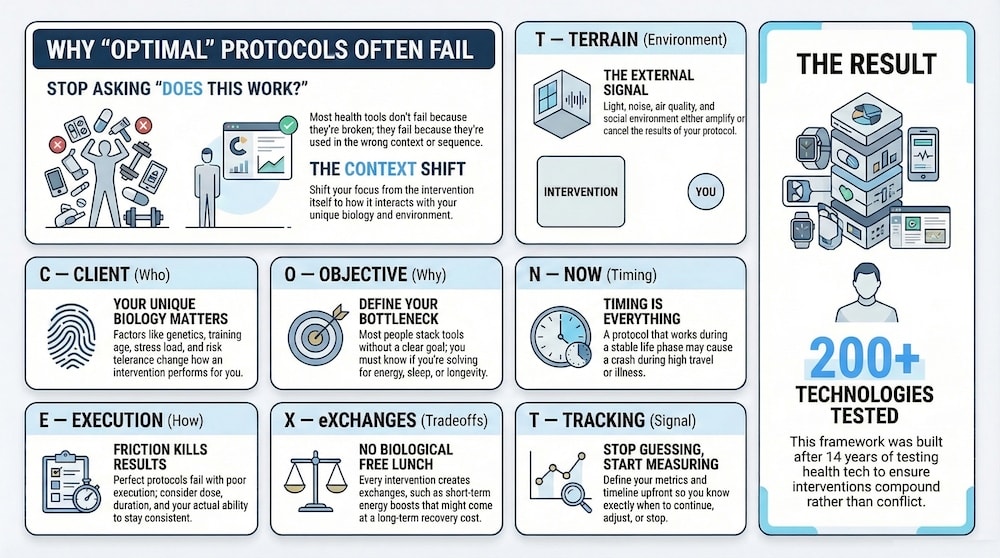
Before trying any new intervention, run it through these seven coordinates.
C. Client (who)
Who is this for, specifically?
Biology, goals, constraints, stress load, training age, sleep quality, and risk tolerance all change how something works.
An intervention that’s perfect for one person can backfire for another.
O. Objective (why)
What problem is this actually solving?
Energy, sleep, cognition, recovery, longevity, resilience.
If the objective isn’t clear, the intervention won’t be either.
Most people stack tools without defining the bottleneck they’re trying to remove.
N. Now (timing)
Why now?
Circadian timing, life stress, travel, illness, training phase, and recovery status all matter.
The same protocol that works beautifully in a stable phase can fail during chaos.
T. Terrain (environment)
Where is this happening?
Light exposure, noise, air quality, mold, temperature, work demands, microbiome, and social environment all shape results.
Your environment (internal and external) either amplifies or cancels what you’re trying to do.
E. Execution (how)
How will this actually be implemented?
Dose, duration, consistency, friction, and adherence determine whether something works in the real world.
Perfect protocols fail with poor execution.
X, eXchanges (interactions & tradeoffs)
What does this affect besides the intended target?
Every intervention creates exchanges:
- short-term vs long-term
- energy vs stress
- benefit vs cost
- synergy vs interference
Most people ignore interactions and second-order effects.
That’s where many problems begin.
T. Tracking (signal)
How will you know if it’s working?
What metrics matter?
How long should it take?
What tells you to continue, adjust, or stop?
If you’re not tracking, you’re guessing.
Context determines outcome
A cold plunge, peptide, supplement, workout, or fasting protocol can be incredible in the right context and harmful in the wrong one.
Coffee can be a helpful tool when taken in the morning, and crushing when taken before bed (or with the wrong genetics, or by someone highly stressed, or when combined with other heavy stimulants).
The tool isn’t the problem.
The context usually is.
This is why two people can try the same “optimal” protocol and get completely different results.
One ran it through context. The other didn’t.
Making the Context Shift
Most of the health world focuses on choosing interventions.
While that can work, I prefer a context-first approach.
Instead of asking:
“Is this good or bad?”
Ask:
For who, for what goal, at what time, in what environment, with what tradeoffs, and how will I know?
Run that filter consistently and your results change fast.
Because the right intervention in the right context compounds.
Have you personally noticed any unintuitive biohacks that work great in one context but backfire in another? Drop a comment below and let us know!

Comments