
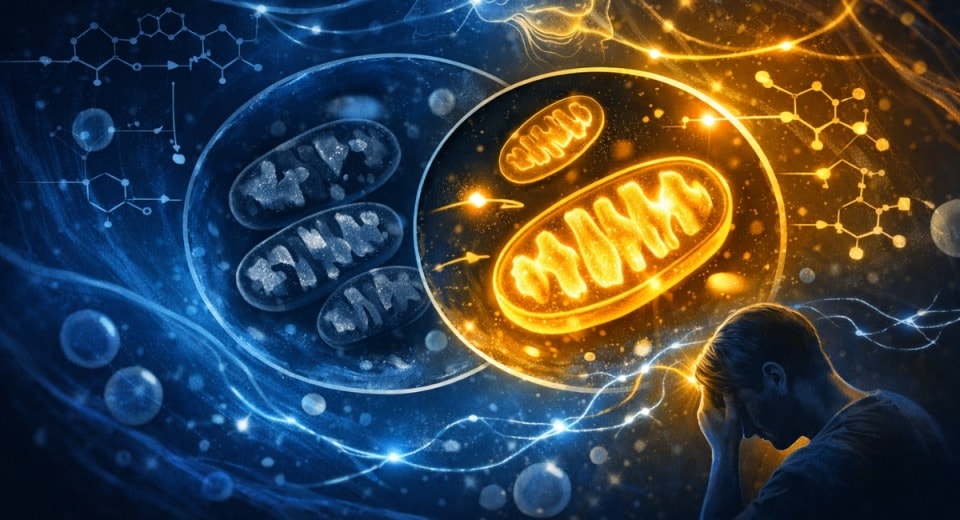
With Dr. Scott Sherr of Troscriptions, Episode 252




What You’ll Learn
- Holobiont concept: Why Dr. Sherr reframes biohacking as “biont hacking” to account for the trillions of organisms that make up your body. [01:01]
- Sympathetic spiral of doom: How chronic fight-or-flight activation degrades mitochondrial function and triggers a cascade of fatigue, brain fog, and anxiety. [06:01]
- HRV as a nervous system barometer: Using heart rate variability to gauge whether your autonomic nervous system is stuck in sympathetic overdrive. [14:04]
- Mitochondria beyond the textbook: Reproductive cells contain the most mitochondria per cell, with the brain, heart, and liver close behind. Neurons hold up to 1 million. [21:25]
- 5 root causes of mitochondrial dysfunction: Sympathetic overactivation, insulin resistance, environmental toxins, infections (COVID, mold, Lyme), and common medications like metformin and PPIs. [41:00]
- GABA-glutamate imbalance: These 2 neurotransmitters account for 80% of brain signaling, yet most doctors prescribe SSRIs instead of addressing the GABA system. [50:58]
- Methylene blue as a bridge: After nearly 6 years of clinical use, Dr. Sherr explains how this 1870s compound supports mitochondrial energy production and gets triaged to the organs that need it most. [48:50]
- Obligate pairs for GABA support: Combining a GABA source with a GABA receptor enhancer prevents the tolerance and dependence associated with alcohol and benzodiazepines. [53:26]
- The parasympathetic edge: Why relaxation is not weakness. Operating from parasympathetic mode gives you more capacity and reserve when you actually need to perform. [01:07:37]
Why It Matters
Most people treat fatigue and anxiety as separate problems, cycling through caffeine, sleep aids, and SSRIs without addressing the shared root cause. Dr. Scott Sherr, an integrative hyperbaric medicine specialist with nearly 6 years of clinical methylene blue experience, traces both symptoms back to mitochondrial dysfunction and a GABA-glutamate imbalance. His framework offers a clear sequence: stabilize mitochondrial energy first, restore GABA signaling second, then layer in long-term lifestyle optimization.
Who Should Listen
- Biohackers who stack red light devices, hyperbaric sessions, and nootropics but still feel stuck in a fatigue loop.
- High performers running on sympathetic overdrive who can’t downregulate despite meditation and breathwork.
- Anyone exploring GABA support, methylene blue, or mitochondrial supplements and wanting a clinician’s sequencing protocol.
Episode Overview
Dr. Scott Sherr, integrative hyperbaric medicine specialist and co-founder of Troscriptions, joins Nick Urban on the High Performance Longevity podcast to break down why mitochondrial dysfunction sits at the root of modern fatigue, anxiety, and cognitive decline. With nearly 6 years of clinical experience using pharmaceutical-grade methylene blue, Dr. Sherr explains how chronic sympathetic nervous system activation creates what he calls the “sympathetic spiral of doom,” draining mitochondrial reserves and depleting GABA stores.
The conversation covers his 3-tier intervention framework: short-term methylene blue as an energy bridge, medium-term GABA system restoration through obligate pairs (a GABA source combined with a receptor enhancer), and long-term Health Optimization Medicine protocols spanning 7 modules. Dr. Sherr shares specific data points, including that glutamate and GABA account for 80% of brain neurotransmission, and that eggs and sperm contain the most mitochondria per cell.
You’ll walk away with a clear understanding of why sleep architecture is the safest starting point for nervous system recalibration, how to avoid the “sympathetic crash” that comes from downregulating too fast, and why the parasympathetic state is not a luxury but a competitive edge for sustained performance.
Key Terms Quick Reference
- [01:01] Holobiont: The entire ecosystem of human cells plus the trillions of bacteria, fungi, and viruses living in and on you. Reframes health optimization as a whole-system project, not just human cells.
- [06:01] Sympathetic spiral of doom: Dr. Sherr’s term for the self-reinforcing loop where chronic stress depletes mitochondrial energy, which triggers more stress signaling, which further degrades mitochondria.
- [48:50] Redox cycling: The ability of compounds like methylene blue and molecular hydrogen to alternate between oxidized and reduced states, supporting both energy production and detoxification simultaneously.
- [53:26] Obligate pair: A supplementation strategy pairing a GABA source with a GABA receptor enhancer. Prevents tolerance buildup by avoiding depletion of endogenous GABA stores.
- [55:53] Nicotinyl GABA (B3 GABA): Vitamin B3 attached to GABA that crosses the blood-brain barrier via B3’s transporter. Provides GABAergic relaxation without sedation because B3 is mildly activating.
- [56:38] Agarin: A compound from dried Amanita muscaria mushroom that binds directly to the GABA receptor where GABA normally binds. Used at 1 mg or less in sleep formulations.
- [47:37] Health Optimization Medicine (HOMe): A 7-module clinical framework covering epigenetics, chronobiology, metabolomics, and more. Designed for long-term cellular foundation building rather than quick fixes.
Why Does Chronic Stress Destroy Mitochondria?
The short answer
Sustained sympathetic nervous system activation diverts cellular resources away from mitochondrial repair and energy production. The result is a self-reinforcing loop Dr. Sherr calls the “sympathetic spiral of doom.”
What Sherr found
In nearly 6 years of clinical practice, Dr. Sherr identifies chronic sympathetic activation as the number one cause of mitochondrial dysfunction. When the body stays locked in fight-or-flight, it prioritizes survival signaling over cellular maintenance. The mitochondria degrade, energy output drops, and the body compensates by ramping up stress hormones further. He ranks this above insulin resistance, environmental toxins, infections, and medications as the primary driver.
Heart rate variability serves as the key diagnostic indicator. Low HRV signals sympathetic dominance and correlates with reduced mitochondrial capacity. Dr. Sherr uses this marker to track patient progress throughout treatment.
What to do about it
Start with sleep architecture. Dr. Sherr considers this the safest entry point because downregulating the nervous system during waking hours can trigger reactive anxiety in patients accustomed to high sympathetic tone. Pair sleep optimization with short-term mitochondrial support (methylene blue) to create what he calls a “bridge” back to baseline function.
“When you’re always in this sympathetic loop, fight or flight, can’t get out. That’s probably number one.” – Dr. Scott Sherr
Related: Best Mitochondrial Supplements
How Does Methylene Blue Support Mitochondria?
The short answer
Methylene blue acts as an alternative electron carrier in the mitochondrial electron transport chain. It gets triaged to the organs with the highest energy demand first: brain, heart, and liver.
What Sherr found
Since launching the first commercial methylene blue product in February 2020, Dr. Sherr has documented consistent clinical patterns. The compound supports mitochondrial energy production through redox cycling, alternating between oxidized and reduced states. It preferentially reaches tissues with the greatest energy deficit. One patient who had lost her sense of smell for years after COVID recovered it the day after taking a quarter troche of Blue Cannatine at a conference.
What to do about it
Dr. Sherr uses methylene blue as a short-term bridge, not a standalone solution. The initial energy boost helps patients begin basic lifestyle changes (walking, sunlight, sleep hygiene) that would otherwise feel impossible during deep fatigue. Once the foundation is established, methylene blue shifts to an as-needed role for performance, travel, jet lag, or illness onset.
“What I’ve found with methylene blue has just been so transformative is that it’s that bridge for so many people.” – Dr. Scott Sherr
Related: Best Methylene Blue Supplements
Why Is GABA More Important Than Serotonin?
The short answer
Glutamate and GABA handle 80% of all brain neurotransmission. Serotonin, dopamine, and norepinephrine combined account for the remaining 20%. Yet standard psychiatric treatment targets the minority system.
What Sherr found
Dr. Sherr reports that most patients arriving with anxiety, depression, or insomnia have been prescribed SSRIs without anyone evaluating their GABA-glutamate balance. The conversion pathway runs from dietary glutamine to glutamate to GABA, requiring magnesium and vitamin B6 as cofactors. Most people are deficient in both. He also observed a patient whose GABA supplements stopped working after gut optimization, confirming the supplements had only worked due to a leaky blood-brain barrier.
What to do about it
Short-term, use an obligate pair: a GABA source plus a receptor enhancer. This avoids the tolerance spiral of alcohol and benzodiazepines. Long-term, optimize the gut (which repairs both intestinal and blood-brain barrier permeability), replete magnesium and B6, and prioritize glutamine-rich foods. Start with sleep-focused GABA support before daytime protocols.
“Glutamate and GABA together are about 80% of your brain’s neurotransmission. So serotonin, norepinephrine, dopamine, there’s many other neurotransmitters, 20% compared to glutamate and GABA.” – Dr. Scott Sherr
Related: Best Magnesium Supplements
The Sherr Mitochondrial Recovery Protocol
A sequenced approach to restoring mitochondrial function, nervous system balance, and sustained energy. Order matters: stabilize energy first, restore GABA second, optimize long-term third.
- Assess your HRV baseline: Low heart rate variability signals sympathetic dominance and correlates with mitochondrial dysfunction. Track daily to measure progress.
- Start with sleep architecture: The safest entry point for nervous system recalibration. Downregulating during the day can trigger reactive anxiety in people accustomed to high sympathetic tone.
- Bridge with methylene blue: Use pharmaceutical-grade methylene blue to boost mitochondrial energy production short-term, creating capacity for lifestyle changes that feel impossible during deep fatigue.
- Address GABA-glutamate balance: Use an obligate pair (GABA source + receptor enhancer) rather than alcohol, benzodiazepines, or standalone GABA supplements.
- Replete magnesium & B6: These cofactors are required for the glutamate-to-GABA conversion. Most people are deficient in both.
- Optimize the gut: A leaky gut correlates with a leaky blood-brain barrier. Gut repair simultaneously improves GABA metabolism and nutrient absorption.
- Layer biohacking tools on a foundation: Red light therapy, hyperbaric oxygen, and nootropics work best when mitochondrial function and nervous system regulation are already stabilized.
Common mitochondrial recovery mistakes
- Downregulating the nervous system too fast: Can trigger a sympathetic dump with reactive anxiety and cognitive dysfunction.
- Stacking biohacking devices without a cellular foundation: Red light, hyperbaric, and nootropics in a silo produce diminishing returns without addressing root mitochondrial dysfunction.
- Using alcohol or benzodiazepines for GABA support: Both deplete endogenous GABA stores, downregulate receptors, and create tolerance and dependence.
Source: Dr. Sherr’s Mitochondrial Recovery Framework, Troscriptions
Frequently Asked Questions
What is the sympathetic spiral of doom?
A self-reinforcing cycle where chronic stress depletes mitochondrial energy, which triggers more stress signaling, which further degrades mitochondrial function. Dr. Scott Sherr uses this term to describe how modern lifestyles keep the nervous system locked in fight-or-flight mode.
What cell has the most mitochondria?
Eggs and sperm contain the most mitochondria per cell. The brain, heart, liver, and musculoskeletal system have the next highest concentrations. This explains why reproductive health, cognitive function, and cardiac performance decline first during mitochondrial dysfunction.
How does methylene blue support mitochondrial function?
Methylene blue acts as an alternative electron carrier in the mitochondrial electron transport chain through redox cycling. It gets triaged to organs with the highest energy demand first, including the brain and heart. Troscriptions launched the first commercial methylene blue troche product in February 2020.
What percentage of brain neurotransmission involves GABA & glutamate?
Glutamate and GABA together account for approximately 80% of all brain neurotransmission according to Dr. Sherr. Serotonin, dopamine, norepinephrine, and all other neurotransmitters make up the remaining 20%.
Why do GABA supplements sometimes stop working?
If oral GABA supplements work for you, it likely means you have a leaky blood-brain barrier because GABA molecules are too large to cross an intact one. Dr. Sherr observed a patient whose GABA supplements stopped working after gut optimization repaired both the intestinal lining and the blood-brain barrier.
What is an obligate pair in GABA supplementation?
An obligate pair combines a GABA source with a compound that enhances GABA receptor binding. This dual approach prevents the tolerance, withdrawal, and dependence associated with alcohol and benzodiazepines, which bind to the GABA receptor so tightly they deplete endogenous GABA stores.
What is agarin & how is it used for sleep?
Agarin is a compound derived from dried Amanita muscaria (fly agaric) mushroom. It binds directly to the GABA receptor where GABA normally binds. Troscriptions uses it at doses of 1 milligram or less in their sleep formula TroZzz. Higher doses can produce twilight-like effects.
Why does Dr. Sherr start treatment with sleep optimization?
Sleep is the safest entry point for nervous system recalibration because people rarely experience reactive anxiety while sleeping. Improving sleep architecture helps regulate the sympathetic nervous system and supports mitochondrial repair before attempting daytime stress reduction protocols.
Products, Tools, & Resources Mentioned
Outliyr independently evaluates all recommendations. We may get a small commission if you buy through our links (at no cost to you). Thanks for your support!
Supplements & troches
Troscriptions: Precision-dosed, pharmaceutical-grade buccal troches formulated by Dr. Scott Sherr. Best for targeted mitochondrial and nervous system support.
Blue Cannatine: Methylene blue combined with nicotine, caffeine, and CBD in a buccal troche. Best for focus, energy, and cognitive performance.
Just Blue: Pure pharmaceutical-grade methylene blue troche from Troscriptions. Best for mitochondrial energy support without stimulants.
TroCalm: GABAergic relaxation troche containing nicotinyl GABA (B3 GABA) from Troscriptions. Best for daytime stress reduction without sedation.
TroZzz: Sleep troche containing agarin from Amanita muscaria at 1 mg or less from Troscriptions. Best for deep sleep support through direct GABA receptor binding.
TroMune: Immune support troche from Troscriptions. Best for immune system optimization.
Therapies & modalities
Hyperbaric oxygen therapy (HBOT): Dr. Sherr’s clinical specialty. Increases oxygen delivery to tissues and supports mitochondrial repair. Best for recovery, brain injury, and systemic inflammation.
Red light therapy: Pairs synergistically with methylene blue for enhanced mitochondrial energy production. Best layered onto an existing cellular health foundation.
Molecular hydrogen: Supports detoxification and energy through redox cycling. Dr. Sherr notes clinical relevance despite initial skepticism. Best for detox-forward mitochondrial support.
Organizations & resources
Health Optimization Medicine & Practice (HOMe/HOPe): Dr. Sherr’s nonprofit offering clinical training in the 7-module health optimization framework. Best for practitioners seeking integrative medicine education.
Dr. Scott Sherr’s practice: Personal consulting and integrative hyperbaric medicine. Best for direct clinical guidance on mitochondrial and nervous system protocols.
About Dr. Scott Sherr
Dr. Scott Sherr is an integrative hyperbaric medicine specialist and co-founder of Troscriptions, the company behind the first commercial pharmaceutical-grade methylene blue product. He provides worldwide hyperbaric consultation, education, and advocacy. With nearly 6 years of clinical experience using methylene blue troches, he has developed protocols bridging mitochondrial dysfunction and nervous system recalibration. Dr. Sherr also co-founded Health Optimization Medicine and Practice (HOMe/HOPe), a nonprofit training clinicians in a 7-module framework for cellular health optimization. He is the founder of OneBase Health, developing next-generation sensor and app technology for health monitoring.
Follow Dr. Sherr: Website
Related Episodes & Articles
- Episode 162: Mitochondrial Cellular Energy Optimization with Dr. Tim Jackson
- Episode 68: Methylene Blue Benefits Ultimate Guide with Mark Sloan
- Episode 147: Molecular Hydrogen Water Benefits with Alex Tarnava
- Episode 228: Hyperbaric Oxygen Therapy with Dr. Jason Sonners
- Episode 224: Nervous System Connection Longevity Framework with Blair LaCorte
- Article: Mitochondrial Supplements
- Article: Methylene Blue Supplements
Full Episode Transcript
Nick Urban [00:00:01]:
You’re listening to High Performance Longevity, the show exploring a better path to optimal health for those daring to live as an outlier in a world of averages. I’m your host, Nick Urban, bioharmonizer, performance coach, and lifelong student of both modern science and ancestral wisdom. Each week we decode the tools, tactics, and timeless principles to help you optimize your mind, body, and performance span. Things you won’t find on Google or in your AI tool of choice. From cutting-edge biohacks to grounded lifestyle practices, you’ll walk away with actionable insights to look, feel, and perform at your best across all of life’s domains. Hey, Dr. Scott, welcome to the podcast.
Dr. Scott Sherr [00:00:53]:
Well, it’s good to be with you, Nick. Thank you for having me.
Nick Urban [00:00:55]:
Tell listeners who are not tuned into the video version of this podcast what it is on that shirt you’re wearing.
Dr. Scott Sherr [00:01:01]:
Uh, yes. So for those that are watching at home, it’s, it’s called biont hacking, B-I-O-N-T hacking. So you’ve heard of biohacking. Everybody from your podcast probably has heard that word before, but this is actually a play on a different word called the holobiont. Have you heard this word before, Nick?
Nick Urban [00:01:19]:
I have. Break it down for us.
Dr. Scott Sherr [00:01:21]:
Yeah. So the holobiont is a very cool concept. The idea is that, yes, are you an individual that lives in a town that has a city that’s in a state, in a country? Yes, that is true. You live in an ecosystem as a human, as a person, but your organism is its own ecosystem because you’re not only made up of human cells, you’re made up of, fungus, bacteria, virus, and these vastly outnumber your human cells, which begs the question, of course, who’s controlling who in that capacity. Right. And so the holobiont is a concept where you look at external inputs and you look at internal inputs and how they’re interacting on the cellular level, at your basic cellular level, knowing that those inputs are not just human, they’re food, they’re microbes, they’re pollutants, they’re, cosmetics, their drugs and toxins, all of those things are affecting your human and your holo-organism together, not just your human cells. And so we have a nonprofit organization called Health Optimization Medicine and Practice, or HOMHOPE for short. This organization trains practitioners on how to optimize health rather than focus on disease using a 7-module certification.
Dr. Scott Sherr [00:02:43]:
And the primary or foundational module is called metabolomics. And metabolomics is the study of small molecules from that holobiont perspective, because they’re all looking, we’re all, we’re assessing real-time metrics happening at the cellular level from those external inputs, from those internal inputs, and then crunching all that information to understand how optimized or not you are. So if you’re biohacking without holobiont hacking, you are missing a foundation for what you’re doing. Because if you’re just biohacking your light and your sound and your water, these are all important. But if you don’t know actually what’s happening at the basic cellular level, you don’t really know what’s going on and how those other inputs, when you change them, are really working or having an impact on your cellular foundation. So holobiont hacking is the basis of what biohacking should be, which is giving you a foundation of everything else.
Nick Urban [00:03:43]:
Yeah. Well, there’s a really important and popular now concept of bio-individuality, or how we all differ from, like, based on a lot of different factors, including the things inside us, on us, around us, uh, and not just our human cells. It sounds like that metabolomics and biohacking is a way of, like, breaking that down, quantifying it, qualifying it, and understanding like the different components of what’s causing that bioindividuality. 100%.
Dr. Scott Sherr [00:04:13]:
Yeah. So bioindividuality is just a, a fancy term for personalization, right? The idea is that you’re personalizing your stack of supplements, your diet, your lifestyle to what you actually need. And you know, I give a, you, you’ll like, you’ll actually like this, Nick. In, in 2019, I gave a talk at a biohacking conference and I asked everybody in the audience if they took supplements. 99% of people raised their hand, right? But I asked the next question, how many people are taking supplements that they actually need because they base what they need on laboratory values that they’ve checked? And they said, okay, this is what I need because of those laboratory values. And maybe 30% of people raised their hand, right? Because most people are just taking things because they hear it’s cool or like, oh, like that new supplement that this influencer’s talking about, or like this new new, you know, supplement that I heard might be good for my gut or whatever, right? Instead of actually looking at the data itself and then creating a base stack of supplements that you’re taking based on that data and then following that data over time. And naturally what I talk about a lot with my patients is that you need to have a base level of things that you’re taking on a regular basis that’s based on your data, right? And this is your bioinvisualisation, but, but it’s more than just You know, data that you get from the ether. This is like, well, what, what kind of data are you using? Right.
Dr. Scott Sherr [00:05:34]:
This is data that metabolomics, I, I, I think at least in clinical practice is the most actionable because it’s telling you what’s happening right now in your cells, real time. Right. And then what has just happened in your cells. Right. And, and, and knowing this, right. We all have, you know, hearts and livers and brains. I, most of us, right. You know, maybe the scarecrows out there don’t have hearts or What is it? The Tin Man.
Dr. Scott Sherr [00:05:58]:
Um, I can’t remember which one it is. The brain is, it is the Tin Man’s the heart and the Scarecrow is the Tin Man. But anyway, that’s my, my Wizard of Oz, um, knowledge is a little bit rusty, but you get that we all have organs, right? And we all have tissue, but at the base of all of our organs and tissues is the basic cell. So if you wanna have best optimal neurologic function, you have to have a good cellular function too. If you don’t have good cellular function, no matter how many nootropics you throw at it, no matter how many peptides you throw at your brain, it’s not gonna be as helpful, as impactful as if you were optimizing from a foundational perspective first. So if you wanna have true neurologic optimization, you have to have true cellular optimization, true heart cardiovascular optimization, cellular optimization, true sexual optimization, same thing. True cellular optimization. So it all goes back to that, that’s that, that basic cell.
Dr. Scott Sherr [00:06:53]:
And that’s where metabolomics really shines because it takes things down to that level. Yes, you have hearts and livers and things like that, but at the basic level, it’s the cell that runs it all. You know, it’s like that one ring that rules it all in that other movie trilogy that I like as well, the Lord of the Rings, right? But not in a sinister way. This is in a positive way, you know? So.
Nick Urban [00:07:15]:
With that, there’s obviously a lot of value in this, and there’s a lot of different forms of self-quantification and testing. The typical annual blood draw that most people go to, you won’t necessarily see issues arising in, say, like the blood serum for things like minerals, because if there’s an issue, your body is going to work really hard to make sure it’s stable. It’s going to pull from bones, and you’ll see the same blood serum levels unless there’s a really big issue. How do you, like, do you use typical blood labs as well or do you focus mainly on metabolomics and perhaps other omics like proteomics and stuff like that?
Dr. Scott Sherr [00:07:50]:
Well, I mean, in, in the end, I think what’s gonna happen, there was a paper that was written almost 10 years ago and it talked about how in the future, you know, whenever that is, you’re gonna be able to me, you measure your genome, your transcriptome, your proteome, your metabolome, your epigenome, like there’s others, right? And this will become what we call your narcissome, right? It has everything about you. It’s like, it’s the narcissistic Scott and Nick, and you have this capacity to look at it real time. And then you’ll have AI like crunching all the data and being able to give real-time metrics of what you need to do today because of all those levels. So that’s kind of where we’re going. Right. Um, but right now what we have that’s really actionable, metabolomics is very, very actionable, right? Because you know exactly what’s happening now, what just previously happened, but it’s not, it’s not everything right in the sense that. It’s what I think the distinction I would make here is that when you go to your regular doctor, what they’re really looking at is signs for early signs of disease, you know, signs of, of illness, right? What metabolomics allows you to do, you can look at patterns of illness with metabolomics, but what is very cool about it is actually you can look for patterns of health. And so what we do at the nonprofit at Health Optimization Medicine is we look at it from a health perspective.
Dr. Scott Sherr [00:09:07]:
So how can you optimize somebody not to be normal for their age, but to be optimal for their age? What does that mean? That means optimizing somebody’s vitamins, minerals, nutrients, hormones, their gut neurotransmitters to when they were at their optimal age, which is between 21 and 30. So we shift all of the ranges to that age. So do you want to be normal for 50 years old? No, right? You want to be optimal for a 50-year-old or a 35-year-old or whatever you, you You don’t want to be, you, and that means being in that age range. And so you go to your regular doctor, and all of my patients, you know, in my, in my clinical practice, have to have a primary care doctor that they can go see on a regular basis to get those basic things done and basic cancer screening done and all those kinds of things depending on their age. But if you can shift the perspective to health and go, okay, well, what do we can do at this ground level, this foundational level, metabolomics, That’s where we can see power because you can prevent things from happening over the long-term. If you look at that cellular foundation, because at that cellular foundation, if you have a good cellular foundation, the risk of illness goes down dramatically, right? The risk of dege, deterioration, degeneration goes down dramatically. And there’s a lot of windows in this for people, Nick. I think that the one that was most interesting for me, and I think has become like a very hot topic over the last couple years.
Dr. Scott Sherr [00:10:34]:
People call it cellular medicine, but really what this, what I would describe this is, is mitochondrial medicine, looking at the mitochondria itself. Because if we know that dysfunctional mitochondria in general cause heart disease, they cause autoimmune problems, they cause cancer, basically any condition you can think of, most likely there was and is a mitochondrial component to this. It might not be the only thing going on. It might be because of toxins and infections and things like that. But in the end, It’s a mitochondrial dysfunction. And so what we do with metabolomics, what we can do is really get a significant dialed-in understanding of energy metabolism, of how well your cells are making energy and how well your cells are dealing with the energy production that we make, because we’re more like gasoline-powered cars. We make ATP, our energy currency. We also make water and carbon dioxide, and we make reactive oxygen species, the free radicals as it is.
Dr. Scott Sherr [00:11:31]:
We need some of these to help signal the mitochondria, how to know how much energy we should be making. But if we make too much, or if we don’t have enough antioxidants around to help neutralize that, we start getting into trouble. And this is where we get deterioration of function over time. And the statistics are crazy. It’s like 94% of US adults have some element of mitochondrial dysfunction, right? And if you can think about the, how significant that is, And you, it’s, it’s correlated to everything you can imagine from a disease perspective, but it takes a while for disease to manifest. It doesn’t happen right away. And that’s the good thing. We have, we have compensatory mechanisms so that the sooner we can address what’s happening foundationally, the faster we’re gonna see benefit, of course, but also the more long-term benefit you’re going to see.
Nick Urban [00:12:19]:
We’ll zoom into the mitochondria and cellular optimization in a minute. But to zoom back out first, like, what is the, if like all these tests are like the metabolomics test is for the holobiont and like understanding like what’s going on uniquely inside of you, what’s the reason it hasn’t been adopted? I know when I looked into it a bit previously in previous years, it was fairly expensive. Has the cost come down at all?
Dr. Scott Sherr [00:12:46]:
So it is expensive, but the cost has come down. So both. It’s not a simple test to read, Nick. It’s not like you can just look at this as a, as a doctor and say, oh, this is what you should do because it, everything is networked. Or you’re looking at like B vitamins and then antioxidant capacity and then mitochondrial function and energy metabolism. Like these are all things that you can’t look in, in a silo. Right. Um, it’s doctors are, are taught to look at B12 and folate levels.
Dr. Scott Sherr [00:13:13]:
Right. But there’s like a couple of other B vitamins, right? That’s why that says B12. Right. And so like, There’s a lot of B vitamins, right? And so how do you look at those in a network fashion? Metabolomics has been around for almost 30 years and it’s just starting to get more diffusion inside the integrative world over the last 3 to 5 years. Actually, most of that’s still from a disease perspective, looking at it from that angle, which is how can it help? How can we optimize your metabolomics to help your diabetes, your high blood pressure, your, you know, those kinds of things. Um, That’s good, but it’s still sort of missing the point where if you can shift that perspective from over, from the disease perspective to health and just optimize that cell on its own. And when I met Dr. Ted Otracosa, who’s the founder of, of Health Optimization Medicine, 2017, and he kind of gave me this perspective shift, it was like, why aren’t we doing this, right? It almost becomes like so obvious, right? And then, you know, it’s a good idea when something is so obvious to you as a clinician, and you’re like, well, why aren’t we doing that, right? Why aren’t we just saying if we optimize that basic cell, everything is going to get easier, everything’s going to get better? Very likely you’re going to see a significant decrease in risk of various things over time.
Dr. Scott Sherr [00:14:28]:
This is hard to study, right, as you know, because if you optimize the system and you prevent things, well, you have to have huge populations to be able to see these kinds of outcomes over time. That’s why it’s been so difficult for functional medicine, right? Because you have a number of, you’re not just doing like one thing for this patient. You’re doing, let’s give you a dietary strategy, a supplement strategy, like a way to decrease your stress. And like, and that overall has a fantastic benefit, right? But it’s not just like it’s one marker. Like, let’s give them B12, let’s give them a little bit of iron, you know. Like, these are important, but they’re, they’re one metric over multiple metrics, right? That are what one, or one piece of data over like multiple pieces of data when, when data is very networked together. And so it’s not easy to interpret. That’s what we teach actually in the course is to teach how to interpret a metabolomics test along with other things as well.
Dr. Scott Sherr [00:15:22]:
It’s not cheap, you know, it’s not always covered by insurance either. It’s gonna cost $400 to $600 to get a metabolomics test typically. So it’s not thousands of dollars, but it’s not, you know, it’s not, you know, pennies on the dollar either.
Nick Urban [00:15:35]:
And then to play devil’s advocate a bit here, if we’re going to the cell, as some people say, go, go to the cell to get well, and we’re focusing on optimizing that, why don’t, why doesn’t everyone just start there? What’s the issue with just like, it seems like it’s not very personalized. And perhaps the interventions we’re doing to actually address the cell are personalized, but like that concept of like focusing on the cell as like the initial target seems fairly broad.
Dr. Scott Sherr [00:16:02]:
It’s not sexy enough for you, Nick? Is that what you’re telling me?
Nick Urban [00:16:05]:
Yeah.
Dr. Scott Sherr [00:16:06]:
It’s one of those things where we get so, what’s the word? We get so tantalized. We get so wrapped up in something new and, and, and sexy and, and exciting. This is the biohacking movement to a T, right? Like, what’s that squirrel? What’s that squirrel? Like, but like, we’re not very good as humans, right? To think about the long term, to think about things that are boring but might be the most important on a day-to-day basis. You know, evolutionarily, all we’re really supposed to do, guys and gals, is survive and procreate. That’s it. You know, that’s all evolutionarily we’re supposed to be doing. Now, we have another part of our brain that allows us to think and to feel and to have, you know, complex emotions and things like that, but it’s still just to procreate and to survive if you’re not careful, right? And so, and we like novel things where we like novel ways, because that’s how we’ve evolved as a human species to live in novel locations, to create novel ways of doing things, right? So when it comes to understanding the cell, what I try to shift in perspective again is like, this is the most novel thing that you can do because your cell is extremely different on how it’s actually working compared to somebody else’s, right? And if we can take it this level, Everything else is going to get easier. You’re going to see the ramifications on every macro level you can imagine, right? But it’s not basic in the sense of how complex it is.
Dr. Scott Sherr [00:17:35]:
It’s just the basic fundamental building block. Think of it this way, right? The idea is that if you can have a pattern that repeats itself at scale, but it starts off very small, like if you can find that base pattern, everything else is going to sort of expound, or it’s going to be exponentially increased in a positive way from there, right? Because you had the seed correct. If you had the seed incorrect, right, and you’re now exponentially, you know, building from there, well, the whole thing’s not going to go as well, right? So think about it as the, the word that’s used in, I think it’s in physics, is the fractal, right? It’s like that base pattern. It’s like your Fibonacci sequence or your Or the golden ratio, if people know those kinds of things, like these are patterns that repeat themselves in a way that you see in nature all the time. But if that pattern’s not correct in the beginning, it all goes to shit. Right. And so, well, what happens is that, that basic cell loses those beautiful patterns over time. And then it, it, those patterns then in a negative way propagates, right? So the goal is to bring back to that base pattern and to work on that base.
Dr. Scott Sherr [00:18:56]:
Is it more sexy now? I don’t know. Definitely not yet. Okay.
Nick Urban [00:19:00]:
You know, it is, some of our colleagues have other viewpoints about like where it makes the most sense to start. We probably know about muscle-centric medicine or muscle-centric health, and then the immune-centric perspective, then the nervous system-centric. What’s convinced you that the cell is that place to focus aside from it being just like the smaller of the units that I just mentioned?
Dr. Scott Sherr [00:19:24]:
It’s the base of all of those things. Like, that’s what I mean. Like, like, and so yes, we’re, you’re thinking about muscle, we’re thinking about nervous system, but it’s all manifesting on the cellular level. Right. And so like, I talk a lot about sympathetic activation these days, and I think it’s important because most of us are living in fight or flight. More of the time than they realize, right? And that’s that sympathetic activation. And what does that do? Hormones like cortisol go through the roof. Neurotransmitters like norepinephrine and epinephrine spike.
Dr. Scott Sherr [00:19:53]:
That puts a lot of stress on your mitochondria, a lot of stress on your cell to make more energy. Can’t do it all that well over time. It’s going to break down. The system is going to break down. The immune system is going to break down. The muscles are going to break down. The whole thing, right? And so What I, I guess what I always try to, you know, sort of zoom out and say, yes. Do I think muscles are important? Absolutely.
Dr. Scott Sherr [00:20:15]:
Right. I, I think that’s a big deal. Do I think nervous system regulation is absolutely important? Yes. But what if I was going to break it down for you, Nick, in sort of two major buckets, it would be nervous system regulation and mitochondrial dysfunction, because if you can work on those two together, as mitochondria being sort of the window into the cell from energy perspective. And then the nervous system regulation, knowing that we can have very much things outside of our, in outside of our holobiont, for example, that are causing that stress. But we can also have things inside of our holobiont itself that are causing stress on the system that can be spiraling our, our stress in various ways. If you can work on them together. I found that that’s, you know, the most powerful combination of looking at this in sort of more of a very sort of specific way.
Dr. Scott Sherr [00:21:07]:
And there’s something that I, I’ve, I’ve, you know, uh, very nicely or very terribly called the sympathetic spiral of doom. And, and I think that, you know, it sounds ominous, but really what it is is describing this pattern that I think if, if we can address in people now and in the long term can be transformative to their health.
Nick Urban [00:21:25]:
So I think people have heard the term mitochondria possibly in an early biology class as like the powerhouse of the cell. And some of the research I’ve seen around mitochondria is, like, paints a very different, more comprehensive picture of what exactly they do. Even if they were just to produce the energy, that would be very significant because everything in the body, every process requires energy to operate. And if you don’t have enough energy, you have a power shortage, and then you have to choose where to cut resources. So you can, you, your body has to choose between what functions are less important. But then also, like, I saw some research about the certain cells having more mitochondria than we see in the textbook, which shows one per cell, versus I think neurons in the brain have up to like a million mitochondria. What is it? Why are these so important to humans?
Dr. Scott Sherr [00:22:15]:
Well said, and thank you for the preamble, Nick. I mean, I often like to ask the question What cell in our body, human cell, has the most mitochondria per cell? Do you know?
Nick Urban [00:22:26]:
I thought it was neurons, but maybe not.
Dr. Scott Sherr [00:22:28]:
It’s close. So neurons are second to eggs and sperm. So eggs, so our reproductive process, you know, not for, for men, it’s pretty quick, you know, but sperm have lots of mitochondria per cell. For, for females, the eggs have the most mitochondria per cell, but just behind the reproductive organs is actually the brain and the heart and the liver, uh, musculoskeletal system, kidneys, et cetera. And so yes, in science class, my daughter, she’s 15. She showed me a picture of the cell that she was learning in biology class. It has one mitochondria, right? But that’s not the case. So we, we have a huge amount of energy demand.
Dr. Scott Sherr [00:23:07]:
In fact, um, you mentioned a really great, great way of thinking about it is that like we have to meet these energy demands on, on a daily basis. And if we can’t, well, what do we do? Right? We have to triage, right? And so So on average, you’re trying, your body’s trying to make about 150 pounds of ATP every single day. It’s a huge amount of energy, right? And a lot of that energy is going to where it’s required, right? Which is where you have the most mitochondria per cell. And so if you are having mitochondrial dysfunction in the brain, what are you going to have? You’re going to have brain fog. You’re going to have concentration problems. You can have mental health problems. You’re going to have a lot of black and white thinking.. And this is one of the things that I’ve been talking about a lot recently is that it’s much more difficult for your brain, for your cognitive capacity to live in the gray area, to live in nuance.
Dr. Scott Sherr [00:23:57]:
If you don’t have enough energy available to your brain to make that gray area possible. So you think about why social media is so effective in polarizing. It’s because it’s very much, much simpler for your brain to look in those polarized lenses than it is to look in that gray area in between, which is where most things are. So if you don’t, if you don’t have enough capacity to meet your energy demands, you’re gonna be much more apt to think in black and white rather than nuance. Okay. And so this is just kind of an example, but there’s a lot of other examples that we can give, but it’s really important to remember that what mitochondria are doing in, in essence is that yes, they are making energy, but they’re more sensing the needs of energy. Than making it directly only. Okay.
Dr. Scott Sherr [00:24:47]:
So they can sense how much you need and how little they need to make or how much they need to make. But what can happen over time is if you’re giving the sense, you’re giving the signal that the body’s supposed to be making all of this energy, but they can’t keep up with demand. What’s going to happen is that the mitochondria go into this hibernation stage called the cell danger response. And what happens there is that you’re no longer making energy from the oxygen that you’re breathing. And not very well, you’re actually making it from what’s called glycolysis or your anaerobic respiration, which is not very, very effective. And so what happens is that you’re starting to make less energy, but you’re putting your body in the state where it needs more. So then the sympathetic nervous system goes, well, holy shit, I need to make more energy. And so that put, pumps out more cortisol, more norepinephrine, more epinephrine, but you can’t do anything with it.
Dr. Scott Sherr [00:25:40]:
Right. And then it becomes this place where. You feel not so good. And so when people ask me like, what does it feel like to have, you know, mitochondria that aren’t functioning well and being in the sympathetic loop? Well, it’s, it’s spectrum of course. Right. But in the end, you’re tired, but you’re wired at the same time. You can’t recover anymore from simple things, maybe from a day of flights or a bad night of sleep. Um, you have a mood that’s all over the place.
Dr. Scott Sherr [00:26:07]:
Like your mood is up. It’s down, it’s left, it’s right. It’s sideways when it used to be, you know, pretty even keel, right? Um, you will feel like little things become big things, whether it’s like a small little injury that just doesn’t get better for a long period of time, or like you’re just working out the gym and all of a sudden you start getting these small injuries that just weren’t an issue before, right? These are all potential signs that your system is under significant stress and that there is this sympathetic, loop with this mitochondrial dysfunction that’s happening. Now, it may not be severe yet, um, and you may just be mild, and, and that’s obviously better than if you’re at that, you know, more sort of more significant spectrum. But no matter where you are on that spectrum, there are things that we can do to help.
Nick Urban [00:26:51]:
Yeah, we’re definitely gonna double-click into those ’cause that’s an important part of the conversation itself. It also sounds like a lot of the things you’re mentioning, the symptoms and the side effects of having like poor mitochondria health or function correlate very strongly with age? I know, I know there are a few different companies that have mitochondria tests these days. I think they’re like blood, maybe they’re, I hope they’re not muscle biopsy, but you submit them and it tells you how well they’re functioning. But do we see mitochondrial decline of some kind as humans age?
Dr. Scott Sherr [00:27:22]:
Yes. I mean, in short, we’re gasoline-powered cars, as I mentioned. So we rust over time because we have to make so much energy to run these meat suits that we wear. While we’re here. Okay. And so yes, the process of energy metabolism, the process of making energy is something that does age us. In fact, it may be the thing that ages us more than almost anything else. Um, when it comes down to it, and there’s a lot of tests out there that have come out, especially over the last couple of years that purport to talk about mitochondrial function.
Dr. Scott Sherr [00:27:55]:
You know, it’s all very unclear at this point on how easy it is to interpret them. I was talking to another one of my colleagues yesterday. Actually, and we were talking about how some easy things, like some easy tests can be much, much better as windows and much less expensive, maybe not much better because we don’t have, you know, direct correlations yet, but at least less expensive.
Nick Urban [00:28:16]:
Right. What are those tests?
Dr. Scott Sherr [00:28:17]:
I mean, they’re very simple ones. They’re looking at, um, like even your uric acid level, interestingly enough, like if you have a uric acid level that’s too low, that be, that could be because your, your mitochondria are under too much stress actually. So, and then. Or looking at lactate pyruvate levels, for example, or looking at LFTs. Um, there’s a couple other markers as well, looking, that could be very, very helpful here. Um, and what I, what I think is important to understand is that the only gold standard right now for mitochondrial function is the one that you said that people you hope are not getting, which is a muscle biopsy, right? Is that’s the only sort of gold standard for this. Like what I do in clinical practice is I use metabolomic testing, right? The metabolomic testing itself is good because it can give you sense of energy metabolism, antioxidant capacity, you know, vitamin, mineral, nutrient status. And so I can follow that over time objectively, and I can follow it over subjectively as well when I’m talking to people and, and working with them.
Dr. Scott Sherr [00:29:14]:
I found that, you know, basic labs with metabolomic testing is what I do to get a good sense of what’s happening. Um, and I get a good window into what’s happening. Um, I know there’s a number of different tests out there that are very specific. Like you have complex one, complex two dysfunction on your mitochondria. You have, and I did, This is interesting to me, but the answer, like I always reflect back, is that objectively we can do this with basic testing to get a good idea, maybe not exactly that much detail. And subjectively, if somebody’s coming in with the symptoms that I mentioned, they have mitochondrial dysfunction. And I know very likely that what I do to intervene there is going to be an effect on some of those complexes and things like that, that are that are going to see a benefit whether I know the complex or not, you know, like if I know it’s complex 2 or complex 4, like in the end it doesn’t usually matter because in the end it’s really the same conceptual framework you want to use to optimize the cellular system, you know, using the frameworks that I’ve been discussing. So I think they’re interesting.
Dr. Scott Sherr [00:30:16]:
I’ve had a couple of my patients send me some of the reports recently and I’ve definitely dug into them and I’m like, wow, this is super interesting. Yeah, you’re in, you’re actually recommending methylene blue. That’s interesting. But like, but But also most of the time what I’ve seen, Nick, is like, you have complex II, complex III dysfunction. Here are the 100 supplements you can think about taking as a result of that. I’m like, well, that does that, how does anyone, you know, what are you gonna do with that? Right. And so for me, it’s, I think it’s interesting, you know, mental masturbation on some level to get that granular detail. But from, but in clinical practice, it doesn’t matter as much because you have a good sense.
Dr. Scott Sherr [00:30:54]:
With a person as they’re with you right in front of you. What, what, what can you do now to help them? Right. And then knowing long-term, that’s the goal, right? But to get them there, you know, you have to think about what you can do short-term too, right? Because looking at metabolomic testing, for example, it takes a while for somebody to rebuild their mitochondria, to rebuild their vitamins, nutrients, their antioxidant capacity, their gut, you know, their GI st, I mean, their neurotransmitters, their hormones. These take. A while, right? And so you have to have things along the way that are going to help them too. And so that’s the clinical navigation that I’m always trying to, you know, to play with my patients is like helping them now along that longer path.
Nick Urban [00:31:33]:
So with metabolomics, like there, uh, with each test there’s a trade-off between are you getting a snapshot that’s right now that will change in 1 hour where all the values will be different, or is it stable? But then the issue with if it’s really stable and it’s like a much bigger snapshot, over, let’s say, the last couple days, weeks, months, it’s very hard to change and it takes a lot longer. So with metabolomics, are you seeing changes people make like fairly quickly or slowly? Like if, if I took a test today and then I changed my routine, how long until I would start to see differences on it?
Dr. Scott Sherr [00:32:07]:
3 to 6 months. So it takes time. It’s not something where you’re gonna see it initial, initially over a couple, you might start feeling a little bit better or feel a bit different. Sometimes not even the case. Like sometimes it takes, 3 or 6 months to start seeing the benefits of doing a shift in your, in your biochemistry, using, you know, supplementation, using dietary changes, you know, the whole thing. That’s what could be very discouraging for people sometimes because it’s like, well, I gotta wait 3 or 6 months to feel better. I’m like, well, look, it’s a long-term play, right? We’re looking at rebuilding your system from the ground up. That basic sexy cell we were talking about earlier.
Dr. Scott Sherr [00:32:46]:
But we can find ways to help support you along the way, and I think that’s what’s important. As a clinician, I know this, right? If somebody, if I tell my patients, don’t worry, it’s just going to be 6 months, you’re going to feel better, like, how many people are going to sign up for that, right? And understandably, like, I wouldn’t want that as, as if I was a patient too. And so what are those things you can give along the way to start giving people, you know, some relief now. Like, that’s where I think it’s super important. And that, my focus typically here is going to be on supporting the mitochondria, and I use a lot of methylene blue here, as you know, Nick. And then I also look at downregulating the nervous system, but I don’t expect them to work on their trauma tomorrow, right? Work on the, the issues they’ve had since they were a child. And that’s extremely important if you’ve had a lot of issues that have come up in the sympathetic nervous system keeping you feeling unsafe for years or decades, like, that needs to be addressed, ladies and gentlemen. There’s nothing I’m going to be able to do from a supplement perspective to help you.
Dr. Scott Sherr [00:33:46]:
And this is like, the funny thing is, I, as a conventionally trained doctor, I have colleagues that will say, you know, all those supplements that you’re taking, it’s just expensive urine, right? And I agree with them if you’re in this sympathetic spiral, if you’re in the sympathetic loop, because there’s no amount of mitochondrial support that I can give you that’s going to break that spiral. Okay. Because your sympathetic nervous system has to come down. Now that’s somewhat black and white that I just described here, because there’s nuance there. Because when you support somebody’s mitochondria a little bit, sometimes what you can actually see, especially if it’s more of a, a mitochondrial issue itself. You can see their nervous system relax because all of a sudden the mitochondria are making energy more effectively again. So there is a possibility. And I had somebody just a couple months ago, a practitioner, he’s like, Scott, you gave me, you recommended I take methylene blue.
Dr. Scott Sherr [00:34:45]:
I started taking it, my anxiety went away. I’m like, hmm, interesting, right? Because it’s not something that I would tell him or anybody, look, take methylene blue for your anxiety. Like, no, I’m not going to say that, right? But when you have a significant mitochondrial component to that stress response, that’s internally happening in the mitochondria. And you just, you take, you take off the contract a little bit there. You just, you let, you let things release a little bit. All of a sudden the mitochondria are starting to make more energy and the system can calm down a little bit. So yes, I say it’s very important to downregulate your nervous system. And, and, and, and if you, if you don’t do that, you’re not gonna see benefit, but there’s always nuance there.
Dr. Scott Sherr [00:35:28]:
Okay. So for me, sequencing wise, I always work on the mitochondria first, even if they have sympathetic activation, that’s kind of through the loop. Because if you just, again, as I mentioned, what, what’s an important other distinction here is that what I found is if you just downregulate somebody’s nervous system, calm them down. You don’t tell them to calm down. That’s a bad idea. Don’t tell anybody to calm down, especially your partner. Um, or your, you know, my wife, if I tell her to calm down, like that’s not gonna go well, but If you give them the experience in a safe space of calming the nervous system down and their ner, their mitochondria are not doing well, they’re gonna feel like crap. And they, and I had another practitioner, actually just another, another person come up to me a couple days ago and said, my practi, my naturopath, like I have mold toxicity, Lyme toxicity.
Dr. Scott Sherr [00:36:17]:
I’ve been on the stress loop. They gave me something to calm down my nervous system and I crashed. Why? Because the system was trying to compensate. Right. And then all of a sudden you took off any compensatory mechanism of that sympathetic nervous system and they just crashed. Right. So that’s why it’s so important. At least when you’re thinking about these things personally or professionally as a clinician, for me is like, focus on starting on that mitochondrial optimization first, even for just a little while, even if, you know, they have a lot more sympathetic work to do.
Dr. Scott Sherr [00:36:49]:
And most of us do, right? That’s okay. But get that mitochondria supported first. And, and that’s that window into the cell that’s so sexy, everybody, you know, that we really wanna start with in most people.
Nick Urban [00:37:01]:
It seems like you might be able to do them concurrently too. I saw a paper a couple years back, and this is your domain, so you probably know more about it than I do, but it was on methylene blue as like a fear extinction compound, or like helping people get over like traumatic experiences. And it’s not used in isolation. It’s used in conjunction with talk therapy or some kind of assistance. But what do you think about that? Like using certain molecules to help, I guess, downregulate the nervous system and also support the mitochondria at the same time.
Dr. Scott Sherr [00:37:31]:
I love that you mentioned that study. I, I have seen that one particularly, and methimazole’s got a, got a very interesting mechanism or very interesting mechanisms of action, right? It’s working in the mitochondria. Um, it’s working with both on the energy production side and detoxification. So I talked about how our cells are like gasoline-powered cars. Well, methylene blue comes in more like an electric-powered car. There’s no waste because it helps with energy, also helps with detoxification. So it’s not causing any energetic stress on the system. Um, like we would typically have in ourselves, but in, in addition to that, it’s all, that’s called being a redox cycler for those fancy people out there.
Dr. Scott Sherr [00:38:10]:
And then. In addition, it also prevents the breakdown of norepinephrine, serotonin, and at higher doses dopamine as well. And so there’s a, there’s a biochemical neurotransmitter aspect of things, which is interesting there too. So I think what it’s, what’s happening in like the fear-based response, it really in any mental health disorder, and there’s been studies in depression, in bipolar with methylene blue too, is that Yes, it’s happening on the neurotransmitter side and having a benefit potentially there too. And remember, this is also dose-dependent. Like, low doses of methylene blue not having a huge impact on neurotransmitters, they’re having some, but there is the mitochondrial component, which is huge with all this. And so I think that what people forget is that depression is not a serotonin problem, okay? Um, depression is biochemical maybe, but it’s mostly a mitochondrial issue, right? And then if there’s any neurotransmitter that’s actually prominent and correlated to depression is your GABA system. GABA being your primary inhibitory neurotransmitter, right? GABA calms down the brain.
Dr. Scott Sherr [00:39:17]:
It’s your brakes. GABA deficiency is associated with depression, anxiety, insomnia, tremors, mental health issues. It’s also associated with sympathetic activation. Much more GABA is, is associated with depression than serotonin. So let’s just throw that out there. But when I talk about sequencing it Nick, I, I think that it’s nuanced here, of course, right? So we have to have that energy capacity, but in essence, you can do them at the same time with good support for sure. But what I’ve found for people that, you know, are more tenuous is that starting off with the mitochondrial support first and then downregulating can be very helpful. I haven’t done a lot of this together with, in clinical practice with Methylene Blue and the, the Extinction and things like that.
Dr. Scott Sherr [00:40:04]:
I often get them supported, give them the experience of calming down their nervous system using GABAergic compounds, and then send them over to somebody that does, you know, talk therapy or psychedelics or, or EMDR or something else, like depending on what, you know, what they’re interested in or what is most aligned. But I love the idea, but you’d have to be a very skilled practitioner, I think, to be able to be doing all these things at the same time. I feel like I’m pretty skilled, but I’m not that skilled, you know?
Nick Urban [00:40:29]:
So, well, we will continue building the suspense just a little bit longer. When it comes to issues with mitochondria, we’ve mentioned a bunch of different symptoms and the conditions that can be associated with them. And it’s not as simple as just like, oh, I have low energy, therefore mitochondria issue. That’s, it can present in a lot of different ways. I’m also thinking about since like if there’s a ton of mitochondria in different types of cells, depending on the type of cell, but more or less, perhaps if we’re having issues with the functionality around certain organs or where those cells are most prominent, it’ll show up as symptoms there. For example, if I have mitochondrial issues, maybe my vision will deteriorate faster, or I won’t, like, I’ll have issues with my reproductive health or something like that. What are your thoughts there?
Dr. Scott Sherr [00:41:15]:
Well, the, where you have the most mitochondria per cell is where you have the most energy demands, right? So typically you’re gonna have it manifest mitochondrial dysfunction in the places where you have the most energy requiring, right? So If it’s reproductive issues like fertility rates, they’re not going up, you know, they’re going down.
Nick Urban [00:41:34]:
Right.
Dr. Scott Sherr [00:41:35]:
And this is really because of mitochondrial dysfunction. And I mean, I guess I should sort of maybe zoom out just a little bit here and say, okay, what, what are the main causes of mitochondrial dysfunction? Okay. So we’ve talked about one of the biggest, which is this sympathetic activation. When you’re always in this sympathetic loop, fight or flight, can’t get out. Okay. That’s, that’s probably number one. Number two though. Insulin resistance.
Dr. Scott Sherr [00:41:56]:
So if you have high blood sugars, your sugar is high, right? That means you have a lot of potential sugar to go to your cells to make energy, but your cells can’t keep up for forever and they start deteriorating in their capacity. Okay. So, and then the mitochondria start deteriorating as well. So mitochondrial dysfunction from insulin resistance, toxins in our environment, from anything from pesticides to cosmetics. To EMF exposures and others, right? Other things that are toxicity are causing mitochondrial dysfunction. Infections in themselves, so like your COVIDs, mold, Lyme, you know, you name it. Like even a, even a common cold is going to cause some element of mitochondrial dysfunction for a short period of time. Okay, and then you also have medications, medications that many of us are taking on a regular basis, proton pump inhibitors, birth control pills, Metformin, metformin has a significant impact on the capacity of your first complex in your mitochondria to work well.
Dr. Scott Sherr [00:42:53]:
The goal with metformin, it’s like a whack-a-mole situation where like you just make new ones all the time to compensate for the ones that aren’t working very well because of the metformin. You know, I don’t think it’s a great strategy for most people unless you’re a diabetic potentially, but I know metformin is a bit controversial there. But, um, but anyway, so those are the reasons why we have mitochondrial dysfunction at its sort of like high level. Okay. And then organ-based is where you’re going to feel it. Fertility, uh, brain function, uh, systemically with, you know, with pain, with inflammation, et cetera. These are all related to some element of mitochondrial dysfunction. What’s also interesting, Nick, is that, um, there are new studies showing there’s different populations of mitochondria that are, that have different phenotypes depending on the type of tissue that you’re in.
Dr. Scott Sherr [00:43:40]:
And they have different ways of sensing and making energy depending on demands. It’s like, it’s very cool. Like this is, this is very new research. I was just reading about a week ago. It was like, that’s why it’s, it’s very, and, and it’s not like just the mitochondria, like working on their own. They’re also giving lots of different signals to the nucleus, um, and how to transcribe proteins and, and how to not transcribe things. And, and so like there’s all this sort of vast communication. And so, you know, I think what we’re all becoming more at least in my world, interest in it is like, well, maybe it’s not the nucleus that’s really all that important, you know? Maybe it’s the mitochondria that are much more important.
Dr. Scott Sherr [00:44:18]:
In general, the nucleus are a warehouse for things to, to work, but what’s actually making all of that happen is happening outside of the nucleus. Your cell membrane, for example, is extremely important, right? Like, Dr. Ted, who I work with, he’ll, and he’ll always ask the question like, What is the brain of your cell? And everybody’s going to say the nucleus, but it’s actually not the nucleus. It’s your, it’s your, it’s your cell membrane because your cell membrane is what’s actually interacting with the outside environment in a way that actually creates signals and understands what’s actually happening. Right. And so your nucleus is just like, it’s a warehouse of things that, that is very, very important, but it’s your cell membrane. It’s your mitochondria. It’s your endoplasmic reticulum.
Dr. Scott Sherr [00:44:59]:
It’s the other aspects of your cell that are really. Making everything work and then go to the microtubular structure and then everything. And there’s all, you know, there’s, we can go down deep here, Nick, but in the end, the cell is where it’s at. It’s, I’ve made it sexy for all of you now. So everybody believes me.
Nick Urban [00:45:16]:
Well, I mean, that’s a compelling, like, demonstration depiction of the cell and why to focus there specifically. And you’ve already mentioned some of the causes why the mitochondria wouldn’t be working the way they could and should be. Now everyone’s fair apart, what are the things that we can do to help the mitochondria do their job most effectively and efficiently?
Dr. Scott Sherr [00:45:40]:
Calm down. Just, just relax. You know, it’s easy, you know, and, uh, go back to living 50,000 years ago ancestrally where you were getting good sunlight every day and the perfect water. And you had only stress when you were being preyed upon. And otherwise you were, You were okay, right? And you had, so the idea was stress, right? It’s like, we’re supposed to have stress. Stress is supposed to be there. It saves our lives, running away from, you know, the proverbial saber-toothed tiger, as we always say in medicine. But we’re supposed to have stress, and then we’re supposed to live most of our life in parasympathetic mode, relaxation, digest, detoxification, right? And so, but again, we don’t live in that kind of situation anymore, right? And so in the, in the world that we live in now, we have you know, synthetic lighting and, you know, toxic water and toxic people and toxic relationships and, and everything along the way.
Dr. Scott Sherr [00:46:32]:
So in my world, it’s like I break it down like this: there are things we can do now, short-term, things we can do medium-term, and things we can do long-term, right? I’ve already given you like the, the long-term window, which is Health Optimization Medicine, the framework, metabolomics, looking at, we have, there’s 7 modules of it. We look at epigenetics and chronobiology and, and multiple other things as well. So you can look at things long-term to optimize your diet, your lifestyle, your stress, and then optimize your supplementation to really work on that cellular foundation that we’ve been talking about. But again, that’s going to happen later. It’s not going to happen tomorrow. Okay. And then, well, then the biohackers out there, well, I should just get a red light device and I’m gonna get a hyperbaric chamber and I’m gonna take nootropics and I’m, and, and okay, okay. That’s my, that, that’s, that may be there, if you’re building a foundation at the same time and you’re adding in red light, you’re adding in hyperbaric therapy, you’re adding in, um, meditation devices that shock your brain or whatever, like, those can be really, really helpful.
Dr. Scott Sherr [00:47:37]:
And so I use all that stuff, right? But I don’t use it in a silo and say, okay, go just get the next red light device or go get the next hyperbaric chamber, like, of which I’m a big fan of hyperbaric medicine, as you probably know, right? So, and so the short-term now What can we do now, right? Because I think that’s the most important, is that, is that I’ve, I’ve alluded to these things and, and I’ve found various ways of doing it, but I use basic lifestyle maneuvers, lifestyle measures for people, and I start them on basic things on, from a supplementation perspective that I know they’re going to help now. Okay, so basic on the lifestyle, um, is just trying to get better sleep. Is that too basic for people, right? Is it trying You know, be better sleep, right? Getting a little bit better movement throughout the day. Um, trying to understand our hydration, trying to understand what it means to get a little bit of sunlight throughout the day. Like these are not things that are rocket science. Okay. But they can be hard for people without a little bit of motivation. And that’s where the supplementation really, really can be so effective where something like methylene blue, for example, which is this, you know, very strange blue pigment dye that came from the 1870s, 1870.
Dr. Scott Sherr [00:48:50]:
So a long time ago, it is old, but it’s very well understood that it has this amazing effect at supporting that mitochondria, those mitochondria, those quadrillions of mitochondria, by the way, it’s quadrillions in the body, help them make energy more effectively. And it’s going to get triaged to the energy production areas that are required. More than the ones that are not. So your brain will start feeling a little bit better. Your inflammation and, and dysfunction will likely start feeling a little bit better. And then all of a sudden you can move a little bit more, you can get a little bit more sunlight, you can start taking some other supplements that are going to be long-term for you. You can start thinking, well, maybe I should get a red light device because medlite, methylene blue and combining with red light, that’s going to be even better, right? But it’s what I found with with, with methylene blue has just been so transformative is that it’s that bridge for so many people, right? And once you get that bridge, once you get over that bridge, I should say, and you’re on that other side and doing well, then you can use it more as needed for performance, for travel, for jet lag, for when you feel like you’re coming down with something. Methylene blue I’m talking about here.
Dr. Scott Sherr [00:49:59]:
But in the beginning, it’s that bridge where you’re like, okay, now I can use this to start feeling a little bit better. So that I can do the things that I know are going to be helpful long-term or even medium-term, right? You know, and that’s hard for us to do sometimes. Like, sometimes even just taking a walk around the block is hard, right, if you’re not feeling good. And so finding ways and a path, that threading of the needle with, with methylene blue has been transformative in my clinical practice. And, and we have now almost 6 years, almost 6 years to the month of experience using methylene blue in clinical practice and understanding how it really is having this significant capacity, capacity enhancement of the mitochondria, right? And then on that sympathetic side, I’m thinking about the GABA system all the time. I’m thinking about how can you regulate the GABA system, put those brakes back on. GABA is always in balance with another neurotransmitter in the brain called glutamate. Glutamate Glutamate is excitatory.
Dr. Scott Sherr [00:50:58]:
GABA is inhibitory. Glutamate is converted into GABA in the brain. Many of us, I mentioned, are GABA deficient because of stress and many other things, but mostly sympathetic activation. So long-term, we need to build up that GABA system. Well, how do we do that? We optimize somebody’s gut. We, um, because if you’re, if your gut is, is leaky and you’re inflamed, well, all that glutamine that’s supposed to be powering your small intestine, but your gut is all leaky, so all that glutamine is going there to try to heal it. Glutamine’s an amino acid that we can get in our diet, right? Um, glutamine’s the precursor to glutamate, and then glutamate gets converted into GABA. Um, also you need magnesium and B6.
Dr. Scott Sherr [00:51:39]:
Magnesium and B6 are the conversion, to convert glutamate to GABA. So you need to replete those. Most people are magnesium deficient, right? And so, and B6 deficient too, right? And so as a result of this You want to think about that grain, that ground game. But that takes, again, that’s not going to happen immediately. It’s like optimizing somebody’s gut doesn’t happen tomorrow. Optimizing their magnesium and B6 level doesn’t happen tomorrow. And so what? Give them GABA supplements, right? The problem with GABA is GABA is too big of a molecule to get across into the brain. If you take GABA supplements and they work for you, it’s because you have a leaky blood-brain barrier.
Dr. Scott Sherr [00:52:16]:
Doesn’t sound good. It’s not, but it’s not the end of the world. The gut being leaky is a correlation dramatically for a leaky brain too. So if you can optimize somebody’s gut, you’ll also optimize their blood-brain barrier as well. And I’ve seen this in, in clinical practice where I had a patient, um, that was, you know, first came to see me taking GABA supplements. They were working fantastic. He was feeling so calm and relaxed. We optimized his gut and they stopped working.
Dr. Scott Sherr [00:52:46]:
Because his gut was no longer leaky, his blood-brain barrier was no, no longer leaking as well. So you can use other compounds. I use things like kava and CBD and CBG, which are great. Um, it’s important to know that alcohol and benzodiazepines are not your friend here, everybody. They do work on the GABA system too. They do get into the brain, no problem. That’s why alcohol and, and benzos feel so good, but they bind to the GABA receptor so tightly that they increase your risk of tolerance and withdrawal and dependence and things like that. And so we created a system that helps navigate the GABA system in a way that prevents you from having that.
Dr. Scott Sherr [00:53:26]:
And the key is to give a GABA source at the same time as giving something that’s going to enhance GABA to bind to its receptor. And that’s something, something called an obligate pair, obli-pair for the short way, and Um, that’s a company called Truscriptions that makes some of these products, by the way. And so, but given the experience of decreasing that nervous system overactivation gives you the feeling of where there is. And then when that nervous system goes back into parasympathetic, it’s like, oh, okay, I, I can meditate and get back there. I can do my breathwork and get back there. I can do my yoga poses and, and things like that. But if you don’t know where there is, You’ve been compensating for a long time. You know, the hustle is real, everybody.
Dr. Scott Sherr [00:54:09]:
I live the hustle too. We all do, right? It’s hard to calm down the nervous system, but you know, when, where there is, when you know, when, where there is, then you can get back there. And so that’s the short term for me is like giving the window of opportunity, opening up those critical windows, you know, for your brain neurochemistry to like reconnect and go, okay, we can do this, you know? And then we can do this long-term by doing some of the harder stuff. Um, that requires
Nick Urban [00:54:38]:
more long-term focus. Yeah, that was a really fascinating one, and it’s not very commonly discussed outside of like neuroscience circles. And I think because of you guys, it’s starting to get a little more press, but for a long time it got absolutely none. And there’s other forms of GABA that are less well-researched, but they’re still sometimes used, often previously in Russia. That do cross the blood-brain barrier and have pretty significant effects. But I think I’m just not gonna mention which ones they are because they’re more experimental than the, the way you
Dr. Scott Sherr [00:55:14]:
guys wanna, Yeah, there’s, there’s one, I think the one you’re talking about is nicotinyl GABA, vitamin B3 attached to the GABA. And that one’s pretty well, pretty well described. The thing about that one is it has a B3 attached to the GABA. So the B3 has a transporter that gets across and then it takes the GABA with it. So you can have an act, you can have an actively a good blood-brain barrier, um, that’s doing what it’s supposed to do and still get B3 GABA across. What’s nice about that one is that, um, B3 is mildly activating. And so you get the GABAergic relaxation, but you also don’t feel tired. And so we have, you know, Tro Calma, transcriptions has nicotinyl GABA, B3 GABA in it.
Dr. Scott Sherr [00:55:53]:
Um, the other compound that we use in a sleep formula is called agarin, uh, which is from the Amanita Mascaria mushroom, the fly agaric mushroom, psychedelic, um, mushroom. If you eat it without drying it, it’s toxic and you will not feel good. Um, drying the mushroom, uh, makes it less toxic because there’s another ingredient in there called ibotenic acid and ibotenic acid gets converted into agarin. Um, but ibotenic acid is also neurotoxic. Fun fact. So if you’re getting, if you’re looking at, there’s a, I think, I dunno if you’ve seen this, Nick, but there’s been more press around the Amanita recently and people using it in various ways. Um, but I get concerned about ipotenic acid content. Um, but we use just the agarin, which is long-acting, binds to the GABA receptor directly where GABA would bind.
Dr. Scott Sherr [00:56:38]:
And what’s, again, what’s nice about that is that you can give something that binds to a separate site that increases the affinity for GABA to bind. You’re giving a source of something like GABA binding to where GABA binds. So you’re not causing a deterioration or depletion of GABA, when you’re using a compound that’s binding to a separate site. So that’s a little bit tricky biochemistry, but in the end, what this means is that if you’re drinking alcohol, for example, you’re just vastly depleting your GABA stores very, very quickly. And as a result of that, your brain, your, your receptors go, well, we don’t need as many receptors anymore for GABA. And so you take away or you decrease the number of GABA receptors you need. And so get that same effect that you did the last time you drank alcohol or a week ago, you need to drink more. Right.
Dr. Scott Sherr [00:57:23]:
And then more and more and more. And that’s how it goes, right? That’s the American way. Um, and that’s what happens. It’s brain neurochemistry 101, right? It’s feedback loops. And so what we have done is try to make it so that you have this inability to have the dependence and tolerance because you’re giving a source of GABA at the same time. And I think that’s been very tran, I know it’s been very transformative, you know, for patients that I work with, uh, on various levels, you know, because having something that supports the GABA system
Nick Urban [00:57:51]:
goes a long way. Yeah. And for any explorers out there, I don’t recommend this, but there’s one other GABA-related substance called beta-phenyl GABA, or I think it’s called, pronounced phenibut, phenibut, phenibut, something like that. Yeah. And that’s another one, but it has a really high risk tolerance or risk profile. People get addicted to it. So use or not even use, research at your own peril. But there’s a lot of cool stuff out there and finding the right one that works for You and your neurochemistry is great.
Nick Urban [00:58:22]:
And if you guys want the safe option, Troscriptions has you covered.
Dr. Scott Sherr [00:58:26]:
Yeah, no, uh, it got taken off the market, phenyl GABA, because of those reasons, but it’s, it’s highly permeable against, across the blood-brain barrier. And so as a result of that, you have that, uh, that risk tolerance, the risk perspective. It’s not so much, it’s very different risk than drinking alcohol because it’s actually giving you GABA itself. Um, but it’s, But it’s highly addictive because you’re getting the GABA itself on its own without having some sort of governor on the wheel too. So it’s very interesting. Um, agaric is good. Um, but again, it has to, has to be used at low doses. Um, you don’t want to use, we’re using a dose of a milligram or less typically in a product versus, you know, a higher dose, which could almost sometimes not psychedelic and like, uh, like tripping on psilocybin psychedelic, but it’s more like a twilighty kind of thing that you can get on the higher doses of that.
Dr. Scott Sherr [00:59:15]:
So people have to be careful. Um, So that’s why it’s only in our sleep formula, for example. But, but you’re right. I think, Nick, that people forget about the GABA system. And like, if you go to your doctor with anxiety, depression, insomnia, OCD, or whatever, they’re going to give you an SSRI. They’re not even gonna think about the GABA system. Right. And it’s sad to me, right? It’s sad because we know most of this stuff is being regulated by glutamate and GABA.
Dr. Scott Sherr [00:59:39]:
Glutamate and GABA together are about 80% of your brain’s neurotransmission. 80%. So serotonin, norepinephrine, dopamine, there’s many other neurotransmitters, 20% compared to glutamate and GABA. So if you’re glutamate overloaded, you do not feel good. Okay. And the best example of this in the acute setting is go and have some monosodium glutamate at a Chinese restaurant.
Nick Urban [01:00:03]:
That’s one right there. MSG. It’s like, there’s so much debate around it. And like, it sounds like you’re not a fan because I think mo, most people already have too much glutamate and you’re gonna increase the conversion to glutamate in the brain if you consume MSG.
Dr. Scott Sherr [01:00:19]:
Yes. I, I, that’s the thing is some people are very quickly converting from glutamate to GABA if they have a system, but that’s the minority. Most people that are going to have MSG are not going to feel very good. They, it might be subtle, it might be like more irritability, irritability, like a difficult time sleeping that night. Um, a little more just you know, foggy in the brain, that kind of thing. But others would be like, this is the worst thing that ever happened to me, right? Because I can’t think. And like, I remember as a kid, like, my dad would go to, like, we’d go to a Chinese restaurant and my dad would be like just bombed from having some of the food. Like, I felt fine.
Dr. Scott Sherr [01:00:55]:
I was like, okay, I went to bed, you know. It’s also, I was also a kid, right? Like, when you’re a kid and you’re younger, you’re much more optimal in general. And that’s why again, your more optimal range is between 21 and 30 years of age. Right. And so that’s why you wanna build back the system and, and having capacity so that if you do have like a load of MSG, you’re not gonna suffer terribly from it.
Nick Urban [01:01:17]:
And the reason it’s used on food is because it teaches your brain to pair the food you’re consuming with hitting the gas when you’re increasing your glutamate levels.
Dr. Scott Sherr [01:01:26]:
Is that what it is? No, I, I, I don’t think so. I think I could be wrong though. So I have to look it up, but I thought it just makes it sweeter because I think it just makes it, it’s like an umami tasting almost. So it’s like MSG is just, so glutamine as an amino acid is sweet. So if you have glutamine, uh, if you have that in like in a powder, like you’re gonna, it’s like a little sweet, you know? Um, and so that’s why, um, that’s why it’s typically used is to make the food sweeter and more savory as a result of taking it. I don’t know if it has any capacity like that, that, that you’re talking about, but it, it very well could.
Nick Urban [01:02:01]:
Okay. And I, I have to rewind to something you said earlier and that you don’t necessarily, when you’re working on someone’s mitochondria, to, to downregulate them too quickly. You wanna make sure they have that capacity there first before you start working on the nervous system and like taking them out. Otherwise they can crash. If you’re using these things to support the GABA system, Will you not be causing a crash of some kind?
Dr. Scott Sherr [01:02:23]:
You have to be careful, right? You have to be careful if somebody’s in the sympathetic overload or, uh, piece that we were describing. And if you just downregulate them too fast, they can crash for sure. Because they’re used to being at such, you know, at a sort of tension level, right? And you just bring it down. And then there’s a psychology of that, which is important, but there’s also the mitochondrial piece, right? Which is very, very important too. And I, what I’ve seen in, in practice, I remember, this is a long time ago now, but it was almost, it was like the most, um, one of the, I have two different examples that I’m thinking of. It’s pretty profound, right? One would be a lady that I was working with at the time, and we gave her something to downregulate her nervous system. I’m not going to say what that was, and, um, it may or may not have been legal, but okay, short story. And she had this sympathetic dump where she got, she was like, oh no, what’s going on? My brain’s not working.
Dr. Scott Sherr [01:03:16]:
I don’t know what to do. Like, I, I’m not supposed to feel this way, right? Because you can get this reactive anxiety when you start coming down from that high level of tension. Okay. And so that’s an important thing to always be aware of when, when you’re thinking about this clinically, I’m thinking about this all the time because when I’m bringing them down, it’s, it’s, it could be very stressful psychologically. Okay. And then. Another example would be a lady that I wor, that we gave. So one of our products, Blue Cannotine, actually at a conference.
Dr. Scott Sherr [01:03:48]:
This is a combination of methylene blue with nicotine, caffeine, and CBD. It was our first product in, uh, 6 years this month in February when we launched it actually 2020. Um, Nick, you might’ve been one of our first customers. I don’t remember, but we were talking about it back then.
Nick Urban [01:04:01]:
Anyone who saw the blue tongues all over social media in the last 6 years, that was thanks to TroScriptions.
Dr. Scott Sherr [01:04:07]:
There you go. Right. Um, We gave her just a quarter of a troche of blue canthine. She had this physiologic response, right? Um, she hadn’t had smell for a couple years after COVID. She got her smell back the next day, right? And it was like, what is happening here, right? So we recalibrated her system very quickly using mitochondrial support. And then she was there with us getting emotional support while this was happening, you know, at the booth, interestingly enough. But, you know, I’ve done this before. You know, it’s fine.
Dr. Scott Sherr [01:04:40]:
Um, but I mean, I guess that’s a combination that we were talking about earlier, right? Um, as you said, like, you know, pair them together. So you have to be mindful of where somebody’s starting. Right. And the safest place to do this, honestly, Nick, is with sleep because when you’re sleeping, you don’t typically get a lot of anxiety, you know, so people do, but it’s less common. And so. So what I’ll typically do here is work on sleep specifically for people, um, before I start really working on their stress during the day, because if you can get them to sleep better, typically their nervous systems can be better regulated. Um, their mitochondria, you know, even from that are going to work a little bit better. Um, and so it’s a bit of a dance, you know.
Dr. Scott Sherr [01:05:23]:
Um, but I think what I found over the years with this sympathetic spiral of doom, as I call it, is, is that mitochondrial support is essential. Essential and sleep is essential. Okay. And so it depends on the person, but oftentimes I’m trying to really work on their sleep architecture, um, as the primary driver of regulating their sympathetic nervous system before we’re even thinking about, you know, their stress during the day, because that can be much harder for people to initially tolerate for the reasons just mentioned.
Nick Urban [01:05:54]:
All right, Dr. Scott, for people who’ve made it this far, any final substances? If I was to list a bunch of the common stuff out there from mitochondrial peptides to molecular hydrogen, to PQQ, taurine. Are there any either substances or lifestyle things or protocols that you think are worth looking into?
Dr. Scott Sherr [01:06:13]:
We end a podcast with that big of a question, my friend. Um, I’m just kidding. I, I think that a couple things come to mind. I, the one that, um, I, I was thinking about earlier, molecular hydrogen’s very interesting to me. I was not very excited about this one initially, but it’s something that I do see clinically relevant actually in patients and in personal experience, which I was, I was honestly surprised about. It’s actually, it has its own capacity to redox cycle, just like methylene blue. And so it does help with energy and detoxification. It’s more detox than energy, but it’s definitely got an energy production side of it, which I think is interesting.
Dr. Scott Sherr [01:06:44]:
I mean, to get a little bit crazy, I, I’m very, um, bullish on ketamine in general. I think ketamine therapy, especially for sympathetic downregulation and understanding like the long-term recalibration of the nervous system, is huge, especially shutting down the default mode network, which is the part of the brain that, you know, the ego sits, where all your stories are. And also, we know that increases neuroplasticity as well. Some of the other psychedelics have also been shown to do this, um, things like psilocybin and LSD and others. And so I think that there is probably a role for some of that in the right context, location, legality. You know, everybody should come move here into Colorado with me, it’s all decriminalized anyway. But, um, so I think the psychedelic world is a very interesting place from mitochondrial perspective, and I think Um, we definitely are going to be seeing more and more when it comes down that way. Um, I think when it comes to lifestyle, I think the biggest thing, as I mentioned, is just finding ways to downregulate the nervous system.
Dr. Scott Sherr [01:07:37]:
Most of us don’t need to be doing more with our life and we need to be doing a little bit less, you know, and having more time to, to, to come into parasympathetic. And I think that’s something I try to recognize personally. Um, and also, you know, with my patients as well. So I’m, I’m a big proponent of, of those kinds of, perspectives and shifting my patients into, into parasympathetic mode. And I call it the parasympathetic edge, by the way, Nick, because when you’re more parasympathetic, you have a bigger edge than you actually realize. You have more capacity, you have more reserve, you can do more because you have more of a delta, you have more of a, a shift that you can make when you need to actually get shit done. And so remember, it’s not a weakness, it’s an edge being in parasympathetic mode. And that’s what I tell my patients,
Nick Urban [01:08:19]:
and, and that seems to help I love it. I call recovery in general the edge. It’s not, performance comes from adequate recovery. So I love to hear that, that nuance, that it’s not even just recovery, it’s being in parasympathetic.
Dr. Scott Sherr [01:08:32]:
I think we’re talking the same thing. I think what I’m doing is, is just bringing it out a little bit, like a little, like 1 or 2 more levels and just saying it’s parasympathetic.
Nick Urban [01:08:41]:
That’s the key. Well, Dr. Scott, if the biohacker out here want to connect with you to check out transcriptions How do you wanna send them?
Dr. Scott Sherr [01:08:49]:
Where do you wanna send them? We’ve converted them all from biohackers to bione hackers, I hope. And at least to think about things in that way. So yeah, if you’re interested, our company’s called TruScriptions, uh, truscriptions.com is the website. We have a couple different products, Blue Canotine, Just Blue, that are involved on the, in, in the methylene blue side of things. We are the first company actually with a commercial product with methylene blue back in methylene blue back in 2020. Um, we have some of the best stuff out there. Uh, we have the best purity, you know, the best, uh, quality out there that we’ve been able to find and consistently have over the number of years. Um, and then we also have something in the GABAergic space, TroCom, TroZzz.
Dr. Scott Sherr [01:09:25]:
You can check those out for relaxation, stress reduction, anxiety, sleep. So check it out at transcriptions.com. Um, our nonprofit’s called One Base, excuse me. Yeah, that’s it. And TroMune, nice. We have TroMune as well, which is one of our other products, uh, that I love. Uh, Transcriptions, um, our nonprofit’s called Health Optimization Medicine and Practice. Homehope.org is the website.
Dr. Scott Sherr [01:09:44]:
If you’re a clinician or you’re a practitioner, you don’t have to be licensed. If you’re looking for more training, you can check it out at homehope.org. Check out metabolomics. That’s the foundational module. And yeah, I think my, my personal website’s drscottsher. My website, my, my name, dr, D-R-S-C-O-T-T-S-H-E-R-R.com. Um, you can check it out, my personal consulting and, and my practice. But yeah, check it out.
Dr. Scott Sherr [01:10:06]:
I think, you know, the, the goal is to give you guys and gals some help now along the path. And then the longer path is health optimization medicine.
Nick Urban [01:10:13]:
So yeah, enjoy, check it out.
Dr. Scott Sherr [01:10:15]:
Beautiful.
Nick Urban [01:10:15]:
And there were a lot of resources there. So like always, I will put everything in the show notes for this episode. And we didn’t even get to touch on the troche delivery mechanism that you guys use in your supplements and a lot of other parts of your practice. So perhaps that’ll be a later episode.
Dr. Scott Sherr [01:10:31]:
Happy, happy to do so, Nick. Thanks for having me.
Nick Urban [01:10:33]:
Take care, everybody. Awesome. Thanks, Dr. Scott. Thanks for tuning in to High Performance longevity. If you got value today, the best way to support the show is to leave a review or share it with someone who’s ready to upgrade their healthspan. You can find all the episodes, show notes, and resources mentioned at outlier.com. Until next time, stay energized, stay bioharmonized, and be an outlier.

Comments