

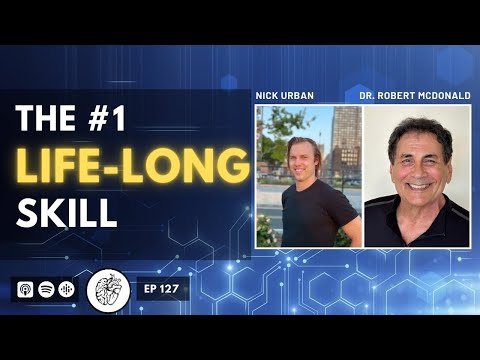
With Dr. Robert Dee McDonald of Telos Center, Episode 127



What You’ll Learn
- Passivity, aggression & assertion: Dr. McDonald breaks down the 3 communication modes and why only assertion produces equanimity and honest connection. [06:07]
- 4 core emotions: Sad, mad, glad, scared. These Old English words form the complete emotional vocabulary. Metaphors like “I feel crushed” obscure real feelings and block clear communication. [10:05]
- Assertive format: A structured template: “When you [behavior], I feel [emotion], and I want [measurable request].” Precision in each element determines whether assertion actually works. [09:15]
- Behavior vs. metaphor: “You acted like an idiot” gives zero actionable information. Describing observable actions (“you shook my hand, you smiled”) is essential for healthy feedback. [14:11]
- Personality is dynamic: Nick shares how within 2 weeks of practicing assertive communication, his personality measurably shifted. Identity consists of knowing what you feel, want, and think. [18:17]
- Emotional awareness alarm: Nick set a phone alarm every 20 minutes for a full week, noting his feelings, thoughts, and wants at each interval. After 2 days, emotional granularity improved significantly. [21:13]
- 50 years of clinical evidence: Dr. McDonald has worked with approximately 250,000 clients worldwide, demonstrating that grief, shock, and trauma can all be resolved when people learn the proper methods. [01:59]
- Forgiveness as health intervention: Sustained anger elevates blood pressure, damages eye health, and contributes to men dying 5-7 years younger than women. Forgiveness is the only path to peace of mind. [27:19]
- Look for the good: Dr. McDonald’s daily practice: look for the good, find the good, praise the good, share the good. Every moment, not just once. Gratitude produces joy the way forgiveness produces peace. [40:28]
Why It Matters
Most people default to passivity or aggression in difficult conversations without realizing a third option exists. Dr. Robert McDonald, creator of the Destination Method with 50 years of coaching experience and approximately 250,000 clients worldwide, teaches that assertive communication follows a precise formula anyone can learn. Mastering it transforms not just relationships, but emotional health, physical well-being, and even personality itself.
Who Should Listen
- Leaders, coaches, or therapists who want a structured communication framework they can apply in sessions and daily life.
- Men who feel disconnected from their emotional life and want practical exercises to rebuild that awareness.
- Anyone holding onto resentment or anger who suspects it’s affecting their health, relationships, or peace of mind.
Inside Dr. McDonald’s Ultimate Communication Skills Course
In this episode of the High Performance Longevity podcast, Nick Urban continues his two-part series with Dr. Robert Dee McDonald, creator of the Destination Method and co-founder of Telos Center. With 50 years of experience and roughly 250,000 clients around the world, Dr. McDonald is one of the foremost practitioners in communication, NLP, and emotional transformation. Nick recently attended his Ultimate Communication Skills course in Los Angeles and shares firsthand how it changed his life.
The conversation centers on the critical distinction between passivity, aggression, and assertion. Dr. McDonald explains a structured assertive format: identify the specific behavior, name the actual emotion (not a metaphor), and state a measurable request. Nick reveals how adopting this framework led him to set 20-minute alarms for an entire week to track his emotions, thoughts, and wants, building emotional granularity from scratch within days. The discussion extends to forgiveness as a trans-rational act, the hermeneutic value of pain, and why men’s suppressed emotional lives contribute to dying 5-7 years younger than women.
You’ll walk away with a practical assertive communication template you can use immediately, a daily emotional check-in exercise, and Dr. McDonald’s guiding principle: look for the good, find the good, praise the good. These tools require practice to master, but they’ve already changed Nick’s personality, relationships, and quality of life within weeks.
Key Terms Quick Reference
Several specialized terms come up throughout this conversation. Here’s a quick reference.
[06:07] Assertiveness: A communication mode between passivity and aggression. It involves stating what you feel (a real emotion), identifying the behavior that triggered it, and making a measurable request. Unlike aggression, it doesn’t demand compliance.
[10:05] The 4 core emotions: Sad, mad, glad, scared. Dr. McDonald’s simplified emotional taxonomy. All other feeling words are either variations (depressed, irritated, joyous, frightened) or metaphors (crushed, flooded, bottled up).
[19:29] Identity (in McDonald’s framework): Defined as knowing 3 things: what you feel emotionally, what you want, and what you think. Without access to emotions, identity becomes incomplete, which is why suppressed feelings erode self-knowledge.
[31:57] Trans-rational: Beyond reason, not irrational. Dr. McDonald uses this to describe forgiveness: a fully rational person would never forgive because the offender might repeat the action. Forgiveness requires integrating opposing desires into something new.
[30:49] Hermeneutic value: Named after Hermes, the Greek messenger god. Pain’s “message value.” Physical pain says “remove your hand from the stove.” Emotional pain signals that something in your life or thinking needs to change.
[33:38] Unnecessary suffering: Suffering that persists because the person doesn’t know its positive function or how to resolve it. Once both are understood, the suffering becomes unnecessary. Grief, shock, and trauma all qualify as resolvable.
What Is Assertive Communication & Why Does It Work?
The short answer
Assertion is the functional midpoint between passivity (not speaking up) and aggression (bullying to get what you want). It follows a precise formula: name the behavior, state the emotion, and make a measurable request. The outcome doesn’t depend on the other person changing.
What McDonald found
Across 50 years and roughly 250,000 clients, Dr. McDonald has observed that most people oscillate between passivity and aggression. Passive people assume others can read their minds, and they become depressed when their needs go unmet. Aggressive people bully to get results, but force destroys equality in relationships. Assertion breaks this cycle because it detaches truth-telling from outcome. You state what happened, how you feel, and what you want. Whether the other person complies is secondary. The assertive person wins self-esteem, self-worth, and self-respect simply by telling the truth.
What to do about it
Use this template: “When you [specific observable behavior], I feel [sad/mad/glad/scared], and I want you to [measurable behavioral request].” Test each element by asking: could 10 strangers act out this behavior identically? If not, make it more specific. Practice with low-stakes situations first and build up. Don’t attach your success to whether the other person changes.
“I tell the truth without regard for whether or not the other person changes. This is very different. It’s like I’m not attached to outcome, I’m attached to telling the truth.” – Dr. Robert McDonald
Related: Biohacking Relationships Tips
How Does Suppressed Emotion Damage Physical Health?
The short answer
Sustained anger raises blood pressure, increases stroke risk, harms vision, and impairs brain function. Men who suppress all emotions except anger die 5-7 years younger than women, partly because chronic anger is the only emotional outlet they permit themselves.
What McDonald found
Dr. McDonald explains that anger functions like a straight arm: it says “Stop.” The chemistry behind it raises heart rate and blood pressure. Men have strokes from anger they cannot release. High blood pressure destroys eye health, impairs brain function, and cascades through the body. Society teaches men that anger is the only acceptable emotion, creating a one-dimensional emotional life. Heroes in literature are unemotional except when angry. Dr. McDonald has led men’s groups since 1970 and believes the problem has gotten worse, not better, over 50 years.
What to do about it
Build emotional awareness using Nick’s 20-minute alarm method: set a timer throughout the day and record what you feel, think, and want. Start with the 4 core emotions (sad, mad, glad, scared) and expand to variations. Practice forgiveness as a daily discipline. Dr. McDonald describes it as the supreme spiritual power: letting go of the demand that the past be different. His “Forgiving the Unforgivable” MP3 is available on his website for guided practice.
“Anger that goes on and on is really unnecessary. We can change it, it can be done. Grief can be resolved, shock can be resolved, trauma can be resolved, all this stuff.” – Dr. Robert McDonald
Related: Biohacking Stress Tips
Why Is Forgiveness Essential for Peace of Mind?
The short answer
Forgiveness is the only source of peace of mind. Without it, suffering persists indefinitely. It’s not a rational act. It’s trans-rational: going beyond reason to integrate the part that wants to forgive with the part that doesn’t.
What McDonald found
A fully rational person would never forgive anyone because the offender might repeat the behavior. But refusing to forgive is like drinking poison and expecting the other person to die. Anger toward someone burns the person holding it first, just like picking up a hot rock to throw. Dr. McDonald draws a distinction: forgiveness is not irrational either. It’s a spiritual awareness where opposing parts integrate into something new. He’s seen clients suffer for months, years, and decades from unresolved grief. Once they learn to forgive, the suffering ends. He’s clear: there is no possibility of peace of mind without forgiveness.
What to do about it
Recognize that unforgiveness is a choice with consequences: sustained suffering. Start small. Identify one person or situation where you hold resentment and practice letting go of the demand that the past be different. Dr. McDonald’s “Forgiving the Unforgivable” guided audio (available at teloscenter.com) provides a structured process. Pair forgiveness practice with daily gratitude. There’s no way to joy except through gratitude, just as there’s no way to peace except through forgiveness.
“To forgive is to let go of the demand that the past be different than it was.” – Dr. Robert McDonald
Related: Biohacking Stress Tips
The Telos Assertive Communication Protocol
Use this framework to replace passivity and aggression with honest, structured communication. Dr. McDonald refined these principles across 50 years of clinical practice.
- Identify the specific behavior: Describe what the person did in terms 10 strangers could act out identically. “You raised your voice” works. “You acted like a jerk” does not
- Name the actual emotion: Use one of 4 core words: sad, mad, glad, or scared. Variations like “depressed” or “irritated” are acceptable. Metaphors like “crushed” or “flooded” are not
- State a measurable request: “I want you to apologize for calling me names” is measurable. “I want you to be nicer” is not. The request must describe observable behavior
- Detach from outcome: Assertion means telling the truth without requiring the other person to change. You win self-respect by speaking honestly, regardless of their response
- Build emotional awareness daily: Set a recurring alarm (every 20 minutes to start) and record what you feel, think, and want. Within 2 days, emotional granularity improves noticeably
- Practice forgiveness proactively: Identify where you hold resentment and let go of the demand that the past be different. Unforgiveness produces sustained suffering. Forgiveness is the only path to peace of mind
- Apply the gratitude principle: Look for the good, find the good, praise the good, share the good. Do this every moment, not just as a morning practice. Gratitude produces joy the same way forgiveness produces peace
Common communication mistakes
- Assuming others can read your mind: The basis of passivity. No one can read minds. If you don’t say what you want, you can’t blame others for not providing it
- Using metaphors instead of emotions: “I feel crushed” is not an emotion. “I feel sad” is. Metaphors force listeners to guess, which creates confusion and conflict
- Swinging directly from passivity to aggression: When unmet needs build pressure, people skip assertion entirely and explode. Regular emotional check-ins prevent this cycle
Source: McDonald’s Ultimate Communication Skills, Telos Center
Frequently Asked Questions
What is the difference between assertion & aggression?
Assertion is stating what you feel and what you want without demanding compliance. Aggression is bullying or forcing someone to meet your demands. Assertion preserves equality in the relationship while aggression destroys it. The assertive person wins self-respect by telling the truth, regardless of whether the other person changes.
What are the 4 core emotions according to Dr. Robert McDonald?
Sad, mad, glad, and scared. These Old English words cover the full range of emotional experience. Variations like depressed, irritated, joyous, and frightened fall under these categories. Metaphors like crushed or flooded are not emotions and should be replaced with the actual feeling word.
How do you practice assertive communication?
Use the format: When you (specific observable behavior), I feel (sad, mad, glad, or scared), and I want you to (measurable behavioral request). Test each element by asking whether 10 random strangers could act it out identically. Practice with low-stakes situations first and don’t attach your success to whether the other person changes.
Why do men struggle more with emotional awareness?
Society teaches men to suppress emotions. Heroes in media are portrayed as unemotional except when angry. Sports, military, and cultural norms coach emotional expression out of boys and men. Dr. McDonald has led men’s groups since 1970 and believes the problem has worsened over 50 years.
What is the hermeneutic value of pain?
Hermeneutic value means message value, named after Hermes, the Greek messenger god. Pain tells you something needs to change, just like touching a hot stove tells you to remove your hand. Emotional pain carries the same function: it signals that a behavior, relationship, or way of thinking needs attention.
How does forgiveness improve physical health?
Unforgiveness sustains anger, which raises blood pressure, increases stroke risk, damages eye health, and impairs brain function. Men die 5-7 years younger than women partly due to chronic emotional suppression. Forgiveness releases this physiological burden by ending the chemical stress response that anger maintains.
What is Dr. McDonald’s Destination Method?
A coaching and therapeutic methodology created by Dr. Robert McDonald over 50 years of practice with approximately 250,000 clients. It integrates NLP, communication training, therapeutic metaphors, and emotional resolution techniques. Courses are offered through the Telos Center in Los Angeles.
Products, Tools, & Resources Mentioned
Courses & programs
Telos Center: Dr. McDonald’s training center in Los Angeles offering courses in communication, dynamic listening, therapeutic metaphors, and core belief change. Multi-day intensive formats with in-person practice.
Ultimate Communication Skills: The Telos Center course Nick attended. Covers passivity, aggression, assertion, behavioral specificity, and emotional literacy across multiple days of instruction and hands-on practice.
Dynamic Listening course: Dr. McDonald’s course on advanced listening skills, therapeutic metaphors, and core belief change. Available through Telos Center.
Digital resources
Forgiving the Unforgivable (MP3): Dr. McDonald’s guided audio for forgiveness practice, available for purchase at teloscenter.com. Designed to help people move past their own limitations toward peace of mind.
Books & references
How to Win Friends & Influence People: Nick references this classic by Dale Carnegie as depicting influential leaders who are kind, vulnerable, and emotionally present, countering the myth that power requires emotional suppression.
About Dr. Robert McDonald
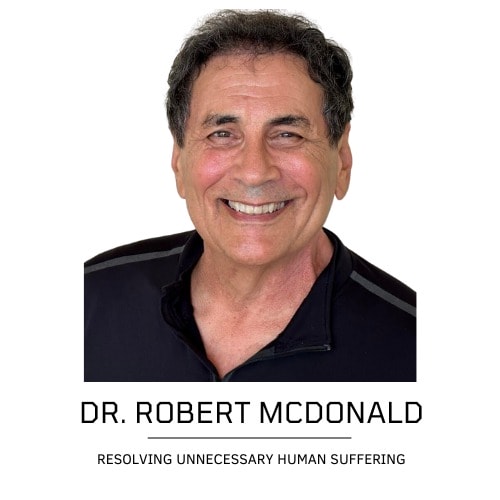
Dr. Robert Dee McDonald is the creator of the Destination Method, an NLP Master Trainer, author, and co-founder of the Telos Healing Center in Los Angeles. Over 50 years of practice, he has worked with approximately 250,000 clients worldwide, specializing in communication, grief resolution, and emotional transformation. He’s known for helping people resolve suffering that has persisted for months, years, or decades when nothing else has worked. Dr. McDonald teaches courses including Ultimate Communication Skills, Dynamic Listening, and Therapeutic Metaphors through the Telos Center. Connect with him at robert@teloscenter.com.
Related Episodes & Articles
- Episode 126: Resolving Grief, Dynamic Listening & Therapeutic Metaphors with Dr. Robert McDonald
- Episode 25: Emotional Intelligence, Relationships & Leadership Performance
- Episode 59: De-escalate Conflict Resolution Science & Tips
- Episode 58: Words, Thoughts & Stories Create Reality
- Episode 216: Performance Psychology Techniques
- Article: Biohacking Relationships Tips
- Article: Biohacking Stress Tips
Full Episode Transcript
Nick Urban [00:00:05]: Today we’re going to be discussing a topic that nearly everyone thinks they have near professional capacity to do it, yet very few people actually do. In the most powerful way, this skill can transform your relationships, your business or your career, your athletic performance, your teamwork, and so much more. And as I mentioned in the episode, the skills and experience I gained from learning and practicing this has dramatically transformed my life. Hi, I’m Nick Urban, host of the MINDBODY Peak Performance Podcast, and today I’m looking forward to bringing you the second part of a two part series I did with a man named Dr. Robert D. McDonald. To summarize our last conversation, he explained the difficulty and importance of learning and how storytelling can be one of the most powerful tools to transform health. So much so that he’s seen physical symptoms like allergies and even rashes rapidly disappear from nothing.
Nick Urban [00:01:13]: But the story seems impossible. But in that episode, he explained how it works and why it works. And he has a six day course beginning on November 7 teaching those exact processes. I’ll be attending and I would love to see you there. And to give you a little more context about who he is, I’d say Dr. Robert is one of the world’s foremost experts on the mind. Not just an intellectual understanding, but actually using applying that knowledge to transform health and do what modern science would deem impossible. So far, he’s been doing this for 50 years, and with about 250,000 clients around the world.
Nick Urban [00:01:59]: In this episode, you’ll learn an essential framework to good and healthy communication, a process that I personally used to start getting in touch with my emotion, health, and well being, and the difference that makes on overall quality of life. The different levels of effective listening, how things that seem fixed and impossible to change are actually quite malleable and dynamic and a whole lot more so. Who is our guest this week? Dr. Robert D. McDonald is the creator of the destination method. He’s an author, an NLP Master trainer, an internationally known speaker, co founder of the Telos Healing Center, a teacher, and one of the most effective coaches I’ve seen in the industry. Dr. Robert is known to help people resolve grief and unnecessary suffering that have plagued them for months, years, or in some cases, even decades.
Nick Urban [00:03:01]: He’s been an instrumental go to resource that people saves turned to when nothing else has worked. If you want to see our previous conversation on dynamic listening and storytelling and all that stuff, you’ll find our previous conversation linked in the description below this. But you can also visit the show notes at outliyr.com, the number 126. And if you’re seeing this before November 7, yes, it’s very last minute, but you can still apply. To join his upcoming course and pain these invaluable tools for yourself. I’ll be there, and I hope to see you there. To connect with Dr. Robert, you can email him at robert@teloscenter.com or visit them on the web at teloscenter.com.
Nick Urban [00:03:49]: That’s spelled telos center. C-E-N-T-E R.com. All right, with that out of the way, let’s sit back and improve our communication with Dr. Robert D. McDonald. All right, Dr. Robert. Welcome back to MINDBODY Peak Performance.
Dr. Robert McDonald [00:04:08]: It’s good to be back. Thank you. I’ve enjoyed our last session.
Nick Urban [00:04:12]: Yes, me too. And I enjoyed my first session working with you in person when I was over there in La. About two months ago. And I talked to some friends beforehand, and I had the same thoughts, which are, how can you spend multiple days, eight plus hours a day, talking about something as, quote, simple as cognition? And little did I know, but you were able to blow my mind with some of the things you taught me, one of the most transformative experiences of my life so far. And I wanted to share some of that on this episode because I know that your latest course, your dynamic listening course, is going to be in a couple of weeks, but you have plenty of other courses in you, and the ultimate communication skills was the one that I took. And I realized how important and underutilized this skill is. We all think we’re communicating effectively at all times, but there is a lot we can be doing, myself included. So welcome to the show.
Dr. Robert McDonald [00:05:19]: Thank you. Good to be here. And, yes, that’s true about communication. I’m glad you took ultimate communication skills. That’s a great course to begin things with, a really great one. Making a distinction between passivity, aggression, and.
Nick Urban [00:05:34]: Assertiveness, that’s actually exactly what I wanted to start, so I was completely unfamiliar with that idea. And to me, when I learned about the difference between assertion, passivity and aggressiveness, assertion also seemed unhealthy to me. It seemed too aggressive. And you answered all the questions in the class very well. People challenged you, and I was blown away how well you were able to logic and reason your way through them. But can you first start off by explaining what each of those are?
Dr. Robert McDonald [00:06:07]: Sure. The one that’s most popular, the two that are most popular are passivity and aggression. Person becomes passive. They don’t speak up. They want something, and they don’t say what they want. They either assume that the other person already knows, and therefore they don’t have to speak up, or they assume the other person already knows, and they’re upset because the person who already knows isn’t giving it to them. Passivity is just waiting around for the other person to get the message. And oftentimes it comes as a consequence of fear.
Dr. Robert McDonald [00:06:46]: Like, I’m afraid to say what I want. If I say what I want, doesn’t that make me an aggressive, selfish, bad person? So I don’t want to be an aggressive, selfish, bad person. I just won’t say anything at all. And surely the other person will get the message of what I want. Well, this is taught passively person to person. And what happens is people become upset because other people because they can’t believe that other people cannot read their minds. The basis of this is this massive hallucination that people have that one person can read another person’s mind. Well, I’m of an age where I have tried for many decades to read people’s minds, and I can’t do it.
Dr. Robert McDonald [00:07:38]: And people oftentimes think I can read minds because I listen well, but I can’t read people’s minds at all. And so when I want something and understand the person can’t read my mind, then I need to let them know what I want. And if I don’t, then I’m passive and I reap the results of that, which are typically depression. So I’m not getting what I want. Why am I not getting what I want? Well, I’ve never told anybody. And so this is waiting around for the world to change without having input. The other side of that is aggression. A person says, Well, I’m tired of being passive.
Dr. Robert McDonald [00:08:19]: I’m going to yell and scream and get angry and demand and overwhelm and push people around and bully them to get what it is I want. I’m going to aggress in a very painful way, thinking, yeah, the only way to get what I want is to bully people. Well, it doesn’t get what I want because it doesn’t produce equanimity and certainly doesn’t produce, with us, equality. We don’t have equality. I’m just telling you what to do and demanding it. Well, there’s something in between passive, which is dysfunctional, and aggression, which is dysfunctional. And that’s the functionality of assertiveness. To be assertive, to say, to tell a person with some clarity what I want, I must come up with, this is what I feel and this is what I want.
Dr. Robert McDonald [00:09:15]: And so assertive formats are important in the class, the ultimate communication skills. I provided you with a format of being able to tell somebody, well, when you call me an idiot, I feel hurt and a little angry, and I want you to apologize for calling me names. This is not aggression. It’s not it’s just saying, this is what I’m feeling and what I want from you. And so what I’m feeling must be specific. It must be an emotion. The hard thing for people to learn, or let’s say the thing that’s rarely taught is what are emotional words? Person says, I feel crushed, and they think they’re talking about an emotion, but they’re not. I feel crushed is not an emotion.
Dr. Robert McDonald [00:10:05]: I feel sad is an emotion. Sad is an emotion. Crushed is not an emotion. It’s a metaphor. And people are supposed to assume from the metaphor of crushed that it’s some sort of unwanted feeling. But we don’t know what the emotion is. It’s vague. Passive.
Dr. Robert McDonald [00:10:22]: People will speak in metaphors like that. I feel crushed. I feel flooded. Well, there’s no emotion in that. Emotions are generally four people sometimes will talk about some other emotional labels. But in my world, I like to make things simple. I’m really into simplicity. And so there are four emotions sad, mad, glad and scared.
Dr. Robert McDonald [00:10:46]: These are old English words. That’s why they’re short like that. Sad, mad, glad, scared. And so if I speak and I tell people what I feel, and I use some other word, some word other than sad, mad, glad or scared, I’m probably going to go into something that’s metaphorical. Now, there are variations on the word sad, depressed. I feel depression is certainly an emotion. I feel depressed, I feel sad, I feel sorrow, I feel grief. These are emotions.
Dr. Robert McDonald [00:11:19]: But it’s different than saying, I feel all bottled up inside. That’s not an emotion, that’s a metaphor. So if I’m going to be communicating well, I must make a distinction. What do I want that person to know about me? That I have an emotion? Well, what is the emotion? And I must pay attention. First person for me to pay attention to is me. What do I feel? I feel sad. Well, maybe I feel mad. I feel mad, angry.
Dr. Robert McDonald [00:11:48]: There are different words for it. Mad, angry, rage, jealous. These kinds of experiences of mad, okay, I feel mad. Miffed can be a way to have people talk. I feel cross. These are very light. We’re irritated, annoyed, frustrated. All of those are with the heading of mad.
Dr. Robert McDonald [00:12:10]: But if I say, Well, I feel like I’m on fire, that doesn’t tell you that I’m mad, tells you I feel like I’m on fire. And you have to discern. You have to kind of wade through the metaphor to find out what I actually feel. So sad, there’s mad, there’s glad. I feel happy, glad. Synonym might be happy, joyous, grateful. I start talking about those feelings of joy in my body, it’s really great. I feel like bouncing off the walls is a metaphor.
Dr. Robert McDonald [00:12:44]: Doesn’t quite get the fact that I’m happy. I feel glad, sad, mad, glad, scared. I feel frightened. These four words categories sad, mad, glad and scared are of deep importance for the person who’s speaking to know about why. To be clear, I want you to know what I feel. And when I tell you that I feel a certain emotion, I want it to be as clear as possible that it is the emotion, not a metaphor, I want you to know about at some point. Of course, I’m not against metaphors. I’m just saying I want people to be clear and clean about what the emotion is that they actually feel in the body, rather than a thought about the emotion.
Dr. Robert McDonald [00:13:26]: And so that’s fundamental to know the four categories for emotion and then be able to say, so this is what I feel and why do I feel it? Because of some behaviour the other person is engaged in, and I must be able to identify the behavior. What did the person do. And if I say, well, you acted like an idiot. Acted like an idiot. No one knows what that means in the world. Acted like a fool. What exactly did you do? What did the person do? And it has to be something that’s described as a behavior. And people are rarely taught how to describe behavior.
Dr. Robert McDonald [00:14:11]: But if I learn how to describe behavior, I can say, this is what I saw you do, and I feel very happy. When I met you and you shook my hand, I felt you shake my hand. I saw your smile in your face. I really feel happy when I think about what you did. That’s the behavior. You shook my hand, you smiled. Great. That’s clear.
Dr. Robert McDonald [00:14:34]: But if I say, I’m so glad because you’re such a nice guy, nobody knows what nice guy means. So I give you a behavior that you engaged in. And then when I want something, I need to also speak in terms of measurable behavior. What do I want the person to do? So the one who’s speaking needs to be clear about the behavioral change that is wanted. This will help in assertion. Assertion is not aggression, and it’s not passivity. It’s an honest communication. Simple to say it, simple to describe it.
Dr. Robert McDonald [00:15:07]: But you know what? Rarely used. Rarely. And in the course that you took the ultimate communication skills, that was part of it. I’m glad that you enjoyed it. I understand that it affected you and your family.
Nick Urban [00:15:22]: Yeah, that and also when we went around the room and we shared our practice examples of this, I was surprised it wasn’t just me that had multiple revisions to actually assert myself properly. I fell into the trap of communicating the actions as ambiguously, so it wasn’t clear exactly what the action was. And the way I started thinking about it that really helped me was if I was to give this to ten random people on the street and ask them to act out the action, could they do it? And if they couldn’t do it exactly the way I’m thinking of it, then it’s a weak example and needs to be revised.
Dr. Robert McDonald [00:16:00]: Yeah. You need to make it more plain, more clean. Yeah.
Nick Urban [00:16:04]: Another thing I realized through this change and working on my assertion, I first realized that when I don’t think I have a need in a situation and I don’t assert myself, I’m passive. Then if I’m not aware of the fact that there is a need and I’m just not communicating it, then I’ll very quickly go from passivity to aggression, just like that. And it’ll seem like it just happened and it wasn’t in my control. And it’s very frustrating. But then when I have this awareness of, like, okay, if you do this in the beginning, you might not get what you’re looking for out of the situation. You might not get the other person to agree to take those actions to change. But at least you’ll have put yourself out there and you’ll have done the best that you can do.
Dr. Robert McDonald [00:16:46]: Yeah, one way to think about it is at least I’ve done the best I can. A very powerful way to think about assertion is that I tell the truth without regard for whether or not the other person changes. This is very different. It’s like I’m not attached to outcome, I’m attached to telling the truth. When you did such and such, I felt this emotion and here’s what I want you to do does not mean that the other person is going to do it. It’s like maybe they’ll do it, maybe they don’t. But I win. I win the rewards of telling the truth.
Dr. Robert McDonald [00:17:22]: So I’m no longer passive and I’m no longer aggressive. I win because I’ve been assertive, I’ve cleanly, spoken the words out loud in front of the person. The person may or may not change, but that doesn’t matter nearly as much. What really matters is that I have one self esteem and self worth and self respect because this is the truth of me. I can’t control other people’s behavior. I can’t make sure they do what I want me to. I can make sure people do exactly what I want. If I use a gun and I’m aggressive, sure, but that’s aggression.
Dr. Robert McDonald [00:17:58]: If I bully the person into getting what it is I want, so what? That’s not helpful to me and not helpful to them. So assertion is a recognition of my own power and my own powerlessness. Both. I have a great power. When I tell the truth, I’m powerless to get the other person to understand or to change.
Nick Urban [00:18:17]: And by implementing some of the things that I learned in this course too, I realized that I always viewed my personality and personalities in general as these fixed, constant things. It’s just who I am. I was born with it. I’ll always be like this. And after I started changing the way I was communicating, I realized that personality is really dynamic. And within a couple of weeks of practicing these skills, all of a sudden I was a different person. I became a different person and I liked the changes that I had started noticing myself.
Dr. Robert McDonald [00:18:48]: That’s really great. Human beings, you and I are quite flexible and resilient. You and I can learn so much. There’s some things that are fundamental, but we are able to change. I’m not my body and I can change my body. I’m not my emotions and I can change my emotions. I’m not my mind and I can change my mind. So what I am is that which has a body, emotions and mind.
Dr. Robert McDonald [00:19:16]: I have thoughts, I can change my thoughts. I can observe my thoughts, I can observe my body. I can observe my emotions that move through me. This means since I’m observing them, I’m not them. Therefore I’m able to make decisions to change my body, change my emotions, change my mind. This is evidence that I’m very, very powerful in how I exist in the world. Body, emotions, mind. I’m not that just like I own a car.
Dr. Robert McDonald [00:19:50]: I’m not my car. I can change my car. I have a body. I’m not my body. If my arms and legs are cut off, I’m still me. My body’s less, but I’m not. So I have to go. Ultimately, that kind of inquiry will lead to, well, then what am I? And who am I, really? Ultimately will bring us to a spiritual examination.
Dr. Robert McDonald [00:20:12]: But in the beginning, with just being assertive, I need to go, well, yeah, I can change the way I speak to people, of course. It just means I need to learn things. I don’t know how to play the piano, but I can learn how to play the piano. Of course. It’s just a skill.
Nick Urban [00:20:28]: Dr. Robert, I don’t think I told you this, but on day two, all of a sudden, something hit me. Not literally, but I realized that a lot of communication, both being able to deeply empathize and hold compassion and to assert yourself, assert myself in a healthy way, stems from being in touch with what I was feeling at any given time. And for someone who grew up without that ability, it was, in a way, coached out of me from sports. And I’m sure for a lot of people, it’s a military beast. It out of them for whatever reason. Seems like in our society, the odds are stacked against everyone, and I’d say particularly men. But then what I did is it was a pain.
Nick Urban [00:21:13]: But for a week, every 20 minutes, I had an alarm, my phone, and I would pause, I would jot down what I was feeling in that moment and what I was thinking and wanting. And it took a bit of practice and it was very difficult. At first, I didn’t really feel anything and I had nothing to write down. But then after maybe two days, it started becoming easier and I started getting more granular with what I was noticing, where I was noticing it in my body, what I was wanting. And by the end of two weeks, I was actually able to do this. And very quickly. It’s the same kind of thing where it translated into better communication, which translates into better relationships, which translates into higher quality of life.
Dr. Robert McDonald [00:21:56]: Wow. How impressive that is. Congratulations. You really committed yourself. You got these wonderful results. I’m really impressed. Yes, I happen to agree with you. The social structure has role expectations for men and for women.
Dr. Robert McDonald [00:22:18]: And one of the role expectations of men is that they are there to be without feeling. And otherwise, how do you get them to kill other men? So there’s a movement in the direction of, well, don’t feel bad about it, don’t feel anything, don’t cry. Certainly men will oftentimes be taught that it’s okay to lose their temper and be angry, but usually at some point it’s like, no, don’t get angry, don’t cry, don’t feel sad, don’t feel mad, don’t be scared of anything. And as far as, like, joy or happiness, well, maybe you’ll have that, but don’t have these other feelings. Women are mistreated. It’s obvious that women are mistreated. There’s no question in my mind. The society does this, not only our society, the whole world, but men are harmed.
Dr. Robert McDonald [00:23:16]: And it’s kind of a secret. People are not supposed to notice how much they’re harmed. But yes, to not feel like the ideal man is to have no emotions. That’s our heroes. When we watch our heroes, they are without feeling. By and large, they’re without feeling. So they go, okay, then I’m going to be like that. I’m going to grow up to be like James Bond and I can just shoot people and not care or some other popular male figure.
Dr. Robert McDonald [00:23:51]: It’s a hero just laughs at danger and shoots people and doesn’t really care, doesn’t sit down and have a good cry and come to himself, isn’t interested in what does he feel and want and think. He’s duty bound, does his work, or he’s a rebel and he’s not dutiful for anything. So, yeah, I think it’s definitely a pressure on men to be without feeling. And for me, it’s a great sadness. I’ve done my best to change that in the world, but I’ve been able to change it in me. I’m very happy that I kept my feelings. I commonly cry. I have my emotions.
Dr. Robert McDonald [00:24:34]: I know what they are. I’m very happy that they were not killed off when I was a boy and I was in the military. So I know the attempt to destroy my emotional life, but I said, no, I’m going to keep it. Very happy about that.
Nick Urban [00:24:51]: I forget which book it is. It might be how to Win Friends and Influence People, but one of those was actually depicting the other side of the narrative where we might see that all these heroes don’t actually have emotions. They’re not vulnerable at all. They are like knights in shining armor, but without the vulnerability. And then that book is showing the opposite. It’s like a lot of the most famous leaders and influential people actually are very kind. They’re vulnerable, they are in touch with themselves. And it’s like, okay, that was mind blowing for me because I always had just assumed that what I saw on TV was everything, and I didn’t realize that these people can have power and at the saves time, be emotional and acknowledge and accept and tune into their own emotions.
Dr. Robert McDonald [00:25:37]: Yes, I think the true power is authenticity with emotion being present. And so it’s not power over other people that makes me powerful. It’s power in my own life that I know what I feel, I know what I want, I know what I think. Identity is defined as I know what I feel emotionally. I know what I want, and I know what I think. I know my opinions. I know what they are. They are not such that they won’t change.
Dr. Robert McDonald [00:26:09]: They are open to change, but they are what they are now. This is what I feel. This is what I want. This is what I think. And I know who I am. And if I’ve been told that I’m not supposed to feel, if I bought into that lie, then I will say, well, I know what I want, but not really, because I can’t know what I want unless I can feel. So the more that men buy into the robot idea of men, they’re lost, completely lost. And I thought this would change, actually, because I began to lead men’s groups in 1970, and I thought it would really change, but it didn’t change.
Dr. Robert McDonald [00:26:47]: I think it’s worse now than it was. But what can be done is the same thing. Just teach men that it’s a blessing to have emotions. Emotion are required for emotional health. Emotional health? Mental health. Physical health requires emotions, not emotions that are like if I have sustained anger over time and I can’t come to peace of mind, it’s going to harm me terribly. Of course, oftentimes heroes in literature will be unemotional, except for when they’re angry, like their anger is okay. Well, anger may sometimes be a very valuable emotion to have, but if it’s sustained over time, it’ll kill the person who is feeling it.
Dr. Robert McDonald [00:27:39]: Forgiveness is the ability to forgive is probably the supreme spiritual power. To forgive is to let go of the demand that the past be different than it was. And so if I can’t forgive and I remain angry, the anger that I feel towards someone is like I want to throw a very hot, burning rock at them. Well, it burns me first. I pick it up. It hurts. I drink poison hoping they will die. Well, they don’t die.
Dr. Robert McDonald [00:28:11]: I just hurt myself. Anger hurts me. But if it’s the only outlet for men because they can’t cry, they can get angry and beat somebody up, well, that’s where they’ll go. We need to have strong, very strong men. That doesn’t mean that they’re without emotion. It means they have wisdom, strength, power, and they create order out of chaos. We need that we don’t have. I think as much of that as I would like to see models for that.
Nick Urban [00:28:48]: Yeah. Will you explain more about what you mean by how anger hurts oneself? Because yeah, I was in that camp, actually, the one dimensional emotional life where I definitely felt my share of anger when I was younger, but then I didn’t really have anything else to counterbalance it. I didn’t know how to forgive. And because of that, I see what you’re saying, but can you explain more about what that actually is?
Dr. Robert McDonald [00:29:10]: Well, if I’m angry, the chemistry of my body changes. Anger is a sign that I feel anger is like the metaphor for that is like a straight arm. I’m sticking my straight arm, I go, Stop. That’s it, damn it. And it’s an attempt to protect myself but requires my heart rate to go up, my blood pressure to go up. Men have strokes from what so angry that they can’t stop being angry. They burst some blood vessel in their brain. They have some sort of hemorrhage.
Dr. Robert McDonald [00:29:50]: Anger wreaks havoc on the physical body. But to be unable to have any anger means that the energy that comes from it that might be useful in some times of danger isn’t there. But it’s not always useful. And if it’s overused or if it’s the only thing that I have at some point it will harm the body. And men die much younger than women. There’s about this five to seven years difference. Women live longer. Men are considerably weaker.
Dr. Robert McDonald [00:30:27]: When you think about it, the disease diseases of every sort. Men are more likely to die from them than women. So it’s like, what’s going on? Women tend to be a bit more in touch with their emotion life and more interested in let’s patch things up. They tend to be not always. And this thing that that men have of holding on to the anger and standing up for themselves in every circumstance and defending themselves, it can wreak havoc if it’s simply blood pressure. High blood pressure destroys eye health. Your eye health is harmed by high blood pressure. Your brain doesn’t function well with high blood pressure.
Dr. Robert McDonald [00:31:18]: It harms the body in many ways that I don’t know how to articulate. But high blood pressure is not a good thing. And so people do the best they can to lower their blood pressure. Well, anger is a sure way to get high blood pressure. So it’s a good thing to find out. Well, how do I deal with I have a justified angry anger. Somebody did something and I’m justified in being angry. And deep self knowledge would allow me to be aware that even though I’m justified, it hurts me to maintain the anger.
Dr. Robert McDonald [00:31:57]: So then what do I do? Well, the primary thing to be done is to forgive, forgive myself and forgive others, which is not rational. So I want to make this point now. To forgive is not a rational activity. It’s also not an irrational activity. It’s a trans rational activity. It’s more than reason. It’s not rational in this way that a fully rational person will never forgive anybody ever, because they might do it again. But when a person is forgiving, they’re not being rational and they’re not being irrational either.
Dr. Robert McDonald [00:32:35]: They forgive because they go beyond reason. And that means they’ve had a spiritual awareness or a spiritual awakening. And that means that they’ve integrated the part of them that wants to forgive and the part of them that doesn’t want to forgive. And something. New is born. That’s an activity of great importance. On my website I have an MP3 that I sell that’s forgiving the unforgivable of tremendous power, to help people get past their own limitations, to get to peace of mind. Because the great gift of forgiveness is peace of mind.
Dr. Robert McDonald [00:33:11]: In fact, my world, there is no possibility of peace of mind without forgiveness. It can’t happen. Forgiveness is the source of peace of mind. So when I find myself upset about something, I know that I’ll be upset until I forgive. I don’t have to forgive, but I have to accept the consequences of not forgiving, which is suffering.
Nick Urban [00:33:34]: So inability to forgive can be one of those core causes of suffering.
Dr. Robert McDonald [00:33:40]: Yeah, the inability let’s say a person doesn’t know how to forgive. Yes, there’s unnecessary suffering because forgiveness is possible. I can teach people how to forgive, yes. And so it’s unnecessary. Unnecessary suffering is suffering that we have and we don’t know its positive function and we don’t know how to change it. Two things we don’t know the positive function of the suffering and we don’t know how to change it. And so it’s necessary. But unnecessary is when we know it’s positive function and we can change it.
Dr. Robert McDonald [00:34:10]: It’s no longer necessary. And anger that goes on and on is really unnecessary. We can change it, it can be done. Grief can be resolved, shock can be resolved, trauma can be resolved, all this stuff. It’s unnecessary to suffer with these experiences because we know how to resolve them. But most people will say they don’t want to change them because they either don’t know how or they’d like to keep feeling bad for a while. I respect that people can have whatever they want.
Nick Urban [00:34:45]: Will you describe the function of pain and suffering? What are you getting out of these?
Dr. Robert McDonald [00:34:52]: The positive function of pain is it tells us ouch. If I put my hand on a hot stove, I go Ouch. And the pain comes to me and says oh, I’m glad I have this pain because if I didn’t, I’d keep my hand on the hot stove. It’s like I tell often this story about the man who came to my office when I lived in the mountains in Santa Cruz. And he walked into my office, I lived in the mountains, in the redwood trees, and he pushed into my office a stove, a hot burning stove and he had his hand on it and it was burning his hand. And I asked him what did he want? And he said, Isn’t it obvious? And I said no, of course he was surprised because he knew I was seeing his hand on the hot stove. But I said I don’t know what you want. Of course I can see your hands on a hot stove, but I don’t know what you want.
Dr. Robert McDonald [00:35:39]: And he said I want you to make my hand stop hurting. And I said, well, you came all this way to see me, and you want me to remove your hand from the hot stove. And that’s when he told me how disappointed he was with me. He says, I’ve been talking to people for years, and they all tell me the same thing you’re telling me right now, and obviously you’re not listening to me. I said, Well, I kind of pride myself on being able to listen. I think I’m a pretty good listener. He said, well, you didn’t listen at all to me. I told you what I wanted, and you just told me to remove my hand from the hot stove.
Dr. Robert McDonald [00:36:13]: And I went, oh, my God, you’re right. I apologize. I wasn’t listening. You want me to make your hand stop hurting? He said yes. I said, you want to continue to do what you’ve always done? Keep your hand on the hot stove and have no pain? He goes, you’re the first person who’s ever heard me. I said, well, you can do that. You can leave your hand on the hot stove. In order to get no pain, we can go down to the local medical doctor who can sever the nerve here, and you won’t feel any pain.
Dr. Robert McDonald [00:36:45]: He goes, really? Can we do that? And I go, yeah, do that, but maybe you haven’t considered the blessing of the pain. He says, well, there’s no blessing to pain. I said, if you have no pain in your body, you’d be like the people in Hawaii who had leprosy and were put down in the caves in Molokai. They couldn’t feel the feelings in the ends of their fingertips because leprosy kills the nerves in the ends of the extremities of the body. I said, and at nighttime, the sea rats would come in and eat their fingertips off, and they would feel no pain at all. So they didn’t have the blessing to go, ouch and keep their fingertips. Pain has message value. It has great value.
Dr. Robert McDonald [00:37:29]: I said, and so if you have no pain at all, you won’t have the message. The value of pain is called hermeneutic value. Hermes was the god that took messages from the gods to the people and the people to the gods. He’s a message value. So pain has hermeneutic message value. Like a lighthouse. It says watch out. There’s some rocks over here.
Dr. Robert McDonald [00:37:48]: Move away from that. Pain has great value. But that doesn’t mean we have to have more pain. It’s just that we need to respect that pain has value and take it seriously and act on it. So, yes, it has great value.
Nick Urban [00:38:04]: Yes. And this applies to non physical pain as well, I guess. Non sensory pain, like, not related to toxic, such as emotional pain or even mental pain.
Dr. Robert McDonald [00:38:15]: All pain. Emotional pain. If I feel sad all the time, that’s evidence of pain. Anger all the time, that’s evidence of pain. Fear all the time, that’s evidence of pain. If I’m afraid to go out, afraid to go out of the house, afraid to drive a car, afraid to cross a bridge, afraid to talk to people, afraid to be in public, afraid to well, that’s pain. And so it tells us that something needs to change. Well, if I ignore the pain or try to stop, which I think most people do that today, that’s why they take so many drugs, is to stop themselves from having the consciousness of the pain.
Dr. Robert McDonald [00:38:54]: Oftentimes it’s a lifestyle that needs to change and not some drug that’s needed need to change the way they think about themselves. So suffering is unnecessary when we know how to resolve it and we find its gift all pain. All pain offers a gift. And that gift is generally compassion. And let’s say I presented myself the way many teachers and trainers and coaches present themselves. Oh, I don’t have any problems. I’ve never had any pain in my life. I’ve solved all that.
Dr. Robert McDonald [00:39:28]: I got no pain. Well, then, if I’ve never had any pain, why would you trust me? I don’t know anything about being human. Being human includes pain and extremely difficult questions to answer. It means that and so I have compassion for other people who are human, who are living, because undoubtedly we’re all in the same boat.
Nick Urban [00:39:54]: Dr. Robert, we’ll start to wind this one down. Are there any final exercises that can be simple? We already gave them the assertion framework of how to do it properly and in a health way. Are there any other things that you think would be helpful for them to know that are easy to understand or implement and start improving their communication or relationships?
Dr. Robert McDonald [00:40:17]: Nothing specific, because people want to be trained by having what they call a tip. Give me a tip. I can give you a tip. Don’t play with matches. That doesn’t help. I can give you a tip. Like, believe in the goodness. That’s fine.
Dr. Robert McDonald [00:40:33]: What really helps to change is actual study and practice. But the general idea, for example, I could say to people, remember this look for the good, find the good, praise the good. Now, if they actually did that, if that were the tip of the day, their whole life would change if they took it seriously. But very few people will because they’ll think it’s done. As soon as they hear it, they go, oh, I get it. Look for the good, find the good, praise the good. But that means every single moment. Find it, find the good.
Dr. Robert McDonald [00:41:07]: It’s like looking for a four leaf clover. Look for it, find it and praise it. When you find it and do that in yourself and with your friends and family, look for the good in them. When they’re talking to you and they’re saying something that you go, wait a minute, I don’t quite understand. Look for the good in it. Find the good. Praise the good. Praise praise people for what it is.
Dr. Robert McDonald [00:41:28]: They are able to do. Look for the good, find the good, praise the good, share the good. That means be grateful. Share gratitude. You want to tip? The best thing to do is be grateful for your next breath. I’m so grateful because I didn’t cause it. I didn’t create the house I’m living in, the body I’m living in. I didn’t create my ability to think.
Dr. Robert McDonald [00:41:53]: I didn’t create it’s all a gift. There’s nothing that’s not a gift. Nothing. Wow. Be grateful for that. The moment I’m grateful, I experience joy. There’s no way to peace except through forgiveness, and there’s no way to joy except through gratitude. These are tips.
Dr. Robert McDonald [00:42:13]: But the problem about tips is that they’re like little short, aprosms little sentences, and people go, oh, yeah, well, I kind of know that that’s true. And they don’t study and do the necessary labor. It requires labor work, hard work. That’s why this course is coming up. Dynamic listening, therapeutic metaphors and core belief change in November 7 through the twelfth in Los Angeles. That’s why I say to people, don’t take it unless you really want to learn. You really are leaning in the direction of compassion and understanding, and you really want to help people. Let’s say you’re a coach or let’s say you’re a psychotherapist or a clinical social worker, or let’s say you’re a minister or a priest or you’re just a family member and you’d really like to know, how do I do this? Well, yes.
Dr. Robert McDonald [00:43:06]: Then take it. Take it and study it and master it. So these kinds of things have to do with the good. What I’m talking about is perceive the good presume positive intent. Cynicism is presuming negative intent. Person presents himself in a certain way and you go, wait a minute, let me look for what’s good about that. Let me praise the good in that.
Nick Urban [00:43:31]: It’s very difficult to take one of those ideas and constantly saves it in the back of your mind and find the good and praise the good in every situation. But even if it’s as simple as starting with a morning practice of waking up and spending a few minutes doing that and then making that a long standing habit, and then eventually scaling up from there and doing it more often, even if something as simple as that can make a huge difference. And I personally have been doing that for a while and noticed that I get a hit of joy every morning, pretty much first in the morning, and now it’s time to take that and to continue that onto the rest of my day.
Dr. Robert McDonald [00:44:04]: Perfect. And it gets better and better all the time. That’s what life is about, gets better and better. Thank you for telling me that. I’m glad you’re doing that.
Nick Urban [00:44:12]: Yeah. And Dr. Robert, thank you so much for joining me on another episode of MINDBODY Peak Performance. Like always, it’s a blast hosting you, and I’m really looking forward to our upcoming time together down in La for your dynamic listening course.
Dr. Robert McDonald [00:44:28]: I’m so glad that you’re coming and Avia’s coming. It’s really a treat. I’m honored that you trust me that you come. Thank you so much, very much. Nick. Have a great time. Wonderful to be with you and anyone else.
Nick Urban [00:44:40]: If you join before it’s too late, we will see you there and look forward to spending some time with you in person as well. I hope that this has been helpful for you. If you enjoyed it, subscribe and hit the thumbs up. I love knowing who’s in the 1% committed to reaching their full potential. Comment 1% below so that I know who you are. For all the resources and links, meet me on my website at outliyr.com. I appreciate you and look forward to connecting with you. As a reminder, please tell your primary health professional before making any questions.

Comments