

Newsletters are one of the fastest ways to stay ahead of the curve in longevity and biohacking, without drowning in PubMed or falling for marketing-heavy sales funnels.
When you choose wisely and plug them into a clear framework, they become a high-ROI intel feed. One that upgrades the exact protocols you track, test, and tune over time.
In this article, I’m going to share some of the best biohacking longevity newsletters of 2026 for every kind of background, relevant goal, and knowledge level.
The strongest newsletter stack mixes evidence, practicality, and long-term sustainability, not hype, fear, or rapid-fire product pushes
Be careful with AI-aggregated newsletter feeds. They offer fast breadth information but require cross-checking since they often lack analysis and nuance
Newsletters focused on supplements and new ingredient launches (such as DoNotAge) are useful for spotting emerging longevity compounds early, but their claims should always be cross-checked for bias
Deep-analysis newsletters like Outliyr, Rhonda Patrick’s Found My Fitness, and Peter Attia’s newsletter provide mechanism-level explanations, biomarker insights, and protocol design guidance you can apply to real-world experiments
Top biohacking longevity newsletters teach you to focus on protocols that actually move biomarkers, performance, and long-term healthspan
Based on Outliyr’s review of biohacking and longevity newsletters, the top publications prioritize actionable research synthesis over promotional content.
Why Health Optimization Newsletters Still Matter in the Era of AI
The biohacking and longevity spaces are exploding with new research, new tech, and new supplements every month. New questionable information disseminated via social media captions and short-form sound bites.
A good newsletter filters that firehose into signal, so you can spend more time implementing (and less time doom-scrolling).
What Makes a Longevity & Biohacking Newsletter Worth It?
When I subscribe to a newsletter, I’m looking for four main things:
- Clear science, not hand-wavy claims
- Actionable protocols I can test in the real world
- Transparency about conflicts, affiliates, and limits of the data
- Minimal fluff so I can scan, save, and move on
You and I don’t need more random health tips. We need inputs that plug cleanly into a Track, Test, Tune workflow.
Here’s the lens I use:
- Track: Use newsletters to spot new compounds, tools, or mechanisms (ie senolytics, NMN, mitochondrial enhancers, new red light wavelengths). Then cross-reference them with deeper resources like my peptide and longevity stacks on Outliyr (therapeutic peptides guide, longevity supplement guide).
- Test: Turn those into small experiments using your own biodata. That includes HRV, resting heart rate, sleep quality, bloodwork, biological age tests, and performance metrics (biological age test comparison).
- Tune: Refine protocols over time using something like the Intervention Integrity Score or PerformanceSpan Ladder. Keep stacking what actually works for you and drop what does not.
If a newsletter doesn’t help you with at least one of those steps, it might not be worth your attention.
What Makes a Newsletter Worth Your Inbox
My inbox gets flooded with health newsletters. Most are content-farm garbage dressed up in clean design. After 14+ years in the biohacking space and 200+ technologies personally tested, I’ve unsubscribed from hundreds and kept a short list worth reading.
I ranked on curation quality, evidence base, writing clarity, and signal-to-noise ratio. A newsletter earns its spot when it consistently teaches me something I didn’t know or changes a protocol I’m running. Yours might land differently depending on your experience level.
Top Health & Longevity Optimization Newsletters to Follow in 2026
While I could list many newsletters, Substacks, and other moderate-length mediums, these are the ones I turn to most often.
Here’s how they stack up.
| Newsletter 📰 | Core Focus 🔎 | Who It’s Best For ✅ |
|---|---|---|
| Outliyr & High Performance Longevity | Deep-dive protocols, real biomarkers, energy optimization, peptides, longevity tips, advanced biohacking strategies | Intermediate → advanced biohackers who want experiment-ready protocols |
| Do Not Age Newsletter | Longevity ingredients, supplement launches, research updates | People wanting to track supplement trends and ingredient news |
| Spannr | Macro-longevity industry trends, funding, companies, longevity economy | Investors, founders, high-level thinkers |
| Ultimate Human (Gary Brecka) | Energy, breathwork, hydration, light, simple protocols | People wanting motivational and accessible upgrades |
| LP Weekly (The Longevity Project) | Aging insights, optimistic reframes, social science | People who want big-picture longevity without heavy science |
| Biohack Yourself | General biohacking culture, media, expert spotlights | Beginners + enthusiasts exploring the space |
| Rhonda Patrick / Found My Fitness | Science-heavy research summaries | Data-driven readers, research enthusiasts |
| Longevity Insider (AI Newsfeed) | Daily quick longevity headlines & breakthroughs | People who want fast, broad updates |
| Peter Attia, M.D. | Clinical longevity, diagnostics, metabolic health | High performers wanting a medical perspective |
Now, a little background on each.
Outliyr & High Performance Longevity
Outliyr and the High Performance Longevity Podcast are a living lab integrating the best of modern science and prevention-based ancient medicine.
This is the one I pour my energy into, so yes, I’m biased. I share deep dives of tools I actually run on myself and with high performers.
I include clear guidance on when to use them, when not to, and what trade-offs you’re making. I often go against the grain and share the research and real-world experience of popular trends.
Topics include:
- Energy optimization protocols
- BPC-157, TB-4, GLP-1 and other peptide insider secrets
- Results of independent product and service quantification from the Outliyr Lab
- Performance-enhancing bioregulators, nootropics, and designer molecules
- Analysis of state-of-the-art biohacking technologies
- Actionable longevity & anti-aging strategies
- Applying the minimum effective dose and 80/20 rule to optimal health
You see protocols tied to biomarkers and performance outcomes. Not just theory. I keep a constant focus on Energy ROI and long-term sustainability (BioHarmony). Unlike biohacking which provides quick fleeting wins that cost you later.
Do Not Age newsletter
What works here is speed and scope.
DoNotAge sits within the longevity supplement ecosystem. You see timely updates on ingredients like NMN, resveratrol, collagen peptides, and longevity ideas before they hit the mainstream.
The flip side is obvious. Their business is selling the same ingredients they write about. That creates a structural pull toward product-oriented content and optimistic interpretations of the data.
Treat this newsletter as a discovery and “what’s launching now” channel.
Run everything through your own Intervention Integrity Score and, where relevant, compare to neutral roundups on Outliyr before buying or stacking (longevity supplement guide, all-in-one anti-longevity supplements, ultimate list of NAD+ supplements).
Spannr
Spannr focuses on the bigger picture of the longevity industry. That includes companies, funding, stock indices, and trends that shape what tools you and I will have access to next.
I’ve spoken to Brent, one of the leads at Spannr, and he’s genuinely passionate about extending healthspan.
The newsletter mixes news, concepts, and a human narrative, so it doesn’t feel like dry finance.
If you care about where the longevity space is headed, beyond simply which supplement or pharmaceutical to take next, Spannr provides a great macro lens.
It still feels aligned with core biohacker values and pairs nicely with deep-dive content on other platforms.
The Ultimate Human newsletter
Gary Brecka’s Ultimate Human world is built for people who want to upgrade their energy, mood, and performance.
The newsletter surfaces tools like red light, oxygen optimization, molecular hydrogen, PEMF, breathwork, and simple high-leverage rituals. These are often paired with podcast content and case stories.
Here’s my honest take…
There are useful signals, especially around low-cost levers like sleep, light, and breath. At the same time, the brand and some associated offerings feel over-hyped and often way overpriced relative to the underlying science
Gary makes trends, so it’s an interesting follow to know what’s coming next.
So I treat this as inspiration and idea fuel, not my primary source of protocol design. When I want grounded analysis on these tools, I look elsewhere.
LP Weekly newsletter (The Longevity Project)

The Longevity Project’s LP Weekly gives you “Three Not-So-Bad Things on Aging and Longevity” each week.
It’s short, calm, and focused on reframing aging with optimism. They use credible stories, policy insights, and social science.
I like this as another macro-level check-in. If you’re already deep into labs and stacks, LP Weekly won’t give you granular protocol tweaks.
It’ll help you zoom out, think in decades, and stay grounded in how longevity fits into work, purpose, and lifestyle design.
Biohack Yourself newsletter
Biohack Yourself positions itself as a global voice of biohacking and longevity. They blend media, events, and a weekly newsletter tied into their print and digital ecosystem.
That’s right, it offers one of the few biohacker magazines.
Biohack Yourself’s a nice cultural hub that showcases different experts, brands, and tools. For newer biohackers, this is a solid gateway into the space.
You get accessible ideas, recognizable names, and broad coverage.
For deeper research or rigorous critique, I treat it as a discovery platform. Then, I follow the rabbit holes elsewhere for hard data and protocol design.
Rhonda Patrick’s Found My Fitness newsletter
Rhonda Patrick has been an OG in translating complex health and nutrition research into understandable (slightly advanced) language for a general longevity audience.
Her updates tend to be science-heavy. She often focuses on micronutrients, exercise, cold exposure, sauna, and disease risk. If you love data and individual studies, this is a strong deep-dive channel.
The limitation is that focusing tightly on single papers can miss the broader systems picture. Many conclusions end up reinforcing what experienced biohackers already practice.
That includes consistent exercise, nutrient-dense food, and regular heat and cold exposure. Use her content to refine your why and improve nuance.
Longevity Insider (Daily AI Newsfeed)
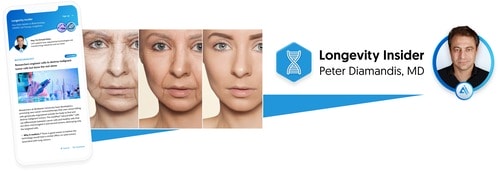
Longevity Insider is a free, AI-driven newsletter that pulls headlines and breakthroughs in longevity, vitality, and aging. It delivers them as quick, scannable updates.
It’s designed as a fast way to see what’s moving in the field each day without manually skimming the whole internet. In practice, it’s perfect for scan-only use.
You get breadth, not depth so do not expect protocol breakdowns or critical analysis. Use it to spot topics worth a deeper dive.
That said, their AI could use a little work in better tailoring content to user preferences.
Peter Attia, M.D.’s Newsletter
Peter Attia has become one of the most visible clinical longevity doctors. He has a strong focus on prevention, diagnostics, and risk reduction.
His newsletter and ecosystem cover lab markers, exercise prescriptions, lipidology, metabolic health, and higher-tech interventions. These are often tied to his podcasts and practice updates.
There’s real value here, especially for understanding how conventional and advanced medicine look at longevity. My critique is that the approach leans heavily on intensive diagnostics and pharma-forward frameworks.
There is minimal emphasis on more unconventional, prevention-based, or time-proven modalities that I personally use and teach. In fact, he often discourages exploring them.
Much of the deepest content also sits behind paywalls. That limits access for many people.
How to Use These Newsletters Strategically
Don’t read every newsletter cover to cover every week. That burns energy and fragments your focus.
Instead, follow a 3-tier consumption system based on your current goals and time available.
Tier 1: Scan-only newsletters
Use these for rapid headline coverage when you want to know what’s moving but don’t need deep analysis. Longevity Insider, DoNotAge, and Biohack Yourself can all sit in this tier.
Skim them in under five minutes. Spot emerging tools, new research, or products worth tracking, then move on.
Tier 2: Digest and bookmark newsletters
These are your weekly curation layers. LP Weekly, Spannr, and DoNotAge again, when they go deeper on specific ingredients.
Read them once a week. Save the sections that align with your current protocol priorities, then move on.
Tag ideas into a Notion doc or your preferred system. Loop back during quarterly Track → Test → Tune reviews.
Tier 3: Deep-dive newsletters
Outliyr, Rhonda Patrick, and Peter Attia fit here.
These are longer reads that deserve focused attention when you’re actively planning a new intervention or stack. Use them to shape your experiments, cross-reference biomarker targets, and learn how mechanisms actually work in context (in context, beyond isolation).
By now, you have your tier structure. Next, plug newsletter insights into your biohacker frameworks.
If I read about a new mitochondrial peptide, I’ll map it against the PerformanceSpan Ladder and Intervention Integrity Score before I even consider ordering. If something scores low on sustainability or has unclear long-term efficacy/safety data, I’ll note it and wait for more evidence.
Finally, rotate your consumption to avoid bias and tunnel vision. If you read newsletters only from supplement vendors or only from clinical doctors, you’ll get a skewed view of what works.
Mix macro-level longevity thinking like Spannr and LP Weekly with protocol nerds like Outliyr and Rhonda Patrick. Helping you stay grounded and creative at the same time.
What’s Missing in the Current Newsletter Space (& What I’d Hope to See by Late 2026)
Even with these solid options, there are still gaps.
Here’s what I’d love to see more of over the next year.
More quantified self integration
Most newsletters talk about theoretical interventions without concern over real, unique biological impact. I want to see case studies with labs and wearables tracking HRV, fasting glucose, VO2 max, Oura scores, DEXA scans, and biological age across months.
Or at the very least, rigorous subjective case reports.
That way, readers can see what worked and what didn’t in controlled n-of-1 experiments.
Balanced critical analysis
Understandably, many newsletters lean into marketing because they’re backed by the brands they’re covering.
I’d love to see more independent voices that call out fads, conflicts of interest, acknowledge uncertainty, and admit, “We don’t know yet” when the data is thin. Evidence (peer-reviewed or rigorous case studies) comes first.
Longitudinal follow-ups on popular interventions
The longevity space loves to announce new “breakthrough” compounds and tools. Few newsletters track back 6 months or a year later to see if they held up.
I’d love more intervention retrospectives. For example, follow up on NMN, rapamycin, metformin, spermidine, peptides, or red light therapy to see if early promises translated into sustained benefits.
Also, to watch for side effects or tolerance that developed over time.
Balanced writing for advanced biohackers who value safety
I see a gap between entry-level wellness content and hyper-aggressive experimental protocols.
I want newsletters for people who are technical, informed, and willing to push boundaries, but who still prioritize long-term safety. They don’t want to fry their biology chasing short-term gains.
Frequently Asked Questions on Biohacking & Longevity Newsletters
How do biohacking newsletters help me stay ahead in longevity & health research?
High-quality newsletters filter thousands of studies, ideas, and tools into actionable insights. Instead of scanning PubMed or social media, you get curated intel on supplements, peptides, mechanisms, biomarkers, and emerging tech, saving you time while also improving decision quality.
What are the best biohacking longevity newsletters to follow in 2026?
For deep scientific context and experiment-ready guidance, newsletters like Outliyr, Found My Fitness, and Peter Attia offer the most depth.
For fast updates or ingredient launches, DoNotAge and Longevity Insider work well. For big-picture longevity trends, Spannr and LP Weekly are great macro sources.
Choose one or create a stack based on your goals.
Are supplement-company newsletters reliable sources for insights?
They can be useful for discovering new ingredients or tracking product launches, but they tend to highlight research that supports their offerings.
Treat these as discovery channels, then verify claims using neutral sources and practice frameworks like Intervention Integrity Score.
Are AI-curated longevity newsletters accurate?
They’re excellent for fast scanning but often lack context, filtering, or safety considerations. Use AI feeds like Longevity Insider for breadth, then rely on expert-led newsletters for depth and interpretation.
Do I need to subscribe to many biohacking newsletters to stay current?
No. 3 to 6 newsletters cover almost everything you need. A balanced stack includes one discovery source, one macro/global longevity source, and one or two deep-dive scientific or clinical sources.
Next Step: Subscribe to a Top Biohacking Longevity Newsletter
You don’t need to follow hundreds of newsletters to stay abreast of key health optimization industry updates. Or to get notified of top new deals, deep dives, protocol inspiration, or big-picture longevity thinking.
You’ll identify a gap based on the 3 types of newsletters mentioned earlier.
Build your own newsletter stack that matches your current goals and time budget
If you’re actively experimenting, lean into deep-dive sources like Outliyr, Rhonda Patrick, or Peter Attia.
If you’re staying aware without getting overwhelmed, use scan-only feeds like Longevity Insider and LP Weekly.
Don’t try to read everything.
Let the tier system and your frameworks, like Track, > Test, > Tune, do the filtering. Your inbox turns into a high-ROI intel feed instead of a source of decision fatigue.
Instead of chasing every headline, the best insights come from a curated set of trusted voices that help you implement. Better, faster, and with more clarity than you could on your own.
Newsletters are just one piece of the puzzle. Pair them with the best biohacking podcasts for deep-dive interviews, the top biohacking YouTube channels for visual protocol breakdowns, and the top biohacking blogs for long-form research you can reference anytime.
Am I missing any of your favorite newsletters? Drop a comment below and let me know your favorite(s).

Comments