

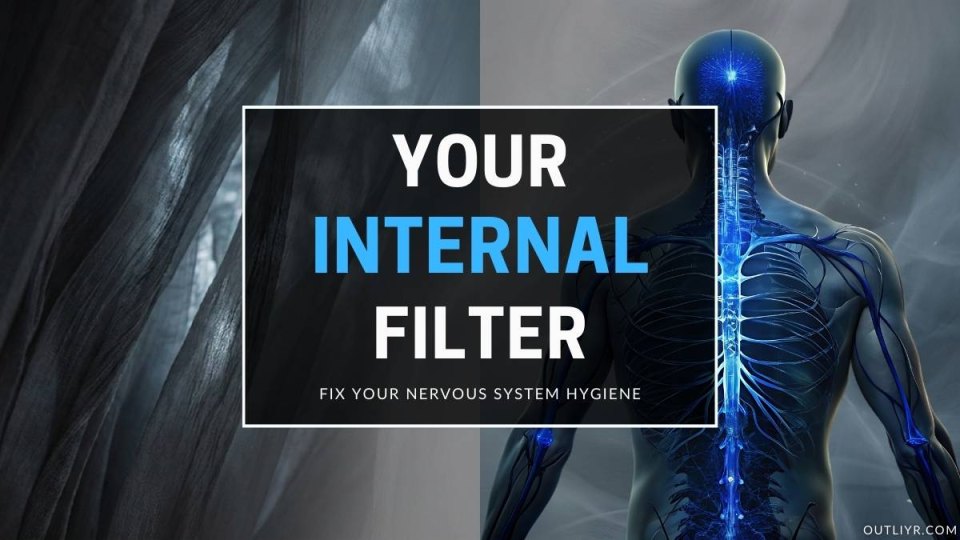
You are your nervous system.
It shapes and filters your entire life experience.
You notice it when you’re exhausted but can’t fall asleep.
When your heart races after a harmless email or a distasteful comment on social media. When you grind through another day running on cortisol and caffeine, wondering why meditation apps and cold showers aren’t fixing the deeper problem.
It’s the system that sets:
- What’s prioritized
- What’s suppressed
- What’s allowed to recover
- What’s perceived as safe vs dangerous
Hormones, immune cells, metabolism, digestion, sleep, longevity, cognition, the gut microbiome, and repair all express differently depending on nervous system state.
Stress is downstream of the nervous system.
Master the art of nervous system regulation means flexibility. The ability to strategically ramp up when needed and downshift when safe
This guide will show you what nervous system regulation actually means, how to measure it, and how to train it without over-biohacking.
A regulated nervous system can ramp up when needed and downshift quickly when safe without getting stuck wired or shut down
Nervous system dysregulation is a capacity problem. Chronic stress stacks faster than recovery clears it, creating allostatic load that shows up as poor sleep, anxiety, fatigue, brain fog, and low HRV
Outliyr recommends nervous system regulation in three directions: bottom-up (breathing, movement, vagus nerve input), top-down (attention, cognition, neurofeedback), & environment (light, sound, routines, safety cues)
Your autonomic nervous system (ANS) runs the show. Sympathetic activation drives performance; parasympathetic activation enables recovery. Health depends on fast switching between both.
Outliyr focuses on widening the window of tolerance. The goal isn’t avoiding stress it’s expanding your capacity so more intensity fits without triggering survival responses.
The Nervous System Described Simply
The nervous system is your body’s control and communication system. It biases the way your process sensory information.
Noisy environments, social cues, or harmless stimuli (like a car passing) can trigger the sympathetic network because they’re processed as potential danger signals.
As a result, it adjusts movement, sensation, thoughts, emotions, and automatic body functions like breathing and heart rate.
What else does it do? The nervous system:
- Directly shapes immune signals (doesn’t just respond to them)
- Suppresses systemic inflammation via acetylcholine from vagal efferents
- Dysregulated ANS correlates with chronic inflammatory and autoimmune diseases
- Adjusts rate of biological aging by altering baseline physiology
Stress and state often shape immunity even without your conscious perception of threat.
Prenatal vagus maturation affects long-term autonomic flexibility and metabolic risk.
The fire hose of modern-day stressors imbalance it. Almost always, sending signals of biological threat.
The human nervous system doesn’t wait for evidence of real danger. It predicts and primes responses based on patterns. This is why chronic low-grade inputs (bad light, sound, notifications) cause sympathetic over-activation.
The antidote? Mastering the art of nervous system regulation.
What regulation actually means
Nervous system regulation is your body’s ability to match your state to your context.
A regulated nervous system can sprint when chased and sleep deeply when safe. It can focus during a pitch and recover after.
Regulated nervous systems shift fluidly between activation and rest without getting stuck in either.
Dysregulation happens when that flexibility breaks down. You get stuck on or stuck off. Wired at midnight. Numb during the day. Anxious without threat. Exhausted without exertion.
Regulation is about range. The wider your range, the more stress you can handle without collapsing into dysfunction.
Why high performers get dysregulated faster
High performers push harder and recover less. That’s the trade.
You stack stressors faster than your system clears them, building recovery debt.
Early mornings, late nights, decision fatigue, conflict, travel, training. Each one pulls from the same recovery budget (Psychoneuroendocrinology).
When you never let the account refill, you end up running on borrowed capacity.
The biology is simple.
Stress hormones like cortisol and adrenaline mobilize energy for action (Neuroscience & Biobehavioral Reviews). It’s fine in the short-term, but long-term stress hormone elevations start damaging the systems they were designed to protect.
Your nervous system knows threat versus safety. Work notifications and lions trigger the same response.
What Controls Your State?

Let’s simplify the factors that shift your nervous system.
How to directly modulate your nervous system right now
These levers change your state immediately by sending powerful signals into safety circuitry:
- Breathing patterns change vagal tone (immediately)
- Vision and gaze alter sympathetic signaling
- Posture and movement shift alter perception
- Sound and rhythm entrain autonomic balance
- Temperature exposure changes autonomic state
These aren’t mindset tricks, they are direct nervous-system inputs that help widen your capacity for stress without survival responses.
Autonomic nervous system regulation: fight/flight vs rest/digest
The autonomic nervous system is your subconscious operating system.
It controls heart rate, breathing, digestion, immune response, and hormone release. All the background processes that keep you alive and functional without you thinking about them (NCBI).
The ANS has two main branches.
- Sympathetic “fight, flight, freeze, or fawn,” speeds you up
- Parasympathetic “rest, digest, relax,” slows you down
A regulated nervous system toggles between both branches without lag or overshooting (ScienceDirect).
Regulated vs. Dysregulated Nervous System
Your state shows up in patterns of behavior, recovery, energy, and reaction.
Here’s a simple comparison.
| Parameter | Dysregulated State | Regulated State |
|---|---|---|
| Sleep 😴 | Poor onset / fragmented | Quick onset / consolidated |
| HRV 📈 | Low or inconsistent | High or improving |
| Recovery 💪 | Slow after stress or training | Rapid |
| Reactivity ⚡ | Easily startled / reactive | Context-appropriate responsiveness |
| Focus 🎯 | Difficulty focusing or compulsive hyper-focus | Clear thinking / flexible attention |
| Emotional state 😊 | Irritable / flat / reactive | Calm / adaptable |
| Physical tension 🧍♂️ | Chronic tension (jaw/neck/shoulders) | Physical ease |
| Digestion 🍽️ | Poor | Normal |
| Illness frequency 🤒 | Frequent | Infrequent |
| Cognitive clarity 🧠 | Brain fog / decision fatigue / rumination | Clear decisions / quick task switching |
The 2 Core Models That Explain Everything
Nervous system dysregulation isn’t random. It follows predictable biological patterns that explain why stress compounds, recovery stalls, and resilience shrinks over time.
The two models below describe how your body manages load and why high performers hit breakdown faster when capacity isn’t protected.
Homeostasis, allostatic load, & why you break down
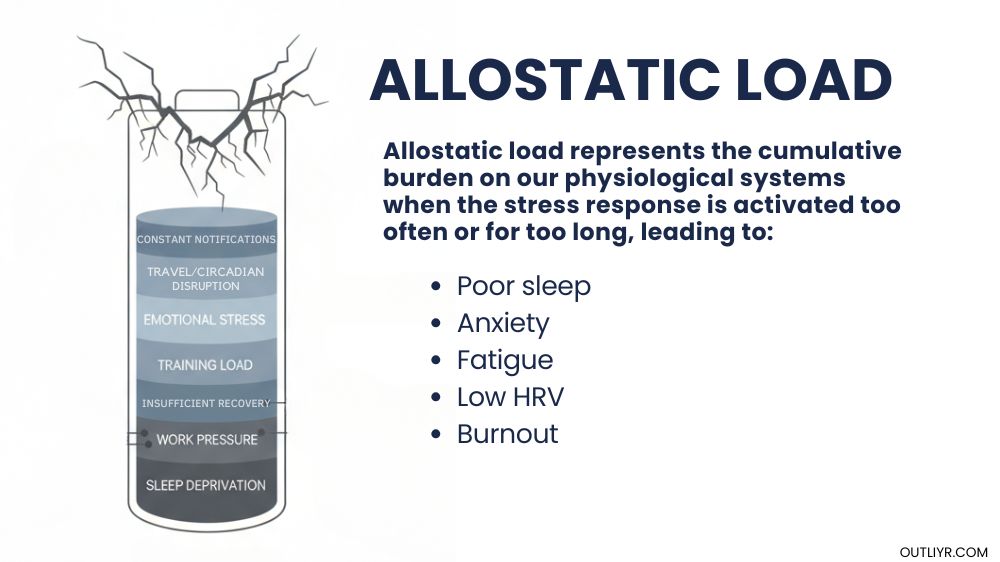
Homeostasis means keeping things stable in a narrow band. Temperature, pH, blood glucose, and other variables stay within tight ranges.
Allostasis means achieving stability through change.
Your body anticipates demands and adjusts heart rate, blood pressure, hormones, and immune activity before and during stress to keep you functioning (PubMed).
If homeostasis is the thermostat, allostasis is the smart system that learns your patterns and preheats the house before you get home.
Nervous system regulation lives in the allostasis world.
Every time your system mounts a stress response, it spends from a finite budget. When you don’t fully recover, the debt accumulates.
Allostatic load is that accumulation across brain, cardiovascular, metabolic, immune, and other key biological systems.
Research links high allostatic load to cardiovascular disease, diabetes, depression, cognitive decline, and mortality (PubMed).
Window of tolerance & capacity
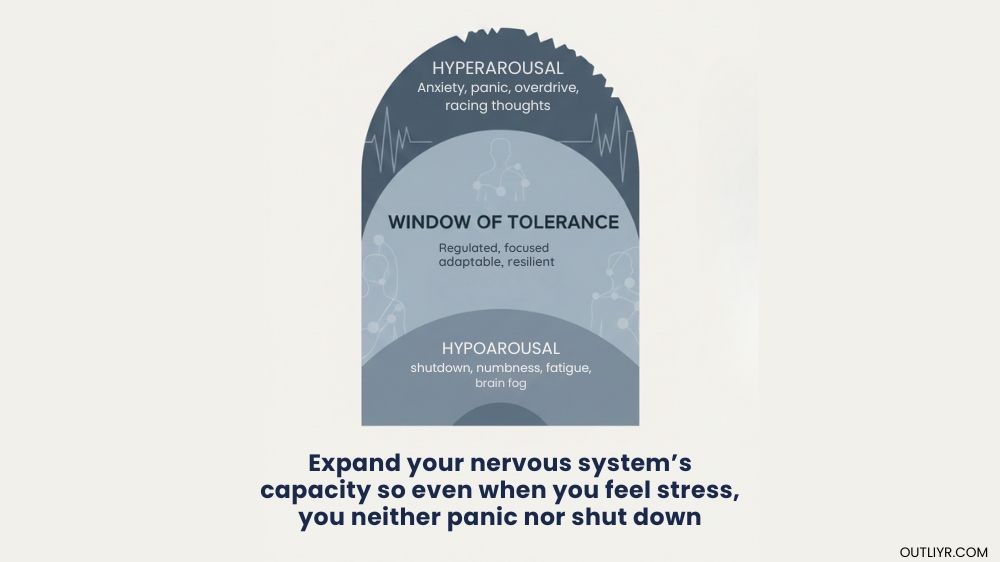
The window of tolerance is the range of stimulation where you can think, feel, and act effectively at the same time.
Inside your window, you can feel stress without flipping into panic or shutdown. You stay present, can make decisions, and recover quickly after activation.
Hyperarousal sits above the window. Hypoarousal sits below it.
Nervous system regulation work is really about widening your window of tolerance so more stress fits inside without pushing you into survival responses.
Like weight lifting, your goal is to progressively increase your nervous system’s capacity.
How to Tell if You’re Regulating Better

Theory is interesting, but not helpful without practicality.
Nervous system health indicators you feel
You don’t need an expensive lab panel to spot basic nervous system health.
Key subjective indicators of a well-regulated nervous system include:
- Falling asleep faster and waking closer to your target time without an alarm
- Feeling clear-headed within an hour of waking, not three coffees later
- Experiencing normal emotional waves without spinning into panic or flattening out
- Noticing real hunger and fullness cues at regular times
- Handling conflict without going straight to attack, defend, or disappear
Interoception is your internal sensing capacity. It’s how you feel your heartbeat, breath, tension, gut cues, and subtle shifts inside your body.
Better interoception = better regulation.
You can detect early stress signals and respond before they escalate.
Neuroception, on the other hand, is your nervous system’s automatic threat detector.
It scans constantly for safety or danger outside your awareness and adjusts your state accordingly (Polyvagal Theory).
When neuroception is more accurate, you react less to harmless cues and more effectively to real threats.
Nervous system measurement biomarkers
Subjective signals are key here, but data can also help. Especially as you train your interoception and neuroception.
Biohackers report noticing the following biomarkers improving as nervous system regulation improves:
- Resting heart rate: lowers as parasympathetic tone and fitness improve
- Heart rate variability (HRV): trends higher and more stable when your system can shift fluidly between activation and recovery
- Sleep efficiency: more time asleep vs in bed, fewer awakenings, more consolidated deep and REM sleep
- Morning energy: lower sleep inertia, more predictable morning alertness
- Recovery scores: many wearables combine HRV, resting HR, temperature, and sleep to give a composite strain/recovery view
HRV is a useful marker of autonomic flexibility, but it’s one piece in a larger picture. See my guide for a deep dive into HRV training, devices, and protocols.
Rather than obsessing over a particular HRV score, ask these better questions:
- Is your baseline trending up over weeks, not days?
- Does your HRV drop predictably with hard stressors and then recover within 24-72 hours?
- Do HRV changes match how you subjectively feel, or are you over-riding your body?
Sleep quality is one of the cleanest readouts of your nervous system state.
Fragmented, shallow, or delayed sleep often means your sympathetic system and HPA axis are still active at night. For sleep optimization strategies, see my guide to biohacking sleep.
The Biohacker’s Nervous System Regulation Toolbox

The best nervous system protocols encourage regulation and build resilience from three opposing ends.
Bottom-up strategies (body first)
Bottom-up regulation starts with the body and lets the brain follow.
These strategies directly influence breathing, posture, facial expression, muscle tone, and visceral signals.
They send powerful “safe” or “threat” messages to your autonomic nervous system and HPA axis (Chronic Stress).
Typical bottom-up tools include:
- Breath control: slow, nasal, and often slightly longer exhales to signal safety, such as box breathing
- Vagus-nerve stimulation: gentle stimulation through breath, sound, or devices to improve parasympathetic tone. This guide shares the best at-home vagus nerve stimulation tools and tips
- Apollo Neuro wearable device that uses vibration therapy to modulate autonomic tone and improve HRV (Apollo Neuro Study). Read my Apollo Neuro review here
- PEMF therapy at specific frequencies (16 Hz) shows promise for vagus nerve stimulation and parasympathetic activation (T&F). My buyer’s guide to the best PEMF therapy devices is here
- Thermoregulatory conditioning: intentional hormetic stress with enough recovery to build capacity, not crush it. Get the full cold therapy protocol + tips here
- Movement: walking, light cardio, and mobility that discharge excess activation and improve interoception
Instead of rushing to implement these, test them one at a time to find the one(s) that work best for you.
Top-down strategies (mind and meaning)
Top-down regulation starts with the cortex. It changes how you interpret sensations, situations, and stories.
Your thoughts about stress shape your biological response to stress. Believing that stress can fuel growth (when combined with good behavior), changes cardiovascular and hormonal responses in real time (AHA Journals).
Top-down levers include:
- Cognitive reframing: changing “this will destroy me” to “this is intense and I can handle it”
- Attention training: directing focus to present cues, not catastrophic futures
- Neurofeedback: advanced brain training helps keep the brain in nervous-system supportive states. These at-home neurofeedback devices are the ones I use
- HRV biofeedback: cues help you learn to effectively balance your nervous system state. This guide compares all the HRV biofeedback devices that work
- Narrative work: updating identity from “I’m a burnt-out person” to “I’m someone rebuilding capacity”
You acknowledge reality, then choose interpretations that support adaptive stress responses instead of amplifying threat (different than toxic positivity).
Environment and “neuroception” (safety cues)
Your environment constantly trains your nervous system.
Neuroception runs below conscious awareness and automatically adjusts your nervous system state based on the perceived danger of your surroundings and relationships.
Subtle safety cues:
- Warm faces, relaxed voices, and predictable interactions
- Consistent routines and clear boundaries
- Lighting, sound levels, and clutter that don’t overwhelm your sensory system
Subtle danger cues:
- Unpredictable interruptions
- Harsh sounds, bright screens late at night, constant notifications
- Spaces associated with conflict, shame, or overload
Treat your environment as part of your protocol. Minimize chronic threat cues, build in reliable safety cues, and design default behaviors that lower allostatic load over time.
A Simple Daily Nervous System Hygiene Checklist
Let’s make this even more practical.
Minimum effective complexity approach
Nervous system hygiene should feel simple/
Capacity builds from small, repeatable inputs that signal safety and allow full recovery between stressors.
Sample daily nervous system regulation checklist:
- One anchor at wake time, within a 60-minute window, even on weekends
- 10–20 minutes outside in morning light (no sunglasses)
- One intentional “off” block where notifications are disabled and you’re not multitasking
- One brief body-based regulation practice such as nasal breathing or a walk after your hardest stressor
- A consistent pre-sleep wind-down that doesn’t involve bright screens or intense inputs in the last hour
- Optional tech upgrade to make the process even easier
Your goal is minimum effective complexity: the simplest stack that reliably keeps you inside (or expanding) your window of tolerance.
How to pick one lever to start
Many folks try to overhaul everything at once. That’s how they burn out on regulation too.
Pick one lever using three filters:
- High impact: It touches ANS, HPA axis, and recovery (sleep or light are great starting points)
- Low friction: It fits into your real schedule with minimal willpower
- Trackable: You can feel and/or see a change in 2-4 weeks
Examples:
- If your sleep is erratic, start with a fixed wake time plus morning light
- If you feel wired all day, anchor one 5-10 minute downshift block after your hardest daily stressor
- If your environment is chaotic, reduce notifications and visual clutter in your main workspace
Give the lever 21-28 days. Watch subjective signals first, then numbers like resting heart rate, HRV trends, and recovery scores will likely follow.
Once that habit feels automatic, layer the next one.
Mastering the Art of Nervous System Regulation
The nervous system is the layer between your inner and outer worlds.
It’s the layer below stress, that shapes how you perceive life.
Implement the triad:
- Bottom-down regulation
- Top-down regulation
- Environment optimization
Choose one daily hygiene lever and one measurement marker to watch for the next month. HRV is the gold-standard.
As you improve your self-regulation, you’ll notice that everything else starts working better too.
What are your thoughts on biohacking the nervous system? Drop a comment below and let me know! Or, send this to your high-strung friend as a loving nudge to empower their best life.
Thanks!
0 reader comments