

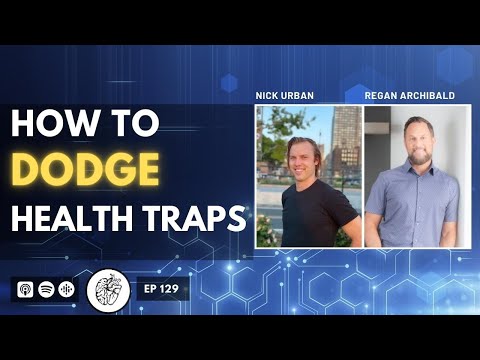
With Nick Urban, Episode 129



What You’ll Learn
- Bioharmony vs biohacking: Nick explains why he coined bioharmony, an approach that works with the body for long-term results instead of chasing quick-fix shortcuts. [04:39]
- Hermetic principles for health: The 7 laws from the Kybalion, including rhythms, reveal core life patterns that explain contradictory nutrition research. [06:39]
- Prediabetic athlete wake-up call: Despite following the USDA food pyramid and playing 3 high school sports, Nick’s fasting insulin bordered prediabetic, proving outward fitness hides internal dysfunction. [08:51]
- Creatine as a cognitive nootropic: Creatine monohydrate improved both physical recovery and memory, demonstrating that the right biological interventions enhance mental performance alongside physical output. [10:05]
- Adaptogen-first nootropic strategy: Out of 100+ compounds tested, adaptogens consistently deliver the most noticeable effects with the fewest side effects, forming the foundation of Nick’s daily stack. [32:25]
- Ayurvedic sun gazing protocol: Starting at 15 seconds and building in 15-second increments when UV index is 0, Nick has reached 5 minutes of sunrise gazing for parasympathetic activation. [25:52]
- Stress spikes blood sugar more than food: A continuous glucose monitor revealed Nick’s glucose was high despite clean eating, with levels normalizing within 1 day of adding parasympathetic practices. [23:52]
- Internal sunscreen stack: Melanin-rich foods, astaxanthin from salmon and shrimp, and the peptide Melanotan reduce UV damage without conventional sunscreen. Indoor workers show higher melanoma rates than outdoor workers. [43:17]
- BPC-157 arginate vs acetate: The arginate form delivers roughly 90% oral bioavailability compared to only 10% for acetate, making peptide salt form a critical purchase decision. [47:35]
Why It Matters
Most people either chase the latest biohacking shortcut or dismiss ancient health systems entirely. Nick Urban, a CHEK Holistic Lifestyle Coach Level 2 who has tested 100+ nootropic compounds and studied both Ayurveda and traditional Chinese medicine, bridges the gap with his bioharmony framework. This episode lays out a practical philosophy for evaluating health information, running safe self-experiments, and building protocols that work with your biology for lasting results.
Who Should Listen
- Health enthusiasts who feel overwhelmed by contradictory nutrition research and want a framework for evaluating claims from any source.
- Biohackers curious about Ayurvedic practices like sun gazing, oil pulling, and constitutional typing who want practical implementation steps.
- Anyone building a personalized nootropic or supplement stack who wants to understand how adaptogens, racetams, and peptides compare in practice.
Bioharmony, Ayurveda & Ancestral Health on the High Performance Longevity Podcast
In this solo episode of the High Performance Longevity podcast, host Nick Urban shares his bioharmony philosophy during a cross-interview on the Unreasonable Health podcast with Reagan Archibald. As a CHEK Holistic Lifestyle Coach Level 2 who has self-tested over 100 nootropic compounds and studied both Ayurveda and traditional Chinese medicine, Nick breaks down why working with the body’s natural systems outperforms quick-fix biohacking shortcuts.
The conversation covers Nick’s Ayurvedic practices (sun gazing from 15 seconds to 5 minutes, oil pulling, tongue scraping, constitutional typing), his adaptogen-first nootropic strategy using racetams paired with cholinergics, and how a continuous glucose monitor revealed that stress spiked his blood sugar more than any food choice. Nick also discusses his internal sunscreen protocol using astaxanthin-rich foods and the peptide Melanotan, his sauna and ice bath contrast approach (190 degrees for 18 minutes, ice for 3-8 minutes), and why barefoot shoes eliminated chronic shin splints after 7 years.
You’ll walk away with a practical self-experimentation framework, specific Ayurvedic routines you can start today, and a clear understanding of how to evaluate health claims by steel-manning both sides before committing to any protocol.
Key Terms Quick Reference
Several specialized terms come up throughout this conversation. Here’s a quick reference.
[04:39] Bioharmony: Nick’s alternative to biohacking that works with the body’s natural systems to amplify signals and create long-term effective changes, rather than chasing short-term shortcuts.
[06:39] Hermetic principles: Seven universal laws from the Kybalion attributed to Hermes Trismegistus. The principle of rhythm explains why health research appears contradictory, as outcomes oscillate based on context and timing.
[07:34] Hormesis: The biological concept that the right dose of a stressor triggers a beneficial adaptive response. Beyond that threshold, the dose becomes the poison. Distinct from the Hermetic principles despite the similar name.
[25:52] Sun gazing: An Ayurvedic practice of looking toward the sun during the first or last 15 minutes of the day when UV index is 0. Practitioners build exposure in 15-second increments to activate parasympathetic response without UV damage.
[32:10] Pitta constitution: One of the three Ayurvedic constitutional types, characterized by fiery, hot, intense energy. Pitta types benefit from cooling foods, cooling breathwork, and ice baths to maintain balance.
[39:06] Proprioception: The body’s ability to sense its position and force through nerve fibers, especially dense in the feet. Conventional shoes with narrow toe boxes and elevated heels distort proprioceptive feedback, altering gait.
[37:36] Horizontal gene transfer: A process where gut bacteria can transfer genetic material from consumed food into the host organism. A key concern with genetically modified foods, separate from the glyphosate toxicity debate.
What Makes Bioharmony Different From Biohacking?
The short answer
Biohacking seeks shortcuts that typically work over a short time horizon. Bioharmony takes the opposite approach: working with the body’s existing systems to amplify natural signals and create lasting changes.
What Urban found
After years of testing every biohack available, Nick concluded that approaches working against the body’s rhythms deliver diminishing returns. The Hermetic principles, 7 universal laws from the Kybalion, offered a deeper framework. The principle of rhythm, for example, explains why coffee alternates between “super drink” and “villain” in research. Context and timing determine outcomes, not the substance itself. By studying Ayurveda’s 5,000-year tradition alongside modern science, Nick developed protocols that honor both perspectives.
What to do about it
Before adding any biohack, ask whether it works with or against your body’s natural rhythms. Use your Ayurvedic constitution (pitta, vata, kapha) as a filter. If you run hot (pitta), prioritize cooling breathwork and foods over stimulating practices. Steel-man both sides of any health claim before committing to a protocol.
“Instead of looking for the quick fixes, the shortcuts, they usually work over a short time horizon. Bioharmony takes the opposite approach, and it works with the body to amplify the signals and make long term effective changes.” – Nick Urban
How Can Ayurvedic Practices Improve Modern Health?
The short answer
Ayurvedic practices like sun gazing, oil pulling, tongue scraping, and constitutional typing offer time-tested methods for parasympathetic activation, oral health, and personalized wellness that modern science is now validating.
What Urban found
Nick built his sun gazing practice from 0 to 5 minutes, strictly during the first or last 15 minutes of the day when UV index reads 0. He describes it as one of the fastest ways to shift into a parasympathetic state. For oral health, tongue scraping removes pathogenic bacteria and improves taste receptor contact with food, which sends better satiety signals to the brain. Oil pulling with coconut or sesame oil for 10 minutes replaces mouthwash, which kills beneficial oral bacteria while pathogenic strains survive and recolonize faster.
What to do about it
Start sun gazing at 15 seconds and increase by 15 seconds each session, only when UV index is 0. Scrape your tongue with a copper or stainless steel tool morning and evening. Replace mouthwash with 10 minutes of oil pulling using coconut oil plus a few drops of peppermint essential oil.
“A lot of our health begins in the mouth. When we’re taking that mouthwash, we’re killing both the commensal bacteria, the good bacteria that are there to protect us, and we’re not leveling the playing field because the pathogenic bacteria have a better ability to survive and thrive despite that.” – Nick Urban
Related: Sun Gazing Guide
How Should You Build a Personalized Nootropic Stack?
The short answer
Start with adaptogens as your foundation, then add small task-specific stacks pairing a racetam with a cholinergic precursor. Always match your nootropic intensity with adequate recovery to avoid burnout.
What Urban found
After testing over 100 nootropic compounds, Nick ranks adaptogens first for consistency and safety. For creative work, he pairs aniracetam with uridine or uses NUPEPT with alpha-GPC, building small stacks supported by precursors to avoid wearing out brain pathways. He emphasizes that nootropics are highly bioindividual. What works for one person may not work for another. Nick also warns that boosting cognitive performance without matching recovery is like only lifting weights without resting.
What to do about it
Build your daily foundation with adaptogens. Add task-specific stacks only when you need them: a racetam plus cholinergic for creative work, different combinations for focus or memory. Match any cognitive enhancement with proportional recovery. Source nootropics from reputable vendors who screen for heavy metals, especially for racetams and peptides.
“If you’re gonna overclock your brain, you’re gonna make it work. You also wanna be pushing yourself. You don’t wanna just be doing your normal routine and living in the complete comfort, you wanna give yourself something to strive towards that’s out of the ordinary.” – Nick Urban
Related: Nootropics Beginners Guide
The Urban Bioharmony Protocol
A framework for integrating ancestral wisdom with modern biohacking to build sustainable health protocols.
- Run lifestyle audits 2x per year: Use tools like a continuous glucose monitor for 2 weeks to reveal hidden stressors your daily routine masks
- Build an adaptogen foundation first: Start with adaptogens before adding potent nootropics, as they deliver consistent benefits with fewer side effects across 100+ tested compounds
- Match enhancement with recovery: Any cognitive or physical performance boost requires proportional recovery investment, or you’ll crash
- Steel-man both sides before committing: Read the proponent and the opposition for any health claim, then sit with both perspectives before taking a stance
- Track cause and effect with a daily log: Record what you consume, how you feel 60-90 minutes later, and correlate patterns over weeks to personalize your protocol
- Layer ancestral practices into your morning: Sun gazing (starting at 15 seconds), grounding on bare earth, and tongue scraping cost nothing and compound over time
- Use your constitutional type as a filter: Know whether you’re pitta, vata, or kapha and select cooling or warming practices accordingly to maintain balance
Common bioharmony mistakes
- Blindly trusting authority: Whether it’s a podcast, book, or doctor, anchoring bias influences every source. Your own biofeedback is the final arbiter
- Chasing shortcuts without systems: Quick-fix biohacks work over short time horizons but erode your biology when used as the primary strategy
- Ignoring stress as a metabolic driver: Clean eating means nothing if chronic stress is spiking your blood sugar higher than any food would
Source: Nick Urban’s Bioharmony Framework, Outliyr
Frequently Asked Questions
What is bioharmony & how does it differ from biohacking?
Bioharmony works with the body’s natural systems to amplify signals and create long-term effective changes. Unlike biohacking, which often seeks quick fixes and shortcuts that work over short time horizons, bioharmony takes a sustainable approach rooted in both ancestral wisdom and modern science.
Is sun gazing safe for your eyes?
Sun gazing is only practiced when the UV index is 0, during the first or last 15 minutes of daylight. You start at 15 seconds and build in 15-second increments. If it hurts at all, you stop immediately. Never wear glasses or contacts during the practice, and never sun gaze when the UV index is above 0.
What are the best nootropics for beginners?
Adaptogens are the best starting point because they deliver consistent effects with fewer side effects compared to potent synthetic nootropics. After establishing an adaptogen foundation, you can add task-specific stacks like a racetam paired with a cholinergic precursor for creative work.
Why does stress raise blood sugar even on a clean diet?
Stress triggers cortisol release, which signals the liver to dump glucose into the bloodstream for fight-or-flight energy. A continuous glucose monitor can reveal that stress spikes blood sugar more than dietary choices. Adding parasympathetic activities like breathwork and outdoor breaks can normalize levels within a day.
What is oil pulling & why is it better than mouthwash?
Oil pulling involves swishing coconut or sesame oil in your mouth for about 10 minutes. Unlike mouthwash, which kills both beneficial and pathogenic bacteria (with pathogens recolonizing faster), oil pulling freshens breath while supporting the oral microbiome balance.
What are the Hermetic principles mentioned in this episode?
The Hermetic principles are 7 universal laws from the Kybalion, attributed to Hermes Trismegistus. They include principles like rhythm, which explains why health research appears contradictory as outcomes oscillate based on context and timing rather than the substance itself.
How do barefoot shoes prevent injuries?
Barefoot shoes have zero-drop arches and minimal padding (a few millimeters), allowing natural proprioceptive feedback through the feet’s dense nerve fibers. Conventional shoes compress the toe box and alter gait patterns. After transitioning 7 years ago, Nick eliminated chronic shin splints and Osgood-Schlatter flare-ups.
Products, Tools, & Resources Mentioned
Outliyr independently evaluates all recommendations. We may get a small commission if you buy through our links (at no cost to you). Thanks for your support!
Wearables & testing
Oura Ring: Wearable ring tracking sleep and recovery metrics. Nick uses it primarily for passive data collection and as a second opinion alongside internal biofeedback.
Continuous glucose monitor: 2-week arm sensor providing glucose readings every 15 minutes. Nick’s lifestyle audits revealed stress-driven blood sugar spikes that clean eating alone couldn’t explain.
Supplements & nootropics
Creatine monohydrate: Dual-purpose supplement improving both physical recovery and memory. Nick started using it in high school for sports and noticed cognitive benefits in the classroom.
Adaptogens: Nick’s foundation nootropic category, delivering the most consistent effects with the fewest side effects across 100+ compounds tested. Best for daily use.
Racetams (aniracetam, NUPEPT): Synthetic nootropics Nick pairs with cholinergic precursors (alpha-GPC, uridine) for creative work. Task-specific, not daily foundation.
BPC-157 (arginate form): Oral peptide with roughly 90% bioavailability in the arginate salt form, compared to only 10% for the cheaper acetate form. Nick keeps it on hand for gut support.
Melanotan: Peptide that increases melanin production in the skin, reducing UV burn susceptibility. Part of Nick’s internal sunscreen protocol.
MOTS-c: Mitochondrial peptide Nick used in a protocol that produced a noticeable energy increase, pairing well with cordyceps.
Cordyceps: Medicinal mushroom that Nick stacked with MOTS-c for enhanced mitochondrial energy production.
Ayurvedic & ancestral tools
Copper tongue scraper: Ayurvedic oral health tool that removes pathogenic bacteria and improves taste receptor sensitivity for better satiety signaling.
Earth Runner grounding sandals: Sandals with conductive lacing that allow electrical grounding while walking. Part of Nick’s barefoot shoe collection.
Xero Shoes: Minimalist barefoot shoes with zero-drop arch and a few millimeters of padding. Nick credits 7 years of barefoot shoe use with eliminating chronic shin splints.
Books & references
The Kybalion: Book detailing the 7 Hermetic principles attributed to Hermes Trismegistus. Framework Nick uses to understand health contradictions through the principle of rhythm.
Tim Ferriss (meta-learning): Nick credits Ferriss’s meta-learning concept for his approach to accelerated skill acquisition across health, career, and relationships.
Richard Feynman (teaching as learning): Nobel Prize-winning physicist whose emphasis on teaching as a form of learning shaped Nick’s approach to sharing health knowledge.
About Nick Urban
Nick Urban is a certified personal trainer, health researcher, and founder of Outliyr, a platform dedicated to evidence-based health optimization. He has personally tested over 100 nootropic compounds and studied traditional medicine systems including Ayurveda and traditional Chinese medicine. His bioharmony framework bridges ancestral wisdom with modern biohacking, emphasizing sustainable protocols that work with the body’s natural systems. Nick hosts the High Performance Longevity podcast and publishes in-depth articles on nootropics, peptides, and performance optimization at outliyr.com.
Related Episodes & Articles
- Episode 86: Optimized Bioharmony Daily Routine
- Episode 81: Bioharmony, Biosynergy & Quality of Life
- Episode 212: Ayurveda & Modern Science with John Douillard
- Episode 96: Biohacking, Ayurveda & Ancestral Wisdom
- Article: Bioharmony Principles for Human Performance
- Article: Nootropics Beginners Guide
- Article: Biohacking Ancestral Wisdom Tips
Full Episode Transcript
Nick Urban [00:00:06]: Ladies and gentlemen, welcome to MINDBODY Peak Performance podcast with your host, Nick Urban. Actually, on this episode, the roles were reversed, and I was a guest podcast on the Unreasonable Health podcast with a previous guest, Reagan Kelly, and he interviewed me. So this time, I was in the hot seat, and we discussed a lot of different varied topics, such as some of the ancient medical systems, why I chose to research traditional Chinese medicine and Ayurveda, the lessons that I gleaned from them, then on the ergogenic slash performance front, how to stay up to date and even ahead of the curve, how to properly evaluate the potential upsides of doing certain advanced biohacks versus properly weighing the potential downsides and how to look at these emerging therapeutics from both the modern science, Western medicine lens and then also through the viewpoint of some of the time tested traditional medicines. For whatever reason, when he asked me about nootropics, I didn’t have much to say even though I use them most days, and have tried hundreds of different compounds and was previously a brain coach at helping people customize their own nootropic formulas. I left that question blank, and I thought I’d add a little color to that in this episode intro. I’ve used just about every single ingredient under the sun, at least the ones that appear to be somewhat safe. My go to’s are definitely the adaptogens, first and foremost. Those seem to yield the best effects for me and the fewest side effects, and I love that they modulate from bodily systems back into balance.
Nick Urban [00:01:54]: I also will turn to some of the Racetams, and I also really like some of the other herbal extracts. And my approach to nootropics is personalized to what works best for me, but then also the kind of day I have ahead of me. So for example, if I’m gonna be doing some creative work, I’ll use something like a racetam, say, aniracetam, with a source of brain fuel, aka a cholinergic. So maybe some Uridine with the aniracetam, or maybe I’ll use NUPEPT and I’ll use some alpha GPC. But I like to build small little stacks and then support them with the precursors to get the best effects without wearing out any of the pathways in the brain. I have lots of articles on nootropics, my favorite stacks. I’m currently writing one ranking everything I’ve taken so you can see what’s worked best for me, but nootropics are very bioindividual. What works great for me might not work for you.
Nick Urban [00:02:53]: So it’s a game of exploration or using a service that knows how to customize them based on your neurochemistry. So if you wanna dig more into that, I will put a link in the show notes and the description below this video where you can check out the articles I’ve written on nootropics. I’ve done a couple different podcasts in them as well. I will put links to those in the description as well. Other than that, sit back, relax, and enjoy my conversation with Reagan Archibald on the Unreasonable Health podcast.
Regan Archibald [00:03:26]: Hey, everybody. It’s Reagan Archibald here at Unreasonable Health. And today, I’ve got a really exciting guest on, Nick Urban. Many of you, yeah, we’ve shared the podcast episode that he and I did together where he interviewed me, and we had so much fun. I said, Nick, will you please come and introduce yourself to our amazing people over here at East West? And Nick was so gracious to accept the invitation. And, Nick is somebody who, he’s got if you go to nickurban.me, you’ll be able to find out all about him. But he is a significant individual in the world of biohacking.
Regan Archibald [00:04:04]: Not only is he taking ancient practices for your performance, your mental health, everything when it comes to your own personal growth plan. Nick is your go to. And so, he is prominent in the field of biohacking. He also has, like you know, he’s really testing the boundaries when it comes to some of the emerging technology. I’m excited for our conversation today, Nick, and welcome to Unreasonable Health.
Nick Urban [00:04:39]: Thanks, Reagan, and that was a very warm welcome. I appreciate you. I had a great time chatting last time as well. One small correction I will make is that instead of biohacking, I am a proponent of what I call bioharmonizing, and it’s very similar biohacking. But instead of looking for the quick fixes, the shortcuts, they usually work over a short time horizon. Bioharmony takes the opposite approach, and it works with the body to amplify the signals and make long term effective changes.
Regan Archibald [00:05:13]: I love that. Well and I think, bioharmonization, is so much better because, the world in the world of quick fixes, why not get your biology harmonized? I mean, that is it. So, yeah, so one of the things that I really appreciate about you is you’re someone who’s always learning and you’re someone who is young, but you’re wise beyond your years. But what are some of the best books that you’ve read that have allowed you to create this term bioharmony?
Nick Urban [00:05:49]: That’s a great question, and I do a lot of reading. It’s partially what I attribute my success to, my limited success so far, but I like to look at information that will expose me to different perspectives. And so early on, I found Tim Ferriss and his concepts of meta learning or, like, how do you improve the one skill that will translate to all other skills? And you can get really good at the process of learning. Then you can pick up information, whether it’s for your relationships, it’s for your career, it’s for your sports, whatever it is. If you get really good at learning, you can become better at any of these other fields. So I started diving deep into that and learning techniques to improve memory, to learn faster, and using that, then I looked for, health wise, some of the older systems.
Nick Urban [00:06:39]: Because, like, our current approach, the Western paradigm, it is limited, and there’s a lot of contradictory information. It seems like one week, coffee is a super drink. The next, it’s a villain. Cholesterol, same thing. Alzheimer’s and dementia, also the same thing where it seems like we understand exactly what causes it, and then new research comes out and shows that it’s limited in our understanding. So I like to look at things like the Hermetic principles, which go a level deeper and try and figure out and tease out the core patterns of life. And so, like, the rhythms, that’s one. There’s a bunch of different principles like that that explains so much of what we experience in our daily life.
Regan Archibald [00:07:29]: So, yeah. And for those of you who are not familiar with hormetic, what that term means, how would you define, like, hormetic activities or hormesis?
Nick Urban [00:07:40]: So those are two separate things. Hormetic is one thing, and these are Hermetic principles. And the Hermetic principles were coined by I think it was Hermes, Hermes Trismegistus. Yeah.
Regan Archibald [00:07:53]: Nice to meet you. Okay.
Nick Urban [00:07:54]: There’s a book called the Kybalion, which details the, like, 7 laws of the Hermetic principles. And then hormesis is a different concept entirely, and that’s, like, to summarize, just the concept of the right amount of something will trigger a biological response that’s beneficial. And if you go much beyond that, the dose determines the poison, basically. So something that’s good in a small dose will be detrimental in a high dose.
Regan Archibald [00:08:23]: Yeah. That’s okay. Excuse me. I’m glad I clarified that. And you’ve had your own, I mean, part of why you got into this whole world is you had your own health journey. I mean, almost insulin dependent. Maybe you could talk to us about your own health journey and how you really became such a ferocious learner, and now somebody who really wants to transform the health of as many people as possible.
Nick Urban [00:08:51]: Yeah. So it started for me back in high school. I was an athlete playing 3 sports in high school, and I thought I was the pinnacle of health. I was very strong, and I looked good. But then the issue became, I went to my doctor, and he checked out my fasting insulin and glucose. And it was very high. I was bordering prediabetic, and they said that if I maintain that for much longer, I would need insulin. And to me, it made no sense.
Nick Urban [00:09:19]: I had the USDA food pyramid on my wall, following it to a tee, and that was not turning me into the picture of health, at least internally. And then the more I dug into the research and tried to decode what all this was, I discovered that the symptoms I assumed that everyone experienced, such as gas, bloating, feeling super lethargic after meals, like a huge crash where I just wanted to curl up for the rest of the day. Those weren’t normal. And after I tried different things, I began fasting occasionally. I cleaned up what I was consuming. I realized that I had not allergies but intolerances to dairy. And at the time, I was drinking couple gallons of milk per week and eating a bunch of yogurt and had a very high dairy consumption. So I started trying to eliminate certain foods, and I noticed that those made improvements. I felt better. And then I also came across the world of dietary supplements, and those were more on the ergogenic side for performance, and I started using those after heavy research and saw a pretty profound improvement to my sports game. And from there, I saw the same improvements in the classroom, which is surprising. I started taking creatine monohydrate, for example, and not only was I able to lift more and recover faster from that, but then I realized my memory was a little bit better. It wasn’t outstandingly better, but it made a small little difference. And I realized that if you do the right things for your biology.
Nick Urban [00:10:57]: They can transform not only your physical performance, but your mental performance, your health, and your long term vitality.
Regan Archibald [00:11:06]: And did you start, I mean, did you share this with some of your teammates, like your rugby teammates, and how quick did you start, I mean, because when I got into nutrition, I was about 16, and I gave my whole basketball team 8 grams of vitamin c. I’m like, we’re gonna crush it. I read this article on it, and it’s really good for endurance, but I gave us all loose stools, and so it was kind of my first failed attempt to help someone in their health journey. But how soon did you start doing stuff like that?
Nick Urban [00:11:37]: Yeah. I began sharing with my teammates about the same age in high school also. And then in college, it really started taking off. People were turning to me all the time, asking me to design custom supplement stacks for them, help them with nootropics. A lot of people around me were using study drugs. And from some of the neuroscience classes I was taking, I quickly realized that I didn’t wanna take those, and I wanted to find other things that could give me a little leg up and help me.
Nick Urban [00:12:03]: And I found some of those things. I used them. People were wondering what they were. I would explain how it worked to them and, of course, give them all the proper disclaimers that it’s for research only and to do your own research. But, yes, sharing what I was learning has always been a big part of my process because it’s one thing to read a book and to really understand, think you understand, and it’s another to be able to read a book, digest the information, assimilate the information, and be able to actually apply that when it counts.
Regan Archibald [00:12:38]: Yeah. I know, early on, Jim Kwik, he’s the memory guy. Just awesome. I took one of his courses and he’s like, the fastest way to learn something is to go teach it. And so I love that. I’ve always applied that. And I think that’s where, you know, when you’re naturally enthusiastic about something you just wanna share it. Even if you’re maybe, you know, our intentions were great, I’m sure there are some of the stacks that you recommended that probably didn’t, may not have been as effective as they would be now. Right?
Nick Urban [00:13:12]: Yeah. Absolutely. And on the topic of learning also, that reminds me of Richard Feynman, who is a Nobel Prize winning physicist.
Regan Archibald [00:13:22]: He is a Nobel. Yes.
Nick Urban [00:13:24]: Okay. Yeah. And he was very adamant about teaching as a form of learning, and there was a lot of others like him. If you study the polymaths, you figure out what they have in common, then you can work on developing those skills.
Regan Archibald [00:13:38]: Yeah. I think that’s great. And I also like the definition that, you know, learning is a change of behavior. And if you haven’t changed your behavior, you haven’t really learned something. Because a lot of people read a lot of books, and the books are in the mind, but they’re not embodied, and they haven’t made big changes. So what would you say the biggest thing that you’ve changed, for the good, has been in the last 10 years.
Nick Urban [00:14:07]: For me, the biggest thing would be to not just blindly accept information because it comes from an authority, whether it’s a podcast, an interview, a book, a course, to actually take that and look to both sides, what the one proponent is saying, what the opposition is saying and then letting myself sit with both of those and just feel both sides, try to steel man both sides, and really make sure that I’m not just having a more broad perspective, and I’m understanding the whole thing before I just take a stance, and then also want to take that stance to realize it’s where I currently stand. But at any point, that could shift if a bunch of new evidence comes out. I’m not gonna pigeonhole myself into dogma.
Regan Archibald [00:14:57]: Yeah. I think that’s great because, you know, you always have to look at both sides. There’s this thing in medicine called the anchoring bias. And are you familiar with that where, you know, our first diagnosis, if I read labs and I’m like, this person has thyroid issues or whatever, and I’ve had to learn to just like, okay, put that on the side and maybe that is and then have some debate about why it may not be. And, that’s a good principle you’ve learned in the last 10 years. So if somebody’s looking at and one of the reasons I wanted to bring you on is because I wanted to help our audience really learn how to assess information. I think you’ve done a great job at that. Bringing in a lot of the science, but also not being closed off to more of the ancient traditions, whether that’s shamanic medicine, Ayurvedic medicine. But, what are some things, some pieces of advice you could give people who are, you know, maybe just entering into the world of transforming their health or the world of peptides or nootropics, but what are some things, some advice you would give them in their learning and research process.
Nick Urban [00:16:17]: Yeah. For learning and research, it’s, again, to find sources that can help you break down what it is. Because if you go straight to PubMed and you look at a study, even if you know what all the words mean, it can be a lot more complicated than that. And there’s a lot of biases. As you mentioned, the anchoring bias, that doesn’t just apply to medicine. That applies across the board. I first learned about that when I was working at a startup, and it was a sales tech startup.
Nick Urban [00:16:44]: And the salespeople would always try and anchor their prospects to get the best possible price for the software. And so, like, being aware of the different cognitive biases that might be influencing your thinking and influencing whatever it is that you’re studying. That’s a big one that I always, I’m wary of whenever I’m reading something because there’s even some research that the study lead, whoever is actually conducting research, if they hold very strong beliefs that something will or will not work, that alone influences the outcome of the study.
Regan Archibald [00:17:18]: Yeah. Well, it goes back to the Heisenberg principle. Right? Is it a particle or is it a wave? And it’s like, well, it depends on the observer. And the biases are, I mean, you and I are biased towards the same kind of thing. We think there’s certain techniques and tools, and there’s new medicine that seem to be better than other stuff. But I guess, what can people do when it comes to, I have a lot of our clients who are like, my brother is a doctor. He thinks what you guys do is just like it’s so far out there. Or they may even say that themselves. Like, well, before I do anything on my own, I really wanna talked to my doctor about this, but what would you talk to them? What kind of advice would you share with them to help, you know, think of the bias that their doctor may have versus their brother or what they wanna do with their own personal journey.
Nick Urban [00:18:23]: One of the first things I think that is helpful for a lot of people to do is to really get in touch with what their body is telling them, the biofeedback of their body. Like, you eat something, notice the cause and effect, say, 60 minutes later, 90 minutes later. And if you have a huge energy crash, for example, that can be a sign that it wasn’t compatible with your body or you ate too much, sometimes too little. And you can get a lot of information about how something lands on you and in you. So that’s one, like, it’s a practice, becoming more in touch with the cues your body gives you. That’s a big one for me. And then also to run some small but safe self experiments, so you get the hang of being your own advocate, your own primary care physician, because everyone has their biases.
Nick Urban [00:19:12]: Your doctor will have their biases. I’ll have my biases. You have your biases. And they all have their value, but ultimately, what matters is the effect on you. So if you’re able to run some self experiments and notice what’s working, what isn’t working. You can also listen to your doctor, and you can do your own research and do some combing through the literature. You can ask around people in your network who have experienced this kind of stuff, and they can direct you to resources while you’re still being aware that there’s gonna be biases in everything you read.
Regan Archibald [00:19:49]: Yeah. Gotta love it. Yeah. These little hidden things. But, you’ve done a lot of things. One of my teachers, my Japanese teacher, she used to say, your body is your laboratory. And so I think from an early stage in my career, this is 25 years ago, I really learned, like, if I got sick or if I had pain, it was like, this is awesome. Now I can figure out how to fix myself. And, yeah. I had Hashimoto’s, and that was what led me into more natural medicine and was misdiagnosed. And nobody was gluten free 25 years ago, and when I got off gluten, I felt so much better and dairy similar to your experience. But, what are some of the experiments that you’ve done with your body that have worked really well? Because I know you’ve done fasting, the carnivore diet, you’re big into Wim Hof, but what’s some of the things that have stuck?
Nick Urban [00:20:46]: Man, well, for me, one habit that I really like is to make a log of what it is that I’m doing and how I’m feeling every day and just keep track of these things because I found that if I put attention on it and then make it a recurring practice, then I’m able to control it and influence a lot more than I could if I just go through my day, and then all of a sudden, I realize at the end that I was unhappy the whole time or I had these issues. And also, this lets me go back and discover patterns. I can say if I go to bed at, say, 11:30 PM, then the next day, I’m sad more often, or I don’t perform quite as well in the gym, or my resting heart rate is higher, and so my recovery isn’t as good. There’s a lot of different ways you can triangulate this data and correlate the data to figure out little lifestyle tweaks to make. And I’ve been using, I wear an Oura ring. It’s a wearable that tracks your sleep and recovery. I like it more for the recovery data than the sleep.
Nick Urban [00:21:44]: And that one was big, especially in the beginning, because it helped me tease out all these factors that were influencing my biological state. And now I don’t use it so much for tracking sleep and recovery and checking it first thing in the morning, but I wear it anyway to passively collect data, and then also, I will use it as a second voice. So if I’m wondering if I should push this last set when I’m working out, or I should ease off a little bit. I’ll check internally to see how I feel. If I feel worn down, then I won’t. And if I’m feeling worn down, then I’ll also check the ring to see what the ring says.
Nick Urban [00:22:23]: But I also don’t just blindly trust it to make, to base my decisions off of because I’ve seen more times than I can count that the Oura Ring or any of the other wearables I’ve used will be inaccurate, so I can’t base my decisions off of that data.
Regan Archibald [00:22:38]: Isn’t it frustrating? I would just obsess over my Oura Ring, and I’d have a big mountain bike plan with all these dudes. And I’m like, no. My HRV is so low today. I can’t do it. It just was ridiculous. But then I’d go do the ride, and I’d crush it. And it was like yeah. So, you know, someday, we’ll have really perfect metrics. We’ll have little nanobots in our bodies, and those nanobots will, you know, we’ll have the smart toilets, and we’ll know all the data, and then, but the real key will be sorting through the data, which I think will take, no matter how much AI we have, I think, biology is, you know, Occam’s razor. Are you familiar with that?
Nick Urban [00:23:22]: Yeah.
Regan Archibald [00:23:22]: It’s like, biology is just infinitely more complex than what we make it once you open up all the variables, but we’re trying. That’s why we do experiments. But so one of yours is, you know, use your Oura ring, make sure that you’re not pushing yourself beyond where you wanna be, or where you, as far as the gym goes, because, hey. Tomorrow, I wanna be able to show up and do the leg day or whatever. What are some other things that have stuck with you, some of these habits?
Nick Urban [00:23:52]: I like to do lifestyle audits every couple times a year. And for the most recent one I did, I got a continuous glucose monitor, and I’ve done this a handful of times. I put it in my arm and it stays there for, I think it’s 2 weeks. And every 15 minutes, it gives me a reading of my glucose and my blood sugar. And the first thing that I noticed was that it was really high. And I’m like, this doesn’t make any sense. I’m eating clean. Why would my blood sugar be high? And I quickly discovered something that we’ve all heard and that it took me some personal experience to actually believe, and that is that stress can profoundly influence blood sugar.
Nick Urban [00:24:31]: And so after I did that, I realized, okay. I should add some more parasympathetic activities into my routine, some breathing routines, getting outside more and taking breaks. And pretty quickly within, I think, it was a day or so, I saw the levels come down and normalize. And it was a good reminder to me that a lot of things that you take for granted you don’t think apply to you probably still apply to you.
Regan Archibald [00:24:58]: Isn’t that crazy? Yeah. That’s, I get on these streaks where, whether I’m planning on a new event, and so I’m putting my, together, preparing for one of our master classes, and I don’t follow my own advice on the 3, 2, 1, stop eating 3 hours before bed. I’m pretty darn good at that. Stop drinking water 2 hours before. That’s easy, but it’s the focus work and the blue lights, the hour before bed is my hardest. And, yeah, just last night, I was like, okay, I had this big research idea, and I’m like, don’t do it tonight. Do it in the morning. And I slept so good last night because I just followed my own advice, and it’s funny how hard it is. Tell me about sungazing. You do some sungazing most mornings.
Nick Urban [00:25:52]: Yeah. So that’s an Ayurvedic practice. And the way they recommend it is you only sun gaze when the UV index is 0, meaning there’s no UV, so you don’t damage your eyes. And the way I do it is I go out, and if I can see the sunrise or sunset, that’s ideal. But for the first 15 minutes of the day, I will go out, I’ll ground myself, I’ll stand on some grass or bare earth if I can find it, or even better, a body of water. I’ll swim in that. And I will look over to the light. And the way they recommend doing it is to gradually build up, and you start off at 0 seconds, then you go to 15 seconds of looking at the sun.
Nick Urban [00:26:35]: And when the UV index is 0 for the first 15 minutes a day, last 15 minutes a day. It’s key to make sure that UV index is 0. If it hurts at all, you don’t do it. And then you just look at the sun for 15 seconds first day, 30 seconds, second day, and you gradually build on in 15 second increments. And I started doing this when I was living in New York City, and I found that that was one of the fastest ways I could shift into parasympathetic. And I felt my whole body relax, and it puts you in a trance like state. It’s really hard to describe, but it’s a practice that I look forward to because it was so different than anything else I did. And in theory, it’s supposed to help your vision. It’s a spiritual practice. So I don’t always have access to the sunrise or sunset now, but it’s a treat when I have that ability. And now I’m up to about 5 minutes or so. And so I will do that. And I’m, again, very cautious to make sure I don’t actually blind myself or hurt my eyes in any way.
Regan Archibald [00:27:40]: Wow. 5 minutes. I heard of this really fascinating interview by Doctor Jack Cruz. Former brain surgeon. And he was talking about some of those same principles and the mitochondria and how the sun is just such a powerful thing. And he talked about the tropic of cancer, the areas where the sun is pretty ideal. And it’s funny because I heard that interview, and it was on Rick Rubin’s podcast, Tetragramma. Have you heard that episode?
Nick Urban [00:28:30]: Uh-uh.
Regan Archibald [00:28:30]: You would love it, Nick. You gotta check it out. But so we went down to Cabo San Lucas. And then we went north of there, which we’re right by the tropic of cancer in Pascadero. And it was actually super energizing. I was like, is this just placebo because I heard him talk about it, or do I really feel energized here? But I think I really felt just this nice, peaceful energy that came from the sun in that area. It was phenomenal.
Nick Urban [00:28:57]: Yeah. It’s very hard to describe. And one thing that’s important is to not wear glasses or contacts or anything, which changes the angle of the refraction of the light. And it’s interesting now that doctor Andrew Huberman and others are talking about that, just how important morning sunlight is, and they harp on it over and over again. It’s one of his top things that he recommends to everyone. Yet if we trace that back, it’s like an old practice, an Ayurvedic practice of 5,000 or more years.
Regan Archibald [00:29:25]: Yeah. Well and Andrew Huberman is on the podcast with Rick Rubin and Jack Cruz. And so, it’s really fascinating, but check it out. So the other thing that you do is the Wim Hof method. And so, it’s been hot in Austin. You’ve had 45 days of weather above a hundred. And there’s quite a bit of humidity in Austin too. So are you jumping in ice baths over the last 45 days, or what have you done to tolerate that?
Nick Urban [00:30:03]: Yeah. So, actually, I do something that might seem strange, and I also use the sauna. I use the sauna year round, but even in the summer. And I find that when I use the sauna and I go in at 190 degrees Fahrenheit for about 18 minutes. Then when I come out, I have better tolerance to the 105 degrees outside. And I also like to combine that with an ice bath. And I’ll do that for between 3 to 8 minutes depending on how I’m feeling and if I worked out before. If I work out before, I’ll do it a little shorter, but it’s great for recovery. It’s also a natural nootropic, and it just makes me feel good and better tolerate the heat. So those are some of my things that I like to do in the summer, especially. I’ll do in the winter also, but I change the timing and the duration of each.
Regan Archibald [00:30:51]: And that’s fascinating because I found that by doing cold plunges and ice baths and even cold showers in the winter here in Utah. I started doing that maybe 8 to 10 years ago. It was the 4 Hour Body. Tim Ferriss’s 4 Hour Body. I think that was actually 2010, so it was 13 years ago. And I just found that the winters were much more tolerable. It’s funny when you just ramp it up. You’re like, oh, you think it’s hot outside? Well, jump into the sauna. It’s 90 degrees hotter.
Nick Urban [00:31:23]: Yeah. And then also, I like to couch this in some of the ancestral wisdom. And my background, I don’t have formal training in it, but from my own studies is more in Ayurveda, and my constitutional type, they call pitta, which is like the fiery, hot, intense personality. And so I will also consume more cooling foods. I’ll spend more time doing cooling breath work as opposed to the stuff that would invigorate me more because one way of viewing health is just a pursuit of balance. And if I’m already naturally hot and I’m in 105 degrees, it only makes things worse. And so then for me, adding in the cooling stuff makes me feel a lot better in the summertime.
Regan Archibald [00:32:13]: Yeah. I like that. And anything that you are doing right now, as far as your nootropic stacks? Like, what does the life of Nick Urban look like?
Nick Urban [00:32:25]: Oh, man. I’m constantly playing around with different nootropic stacks, and I try to combine multiple ingredients together so that they have a synergy, and they tend to work more effectively with fewer side effects when I combine them. But I have a whole cabinet full of probably a hundred, 200 powders and pills and potions and everything that I like to mix together in different proportions. I would say most consistently, I use a bunch of different adaptogenic herbs. I’m sure you’re familiar with a lot of them because of your background. But for me, I find that the adaptogens are noticeable enough that I continue to take them, and also they don’t seem to have the side effects that some of the more potent nootropics that are now becoming popular have.
Regan Archibald [00:33:13]: And if you look at some of the most dangerous nootropics, what would you say people should probably steer clear from, from the research you’ve done?
Nick Urban [00:33:23]: Well, there’s a lot that show potential, especially in the nootropic peptides that I like, and there’s also very little human data, especially in healthy humans. So one that I have and I haven’t played around as much, but I’m interested in playing around with is called Diahexa. I’m sure you’ve heard of that.
Regan Archibald [00:33:44]: Oh, yeah. I love Diahexa. Yeah.
Nick Urban [00:33:46]: It seems like it has a lot of promise. I haven’t played around as much because I haven’t seen all that much research, and I also want to make sure I’m doing it right, the right dosage, the right time. Because with some of these things, if you’re gonna overclock your brain, you’re gonna make it work. You also wanna be pushing yourself. You don’t wanna just be doing your normal routine and living in complete comfort, you wanna give yourself something to strive towards that’s out of the ordinary. And then with a lot of these also, I hear very few people talking about the importance of recovery because you can think of it like a seesaw. If you’re increasing your performance way up here, your recovery needs to go up also or you’re gonna crash and burn at some point down the line.
Regan Archibald [00:34:32]: Yeah. And I think that’s a really good point because nootropics, I find that if I use them, but I don’t really push myself in an exercise, whether I go for a run or ride my mountain bike or push it really hard in the gym, I don’t really get the same benefits. And Diahexa is interesting because originally, it was, you know, a pharmaceutical company funded it for its properties with angiotensin. So it was initially planned being used for a hypertensive medication. And they realized it didn’t really work for that, but people seem to really like the cognitive benefits. And they also found that in some of their Parkinson’s patients who were in the trials, they actually had really favorable outcomes. And so, yeah, Diahexa, it’s oral or you can apply it right to your carotid artery, and it’s a great peptide. We have a lot of our clients who really love it. But with a lot of these nootropics, Diahexa especially, you wanna get it from a compounding pharmacy where you’re getting rid of any kind of contaminants because not all nootropics are created equal, and especially when you go into the racetam family or NUPEPT. Get it from great compounding pharmacy sources that might not have screened out all the heavy metals because a lot of the raw materials aren’t always safe for human consumption.
Nick Urban [00:36:09]: Yeah. Especially when they’re coming from certain countries. And even if they have the certificate of analysis showing that it’s clean, I sometimes still wonder about the authenticity and validity of those if they’re even real.
Regan Archibald [00:36:23]: Yeah. I’m with you. That’s where we have cool pharmacists who can check things. So some of your biosynergy, the bioharmony, you’re not a fan of genetically modified food. Why is that?
Nick Urban [00:36:46]: Because when I was doing the research into this, I was looking at the potential downstream consequences, and it seems like there can be increased free radical production as a result of consuming it. And also, there’s I think it’s called horizontal gene transfer, when you consume certain things that the bacteria in your gut can transfer that material into you. And that was one of the concerns with glyphosate, a huge pesticide, herbicide, active ingredient that is now under billion dollar lawsuits because they said it was safer than water. That was their marketing slogan. And then it turns out to human cells, it is, but we have 3 genomes that run the human body, the human genome, the mitochondrial genome, and the biome genome.
Nick Urban [00:37:38]: And if it’s not safe to the microbiome genome, it’s not gonna be safe to you in the long run.
Regan Archibald [00:37:44]: Yes. And glyphosate, I’ve spoken a lot about glyphosate and the damage they can do. But so genetically modified food, pretty much anything in a package. There’s a reason why there’s the non-GMO label. It’s actually really important. Shoes. Like, tell me what kind of shoes you typically wear.
Nick Urban [00:38:12]: Do you wear shoes? So I do wear shoes usually. Sometimes I don’t, but around Austin, for the most part, when I’m down near Cabo, I will walk around without shoes a lot of times. But when I’m here, I will wear Earth Runner sandals that are grounding sandals, or I’ll wear barefoot slash minimalist sandals or shoes. And those have a zero drop arch, and it more closely mimics the way humans used to walk before shoes because when you’re compressing your feet into a narrow toe box, it doesn’t just change the shape of your foot, but it changes your proprioception where you’re in contact with the ground. And it seems like it’s a small thing, but your feet have tons of nerve fibers in them. And when you do that, you throw off your gait considerably.
Nick Urban [00:39:04]: And when you have the super boosted shoes that’s on the opposite side, you’re more likely to injure yourself because your body loses that ability to discern the right amount of force to apply to the ground. And when you take that off, when you have barefoot shoes, which are not technically barefoot, but they have very small couple millimeters of padding between you and the ground. Then it takes some time to transition into that. But once you do, you walk around. I used to have shin splints. I used to get Osgood-Schlatter, a bunch of different overuse injuries. And since I transitioned, I don’t know, 7 years ago, I haven’t had those flare up at all.
Regan Archibald [00:39:43]: Yeah. Well done. Have you read the book Born to Run?
Nick Urban [00:39:47]: I read part of it.
Regan Archibald [00:39:49]: It’s an interesting book. I read that 18 years ago, whatever, when it came out. And I started using those Vibram, basically barefoot running, and it made a huge difference, and I got into chi running, and that helped a ton. So I love that. I think it’s really important. You’re not a fan of mouthwash. You’re just walking around with bad breath? Or…
Nick Urban [00:40:17]: So, actually, going back to some of the other ancestral health practices. Ayurveda, I’m speaking mostly about that. They have certain things you do that are good for your oral health that are not mouthwash. One of them is tongue scraping, and you carry a lot of pathogenic bacteria and odor causing bacteria on your tongue, and you take a little tool. It’s usually either a copper or stainless steel, and you scrape your tongue with that in the mornings and in the evenings, ideally. And when you do that, it was first studied in modern times for its ability to help with halitosis, I think it’s called, which is bad breath.
Nick Urban [00:40:55]: And it’s also used for a bunch of other things. And one of the interesting things that often flies under the radar is that when you scrape your tongue, your taste receptors have better contact with the food. And in theory, you get full faster from your food because you can taste it more accurately, and that sends better signals to your brain, to your gut, all over. That’s one of them. And then other things I do, I oil pull. So I have some coconut oil or sesame seed oil, and I will add a couple drops of essential oils to that, and then I’ll swish that around my mouth for about 10 minutes in the mornings, and that freshens the breath up nicely without mouthwash. And the reason I don’t like mouthwash is that a lot of our health begins in the mouth. I’m not the one to come up with that saying. That’s pretty common in the functional circles. And when we’re taking that mouthwash, we’re killing both the commensal bacteria, the good bacteria that are there to protect us, and we’re not leveling the playing field because the pathogenic bacteria have a better ability to survive and thrive despite that. And so we’re causing unknown amounts of harm by using that instead of some other alternatives.
Regan Archibald [00:42:17]: Yeah. Couldn’t agree more. And the oil pulling is really nice. So you probably put some peppermint oils, spearmint oil, I’d imagine. If you wanna really ramp it up, you can put some oregano. We have this Doctor La Ronce, and our good friend, and he has this Boca Zen. Have you tried the Boca Zen?
Nick Urban [00:42:38]: Yeah. I’m looking around. I have a bunch of his products. I’ve interviewed him, and his products are powerful.
Regan Archibald [00:42:44]: Yeah. His product is carries a punch. It’s some great stuff. But I think it’s great because, you know, you’re gonna get a lot more if you just think of your mouth, similar to the way you think about your gut, you’re not just gonna be swallowing antibiotics all the time. And that’s essentially what mouthwash is doing. So the other thing I wanted to touch on is sunscreen. What are your thoughts on sunscreen?
Nick Urban [00:43:17]: My thoughts. That’s a hot topic these days. I personally don’t use much sunscreen. I try to get most of my sun exposure in the early morning and in the evening when the UV index is low, so it’s less necessary then. I also like to increase my, as I call it, internal sunscreen. So I’ll eat foods that are rich in melanin, such as mushrooms. I’ll eat foods that are high in the antioxidant called astaxanthin, so salmon and shrimp and those types of food. And those help bolster the body’s natural defenses against UV radiation.
Nick Urban [00:43:54]: And then I’ll also use peptides like one called Melanotan, and that will help increase the melanin in my skin so that I don’t burn as easy. And there’s a couple books that are fascinating about melanin. I haven’t dug into them, but I came across some of the research in a book I was reading about how melanin is very closely correlated with consciousness. And there’s a bunch of books on it. I haven’t actually dug into any of them, but it’s an interesting theory. And I think Sageries is one of the author’s names, he was talking about how melanin was one of the core drivers that let humans become the dominant creatures that we’ve become.
Regan Archibald [00:44:35]: Wow. I gotta look into that. That sounds fascinating because I love Melanotan. I’ve used it for years because not a fan of sunscreen. And if you look at just the incidences of skin cancer since we started applying sunscreen, it’s just through the roof, and so it’s like maybe we should look at something else. Yeah. I think that’s great. And for those of you who, many of you have heard me talk about Melanotan plenty on this, but you can also add some GHK copper. And that’s another way of protecting the skin, because I’m outside all the time. And usually, like you, try to get out first thing in the morning, but on some of the mountain bike journeys or hikes, 4 or 5 hours, and it’s 1 in the afternoon by the time you’re done. So it’s a great way of circumventing the damage from the sun is using some of these peptides. And speaking of peptides, what are your favorite peptides, or what are you most interested in right now?
Nick Urban [00:45:42]: Before we go to that, to add on to what you were just saying, I’ve seen some research that the incidence of melanoma is higher in indoor workers than those who work outdoors full time. So that goes to show that it’s not as clear cut as we were thinking. And when I do use sunscreen, my hierarchy is first to bolster my internal defenses and then to put on layers, so a very lightweight, long sleeve shirt will do wonders to protect the skin more than a sunscreen would. And then if I do use sunscreen, I’ll try and use a mineral based, zinc oxide or titanium dioxide. I don’t love those. But if I’m gonna be out in the sun for a long time and I haven’t built my so called solar callus yet, those can help.
Regan Archibald [00:46:29]: I love that. And I’m not surprised that indoor workers have greater levels of melanoma than people working outside. The sun’s actually really good for us, and so I think it’s easy to forget. And I love the sun gazing you talked about. I think it’s really powerful because one of the things that we encourage our clients to do is every morning as the sun’s coming up, get out in the sun, go for a walk, exercise outside, get your shirt off, really activate your mitochondria, then it resets the melanopsin receptors in your brain so that you’re getting better melatonin production in the evening, and so it’s a way of resetting your circadian rhythms that’s phenomenal.
Nick Urban [00:47:16]: Yeah. And it also inoculates you against some late night blue light exposure, which we don’t want because it interferes with melatonin production. So if you get your early morning light, then you are a little more immune to that late night light exposure.
Regan Archibald [00:47:30]: Yeah. Love it. And did you have any peptides you wanted to talk about?
Nick Urban [00:47:35]: Oh, yes. So the peptides I like. I like BPC. I don’t use it all that often, but I have a form of oral BPC around here somewhere, and that’s using BPC arginate, I think the form is. And I think the arginate form has roughly 90% bioavailability compared to the other form, the typical form, which is only about 10%. So.
Regan Archibald [00:47:57]: The acetate. Yeah.
Nick Urban [00:47:59]: Yeah. Acetate. Exactly. So I will use that more often so I can travel with it more easily. I use Melanotan. I have some GHK-Cu, the copper peptide, that I haven’t dug into.
Nick Urban [00:48:13]: If I’m coming down with something, I’ll use LL-37 and thymosin alpha one.
Regan Archibald [00:48:19]: Nice.
Nick Urban [00:48:20]: Yeah. I don’t use those all that often, but if I need to. I did a protocol of MOTS-c for mitochondria and energy about 2 months ago, and I noticed a pretty profound uptick in my energy with that. And I found it also paired nicely with certain nootropics. And I think we talked about this on my podcast, but with cordyceps, it was a good stack.
Regan Archibald [00:48:45]: Yeah. Love it. Those are great. So, Nick, this has just been really informative. I appreciate all the work that you’re doing. How can people connect with you, and what’s the best way for them to continue seeing what you’re doing?
Nick Urban [00:49:02]: So they can, well, first of all, thanks for hosting me. This has been a blast, and I’m looking forward to doing follow-up conversations with you. And if they wanna check out my work, they wanna connect with me directly, they can go to my website, nickurban.me, and there, you’ll find the articles that I’m writing, the podcast I’m recording, the YouTube videos, it’ll all be right there, and I also respond to all of the comments I get directly. They’re all from me. I don’t have my helpers writing comments or responses, so it might take a little while, but I will personally read and get back to everyone who reaches out.
Regan Archibald [00:49:38]: I love that. So check out nickurban.me. And Nick, you’ve got such an amazing way about you and a uniqueness that is really refreshing, and I really appreciate the work you’re doing. Thanks again for being on the show.
Nick Urban [00:49:58]: I hope that this has been helpful for you. If you enjoyed it, subscribe and hit the thumbs up. I love knowing who’s in the 1% committed to reaching their full potential. Comment 1% below so that I know who you are. For all the resources and links, meet me on my website at outliyr.com. I appreciate you and look forward to connecting.

Comments