

Every elite health and performance program includes movement.
Movement forms one of the primary pillars of wellbeing.
Dr. Peter Attia famously calls fitness the “ultimate lever” to improve health.
It can be all-encompassing…
Back in my college rugby days, I spent three hours per day training. Split between practice and gym sessions. I got decent results.
You don’t have to take that route.
The fitness industry evolves rapidly. New technologies, systems, machines, and principles get athletes and everyday folks transformational results.
In this post, we’ll explore everything you need to know to maximize your results in the shortest possible time. How to transform your body in record time using modern science. All the resources, the foundational principles, and the best gear available to biohack your fitness.
Best Overall: KAATSU
Best EMS: TitanBody
Most Versatile: Harambe System
Best AI Cardio: CAROL Bike
Best Motorized: ARX Fit
Best Compression: Vasper
Best Oxygen: LiveO2
KAATSU blood flow modulation is the most research-backed biohacking fitness tool, with decades of clinical studies and auto-cycle modes for passive cardiovascular benefits
BFR bands deliver heavy-lifting results at just 20-40% of normal load for $30-50, making them the highest-value fitness biohack available
Full-body EMS technology can activate muscles more efficiently than traditional training in 20-minute sessions
The Harambe System provides over 1,000 lbs of variable resistance that fits under a bed, replacing a full home gym
ARX Fit delivers results 94% more time-efficiently than traditional free weights according to published research
Cross-training across multiple modalities prevents injury and builds well-rounded fitness that single-modality programs cannot match
What Is the Best Biohacking Fitness Technology & Gear?
The best biohacking fitness tool overall is KAATSU, backed by decades of clinical research and an auto-cycle mode that works passively. Every other pick below wins one narrower use case, from 20-minute EMS sessions to oxygen contrast training.
Biohacking fitness is the practice of using science-backed technologies, unconventional training methods, and data-driven protocols to optimize physical performance beyond what conventional exercise alone can achieve. Rather than spending hours in the gym, biohackers leverage tools like blood flow restriction, electromuscular stimulation, adaptive resistance machines, and oxygen contrast training to get superior results in a fraction of the time.
If you have a larger fitness budget, these are among the most powerful tools on Earth.
KAATSU
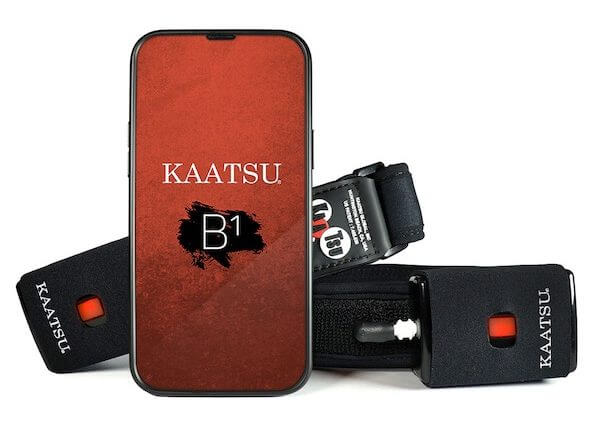
Is KAATSU: Blood Flow Restriction Upgraded worth it?
The original, most-researched blood flow restriction system builds strength and muscle with much lighter loads, packs small for travel, and doubles for injury rehab. The entry price is steep, and proper BFR protocols take learning before you use it safely.
- Technology
- Blood Flow Modulation
- Cycle Mode
- Auto inflate/deflate
- Use Cases
- Strength, Recovery, Rehab
- Portability
- Fully portable
- Research
- Decades of clinical studies
Best For
- You want to build strength with lighter loads (great for injury rehab)
- You're looking for the muscle-building benefits of heavy lifting with less joint stress
- You travel and want an effective training tool that packs small
Skip If
- You have deep vein thrombosis or blood clotting disorders
- You prefer heavy, traditional strength training
- You're not willing to learn proper BFR protocols and pressures
Pros
- Safest BFR system available
- Auto cycle mode for passive use
- Decades of clinical research
- Used by Olympians and elite clinics
- Phone tracking with B1 model
Cons
- Premium price point
- Learning curve for optimal use
Your rating helps others choose
Tap to rate
URBAN10 for 5% offSee every current discount code and sale →
KAATSU is the ultimate system using blood flow modulation technology (more on that later in this post). Basically, KAATSU causes blood to temporarily pool in the muscles and safely simulates lifting heavy weights. It’s used in advanced clinics, by Olympians and elite athletes, and by businesspeople that demand the very best.
KAATSU is the result of decades of clinical research and application by Dr. Sato. A 2019 expert position stand in Frontiers in Physiology concluded that blood flow restriction exercise enhances strength and muscle growth and can prevent atrophy. Precisely engineered to help hospital-ridden patients pack on muscle and strength. One of the primary problems with BFR training is that it requires a bit of guesswork and practice to get the band pressure right. Too much, and the safety decreases. Too little, and you won’t get the effects.
KAATSU is by far the safest and most feature-rich occlusion training system available.
One feature, in particular, puts it in a league of its own.
KAATSU Cycles.
Newer KAATSU devices can automatically inflate and deflate the cuffs to simulate the endothelial effects of performing aerobic activities. Giving you some of the cardiovascular benefits of endurance exercise while you go about your day. You can sit in front of your computer and simultaneously keep your body healthy.
Or, you can use KAATSU cycles as a warm-up or cooldown while commuting to and from the gym. Supplying the muscles with nutrients and helping clear metabolic waste products. Increasing overall performance.
Or while sitting in the car and traveling.
I’ve been using the KAATSU B1 for years now, and it’s what I still reach for regularly. Check out my full KAATSU review for a deeper dive.
Electro Muscle Stimulation (EMS) Technology

Is TitanBody EMS Suit worth it?
For me, yes. I switched from Katalyst to TitanBody in June 2026 and love how light and customizable it is. I can change settings, workout parameters, and even exercise duration from the app mid-session. The dry electrodes mean no wetting down the whole suit, a real win in the Austin summer heat. I also like that TitanBody does not lock anyone into a membership fee. The downside: no on-screen instructor guidance like Katalyst, so I run conventional movements or keep YouTube open nearby.
- Technology
- Full-body EMS
- Electrodes
- Major muscle groups
- Origin
- Russia, 1950s
- Session Time
- 20 minutes
- Use Cases
- Strength, Rehab, Recovery
Best For
- Time-efficient full-body strength training
- You're recovering from injury and need low-impact resistance
- You want to add intensity to workouts without heavy weights
Skip If
- You have a pacemaker or implanted electronic device
- You prefer traditional weight training and have ample gym time
- You're on a tight budget (EMS suits are a premium investment)
Pros
- Activates muscles more efficiently than traditional training
- Low wear and tear on joints
- Accelerates injury rehab
- Complement to existing routine
- Multiple suit options available
Cons
- Requires dedicated suit hardware
- Higher upfront investment
Your rating helps others choose
Tap to rate
URBAN for 10% offMuscle contraction is largely governed by electrical impulses. Given the electrification of today’s world, shouldn’t we have tools to effectively biomimic the body’s natural process?
Rehab clinics and high-end personal trainers have used Full-body Electro Muscle Stimulation (EMS) for decades. This technology originated in Russia back in the 1950s.
How does it work?
You attach electrodes to major muscle groups and perform functional movements, and these systems amplify your workouts. Or you can strategically place them on smaller muscles that are harder to target with traditional exercises.
Research suggests that EMS efficiently activates muscles better than other styles of working out. Faster, and with greater safety. All without the wear and tear of traditional training methods. I’ve written a guide on the benefits of EMS and how it works if you want to learn more.
The newest shining example is a system called TitanBody.
Some folks have gotten great results from replacing all other forms of training with just this system alone. I’ve been using EMS for several years now. So far, I’m mind blown. I still use free weights, but this system is an excellent complement to my routine. Plus, it dramatically accelerates injury rehab and post-workout recovery. For more information, check out my comparison of top EMS suits.
Harambe System
Is Harambe Systems Harambe Fitness System worth it?
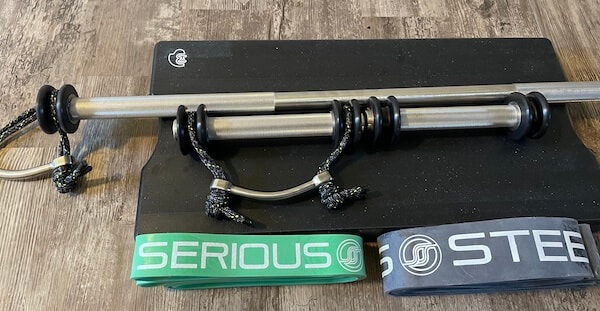
Band deadlifts with the Harambe footplate reverse the load distribution of barbell deadlifts: the top of the movement loads glutes, hamstrings, and spinal erectors harder while quads are emphasized less. [Khalid Bou-Rabee]
- Type
- Variable resistance system
- Max Resistance
- 1000+ lbs
- Bands
- 5 included
- Portability
- Fits under a bed
- Warranty
- Lifetime
Best For
- You want a complete, portable fitness system for home or travel
- You're looking for a structured training program with equipment included
- You want versatile equipment that replaces multiple gym machines
Skip If
- You have a full gym membership you use consistently
- You prefer bodyweight-only training
- You're an advanced lifter needing heavy barbell work
Pros
- Over 1000 lbs total resistance
- Aerospace-engineered footplate
- Fits under a bed or in car
- Full gym-grade workout at home
- Lifetime warranty
Cons
- Requires practice for proper form
- Band-based resistance curve
Your rating helps others choose
Tap to rate
URBAN for 10% offWhen I moved to Austin, Texas, I didn’t have a car. I walked several miles to my nearest gym.
I already had a pair of adjustable dumbbells, but I wanted a more robust “home gym”. To build muscle and strength, I need something capable of providing hundreds of pounds of resistance.
I’d heard a lot about a concept called variable resistance training. But the predominant system didn’t impress me. So I looked into the best X3 Bar alternatives and came across Harambe.
This is one powerful system. It came with five resistance bands (totaling over 1,000 pounds of resistance), an aerospace-engineered footplate rated up to 1,000+ pounds, a heavy-duty stainless steel bar, and a special sling system to evenly distribute the weight.
From the comfort of my home, I could deadlift with ~405 pounds, squat 315+ pounds, bench 225 pounds, and get a gym-grade workout.
At the same time, the entire system is small enough to easily tuck under my bed or toss in my car while traveling. With enough resistance and a warranty that will progress with me.
You’ll find my full Harambe System review here.
CAROL Bike
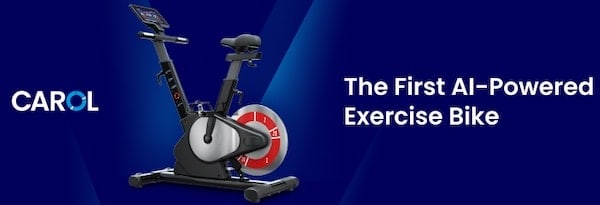
CAROL is a “smart” stationary bike designed for low-impact but high-intensity exercise.
Traditional aerobics spinning classes keep stress hormones elevated for prolonged periods and result in little anabolic growth. CAR.OL flips that, instead guiding you through adaptive-resistance powered bike sprints.
The entire workout consists of just a few sprints, and takes mere minutes. According to their Science Team, your CAROL workout produces the equivalent benefits of 45-minutes of cardiovascular training.
I found the CAROL bike system to be considerably easier than ARX. Personally, I prefer to hop on my actual bike and do bike sprints in fresh, sunny air.
But if you’re crunched for time, don’t want to get sweaty before work, or live somewhere with terrible weather, CAROL is an interesting technology to test.
ARX Fit
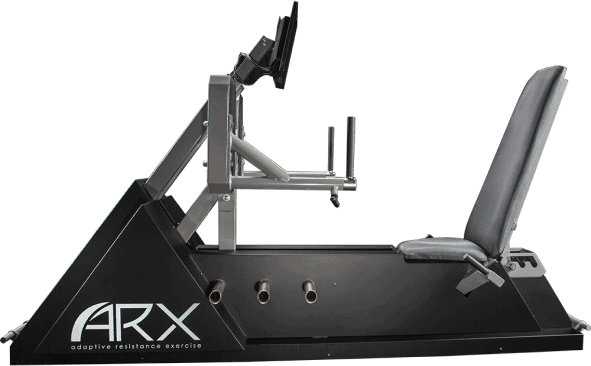
This one is among the coolest fitness systems I’ve used.
As they describe, “ARX is a resistance exercise technology that uses computer-controlled, motorized resistance in place of weights.” This machine tailors your workout exactly to your body’s needs using controlled, safe, and optimal resistance.
Using isometric-style training provides the perfect resistance, and without the danger of heavy weights. ARX workouts are quick, often just 12-minutes, and infrequent. Just one or two full-body sessions per week.
Despite the minimal time investment, several studies have found ARX superior to traditional free weight training, and 94% more time efficient. A 2019 meta-analysis in the Journal of Aging and Physical Activity found that eccentric-focused training, the core of how ARX loads your muscles, produces larger strength gains than conventional training.
ARX systems are feature-rich and some models allow you to perform just about any exercise.
One thing I found especially cool is that it gives you real-time feedback on each rep. While lifting, you see a live force output comparison to your previous workout. Tracking your progress for you, and even gamifying your strength.
Make no mistake, to reap the full benefits, you’ll feel a new (good) kind of pain during ARX workouts. Especially as your nervous system adapts.
These units are not cheap, however, so you can use their website to find local gyms outfitted with ARX.
Vasper
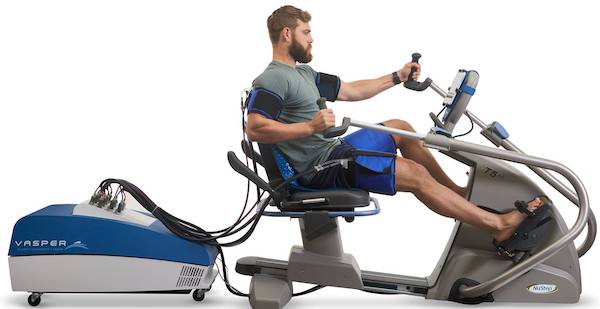
Vasper is what it looks like: a sci-fi recumbent bike that surrounds the user with cords, cuffs, and performance technologies.
Three advanced features make it a unique way to optimize blood and nutrient delivery.
First, they use KAATSU-like occlusion technology to help build metabolite levels in the muscles.
Then, Vasper chills the body to further boost blood flow. Thanks to researchers like Dr. Andy Galpin and the Huberman Lab podcast, peri-workout cooling has taken the fitness world by storm.
Finally, users perform anaerobic training.
What sets it apart is the safety, low stress, and time savings compared to conventional exercise.
As their website summarizes,
“Vasper is a revolutionary health and fitness technology that combines compression, cooling, and interval training to help the body restore, harmonize and reach peak vitality.”
You can use it either as a standalone modality or to complement an existing exercise program.
Again, these systems are quite pricey. Use their provider locator to find one near you.
LiveO2
- Type
- Oxygen contrast training
- Method
- O2-rich / O2-reduced cycling
- Pairing
- Stationary bike
- Benefits
- Oxygenation, Altitude conditioning, Immunity
Best For
- You want an exercise-with-oxygen-therapy system for home use
- You value LiveO2's adaptive contrast oxygen training approach
- You prefer combining exercise with enhanced oxygen delivery
Pros
- Unique oxygen contrast protocol
- Improves brain oxygenation
- Builds altitude conditioning
- Boosts immune health
- Condenses cardio into less time
Cons
- Requires dedicated space
- Premium investment
Your rating helps others choose
Tap to rate
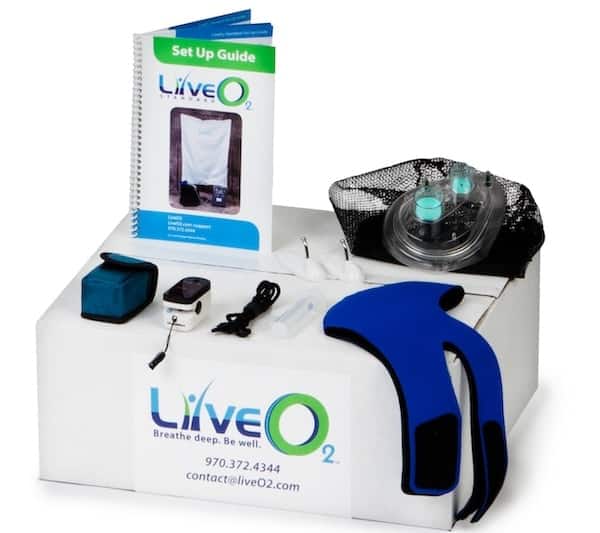
LiveO2 simulates training at altitude, but more.
It’s a style of oxygen contrast training that flips between an oxygen-rich and oxygen-reduced air environment.
Basically, you ride a bike, and the machine cycles between the two states.
LiveO2 encourages maximum blood flow and oxygenation.
Contrasting oxygen like this flushes the body, conditions you for altitude, increases oxygenation of the brain, improves immune health, helps the respiratory system, builds stress resilience, and provides a fantastic workout in less time.
It’s a unique system, and LiveO2 customers swear by it.
The LiveO2 team regularly speaks at biohacking health and wellness events.
Check out their website to find a provider near you.
Which Core Training Modalities Biohack Your Fitness?
Certain forms of training aren’t as high-tech but have passed the test of time. They’re often considerably cheaper (even free), though they may take longer or lack the efficacy of the tech above.
Cross-training across multiple modalities matters. Human physiology requires diverse movement, and limiting yourself to one style eventually leads to problems and injury. Your ideal program will likely include several from below.
Isometric Training
Isometric training has you maximally exert yourself against an immovable object. Research continues mounting in its favor, and it compares favorably to classic weight lifting. These workouts are quick: a full-body session in under 10 minutes. Many high-end devices here use isometric-style resistance, but you can perform these movements anywhere without gear.
Super Slow Strength Training
Popularized by Dr. Doug McGuff in Body by Science, super slow strength training is the ultimate free resistance time hack. One set per muscle group: 90 seconds of reps at a tempo of 5-10 seconds up and 5-10 seconds down. This sends a powerful tissue-building anabolic signal throughout the body.
It’s especially powerful among the elderly, when time-crunched, while traveling, or paired with KAATSU.
Functional Training
Functional training injects instability into movement: kettlebells, Bosu Balls, single-limb work, or uneven loads. It’s neurologically far more taxing than machines or even normal free weights, forcing the brain to recruit more motor units. It also builds underdeveloped support muscles that lag behind with typical training. Weakness in these smaller muscles leads to injury.
I add instability with Bosu balls, Swiss balls, kettlebells held bottoms-up, and one-legged movements.
Working In
We’ve all heard of working out, but that’s only half the equation. Most of us walk around chronically stressed, lacking adequate nutrition, and grueling workouts further deplete reserves. One of my teachers, Paul Chek, calls the antidote “working in”: gentle movement that leaves you energetic and in an anabolic state.
Tai Chi, Qi Gong, yin yoga, and meditation all qualify. If your heart rate stays normal and you can hold a conversation, you’re doing it right. Working in is an ideal form of active recovery at any point throughout the day.
Rucking (Super Walking)
I first discovered what I called “super walking” while carrying 50 pounds of groceries over four miles on foot. I’m strong, and I still felt wrecked the next day. Later, I learned soldiers call it “rucking.” Check out my guide to rucking for the full breakdown.
It’s low impact, requires little gear, gets you outside in natural sunlight, and allows for multitasking. I aim for a 1-2 hour ruck at least once per week to build endurance capacity.
BFR Bands
I came across blood flow restriction training at a state-of-the-art facility back in high school. It works by temporarily reducing blood flow from the muscles back to the heart. This causes an accumulation of lactate, growth factors, and powerful metabolic byproducts. When you remove the bands, they surge throughout the body.
BFR mimics the benefits of heavy strength training at just 20-40% of the load. A 2022 meta-analysis in the Journal of Clinical Medicine found low-load blood flow restriction builds muscle comparable to heavy-load training. Sessions are quick, require less recovery, and dramatically speed up injury rehabilitation. BFR bands are small, lightweight, and travel-friendly. At $30-50 for a set, they’re the best value fitness hack I’ve come across. Read more about the science of blood flow restriction training.
For a full buyer’s guide comparing every BFR band I’ve tested from $30 elastic wraps to $2,600 KAATSU systems, see my best BFR bands and devices roundup.
Free Weights
Dumbbells and barbells are fitness icons for good reason. They’re cheap, widely accessible, and effective. Compound lifts like squats, bench, rows, deadlift, and cleans hit large muscle groups efficiently with incremental progressive overload. If I could only train using one style, I’d pick free weights.
Kettlebells
Originally used as counterweights in 18th-century Russia, kettlebells are unstable by design and require practice to wield properly. Popular exercises work most of the body including the core. They’re great for warm-ups, cooldowns, and circuit training, though poor form can lead to injury.
Bodyweight
Bodyweight training requires zero gear and works anywhere. The lighter the load, the closer to failure you must go: those grueling last reps matter most. While safer than heavy weights, overuse injuries are common among advanced practitioners doing high-volume sets. I prefer to stack bodyweight with super slow strength, BFR, or KAATSU for the best results in less time.
What is biohacking fitness?
Biohacking fitness is the practice of using science-backed technologies, unconventional training methods, and data-driven protocols to optimize physical performance. It includes tools like blood flow restriction bands, electromuscular stimulation suits, adaptive resistance machines, and oxygen contrast training to achieve superior results in less time than conventional exercise.
What is the best biohacking fitness equipment for home use?
The best biohacking fitness equipment for home use includes the Harambe System (over 1,000 lbs variable resistance that fits under a bed), BFR bands ($30-50 and pocket-sized), and KAATSU for blood flow modulation. These cover strength, cardiovascular, and recovery training without requiring a dedicated gym space.
How does blood flow restriction training work?
Blood flow restriction (BFR) training uses specialized bands to temporarily reduce blood flow from muscles back to the heart. This causes accumulation of lactate, growth factors, and metabolic byproducts that mimic the benefits of heavy strength training at just 20-40% of normal load. When bands are removed, these growth signals surge throughout the body.
Is EMS training effective for building muscle?
Research suggests that full-body Electro Muscle Stimulation (EMS) efficiently activates muscles better than other styles of working out. EMS technology, which originated in Russia in the 1950s, attaches electrodes to major muscle groups and amplifies workouts. Sessions take about 20 minutes and provide results with less joint wear and tear than traditional training.
What is the cheapest way to biohack your fitness?
BFR bands at $30-50 per set are the best-value fitness biohack available. Combined with bodyweight super slow strength training (free), rucking with a loaded backpack, and working-in practices like Tai Chi or Qi Gong, you can build a comprehensive biohacking fitness program for under $100 total.
How much time do biohacking fitness workouts take?
Most biohacking fitness modalities require significantly less time than conventional training. ARX Fit sessions take 12 minutes and are 94% more time-efficient than free weights. CAROL Bike workouts take 8 minutes. KAATSU and BFR sessions run 15-20 minutes. Even a full EMS suit workout takes just 20 minutes.
Can you replace traditional gym workouts with biohacking fitness equipment?
Some biohacking fitness tools can replace gym workouts entirely. The Harambe System provides over 1,000 lbs of resistance for full gym-grade workouts at home. However, cross-training across multiple modalities (resistance, functional, working in) produces the best long-term results and prevents the overuse injuries that come from single-modality training.
How Do You Build the Ideal Biohacking Fitness Routine?
The world’s best fitness program is the one you’ll follow. You can get into phenomenal shape on a simple, free program, though it often comes at the cost of time or slower progress.
Futuristic fitness technologies make achieving and maintaining peak shape easier. Cross-training across multiple modalities prevents injury and builds well-rounded fitness that single-modality programs can’t match.
What are your favorite fitness biohacks? Drop them in the comments below.

This article sucks Nick, because I want almost everything in it, haha
On the Kaatsu: been looking at them for a bit, then found your awesome review & really wanted it !
Looked on their website & noticed that both the new C3 & B2 are coming out…..
Reached out to them to get some details on the differences of the new models;
I’d been intrigued w/ the B1 you reviewed & would have pulled the trigger on the forthcoming B2;
However (at least for the launch), it’s only available with 4 controllers;
which is an undesirable luxury, I wouldn’t want, to start & at least 500 more bucks…..
Sooooo, If I’m getting the Katalyst, why get the Kaatsu too, if I’m not rich ?
I have the awesome CAROL bike, that should pair well for VO2Max work w/ or separate from the Katalyst
Never tried tho have read about the pricey LivO2 for years…..
Would you say it’s a superior workout to the CAROL & would be worth getting later ?
There are many amazing reviews & tests shown on their slightly disorganized, yet very informative site
Used the Vasper once at UCSF, near them…..
really fantastic, great call !
Thanks again Nick for all the info you share !
David
Hey David,
Haha that’s the best kind of sucking!
I know what you mean. I’ve been waiting to pull the trigger on the new B2/C4. TBH, I’m not yet sure the difference between the new models are worth the extra cost (TBD). The new KAATSU systems are basically just more rugged.
Nice! How are you liking the CAROL? I’ve used it a number of times but I don’t personally own one. It would be an awesome stack though.
I like LivO2 because it’s one of the best ways to perform Intermittent Hypoxic Training (IHT). This is a super cool training modality that I’m writing about. Just not many solid systems to perform it. IMO, it’s superior because I can get a lot of the benefits of CAROL with other forms of sprinting (but much higher-impact on the body, of course). IHT is hard to perform.
Any other fitness biohacks / tech you’re interested in or have experienced recently?
You’re welcome, David!