

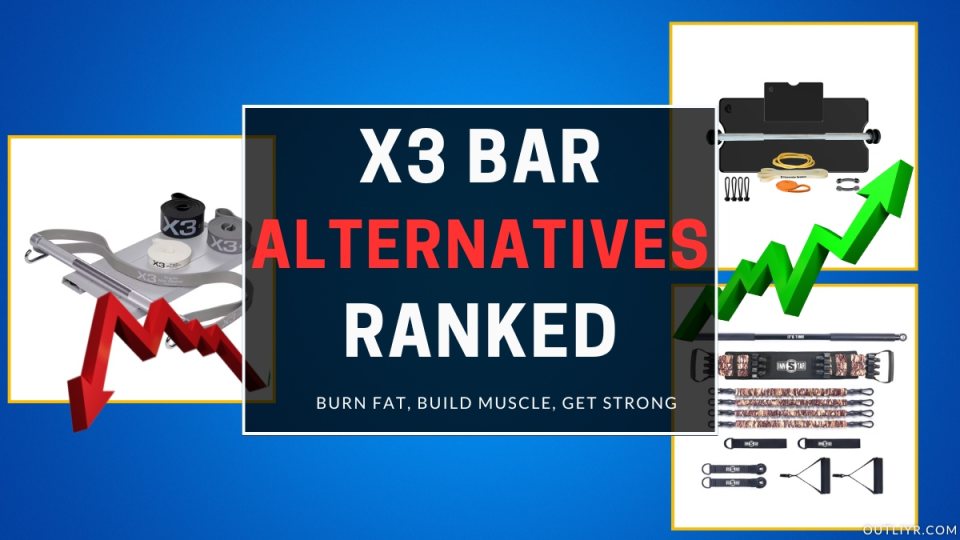
A portable resistance gym is a bar-and-band training system designed for strength workouts in a compact space. It can cover squats, presses, rows, hinges, curls, and accessory work without taking over your home.
The differences between these systems matter. Bar feel, footplate geometry, band quality, resistance range, and setup time shape how consistently you can train.
I’ve used resistance bands alongside free weights for more than a decade. I now use the Harambe System occasionally, and I’ve handled the INNSTAR kit. Its bar felt hollow to me.
I haven’t personally tested Clench Carbon Pro, HeavyDutyBar Swift, XBAR 2.0, Gorilla Bow, or Tension Toner. Those five assessments use current manufacturer specifications, warranty terms, and product design.
Below you’ll find seven current X3 Bar alternatives for different budgets, strength levels, and travel needs.
Harambe System – Best overall
Clench Carbon Pro Kit – Best high-load alternative
XBAR 2.0 – Best beginner-friendly alternative
HeavyDutyBar Swift Bar Set – Best travel platform
INNSTAR Full Body Workout Pack – Best budget alternative
Gorilla Bow Original – Most unique design
Tension Toner – Most compact
I researched and rounded up all of these options on the market before personally choosing the best variable resistance system.
What follows are the best X3 alternatives available for every budget, goal, and training level. Build your ideal body and insane strength. Wherever you are, in minimal time.
A 2019 meta-analysis found similar upper- and lower-body strength gains from elastic and conventional resistance devices across the included studies
Bar construction, footplate geometry, band quality, warranty coverage, and resistance range create the biggest differences between portable gyms
Harambe is my best overall X3 Bar alternative. I use it occasionally and prefer its weighted steel bars, layered bands, and channeled UHMW footplate
Clench Carbon Pro is the strongest new high-load challenger, while HeavyDutyBar Swift offers a compact stainless-steel bar and travel platform
Harambe, XBAR, and HeavyDutyBar provide five-year coverage on their primary hardware. Coverage differs for bands and accessories
I found the INNSTAR bar hollow. Its lower price may still suit budget buyers who value portability over premium bar feel
Which X3 Bar Alternative Fits Your Training?
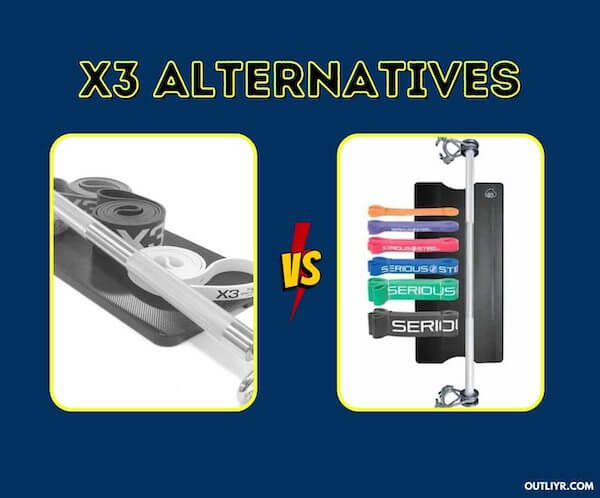
The quality, versatility, and potential results gained from variable resistance systems vary drastically between systems.
You really do get what you pay for.
Premium systems generally spend more on the bar, footplate, bands, hardware, and warranty. Those choices affect feel, durability, and loading options.
- More effective for building muscle and strength
- Can withstand more force (akin to holding more weight)
- Easier to use
- More versatile
- Safer
The greatest testaments to quality are the rated load and product warranty.
A device that cannot withstand hundreds of pounds of force will not let you build muscle or strength.
Certain components of these systems notoriously fail when under heavy load. Not only does that increase your risk of injury, but it ruins your investment.
If you’re interested in doing your own research, I’ve listed important buyer criteria at the bottom of the post.
The comparison below uses current configurations. The SSR cards display current prices from the product catalog.
I use Harambe occasionally. I handled INNSTAR and found its bar hollow. The other five product assessments are based on current specifications and policies.
The strongest choice depends on the movements you train, the resistance you need, and how much equipment you can store.
Start with your required loading range and bar feel. Then compare the platform, band design, warranty, and travel size.
Harambe System: Best Overall X3 Bar Alternative
Is Harambe Systems Harambe Fitness System worth it?
Band deadlifts with the Harambe footplate reverse the load distribution of barbell deadlifts: the top of the movement loads glutes, hamstrings, and spinal erectors harder while quads are emphasized less. [Khalid Bou-Rabee]
- Footplate
- UHMW with multiple channels
- Resistance
- Up to 1,000 lb
- Bar
- Travel 27.75 in or Standard 35.25 in
- Bands
- Serious Steel layered bands
- Warranty
- 5 years
Best For
- You want a complete, portable fitness system for home or travel
- You're looking for a structured training program with equipment included
- You want versatile equipment that replaces multiple gym machines
Skip If
- You have a full gym membership you use consistently
- You prefer bodyweight-only training
- You're an advanced lifter needing heavy barbell work
Pros
- Nick's top alternative to the popular X3 Bar
- Complete portable fitness system with equipment + program included
- Versatile enough to replace multiple gym machines
- Ideal for travel and home workouts
Cons
- Can't fully replace heavy barbell work for advanced lifters
- Learning curve for band-based resistance training
- Premium price for a resistance system
- Bands wear out over time with heavy use
Your rating helps others choose
Tap to rate
URBAN for 10% offSee every current discount code and sale →
When I began my research, people kept pointing me to Harambe. Citing scores of X3 users that transitioned over in search of the ultimate system. I personally spoke to the founder before getting my own unit, which I now use occasionally (I also use EMS technology).
Harambe replicates most of the movements I perform in a typical gym:
- Squats (of all kinds)
- Deadlift
- Bench press and chest flies
- Overhead press
- Rows
- Curls
- Tricep extension
Since I wrote this article, they released a new design. Harambe now offers their premium all-in-one “CyberBundle” or a budget-friendly and competitively priced “Starter Bundle”.
With the CyberBundle, you can choose between two bar options:
- Travel (27.75″), 5.5 lbs
- Standard (35.25″) 11.0 lbs
The Starter Bundle comes with the Travel bar.
Both bars are stable and constructed out of high-quality stainless steel (as opposed to cheap and less durable aluminum).
The bar weight changes the feel, increases the engagement of core muscles (as opposed to stabilizers), and increases the ability to load the start of movements.
Each system comes with an impressive array of powerful Serious Steel bands. You have several options to modulate resistance. You can add multiple bands to the bar, you can either double or single loop the band under the footplate, you can get add-ons to increase force, or choose the other “channel”.
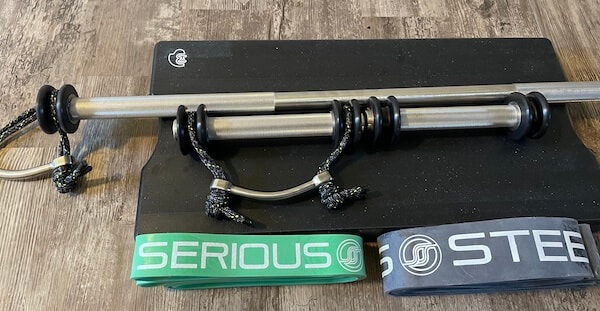
You won’t find another footplate like Harambe’s. Featuring several cross channels (one horizontal, and two vertical) underneath which allows you granular control over the resistance and also to perform more exercises.
Bands wrapped around footplates notoriously break over time due to the friction of the movement. Harambe’s footplate is constructed of 100% ultra-high-molecular-weight polyethylene (UHMW), which makes it self-lubricating and durable.
Together, the state-of-the-art bar and footplate create a geometry that creates a similar force curve to free weights. Guests at my house comment that the system looks and feels professional.
Harambe sits at the premium end of this category. The SSR card above displays the current price and any validated discount.
For more information, read my new Harambe Fitness System Review article or watch my experience.
With a 5 year warranty, Harambe clearly wins the title of best among the variable resistance banded systems available.
Clench Carbon Pro Kit: Best High-Load Alternative

- Footplate
- Yes, wide platform
- Bar
- Carbon, rated to 1,000 lb
- Bands
- Five included
- Accessories
- Handles and ankle straps
- Trial
- 60 days
Best For
- Serious lifters who want a high-load portable system with a wide footplate.
Skip If
- You prioritize a lower price or want a system Nick has personally tested.
Pros
- 1,000-pound-rated carbon bar
- Wide footplate, handles, and five bands included
- 60-day trial
Cons
- Nick has not personally tested this system
- High purchase price
- Light carbon bar may feel less familiar than steel
Your rating helps others choose
Tap to rate
Clench Carbon Pro is the closest new challenger for lifters who care about high loading capacity. Its carbon bar is rated to 1,000 pounds, and the complete kit includes a wide platform, handles, ankle straps, and five bands.
The wide footplate gives you a stable base for squats, deadlifts, rows, and presses. Multiple anchor points also create more setup options than a bar-and-band kit without a platform.
The carbon bar weighs less than a conventional steel bar. Some travelers will appreciate that. Lifters who like the momentum and feel of a heavier bar may prefer Harambe or HeavyDutyBar.
Clench offers free returns, a 365-day warranty, and a 60-day trial on the current listing. That gives buyers more time to test the geometry and resistance than a short return window.
I have not personally tested Clench Carbon Pro. I ranked it from the current hardware, load rating, included accessories, warranty, and the decisions it creates versus the Harambe System I use occasionally.
Choose Clench when you want a wide platform and a high-rated carbon bar. Choose Harambe when weighted stainless-steel bars and its multi-channel UHMW footplate matter more to you.
XBAR 2.0: Best Beginner-Friendly Alternative

- Footplate
- No
- Included Resistance
- Up to 300 lb
- Bar Rating
- Up to 500 lb
- Bands
- Six sleeved tube bands
- Warranty
- 5 years on bar, 1 year on accessories
Best For
- Beginners and travelers who want door-anchor variety and a workout library.
Skip If
- You want a footplate, loop-band loading, or a system Nick has personally tested.
Pros
- More than 100 supported exercises
- 300 pounds of included resistance
- Five-year bar warranty
Cons
- Nick has not personally tested this system
- No footplate
- Tube-style bands differ from loop-band systems
Your rating helps others choose
Tap to rate
XBAR 2.0 combines a curl-style bar, six sleeved tube bands, straps, push-up docks, and two door anchors. The included configuration reaches 300 pounds of resistance, while the bar itself is rated to 500 pounds.
Door anchors expand the exercise library beyond floor-based band movements. You can set up rows, pulldowns, presses, curls, and accessory exercises that feel closer to cable-machine patterns.
The system also includes a workout guide and video library. That structure makes XBAR easier to approach if you are new to band training and do not want to design every session yourself.
XBAR does not include a footplate. Heavy squats and deadlifts therefore use different setup mechanics than Harambe, Clench, or HeavyDutyBar. Its tube bands also feel different from loop-band systems.
The current warranty covers the bar for five years and accessories for one year. Bands remain wear items, so inspect them regularly and replace damaged tubes before training.
I have not personally tested XBAR 2.0. Its place here comes from its current included resistance, door-anchor versatility, exercise guidance, and beginner-friendly package.
HeavyDutyBar Swift Bar Set: Best Travel Platform

- Platform
- Compact travel platform
- Bar
- 58 cm solid stainless steel
- Bands
- Monster bands included
- Storage
- Carry bag included
- Warranty
- 5 years
Best For
- Travelers who want a compact platform and solid stainless-steel bar.
Skip If
- You want a full-width bar, US pricing, or a system Nick has personally tested.
Pros
- Solid stainless-steel 58-centimeter bar
- Five-year warranty
- Platform, bands, and carry bag included
Cons
- Nick has not personally tested this system
- Euro pricing may add import costs
- Compact bar changes pressing geometry
Your rating helps others choose
Tap to rate
HeavyDutyBar Swift pairs a compact travel platform with a 58-centimeter solid stainless-steel bar. The set also includes monster bands and a carry bag, creating a complete platform-based system that packs smaller than a full-width home setup.
The stainless bar gives this kit a more substantial feel than a hollow or ultralight bar. Its shorter length saves space, although it also changes hand spacing and pressing geometry compared with a full-size bar.
A platform is the main reason to choose Swift over XBAR, Gorilla Bow, INNSTAR, or Tension Toner. It distributes band pressure beneath your feet and creates more predictable positions for squats, hinges, and rows.
The compact platform has less working area than the larger Clench and Harambe platforms. Larger lifters and anyone who wants several band channels should compare the dimensions closely before choosing it.
HeavyDutyBar lists a five-year warranty for the current set. The company prices the system in euros, so buyers outside Europe should check shipping, import costs, and support logistics before ordering.
The included monster bands cover a broad starting range, and the open platform leaves room to substitute compatible loop bands as your training changes.
I have not personally tested HeavyDutyBar Swift. I included it because the solid stainless bar, platform, bands, bag, and warranty create a distinct travel option in this category.
INNSTAR Full Body Workout Pack: Best Budget Alternative

- Footplate
- No
- Bar
- 37.8 in carbon-alloy steel
- Resistance
- Four package levels
- Bands
- Sleeved resistance tubes
- Accessories
- Handles, anchors, and foot straps
Best For
- Budget buyers who want several resistance-level options.
Skip If
- You want a premium bar feel or an integrated footplate.
Pros
- Four resistance-level variants
- Lower starting price
- Portable carbon-alloy-steel bar system
Cons
- Nick personally found the bar hollow
- No integrated footplate
- Less cohesive carry setup than premium systems
Your rating helps others choose
Tap to rate
INNSTAR combines its bench-press bar with handles, door anchors, foot straps, sleeved resistance tubes, and an exercise booklet. Four package levels let buyers choose a starting resistance range instead of buying one fixed configuration.
The 37.8-inch carbon-alloy-steel bar is longer than the compact HeavyDutyBar Swift bar. It offers familiar hand spacing for presses and curls without requiring a dedicated platform.
No footplate means squats, hinges, and rows depend on how you stand on or anchor the tubes. That keeps the kit light and inexpensive, but it does not provide the stable loading geometry of Harambe, Clench, or HeavyDutyBar.
I have handled the INNSTAR system. Despite the claimed strength of the bar, it felt hollow to me. I prefer some weight and sturdiness in a training bar, especially when tension increases.
The compact case also does not organize the bar and every attachment as neatly as a fully integrated travel system. Buyers who care more about price and exercise variety may accept those compromises.
Choose INNSTAR when you want a lower-cost entry into bar-and-band training. Skip it when premium bar feel and an integrated platform are priorities.
Gorilla Bow Original: Most Unique Alternative

- Footplate
- No
- Frame
- 56 in aluminum bow
- Weight
- 6 lb
- Resistance
- Up to 300 lb
- Bands
- Gorilla Bands
Best For
- Travelers who want a simple bow-shaped resistance system.
Skip If
- You want a footplate, conventional bar geometry, or a system Nick has personally tested.
Pros
- Six-pound portable frame
- Up to 300 pounds of resistance
- Simple band changes
Cons
- Nick has not personally tested this system
- No footplate
- Bow geometry limits some conventional lifts
Your rating helps others choose
Tap to rate
Gorilla Bow uses a 56-inch aluminum bow instead of a conventional straight bar. The six-pound frame supports up to 300 pounds of resistance and keeps band changes simple.
The bow shape works well for presses, rows, squats, curls, and rotational movements. Its single-piece frame also avoids the hinges and connectors found in folding travel bars.
That shape creates tradeoffs. Gorilla Bow has no footplate, and some conventional barbell movements feel different because the frame curves around your body. It also takes more luggage space than a split bar despite its low weight.
The 300-pound ceiling suits general fitness and moderate strength work. Advanced lifters who need more loading headroom should start with Harambe, Clench, or a higher-capacity platform system.
I have not personally tested Gorilla Bow. I ranked it from the current frame dimensions, resistance rating, band system, portability, and the exercise options created by its bow design.
Choose Gorilla Bow when simplicity and a distinctive movement style appeal to you. Choose a straight bar and platform when you want closer carryover to conventional squats, presses, rows, and deadlifts.
Tension Toner: Most Compact Alternative

- Footplate
- No
- Bar
- Folding split-bar
- Bands
- Five stackable bands
- Resistance
- Up to 106 lb combined
- Return Window
- 6 weeks
Best For
- Travelers who want a folding split bar for lighter full-body training.
Skip If
- You need heavy resistance, a footplate, or a system Nick has personally tested.
Pros
- Folding split-bar design
- Five bands stack to 106 pounds
- Six-week return window
Cons
- Nick has not personally tested this system
- 106-pound resistance ceiling
- No footplate
Your rating helps others choose
Tap to rate
Tension Toner uses a folding split bar that fits into a carry-on, drawer, or small shelf. Five stackable bands provide up to 106 pounds of combined resistance in the current package.
The split design lets each side move independently. That makes unilateral control more obvious and may help you notice when one arm is doing more work during presses, rows, or curls.
Band changes are quick, and the system includes a door anchor, exercise booklet, carry bag, and online exercise library. It requires less setup space than the platform-based alternatives.
The compact design also creates its main limitation. A 106-pound ceiling gives advanced lifters much less progression room than Harambe, Clench, XBAR, or Gorilla Bow. There is no footplate for distributing heavy resistance.
Tension360 currently provides a six-week return window. Buyers should use that period to test the split-bar feel, available resistance, and exercise selection before deciding whether it can support long-term progression.
I have not personally tested Tension Toner. I included it for travelers and apartment dwellers who value minimum storage space more than maximum resistance.
Choose Tension Toner for compact, lighter full-body training. Choose a platform system when heavy squats, deadlifts, rows, and presses drive your decision.
Which Other Systems Did I Exclude?

I see some of the following products recommended elsewhere. Yet, as I’ve discovered from my research and some personal testing, you have more effective options.
Bullworker Steel Bow Personal Home Gym
Though I love the 90-day money-back guarantee and 5-year warranty, their flagship product, the Power Pack, doesn’t provide the resistance nor results of the others on this list. It’s newer, coming to market in 2020, and lacks information. I could only imagine using this to enhance my stretching sessions, so I have a hard time justifying the significant $329.99 price.
OYO Gym
This device is hardly the ideal variable resistance system recommended to replace free weights. For the price, I would either go with another system or save up for something more substantial.
Where Do You Land Among Biohackers?
85% of biohackers take magnesium. 66% train for strength. The largest age group is 65+. Answer a few quick questions and get your free Health Optimizer Profile: your stack, spending, data obsession, and longevity focus, scored against the community.
What Is Variable Resistance Training?
There are two popular forms of resistance training:
- Constant tension
- Variable tension
Free weights use constant resistance. The external load stays fixed while your leverage changes through the movement.
Say you bench press 100 pounds. Those 100 pounds are set, and you must lift that weight throughout the entire range of motion. Muscle failure eventually occurs within the first few inches of the bar leaving your chest. While the last inch is comparatively easy.
Resistance bands use variable resistance. Tension rises as the band stretches.
VRT inverts that popular fitness paradigm by recognizing that the body has disproportionate strength at different phases of any lift.
To return to the previous example, using variable resistance, the load experienced may drop to 90 pounds for the first (hardest) inches of the lift, while increasing to 110 pounds for the last (easiest) inch.
Allowing us to progressively overload each section of the movement with the proper amount of force. Generating more strength and muscle.
The advantages of variable resistance training with bands

Many training fads have come and gone. Resistance training with free weights has stood the test of time, reliably sculpting award-winning physiques.
But in 2026 and beyond, is it still a top choice?
Elastic resistance can build strength when the exercises, effort, progression, and range of motion are appropriate.
A 2020 survey of elite Norwegian powerlifters found 76.9% used variable resistance in training.
Can bands replace conventional resistance devices? The strongest direct comparison found similar strength gains, with important limits around exercise specificity.
The 2019 meta-analysis below included eight studies.
“…resistance training with elastic devices provides similar strength gains when compared to resistance training performed from conventional devices”
Effects of training with elastic resistance versus conventional resistance on muscular strength
A 2019 systematic review and meta-analysis of elastic versus conventional resistance included eight studies. It found no significant advantage for either method in upper- or lower-body strength gains.
Exercise choice still matters. A 2025 Sports Medicine meta-analysis of resistance-training task specificity found dynamic strength improved far more in trained dynamic tasks than in untrained isometric tests. Train the movements you want to improve, use enough resistance, and progress the load over time.
Some of the many benefits of variable resistance training include:
- Quicker workouts take only 10-20 minutes per day
- Faster recovery between sessions
- Safer on the joints
- No ability to cheat by using momentum
- Hyperportable and great for travel
- Versatile for many different styles of workouts
- Stacks nicely with other training styles like SST and BFRT
- Easily train the full range of motion and overcome “sticking” weak points
Weight lifters will rejoice that we can perform many of the same exercises as we do with free weights.
With the right systems, we can perform movements like:
- Squats
- Bench press
- Overhead press
- Bent-over rows
- Deadlifts
- Lunges
And much more.
Check out this post for a thorough discussion on the latest science of VRT.
The drawbacks
Virtually all scientific exercise science research has focused on traditional resistance training with free weights.
Even the studies conducted on variable resistance have mostly used it in conjunction with other forms of constant resistance training.
We’re still uncovering the full pros and cons list.
Compared to free weights, the primary drawbacks of VRT include:
- Less information available
- Less controlled progressive overload
- Less precision over exact force
- Less resistance at the start of lifts
- Less functional carryover to everyday activities
- Fewer exercise options (some work better with weights)
Unsurprisingly, most athletes have gone with well-established and proven modalities like free weight training.
But for the average person who isn’t risking an Olympic gold medal, the right variable resistance system can make all the difference.
How Did I Rank These X3 Bar Alternatives?
A full head-to-head comparison between all the systems is tricky due to the many factors that go into determining the quality and overall rating.
As I did my research, and before I settled on the Harambe as my daily system, I discovered some of the common features of the best VRT Systems & X3 Bar alternatives
I carefully evaluated each device based on the following criteria:
Intelligent design
Having aluminum and steel close or touching can cause galvanic corrosion. Nylon bearings are considered very cheap most often used for the wheels of cheap everyday items (like vacuum cleaners). They won’t last long under hundreds of pounds of force.
Resistance rating
A beautiful system won’t do much if it cannot provide adequate resistance. How much you need depends on your training experience and baseline strength.
Do you plan on committing to getting strong? Remember, you’re better off spending a few extra dollars for a more powerful system today than replacing the entire thing when you quickly outgrow it.
Build quality & durability
Each of these systems is an investment. The lower quality units have issues with bands snapping and parts breaking. Plus, you’ll feel, see, and notice the cheapness during every workout. The cheaper it feels, the less motivated you’ll be to continue.
Conversely, the well-made can last a lifetime and safely generate enough force for even the strongest folks.
Bar construction, width, & weight
The bar is one vital differentiator between resistance bands and systems. Bars are one of several major costs, so manufacturers cut corners. Cheap bars have problems with durability, safety, and feel.
Heavier bars generally outperform the lighter. Good bars have a special grip called “knurling” etched into them. The best metals for bars are (in order) stainless steel, carbon fiber, and lastly, aluminum.
The bar width also makes a huge difference. Wider bars create a more ideal force curve, replicating the geometry of free weights. Many bars contain bearings to allow the bands to twist. Nylon bearings are cheap and weak.
Size, weight, & portability
One of the key attractions of variable resistance systems is their portability. I easily fit my unit into my tiny NYC apartment and can toss it in the car to take it with me when traveling. I’ve even found that I can travel with it in my checked luggage.
Generally, there’s an inverse relationship between size, weight, and quality. Choose your system based on how you plan to use it 90 percent of the time.
Ease of use
Many systems I’ve come across show promise, but practically require a deep study of the instruction manual, the aid of YouTube videos, and plenty of trial and error.
But even after mastering the setup, you’ll want to consider the difficulty of changing resistance. On my Harambe, for example, I can change to any resistance in about four seconds. Difficulty of use impedes consistency.
Plus, time wasted by an inefficient setup or changing resistance levels doesn’t count toward building your ideal body.
Quality & number of bands
With resistance bands, companies cut corners in two ways. They either use far cheaper “molded” bands (as opposed to the superior, stronger, and more durable “layered” bands), or they come with fewer. The more bands you have, the more precise your ability to overload the muscle and get faster results.
I like the bands made by Dave’s Resistance Bands and Serious Steel.
Can stack bands
My favorite systems allow you to add multiple bands together, unlocking far more combinations and resistance levels. This essential feature is called “stacking bands”.
So if you have a 200-pound band and a 10-pound band, you can stack them together to get 210 pounds of resistance. With a quiver of 5 or 6 standard bands, you can create virtually any amount of resistance.
Number of available exercises
Some systems only work for specific types of exercise. Like chest press, front squat, or overhead press. In fact, I find that many popular systems don’t work well for back exercises (such as bent-over rows).
Others allow you to perform virtually any traditional exercise with bands. Having the ability to perform more exercises ensures that you’ll be able to vary your program to break any plateaus and keep workouts fresh.
Often you can spot this right in the product description. If they only advertise low-force movements (like bicep curls or chest flies), it’ll limit you.
Included workout plans, guides, or instruction
Workouts performed using variable resistance usually differ from the traditional.
Either in the movement itself, or the programming (reps, sets, tempo, intensity). You’ll find that many systems come with either full programs, video instruction, or at least manuals with diagrams of the different exercises.
Whether you’re a beginner or advanced, this can help you overcome the overwhelm of starting something new. And at the same time ensure that you get the best results.
Price
Obviously, one of the major determinants of your ideal system comes down to budget. Because these units can get pricey, some offer payment plans, helping you spread the cost out over time. Total costs generally amount to $300 to $500.
If you must cut costs, get fewer bands to start with. Again, I suggest you get something with resistance ratings significantly ahead of your current level. That way it won’t become obsolete when you make serious progress.
Warranty
Good construction should last many years, or in some cases, your entire lifetime.
Pay special attention to systems without warranties. That’s the manufacturer telling you that they’re not confident that their product will last. Variable resistance systems are infamous for breaking-and at the worst times.
There’s no bigger waste than buying a system that wasn’t even built to last and breaks shortly after the money-back guarantee.
Long warranties are a vote of confidence that’ll protect you should anything break, get damaged, or go wrong.
Foot plate width & construction
Your ankles and wrists are the most likely locations of injury when working out with bands.
These vulnerable parts of the body cannot withstand hundreds of pounds of resistance. Footplates alleviate this issue by evenly distributing the load to the muscles needing it and away from weak joints. This is one of the primary advantages over just buying individual resistance bands.
Unfortunately, most plates are either too small or are made out of the wrong materials.
Narrow footplates limit which exercises you can perform on them and also do not evenly distribute force.
Plastic and rubber flex (or break) under heavy loads. Metal provides great strength but severs bands over time (happened to me before Harambe). Proper footplate construction consists of a metal frame with a special plastic coating.
How Can You Transform Your Body Faster?
This free cheat sheet lays out the training tools and methods I use to build strength efficiently.
What Else Should You Know About Resistance Band Training?

Is variable resistance training with bands better than free weights?
A 2019 systematic review and meta-analysis found similar upper- and lower-body strength gains from elastic and conventional resistance devices across eight included studies. Your results still depend on exercise selection, effort, progression, range of motion, and consistency.
Why are high-quality resistance band systems so expensive?
Premium bars, layered bands, durable connection hardware, footplates, and longer warranties raise the cost. Compare those components and the replacement policy instead of judging the system by the number of accessories.
Which is better X3 or Harambe?
I prefer Harambe for its weighted steel bars, layered bands, multi-channel UHMW footplate, and loading options. I use Harambe occasionally. X3 remains a different system with its own bar, plate, bands, and training approach.
What is variable resistance training and how does it differ from constant resistance?
Variable resistance means the load changes throughout your range of motion, matching your body’s natural strength curve. Traditional weights provide constant resistance like if you load 200 lbs, it’s 200 lbs throughout the entire movement, causing you to fail in the weak range while under-stimulating the strong range.
Resistance bands generate increasing tension as they stretch, providing less resistance where you’re weak and maximum resistance where you’re strong.
Are resistance bands safer than weights for my joints?
Neither method is automatically safer. Bands remove a heavy external mass, yet bands and anchors can fail. Use stable anchor points, inspect bands before training, control the movement, and choose resistance you can manage through the full range of motion.
What force rating do I actually need? How do I choose?
Your required force rating depends on your current strength level and progression goals. Beginners (new to strength training): 300-400 lbs sufficient. Intermediate (1+ years training): 500-600 lbs minimum. Advanced (can bench/squat 1.5x bodyweight): 800-1,000 lbs recommended.
Can I combine resistance bands with traditional weight training?
Yes. Bands can add accommodating resistance to squats, presses, deadlifts, rows, and accessory work. Keep the setup stable, track the total resistance, and progress the combined movement like any other lift.
Scientific References for This Guide
The main evidence updates are the 2019 elastic-resistance meta-analysis, the 2025 task-specificity meta-analysis, and the 2020 elite-powerlifter survey.
Which Variable Resistance System Should You Choose?
For over a decade I used added resistance bands, chains, and other VRT techniques in my free weight strength training.
Until I encountered X3, I had never considered standalone variable resistance training. If as effectively as claimed, the benefits had obvious allure:
- Safe
- Effective
- Portable
- Requires little space
- No commute to the gym
- No expensive ongoing fees
- Fixes imbalances and weak points caused by training with constant resistance
I already had my own high-quality bands. I just wanted the X3 bar and footplate. I recoiled from seeing the sticker price of over $500 for one of these systems!
Surely I could make my own.
I put in tens of hours of research and uncovered the complications and sources of the seemingly absurd price.
Here’s the thing…
Creating the optimal anabolic environment to burn fat while building muscle and strength takes massive forces (or the use of tech like BFRT).
But you can’t afford for a system to fail on you while loaded with hundreds of pounds of force.
High-quality materials that can withstand huge force come at a hefty price.
So I lift heavy.
I personally wouldn’t trust my safety and gains to most systems. If you can afford it, nothing beats Harambe. Especially for intermediate to advanced lifters.
Use Harambe Systems discount code URBAN to save 10%
Do you own the X3 bar or another variable resistance system? Let me know your experience in the comments!

I own the X3 and have worked out with it since Sept 2021. It’s definitely an amazing system as I have had great results. However, I with the bar was just a tad longer and the footplate was wider for better positioning on squats. I have been comparing X3 to Harambe for a while now. I think it’s really what I am looking for but I already have the X3 which I am pretty sure I could sell.
That’s awesome! X3 definitely works. Great to hear that yours is going strong. They’re both good systems. When you try Harambe, you’ll notice that it really feels like a premium product. Something I’d find in high-end gyms. I also like that the Harambe team is iterating products. They just released a new system for travel.
Awesome post. What workout protocol do you use with the Harambe? Seems like the specific workout is equally important as the hardware. I understand X3 comes w a specific program that users seem to like.
Thanks! You’re totally right — good point. The recommended program is here on the Harambe System website. I personally think it works best with longer Time Under Tension (TuT) style programs. I like to do something like Super Slow Strength Training with it. Their YouTube Channel also has some good movements/workouts. Feel free to shoot any other questions my way here (or email hello@outliyr.com). I’ll publish my review of the full system soon.
What I would like is for somebody to test the Rigidity/density shift of the DASKING system on Amazon. It is a similar bar to the X3, but is a 3 piece design that can extend to 38.5″ long. For $84 for just the bar w/hooks, this is the best add-on/replacement for X3 since it is one of the prototypes (possibly) for the X3
That’s awesome! I hadn’t seen it. If you choose to go down that route, please report back and let us know how it goes.
Great insights! I’ve been looking for effective alternatives to the X3 Bar, and your breakdown of each option is super helpful. I appreciate the emphasis on the benefits of weight lifting too—definitely motivated to incorporate more of these into my routine! Thanks for sharing!
Great insights on the alternatives to the X3 Bar! I’ve been looking for effective weight lifting options, and your breakdown really helps clarify my choices. I appreciate the detailed reviews and can’t wait to try one of these!
Love the variety of options you’ve included for portable home gyms. I was gonna buy the X3 bar. Having second thoughts now. These seem like a solid investment for at-home workouts. Thanks for sharing!