

The typical biohacker chasing a longer life is older than you’d guess. They spend less than you’d think. And they lean on a few free habits more than any pill.
That’s the headline from this report, and it surprised me.
Picture the popular image of a biohacker. A 32-year-old startup founder in San Francisco. A glucose monitor on one arm. A five-figure budget for plasma swaps and full-body scans.
That person exists, he’s just rare.
I run Outliyr and host a longevity podcast. Most of my week is spent talking with people who optimize their health. I wanted real numbers on who they are. So I built a survey and opened it to my community.
This report is what came back. The survey stays open, so I refresh these numbers periodically as new responses come in.
A few findings reset my assumptions. The biohacking crowd skews older and more longevity-focused than the headlines suggest. The spending is modest. And the most popular practices are free habits or one-time buys, not five-figure treatments.
Here’s what biohackers chasing a longer, healthier life are really doing.
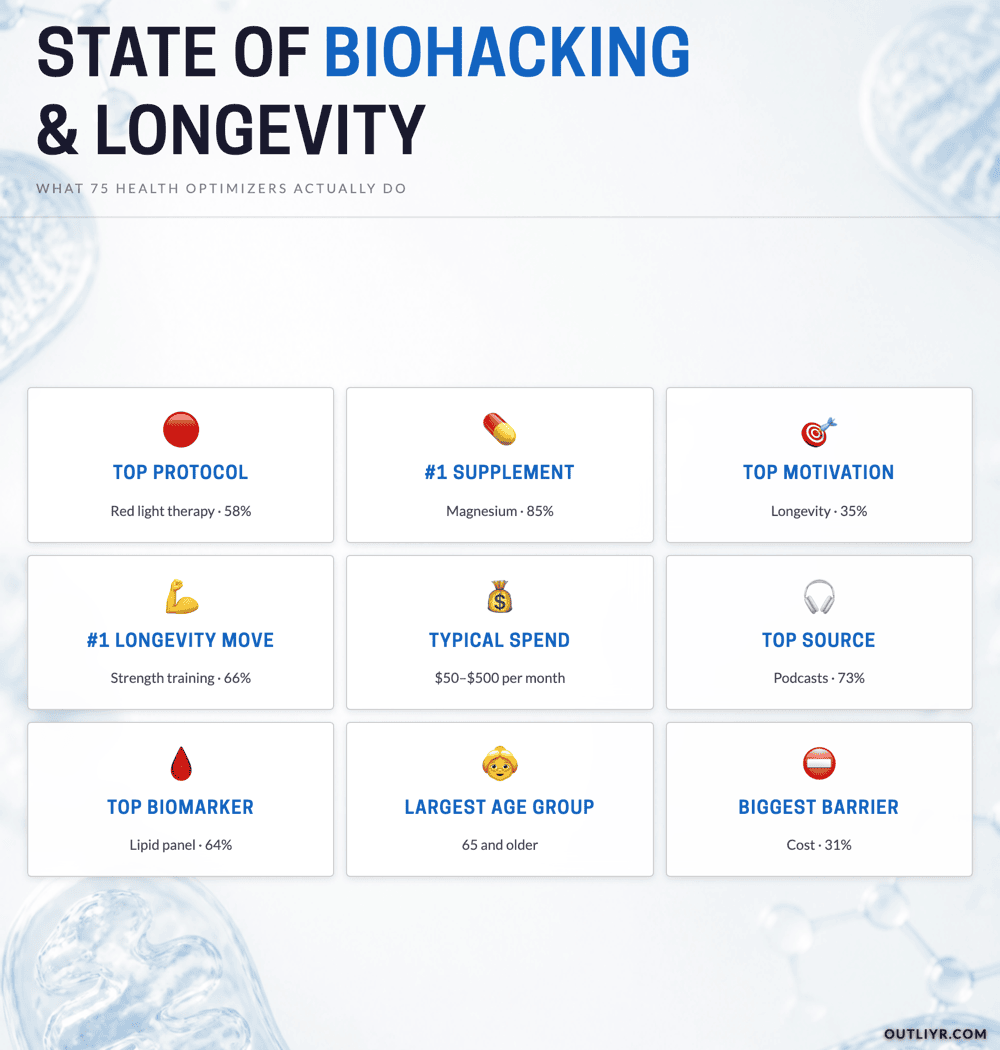
More than a third of biohackers (35%) name longevity or healthspan as their main motivation.
85% of respondents make daily choices with a longer healthspan in mind.
Strength training is the top longevity practice, used by 66% of people pursuing it.
Red and near-infrared light therapy (58%) and fasting (54%) lead all protocols.
Magnesium leads supplements at 85%, then vitamin D3 with K2 (68%).
The largest age group is 65 and older, and 37% are women.
Why Do People Pursue Longevity?
Longevity and healthspan are the top reason people biohack, named as the primary motivation by 35% of biohackers. General wellness and prevention comes second at 29%. Performance, appearance, and recovery split the rest.
This marks a real shift in the movement’s center of gravity. A decade ago, biohacking was about peak performance. More focus, more energy, faster recovery. Now the dominant goal is healthspan, living better for longer.
The commitment runs deep. 51% of respondents make daily choices with longevity in mind. Another 34% call it a core focus of their lifestyle. Only 15% say they don’t really think about it.
Here’s the honest, human part. When asked their actual lifespan target, the most common answer was modest. 34% said they just want to feel good now. People say longevity. What they often mean is quality of life today.
That gap is one of the most useful findings here. The longevity goal pulls people in. The desire to feel good keeps them consistent.
Where do you land on this? Add your data and see how you compare.
What Are the Most Common Longevity Practices?
The most common longevity practice is strength training, used by 66% of people who pursue a longer life. Caloric restriction and time-restricted eating follow at 60%. The supplements and exotic protocols come after the basics.
This matches where the science has landed. Muscle mass and strength are among the most-studied predictors of how long and how well you live, and strength training is one of the few interventions with broad expert consensus behind it.
A 2022 meta-analysis in the British Journal of Sports Medicine tied muscle-strengthening activity to lower death and disease risk.
The longevity stack, ranked by adoption:
Most common longevity practices · % of those pursuing longevity
Rapamycin sits near the very bottom. Longevity forums debate it endlessly. Almost nobody uses it. The discourse and the daily practice are different worlds.
Most people working toward a longer life are lifting weights and timing their meals. They’re not microdosing experimental drugs.
What Do Biohackers Actually Do?
Red and near-infrared light therapy is the most practiced protocol, used by 58% of biohackers. Fasting follows close behind at 54%. Meditation and mindfulness come next at 49%.
What stands out is how grounded the top of the list is. The most common practices are cheap or free. Fasting costs nothing. Meditation costs nothing. Sauna and red light need gear, but they last for years.
The exotic interventions sit lower. Peptide therapy and nootropics each land at 36%. Hormone optimization like TRT reaches 34%. These earn the headlines. They aren’t where most people live.
Here’s the full picture:
Most practiced protocols · % of respondents
The lesson for anyone starting out is simple. The crowd already voted, and they voted for the fundamentals. Dial in light, fasting, and sleep before you chase peptides.
Which supplements do biohackers take most?
Magnesium is the near-universal supplement, taken by 85% of biohackers. Vitamin D3 with K2 follows at 68%. Below them sits a tight cluster: omega-3s, B vitamins, and creatine all in the high 50s.
That consensus is well earned. Magnesium plays a role in hundreds of enzyme reactions in the body, and most people fall short from food alone. A 2016 meta-analysis of randomized trials in Hypertension also tied magnesium supplementation to a small drop in blood pressure.
Creatine has moved from a gym powder to a brain and longevity staple, with a growing body of research into cognitive and muscle benefits beyond athletics.
The rest of the top supplements:
Most-taken supplements · % of respondents
Notice what’s missing from the top. The expensive, exotic compounds sit well below the boring minerals. Serious people build a base before they reach for the frontier.
How Much Does Biohacking Actually Cost?
Most biohackers spend between $50 and $500 a month. Only 1% spend more than $1,000. The most common bracket is $50 to $150 at 26%, with $150 to $300 close behind at 22%.
This finding should reset the public conversation. Longevity gets framed as a rich person’s hobby. The reality looks closer to a gym membership plus a supplement shelf.
Spending breaks down like this:
Monthly spend on biohacking · % of respondents
The big-ticket buys tell the same story. The most common single largest purchase ever was $500 to $2,000. That’s the price of a quality sauna or a red light panel. Only 6% had ever spent over $10,000 on one item.
The lesson here is freeing. You don’t need a founder’s budget for the work that matters. The highest-impact habits cost little or nothing.
How Do Biohackers Track Their Health?
Most biohackers track with a wrist wearable. An Apple Watch, Garmin, or Fitbit leads at 55%. Smart scales follow at 30%, then the Oura Ring at 27%.
The data-obsessed image holds at the top and softens in the middle. More than half wear a tracker. But continuous glucose monitors sit at just 13%. Whoop lands in the single digits, despite its marketing footprint.
On the lab side, people test more than I expected. 40% get bloodwork two to three times a year. Another 37% do it annually. Only 14% rarely or never test.
When they test, here’s what they watch:
Most-tracked biomarkers · % of respondents
What strikes me is how conventional this list is. A good doctor would run these same markers. The frontier tools stay low. Epigenetic age clocks and microbiome panels sit well behind the basics. People talk frontier and test fundamentals.
Curious how your tracking compares? Add your data to the report.
Where Do People Learn About Longevity & Biohacking?
Podcasts are the dominant source, cited by 73% of biohackers. YouTube follows at 50%, then newsletters at 45%. The audio era of health information is in full swing.
This reshapes how good information spreads. People don’t read one authority site and stop. They listen to long conversations on walks and commutes, then triangulate. That books still hold strong, tied with newsletters at 45%, surprised me in a short-form world.
Where biohackers learn · % of respondents
Scientific journals and PubMed reach 28%. More than a quarter of this audience goes straight to primary research. That’s a sophisticated crowd.
What’s the biggest barrier to optimizing your health?
The biggest barrier is cost, named by 31% of people. Information overload follows close behind at 20%. Money and noise, in that order, hold people back. Cutting through that noise has less to do with more information than with better thinking filters.
The overload number is the one I most want to fix. A fifth of motivated people feel paralyzed by too many options. They don’t lack willpower. They lack a filter.
The full barrier list:
Biggest barriers · % of respondents
Stack the top three and a pattern appears. Around 63% of barriers come down to money or confusion. People want to do this well. They’re unsure where to put their limited dollars and attention. That’s a guidance problem, and it’s solvable.
Who Is the Average Biohacker?
The longevity audience is older than the stereotype suggests. The largest age group is 65 and older, followed by 55 to 64. The under-35 crowd that dominates the popular image is a small slice.
That makes sense. Mortality gets vivid with age. Disposable income and free time often arrive later in life.
On gender, the community is closer to balanced than its reputation. 61% identify as male, and 37% as female. A long way from the all-male caricature.
Experience runs deep too. The largest group has practiced for 3 to 5 years. Roughly 4 in 10 have more than 5 years in. This is a maturing field, full of people who’ve filtered out what doesn’t work.
Maybe you’ve felt too old or too new to pursue longevity seriously. The data says otherwise. The tent is bigger than the stereotype.
How This Living Report Stays Current
This report is updated periodically as new responses come in, rather than frozen as a one-time snapshot. The survey stays open, so the picture sharpens over time. The date at the top shows the most recent refresh.
That’s deliberate. Survey reports often freeze at publication and slowly go stale. Keeping this one open sharpens the picture over time. Trends become visible as they happen.
It also means YOU can be part of it. Every response shifts the numbers. Each one makes the next reader’s snapshot more accurate.
Click here to take the survey and add your experience to the next update.
Frequently Asked Questions
Why do most people pursue longevity?
Longevity and healthspan are the top motivation, named by 35% of biohackers. A further 85% make daily choices with a longer healthspan in mind. Most aren’t chasing immortality. They want quality of life today that compounds over the years.
What is the most effective longevity practice?
By adoption, strength training leads, used by 66% of people pursuing longevity. Caloric restriction and time-restricted eating follow at 60%. Both rank well ahead of any supplement or drug. The science agrees, since muscle mass strongly predicts how long and how well you live.
How much should I spend on longevity and biohacking?
Most people spend $50 to $500 a month, and only 1% spend over $1,000. You don’t need a large budget. The most popular and impactful habits, like strength training, fasting, and sleep, cost little or nothing. Build the free foundation first.
Is longevity optimization just for young tech guys?
No. The largest age group pursuing longevity is 65 and older, and 37% are women. The young-founder image is a media stereotype. It doesn’t match who actually does this work day to day.
What supplements do longevity-focused people take?
The three most common are magnesium (85%), vitamin D3 with K2 (68%), and omega-3s (58%). These foundational nutrients are far more popular than exotic longevity compounds. Most experienced people build a base of well-studied basics first.
Where do people learn about longevity?
Podcasts lead at 73%, followed by YouTube at 50% and newsletters at 45%. More than a quarter read primary scientific research directly. The audience leans toward long-form audio and triangulates across several sources.
How was this data collected?
The numbers come from an ongoing survey of the Outliyr community of biohackers, with 75 respondents reported on an available-case basis per question. Full methodology and the downloadable dataset appear in the methodology section below.
Methodology & Data
This report draws on an ongoing survey of self-identified biohackers in the Outliyr community. The latest update reflects 75 respondents who each answered at least three questions. Because the survey stays open to partial responses, every finding is reported on an available-case basis: the number who answered that specific question, its n, ranges from 41 to 77 and is shown with the figure.
A few questions branched conditionally and carry a smaller base. Four optional free-text bonus questions are excluded from the public dataset to protect privacy.
How the data was handled:
- Respondents came from the Outliyr email list, podcast audience, organic social, and network referrals.
- Each response was verified and de-duplicated by source (one record per person). Test submissions were removed.
- Respondents who answered some questions but did not finish are included for the questions they did answer, a standard approach that uses all available data.
- Multi-select questions report the percentage who picked each option, so totals exceed 100%.
- Where answer options were reworded mid-field, equivalent options were consolidated.
Limitations:
- This is a self-selecting sample of an engaged community. It describes committed health optimizers rather than the general population.
- Recruitment through Outliyr’s channels likely tilts results toward topics this audience follows.
- The sample is English-language and weighted toward the United States at 70%. The rest spans Asia-Pacific, Europe, and Canada.
- Numbers shift as the living report grows. Treat them as a current snapshot.
The full anonymized dataset is available to download. It is also on Hugging Face and archived with a permanent DOI under a CC-BY-4.0 license. Journalists, researchers, and writers may cite it with attribution to Outliyr.
Where to Start If You’re New to Biohacking
If this report did its job, you care less about the exotic edge and more about what works. Good. That’s where the real returns live.
Start with what the experienced crowd already chose. Get your sleep consistent. Lift weights a few times a week. Try a simple eating window. Get morning light in your eyes.
None of that needs a big budget. All of it sits at the top of what longevity-focused people rely on after years of practice.
Then layer in the proven supplements before the shiny ones. Magnesium, vitamin D with K2, omega-3s, and creatine cover huge ground for a few dollars a day.
If cost or overwhelm is your barrier, you’re in good company. The fix is the same either way. Do less, but do it consistently. Pick one habit from the top of these lists. Run it for a month before adding the next.
The people getting results aren’t doing everything, instead they’re doing a few things for a long time.
Your version of this will look different from mine, and from the averages here. Good. Use the data as a map, then run your own experiments to find your fit.
Found this useful? Share it with someone curious about living longer and better. And if you optimize your own health, share your experience to the report so the next person’s map gets sharper.

Comments