

Which red light therapy device is best depends on what you want out of it: full-body coverage, portability, brain stimulation, vitamin D, or the most output per dollar. I put these panels through the same bench testing before ranking them, and I flag any device I haven’t measured myself. Here are my picks in each category.
What Are the Best Red Light Therapy Devices?
- Best full-body panel: RLT Home TotalSpectrum MAX
- Best portable device: Vital Red Light Vital Charge
- Best for brain health: MitoMIND
- Best broad spectrum with vitamin D: Mitolux Solar X
- Best budget panel: Bestqool Pro200
The at-home LED light therapy device market is expanding rapidly, with 2.5M monthly searches and 59% year over year growth. It was valued at ~$1.2B in 2024 and is projected to reach $2.5B by 2033 (CAGR of 8.9%).
Top red light therapy devices recommended by experts in 2026 include the RLT Home TotalSpectrum MAX for full-body coverage, Vital Red Light Vital Charge for portability, Mitolux Solar X for vitamin D via broad spectrum, and PlatinumLED BioMax panels for proven reliability.
The Mitolux “Better Than Sunshine Sunlamp” offers an innovative angle for addressing vitamin D needs through home therapy, blending wellness & convenience.
A study of 216 users reported a 45.3 % reduction in acne after 4–12 weeks using red and/or blue LED treatments, particularly when paired with other standard acne therapies.
Expert guidance advises 10-20 min per session, once daily or as per device, with built-in timers/shut‑off features promoting safe & convenient use.
Outliyr predicts next-gen light therapy will go beyond red/NIR, combining pulsed output, dynamic multi-wavelength tuning (blue, green, yellow), brain-targeted protocols, and AI-personalized dosing for precision results.
How Do the Best Red Light Therapy Devices Compare?
Before diving into the individual reviews, here’s a quick side-by-side comparison of every device in this roundup. You can sort by any column and filter to find exactly what fits your needs and budget.
If you’re still deciding what to look for, start with the red light therapy buyer’s guide.
Specs get you to a shortlist. They don’t tell you which device you’ll actually reach for every morning. Here’s what each pick does best, and where it falls short.
What Is the Best Full-Body Red Light Therapy Panel?
The top full-body panels deliver 80+ mW/cm2 of verified output at 12 inches treatment distance.
RLT Home TotalSpectrum MAX: Best full-body panel

Is RLT Home TotalSpectrum MAX 7-Band worth it?
Seven wavelengths across 360 LEDs, including 480nm blue for skin, make this a full-body panel for people who want FDA, CE, and RoHS certified hardware with a 3-year warranty. It’s sold direct only, and the multi-band setup is more than simple-panel buyers need.
- LEDs
- 360
- Wavelengths
- 7 (incl. 480nm blue)
- Coverage
- Full body
- Certifications
- FDA, CE, RoHS
- Warranty
- 3 years + 60-day trial
Best For
- You want a powerful multi-wavelength full-body panel
- You prioritize 7-band coverage including blue (480nm) for skin health
- You want FDA/CE/RoHS certified clinical-grade hardware
Skip If
- You need a budget-friendly entry point under $1,000
- You want a compact or portable device
- You prefer a simpler panel without multi-band complexity
Pros
- 360 LEDs across 7 wavelengths
- Includes 480nm blue for skin and circadian benefits
- FDA/CE/RoHS certified
- 60-day trial + 3-year warranty
Cons
- Premium price point
- Only available direct from manufacturer
Your rating helps others choose
Tap to rate
URBAN for 6% offSee every current discount code and sale →
The TotalSpectrum MAX packs 360 LEDs across 7 wavelengths into a single panel. Most competitors max out at 5. That extra range includes a 480nm blue band for acne and circadian rhythm support, wavelengths the majority of panels skip entirely.
I use this one for full-body sessions. At 12 inches, it delivers consistent irradiance across the entire treatment area without hot spots or dead zones. The build quality feels clinical grade. FDA, CE, and RoHS certified with a 60-day trial and 3-year warranty backing it up.
The main limitation is size and commitment. This is a wall-mounted unit designed for a dedicated treatment space. If you don’t have room for that setup, check the portable picks below. For the complete comparison with spectrometer data, see the full-body panel rankings.
What Is the Best Portable Red Light Therapy Device?
Portable red light therapy devices trade full-body coverage for targeted precision and travel-friendliness. The best wearables deliver 40-100 mW/cm2 directly against skin for deeper tissue penetration, and many now include pulsing modes backed by clinical research.
Vital Red Light Vital Charge: Best portable red light
Is Vital Red Light Vital Charge worth it?
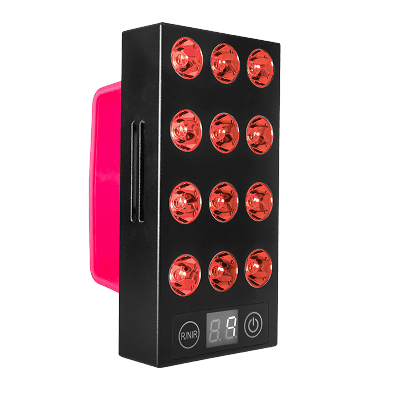
Portable handheld red light with four wavelengths (630, 660, 830, 850nm), zero EMF, and a battery lasting 4+ hours. A fit for travel and targeted face or joint work. Just 12 LEDs, so full-body sessions are out, and it weighs 2.2 lbs despite the portable branding.
- Wavelengths
- 630, 660, 810, 850nm
- LEDs
- 12
- Battery
- 4+ hours rechargeable
Best For
- You want a portable red light device for travel or on-the-go use
- You need targeted treatment for face, joints, or small areas
- You want an affordable entry point into red light therapy
Skip If
- You need full-body red light coverage
- You want a panel you can mount on a wall or door
- You prioritize maximum irradiance for deep tissue penetration
Pros
- Truly portable with rechargeable battery lasting 4+ hours
- Four wavelengths (630, 660, 830, 850nm) in a handheld form factor
- Zero EMF output for safe close-range use
- Non-flicker LEDs
- Affordable entry point
- 10-minute auto shut-off timer prevents overuse
Cons
- Only 12 LEDs limit treatment area to targeted spots
- Not suitable for full-body sessions
- Heavier than a phone at 2.2 lbs despite portable branding
- Lacks the pulsing modes and dose-adjustment of larger panels
Your rating helps others choose
Tap to rate
URBAN for 11% offThe Vital Charge runs four wavelengths: 630, 660, 830, and 850nm. That covers both red and near-infrared bands, the two ranges with the deepest clinical evidence for skin and tissue repair. Battery lasts 4+ hours on a single charge. That’s a full week of 10-minute daily sessions without plugging in.
Running on its rechargeable battery instead of mains power, it avoids the mains-frequency EMF that plug-in devices emit at treatment distance. That matters for close-range face and joint applications where you’re holding the unit directly against skin. Most corded panels spike EMF readings once you get within 6 inches.
At $299, it’s the lowest entry point for a multi-wavelength device from a reputable brand. You won’t get full-body coverage, but you get targeted treatment for joints, face, or injuries without committing to a $500+ wall panel. See the complete portable device rankings with testing data.
What Is the Best Red Light Therapy Device for Brain Health?
Transcranial photobiomodulation (tPBM) is one of the fastest-growing applications of light therapy. The best brain-targeted devices use 810nm or 1070nm wavelengths that penetrate deep enough to reach cortical tissue, paired with precise pulsing protocols that entrain specific brainwave states.
MitoMIND: Best brain photobiomodulation device

Is Mito Red Light MitoMIND Brain PBM Helmet worth it?
256-LED transcranial helmet at 810nm, the wavelength with the most clinical evidence, plus 6 entrainment presets from 0 to 40Hz and an optional 1070nm intranasal add-on. Best value in brain PBM. Independent testing measured 7 to 10 mW versus the advertised 14.
- LEDs
- 256 at 810nm
- Intranasal Option
- 1070nm add-on
- Presets
- 6 brain entrainment programs
- Frequency Range
- 0-20,000Hz
- Session Length
- 6-15 min (preset dependent)
Best For
- Best value 810nm brain PBM with adjustable frequency presets
Skip If
- You want the most research-backed device (Vielight has 25+ studies)
- You need proven through-skull irradiance data
Pros
- 6 preset brain entrainment programs (0-40Hz)
- Manual mode up to 20,000Hz
- 810nm wavelength backed by most clinical evidence
- Optional 1070nm intranasal add-on
- Less expensive than Vielight Neuro Duo
Cons
- No device-specific clinical studies yet
- Independent testing measured 7-10 mW/cm² vs advertised 14 mW/cm²
- No through-skull irradiance data published
Your rating helps others choose
Tap to rate
The MitoMIND runs at 810nm, the most clinically studied wavelength for transcranial photobiomodulation. It ships with 6 preset entrainment programs spanning 0 to 40Hz. That covers everything from delta (deep recovery) to gamma (focused cognition). Manual mode pushes up to 20,000Hz for advanced pulsing protocols.
What makes it stand out: adjustable frequency control at a price point well below the Vielight Neuro Duo, which has dominated this category for years. The optional 1070nm intranasal clip targets deeper neural tissue through a thinner entry point than the skull.
Brain PBM is still an emerging field. Most studies use small sample sizes and optimal dosing protocols aren’t fully settled. But the existing research on 810nm for neuroprotection and cognitive performance is the strongest of any single wavelength. See the complete transcranial PBM rankings.
What Is the Best Broad Spectrum Light Therapy Device?
Most panels focus exclusively on red and near-infrared wavelengths. A newer category combines those with UVB for vitamin D synthesis, eliminating the need for a separate lamp.
Mitolux Solar X: Best broad spectrum panel with vitamin D

Is Mitolux Solar X worth it?
Yes, if you want one panel for red, near-infrared, and UV instead of separate devices. I use the Solar X daily since its ten wavelengths and eleven modes handle full-spectrum light and indoor vitamin D together. It costs more than the simpler BTS2 and demands real UV safety habits, so it fits experienced users chasing full-spectrum coverage, not beginners wanting a plain red light panel.
- Wavelengths
- 295, 310, 365, 380, 415, 465, 590, 630, 850, 940 nm
- Modes
- 11 across Red/NIR, Sun, Tanning/Bronzing, UVA, and UVB
- Dimensions
- 330 × 180 × 35 mm
- Weight
- 1.62 kg (3.6 lb)
- Peak Power
- 85 W
- Minimum UV Distance
- 15 in (38 cm)
- Warranty
- 2 years
Best For
- People who want Mitolux's most advanced full-spectrum lamp
- Experienced light-therapy users who want UVA, UVB, visible, red, and NIR modes in one device
Skip If
- You want the simpler, lower-cost BTS2 for focused UVB plus red/NIR
- You want to avoid UVA or tanning modes
- You will not follow UV safety precautions
Pros
- My current go-to Mitolux lamp because the 10-wavelength, 11-mode system covers more of the solar spectrum than BTS2
- Dedicated Sun, Tanning, Bronzing, UVA, UVB, and Red/NIR modes make it unusually flexible
- Compact tabletop, door-mount, and VESA-compatible form factor
Cons
- Costs substantially more than BTS2
- UV modes demand protective eyewear, conservative dosing, and attention to skin response
- Not a full-body light therapy panel
Your rating helps others choose
Tap to rate
URBAN for 10% offThe Solar X runs ten wavelengths spanning UVB, UVA, visible, red, and near-infrared in one lamp. The 295nm UVB band lets you work on vitamin D indoors without buying a separate device. Eleven modes mean you can run a red and near-infrared session, a short UV session, or a full sun simulation depending on the time of day.
This is the Mitolux lamp I reach for now. It sits on a desk, mounts on a door, or hangs off a VESA arm, so it slots into a morning routine without claiming wall space. I have not published my own spectral measurements for the Solar X yet, so treat the wavelength list as the manufacturer’s spec until I do.
The tradeoffs are cost and caution. It sits at the top of Mitolux’s lineup on price, and the UV modes need protective eyewear, conservative dosing, and attention to how your skin responds. It’s also not a full-body panel, so if systemic coverage matters more than vitamin D, the TotalSpectrum MAX above is the better fit. For the measured spectral breakdown on Mitolux’s UVB lamps, see the Mitolux review.
What Is the Best Budget Red Light Therapy Device?
You don’t need to spend $1,000+ to get effective red light therapy at home. Spectrometer testing shows several panels in the $200-400 range deliver therapeutic irradiance levels comparable to devices costing twice as much. The key metric is irradiance per dollar: divide the verified output at your treatment distance by the price.
Bestqool Pro200: Best budget red light therapy panel

Is Bestqool Pro200 worth it?
Two hundred dual-chip LEDs at 660nm and 850nm in a modular, expandable frame give budget buyers full-body coverage with built-in cooling fans and a digital timer. It sticks to two wavelengths with no pulsing modes, so 7-band shoppers should look elsewhere.
- Wavelengths
- 660nm, 850nm
- LEDs
- 200
- Size
- Full-body panel
Best For
- Budget-conscious buyers wanting full-body red light coverage without premium pricing
Skip If
- You want multi-wavelength (7-band) coverage, pulsing modes, or premium build quality
Pros
- Full-body coverage
- 200 dual-chip clinical grade LEDs
- Modular and expandable system
- Built-in cooling fans and digital timer
Cons
- Limited wavelength selection vs premium 7-band panels
- No pulsing modes
- Less established brand than PlatinumLED or Mito Red
Your rating helps others choose
Tap to rate
URBAN for 10% offAt $589, the Pro200 delivers full-body red and near-infrared coverage with 200 dual-chip LEDs. That puts it at roughly half the price of premium 5+ wavelength panels while still covering the two wavelengths (660nm red, 850nm NIR) with the most clinical evidence behind them.
The modular design lets you daisy-chain multiple units for wider coverage as your budget grows. Built-in cooling fans and a digital timer keep sessions straightforward. No app required. Plug in, set your time, stand in front of it.
You’re giving up multi-band wavelength options that premium panels offer. For most people running basic recovery and skin health protocols, 660nm and 850nm cover the majority of documented benefits. Spend consistently on a quality mid-range panel rather than saving up for premium features you might not need. See the complete budget panel rankings.
How Does Red Light Therapy Work?
Red light therapy is a non-invasive treatment that uses specific wavelengths of red (630-660nm) and near-infrared (810-850nm) light to stimulate cellular energy production, reduce inflammation, and accelerate tissue repair. Thousands of peer-reviewed studies support its use for skin health, muscle recovery, brain function, and more.
Wavelength determines how deep that energy reaches. As Brian Richards explained on the Outliyr Podcast, “Near infrared light is penetrating 4 to 5 inches into the body on average. Red light wavelengths don’t penetrate deeply into the body.” That is why the strongest panels pair red (630-660nm) for skin with near-infrared (810-850nm) for muscle, joints, and deep tissue, a mechanism traced to cytochrome c oxidase in the mitochondria (Hamblin 2018).
Red light therapy has proven benefits ranging from enhanced recovery to hormonal balance to boosting energy. No wonder it’s used by US Special Forces, doctors, and Olympians worldwide. It’s one piece of a bigger picture, and I keep every light, recovery, and energy guide I’ve built organized on my Topic Summaries hub.
Those benefits hold up in controlled trials: a 2007 split-face RCT showed measurable wrinkle and skin-elasticity gains, and a 2024 network meta-analysis found red and near-infrared light effective for knee pain.
How Do I Test & Rank These Devices?
Every pick above is ranked on measurements, not on a spec sheet. Here’s the protocol.
I’ve tested 8 red light therapy devices with over $3,000 in laboratory-grade instruments. A Hopoocolor spectroradiometer, flicker analyzer, EMF meter, EMI meter, decibel meter, and power meter. All to find the best panels for home use.
Every device in this guide went through the same bench protocol. I warm each unit for 15 minutes, then measure irradiance at 12 inches with a calibrated HOPOOCOLOR OHSP350IR spectroradiometer.
I also test flicker with a HPCS330P analyzer and EMF with a Cornet ED88T meter. I have spent over $3,000 on testing equipment to verify what brands claim versus what they actually deliver.
Irradiance alone does not tell the full story. I record the complete spectral output using a calibrated HOPOOCOLOR OHSP350IR so you can see exactly which wavelengths each device produces and at what intensity.
Some panels advertise “5 wavelengths” but my spectrometer data shows negligible output on two of them. Others quietly outperform their marketing claims.
Power output matters as much as wavelength count. As Mark Sloan noted on the Outliyr Podcast, some wearable helmets “could be as low as 8 milliwatts,” a fraction of what a full-size panel delivers, which is why I measure actual irradiance instead of trusting spec sheets.
I also evaluate build quality, thermal management, and real-world usability. Some panels overheat after 20 minutes of continuous use, throttling their output below the advertised spec.
Others produce audible fan noise that makes them impractical for meditation or sleep routines. These details rarely appear on spec sheets but make a significant difference in whether you actually use the device consistently.
See the full testing methodology for my exact protocol, equipment specs, and calibration notes. You can also browse the raw spectral data for every device in the device comparison database.
For hands-on detail beyond this roundup, read my RLT Home review, LightPath LED review, JOOVV review, and Luminousred review.
You can also inspect my light-therapy testing methodology and compare the measured specifications in the light-therapy comparison database.
Independently Tested
Nick independently measures devices using a professional light spectrometer, power meter, flicker meter, EMF meter, and dirty electricity meter.
How to Get Great Red Light Therapy Deals
Panels from brands like Hooga and Bestqool consistently punch above their weight class on this metric. Avoid devices under $100 from unknown brands on Amazon. They typically use lower-quality LED bins, lack safety certifications, and their irradiance claims almost never hold up under spectrometer testing.
The best strategy is buying a quality mid-range panel and using it consistently rather than overspending on premium features most home users don’t need.
Browse Reddit for popular Alibaba brands. Choose one and start by asking the vendor questions:
- What is the beam angle? 30-or 60-degree beam angles are optimal.
- What is the irradiance across the entire body? Should be between 15mW/cm^2 and 150mW/cm^2. It should be third-party verified.
- How was irradiance tested? A professional spectroradiometer gives lab-grade measurements. Solar power meters give inflated numbers. Ask manufacturers for spectroradiometer-verified output data.
- Have the panels been third-party tested for EMF? If so, ask for the test results.
- What is the rated power and true wall draw (in Watts)? Verify the device should be as powerful as claimed.
Next, you’ll want your own equipment to verify the manufacturer’s answers once your panel arrives:
- A professional light spectrometer to measure irradiance at the distance you intend to use the panel. If you don’t own one, borrow from a friend or local biohacking community. Solar power meters give inflated numbers and are not reliable for comparing devices.
- Cornet ED-88TPlus [Amazon] to measure electrosmog output. If the device produces high EMFs, it may do more harm than good.
I like to see an irradiance of at least 50mW/cm^2 across my entire body, at 12″. And minimal EMF output (especially magnetic fields).
Also, check out the red light therapy flicker guide to learn more about real biological consequences of getting a low quality panel.
Overall, the above meters you’d need have other uses as well. But unless you can get them at discounts, the cost savings and difficulty of DIY importation from China aren’t worth the headaches.
I am also building dedicated guides for budget red light therapy devices and red light therapy for joint pain. These focus on the specific metrics that matter most for each use case, from cost-per-milliwatt to joint-penetrating wavelength ratios.
Red Light Therapy Device Questions & Answers
What irradiance should a home red light panel deliver for the best results?
Studies often use 60-100 mW/cm² measured at ~6 inches for skin-level benefits. Premium 2026 panels emit 140-160 mW/cm² to shorten sessions or reach deeper tissue. Anything above 200 mW/cm² offers diminishing returns unless you increase distance. Few panels irradiant 200+ mW/cm² anyway.
How many joules do I actually need, and how do I calculate red light dose?
Calculate dose (J/cm²) by multiplying time (seconds) by irradiance (mW/cm²) and then divide by 1,000. Aim for:
- Skin: 2-10 J/cm²
- Muscles & joints: 10-40 J/cm²
- Bone healing / fractures: 1-45 J/cm² (studies mostly use ~5-20 J/cm²)
- Brain health: 1-537 J/cm² (typically 3-60 J/cm² per site)
- Hair growth: 10-20 J/cm² (often at 630-660nm)
- Wound healing: 1-8 J/cm²
- Performance/endurance & recovery: ~60 J/cm²
Example: 100 mW/cm² × 120 s ÷ 1,000 = 12 J/cm², ideal for tendon rehab.
Is pulsed red light therapy better than continuous wave?
Yes, pulsing (ie 10 Hz) lets LEDs deliver higher peak power without extra heat, which enhances mitochondrial signaling in nerve tissue. For skin health, continuous wave performs equally well in head-to-head trials, so choose pulsing mainly for neuro or pain protocols. Nick’s testing with EEG sensors shows that pulsing light can indeed entrain particular brain wave states (ie alpha or gamma).
Do I need a multi-wavelength panel (630 nm + 660 nm + 810-850 nm) for the best full-body results?
Yes, dual red (630-660 nm) targets skin and collagen, while near-infrared (810-850 nm) penetrates muscle and fascia. Most panels offer at least one red wavelength and one near infrared wavelength. Newer technology “Generation 5” panels allow independent control of each band for customized treatments.
What’s the difference between ‘FDA-cleared’ and ‘FDA-approved’ red light devices?
Consumer panels can only be FDA-cleared (Class II, 510(k) pathway) by proving “substantial equivalence” to an existing device. FDA-approved applies to high-risk Class III hardware, which no at-home red light panel currently meets. Marketers touting “FDA approval” are mislabeling. Class III FDA-approved lasers require a license to operate.
How deep can red and near-infrared light penetrate, and is it enough for muscle or brain?
Red light reaches roughly 2-5mm of tissue. Near-infrared can penetrate 20-40mm, enough for muscle fascia. With high-power 810 nm lasers, <3% of surface energy can still reach 30 mm, appropriate for targeted brain PBM, but LEDs require longer sessions.
Should I choose a wearable device or a full-body red light therapy panel for my goals?
Buy a full-body panel for systemic benefits like hormone balance, energy, or recovery; you’ll treat the entire torso in <10 minutes. Choose wearables (wraps, flex panels, devices) for travel, joint rehab, injury recovery, or spot pain. They deliver focused light and are FDA-cleared for localized relief.
Which Red Light Therapy Device Should You Choose?
Red light is a powerful growth, healing, and regenerative stimulus. Each category serves a different need: full-body panels for systemic benefits, portable devices for targeted recovery, transcranial systems for brain health, and broad spectrum lamps for vitamin D. My current daily driver is the Mitolux Solar X for its unmatched versatility, with the RLT Home TotalSpectrum MAX for dedicated full-body sessions.
The technology is evolving fast. Newer panels now offer pulsing modes, multi-wavelength control, and app-based dose tracking that did not exist two years ago.
I update this guide and the comparison database every time I test a new device or retest an existing one after firmware updates. If a manufacturer improves (or worsens) their product, the data reflects it.
Red light therapy alone won’t work miracles. Most of the benefits accrue over consistent use. If you want the wider context on how I use light, my light therapy articles go through protocols, wavelengths, and the mistakes that cost people results.
The sooner you start, the sooner you’ll begin seeing results and feeling your best. Start with the light therapy dosing guide to optimize your sessions from day one.

Thanks for putting together such an informative and high quality post. Red Light Therapy is one of the foundational biohacks for modern living (where we aren’t getting enough natural sunlight) that is unfortunately cost prohibitive for a lot of people. It’s crazy how high the markup is on some of the widely known (Joovv especially) units available. Definitely will consider one of these alternative when I opt for a larger red light unit.
Hey David. Appreciate the words. I completely agree. And it doesn’t have to be as expensive. Let me know if you’d like help deciding for yourself.
Okay, you’ve totally sold me on the benefits of red light! But I’m confused about one thing. You mentioned that if you didn’t already own a Luminousred you’d buy a Platinum. Does that mean you prefer the Platinum?
Thanks!
Happy to hear that you’re interested! Just updated the post to clarify my thoughts. I have and love my Luminousred. Wouldn’t trade it for any of the others. What I meant to say was that I’d go for Platinum LED if LR didn’t exist. Hope that helps 🙂
Yes, very helpful. Can you say more about why you prefer the Lumiousred panel to the Platinum? I’m torn because the the Platinum Biomax boasts 5 wavelengths, and I don’t know if that matters. Is that meaningful in terms of actual function? Or are the extra 3 redundant? Thanks again!
Good question. To address your questions and then why I prefer LR:
5 wavelengths is a trade-off. Most of the proven benefits of RLT come from a few wavelengths (ie 660nm, 850nm infrared). I’m confident that emerging research will eventually discover other benefits from these additional colors. But I’m not sure that they will outweight the popular ones. So the more wavelengths used, the weaker the power of each.
I prefer Luminousred because their technology is unparalleled. From the optimal beam angle, to the dual-LEDs, to the strongest power-to-price ratio. There’s a big problem with accurate power measurement in light therapy. Most companies use (inferior) solar power meters which give artificially high power readings. Meaning the devices themselves are actually weaker than they appear.
I’ve talked to several other owners in the red light therapy industry. They’ve tested Luminousred themselves and vouch that they measure properly (making the power specs accurate).
I wrote a comprehensive Luminousred review of why I ultimately chose them: https://outliyr.com/luminousred-review
Do you own any of these panels and if so have you tested the EMF?
I own the Luminousred Model 2 Pro and have tested it with my Cornet ED88TPlus. At 6″ there’s <0.5mG. At 0" I picked up about 2mG.
The problem that I have with the Louminousred is that it is shorter than the other models. You have to purchase 1 and 2 together to create the same height. At that point, you’re spending almost as much as the Joovv. Also, the Biomax does not include a stand so when you pay an extra $300 for the stand, again, you’re almost paying as much as a Joovv. So I’m not understanding why they are better options than the Joovv.
What is it about the height that matters to you? LR is more powerful. With the added power, you can treat additional areas faster. I personally hung my Model 2 Pro from my standing desk and use it while I work.
Hey Nick,
Thanks for all the great information!
I’ve been going back and forth between Joovv and Mito Red for quite a long time now. You briefly touched on Mito Red’s mobile option, but what are your thoughts on their new MitoPro Series?
Thanks!
Hey Adam. Glad it has been helpful! I haven’t heard much about the MitoPRO. It also has an idea beam angle and multiple wavelengths. I’d like to see them release the irradiance & EMF data, but aside from that, it looks pretty good. I’ll investigate further and write up more about it.
I’ve been looking at the mini Joovv mostly for facial purposes but Joovv isn’t sold in Canada. Is there a brand of RLT that can be purchased in Canada that you recommend?
Hi Barb! Are you looking for a Canada-based company to avoid any additional fees? Many of the options on this list (Luminousred, MitoRed, PlatinumLED, etc) offer international shipping which includes Canada. When I bought my Luminousred panel, despite them being based in Europe, I didn’t pay any additional USA import fees.
Hello Barb
I was looking for the panels online and I found the company based in Canada call The Red Alternative. They ship free even to USA. I purchased Platinum Red Therapy two years ago the biggest panel for $800. I loved it. The only thing that upset me was the price because when I received the panel it came straight from China with the price listed for the panel $300 while I payed $800 for it. The panels sold by this Canadian company look exactly this same like the older models from platinum red therapy company. I wonder if those are this same units and the price for the panel at The red Alternative is way cheaper.
Nick,
I have a dear friend who unfortunately has ALS. He has terrible cramps and pain in his arms and legs. He is pretty much immobile at this point due to the disease. ALS lose the ability to move their body but do not lose sensation. I have been looking for a good brand with red and NIR light therapy that is a belt or something that can be strapped onto my friends arms, legs since he can’t hold anything anymore. He also can’t move around without assistance so the wall panels or devices on stands don’t look like they would work…. I looked to see if Mito had anything in a belt or pad but they don’t…. I’m would spend $500-$600 on a quality device if I thought there was any chance it would help relieve my friends suffering – but haven’t found one yet that looks like it fits the bill. Do you have any suggestions?
Thank you for any information or suggestions you can provide – Louise
Louise,
Sorry to hear that. Hmm, I haven’t heard of any belts specifically. Perhaps something more portable like the FlexBeam would work? I’ll keep my eyes peeled for other options, but that’s all I’ve come across so far.
I hope this helps your friend! Feel free to contact me directly and we can chat via email.
Thank you so much for sharing this top quality research. Have you heard of biolight? if so, how would you rate it? Would you recommend it? https://www.biolight.shop/
Thank you so much
(This product sepcifically: https://www.biolight.shop/product-page/restore-plus)
Hi Nick,
I was wondering if you are familiar with Vielight. If you are what are your thoughts?
Hey. What’s your goal? I am familiar with it and I’ve heard mixed things. It’s well suited to those wanting light to improve cognition and support the brain. It’s expensive because they patented the delivery mechanism. I believe that they’ve stopped producing the current generation too. If you’re looking for systemic benefits, I would go with one of the others.
Hi Nick, I know this is only indirectly related but I’m trying to find an easy way to make a similar array for UV light as for IR. I have bad eczema and have found sunlight helps, and also have gotten recommendations of which lamps to use, I just can’t find a panel and stand that I could easily screw them into. Do you know of any? Thanks!
Hey Michael,
I haven’t used UV lights specifically but happy to help. Can you send a link to the product? The type of the bulbs matters. Also, are these UV-A, UV-B, or UV-C bulbs?
Thanks for the informative, illuminating article!
Is Luminousred still in business? I can’t seem to find it.
Thanks!
Hey Harry! They are. Are you having problems accessing https://luminousred.com/?
Hi Nick! Thank you for writing this. It is INCREDIBLY helpful! My Boyfriend and I are thinking of splitting a red light therapy machine for our shared birthdays in August. We are most interested in the benefits for our brains (Alzheimer’s runs in both of our families) As well as anti-aging of our skin and for various joint pains. Cost is of course also a consideration.
From reading your article, My BF has zeroed in on Luminousred Model 2 Pro, Red Therapy Co’s RedRush 720 and the MitoPRO.
We were wondering, MitoPRO seems to have more spectrums but are they necessary? And have you tested MitoPRO yet? Also, can we use these larger panels for spot treatments? We would love to hear which one you might suggest for us? Thanks Nick!
Hi Sarah, glad to hear it has been helpful! That’s a great idea and one of my primary motivations to use RLT 🙂
Form his selections, I recommend the Luminousred Model 2 Pro, or MitoPRO 750. I personally have the Luminousred and love it. Using it right now, actually! I’ve only looked into the specs and science behind the MitoPRO, so I cannot give my hands-on assessment. The researchers I know in the industry have not yet verified that the Mito really performs as claimed, so there’s that. I like the idea of using multiple spectrums and I suspect that new studies will come up validating the other wavelengths. This would more closely mimic natural light. So I actually lean towards Mito (if they are honest about the output listed). They also have a 60-day trial period.
You can use large panels for spot treatments! I do that. Some devices are constructed to cram more LEDs into a smaller space and, most important, angle (concentrate) the light beam accordingly. Large panels aren’t as optimal for spot treatments, but they do work.
Hope that helps and I am not too late for your birthday!
Hi Nick, I was wondering about the angle of light beams..how important is that?one of the companies says 90 degrees. My primary use with b e on my face.Thanks for your help!
Hi Brooke! Angle determines the concentration of the light. Too wide, and some of the light rays won’t hit your body. Too narrow, and you’re only spot targeting a very specific part of the body. But if you’re just focusing on one particular place, such as your face, 90 degrees should be great!
I recently purchased a Hooga 500 Panel. After reading these reviews not sure if I should use the unit. Have you heard anything negative about hooga 500 specifically?
Hi! I haven’t. As I mentioned, it wouldn’t be one of my first choices. Even though it flickers and has some other issues, the Hooga probably is still a net benefit. Just hard to say how much.
Hey Nick, thanks for this great info! I’ve been looking at different options for red light therapy at home and was looking solely at Joovv, mostly because it’s talked about a lot. The cost for a full body set up is pretty high though and I think you’re paying for brand more than quality. So, my question is if you had to choose between the Luminous Red Model 2+2 Duo ($3499) and the Platinum LED 2X BIOMAX 900 + 900 ($4885) which one would you choose? Any insight is appreciated! Thanks!
Hey Brent! Glad you found it helpful. Yeah, unfortunately the price of quality panels is still quite high. What exactly are you looking for in a red light system? Personally, I lean more towards a Lightpath LED setup. Great value, especially when on sale. Fantastic build quality and some unique features. Otherwise, I would probably pick the Luminousred Model 2+2 Duo. They’ve upgraded their tech and design since I bought mine, it’s newer than Platinum.
Your review do not make sense. In your review for luminous red you state no other panels feature dual LEDs, but the review for the lightpath panel indicates that it too has dual LEDs.
Hey Sue! Appreciate you pointing that out. I wrote this post originally back around 2020-2021. I did buy Luminousred and still have and use it. Recently, I also picked up a LightpathLED panel. It also has dual LEDs. Forgot to update the Luminousred review. Sorry about that.
any thoughts on joovv-no phone contact only email
Hi Carol!
I’m not a big fan of JOOVV. Even though just about every influencer hypes them up to be the best. If you’re asking about their support, I can’t speak to that much. For a company of their size, I am a bit surprised, though, to hear that they don’t offer phone support.
Would using a red incandescent heat bulb (like the ones in the SaunaSpace sauna) work to provide some therapeutic infrared and red light? I have used one of their bulbs near my desk in the past, but not sure if it is doing enough to be worth it, especially since I live in Arizona and it can increase my electric bill due to the need for more air conditioning. They put out a lot of heat and also have a very broad spectrum of wavelengths.
Yes! Depends on the particular bulb and the wavelengths that it emits. A lot of the really cheap ones put out mainly heat. You want to find the ones that put out red, near infrared, and perhaps even mid-infrared. The other approach is to use a low-powered one and to make sure you’re close enough, but not too close that you burn.