

Your annual physical says your minerals are fine. That doesn’t mean they are.
Your body strips minerals from bones, organs, and tissues to keep blood levels stable. By the time a standard blood test flags a problem, you’ve been depleted for years. Maybe decades.
I’ve tested my mineral levels for over years using methods most doctors never order. What I found changed how I think about supplements, soil, and what “eating well” actually means in 2026.
Trace minerals are naturally occurring elements your body needs in small amounts to power thousands of enzymatic reactions, regulate your immune system, and protect cells from oxidative damage. They’re different from macrominerals like calcium and magnesium, which you need in larger quantities.
Deficiencies in either can cause major issues.
According to Dr. James Dinicolantonio, Americans are wildly deficient in as many as 10 minerals and trace minerals. And the standard tests your doctor runs? They’re almost designed to miss the problem.
Over 90% of people are deficient in at least one mineral. Standard blood panels won’t catch it until organs have already been stripped
Trace minerals act as cofactors for 300+ enzymatic reactions governing thyroid function, immune response, and antioxidant defense
Modern agricultural soil contains up to 85% fewer minerals than 100 years ago, making food alone insufficient for most people
Fulvic and humic acids amplify mineral absorption into cells, acting as nature’s most powerful electrolytes and antioxidants
Ionic and plant-based mineral forms absorb significantly better than synthetic chelated versions
Hair mineral analysis reveals long-term mineral status that single blood draws miss entirely
What Are Trace Minerals & Why Should You Care?
Minerals fall into two categories: macrominerals and trace minerals. Your body needs both. The difference is quantity.
Macrominerals (calcium, magnesium, potassium, sodium, phosphorus) are needed in larger doses. They’re also called electrolytes. Trace minerals are needed in tiny amounts. But “tiny” doesn’t mean unimportant.
Here are some of the most critical trace minerals and what they do:
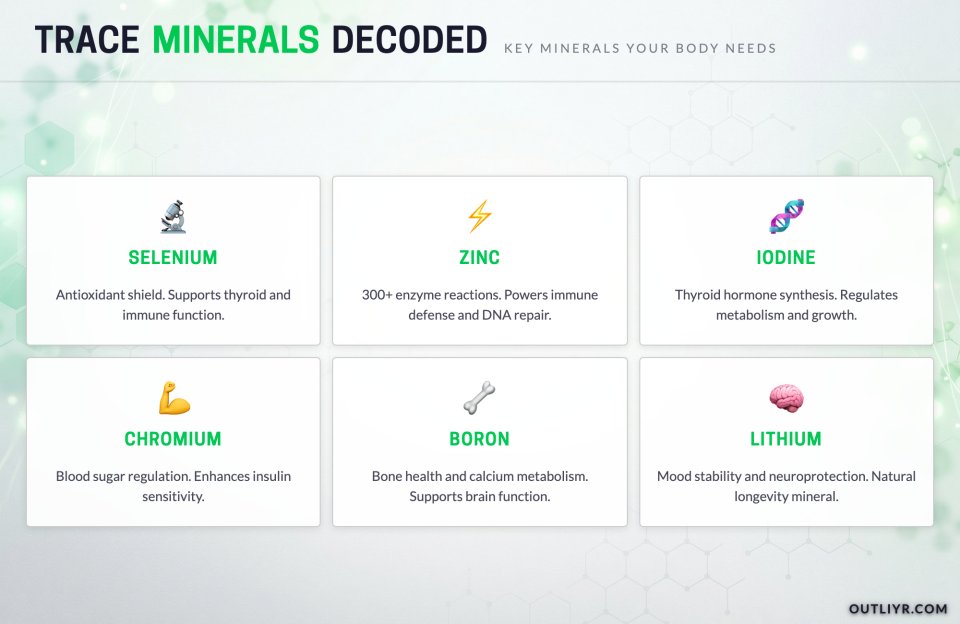
- Selenium: Powerful antioxidant that supports immune function and thyroid hormone metabolism
- Iodine: Required for thyroid hormone synthesis. Regulates metabolism, growth, and development. Also protects against radiation
- Zinc: Involved in 300+ enzymatic reactions. Governs immune regulation, wound healing, and DNA synthesis
- Chromium: Regulates blood sugar by enhancing insulin sensitivity. Gets rapidly depleted through exercise and sweat. We only absorb about 1% from food
- Copper: Supports connective tissue formation, energy production, and iron metabolism
- Manganese: Assists carbohydrate and protein metabolism. Plays a role in bone formation
- Molybdenum: Cofactor for enzymes involved in detoxification processes, especially sulfites
- Boron: Supports bone health, brain function, and calcium/magnesium metabolism
- Lithium: Naturally occurring trace mineral that promotes mood stability, relaxation, and longevity
- Silicon: Helps form and maintain connective tissues including bones, skin, and hair
These are just a handful of the 70+ trace minerals. Many of us go through life deficient in several macrominerals and even more trace minerals.
Why don’t trace minerals get the attention vitamins do? Manufacturers fortify processed foods with a handful of macrominerals. That makes those deficiencies harder to spot on paper.
Trace minerals aren’t fortified. They’re just missing.
What Are the Signs of Trace Mineral Deficiency?
Trace mineral deficiency doesn’t announce itself with one obvious symptom. It shows up as a collection of vague problems most people blame on aging, stress, or “just how I feel.”
Common symptoms include:
- Fatigue and persistent low energy
- Brittle nails and hair loss
- Muscle cramps or spasms
- Weakened immunity and frequent infections
- Slow wound healing
- Mood swings and anxiety
- Brain fog and poor concentration
- Skin rashes or dryness
- Irregular heartbeat
- Reduced fertility
- Blood sugar dysregulation
- Increased sulfite sensitivity
The list goes on. Because trace minerals govern so many processes, deficiency can manifest as virtually any symptom.
Here’s what most people don’t realize about mineral testing.
Your annual physical only flags mineral problems after years of depletion. Routine blood panels measure the mineral content of your blood. But your body demands very precise, stable blood mineral levels to function. So your body strips minerals from bones, organs, and other tissues to keep blood mineral readings in range.
Your results come back “normal” while your body is actively cannibalizing itself. By the time blood labs show a deficiency, you have a serious problem that’s been building for years. This is the biggest blind spot in conventional diagnostics.
That’s why I don’t rely on standard blood work alone for minerals.
What Causes Trace Mineral Deficiency?
Even people who eat well are often deficient. Here’s why.
Depleted soil. Modern agriculture relies on NPK fertilizer (nitrogen, phosphorus, potassium). Crops look great but lack the mineral diversity of food grown in healthy soil. Some estimates suggest modern produce contains up to 85% fewer minerals than it did a century ago.
The wrong foods. Most people simply don’t eat enough mineral-rich foods. Organ meats, sea vegetables, and wild-caught fish aren’t exactly staples of the average diet.
Anti-nutrients. Phytates, oxalates, tannins, and other compounds in plant foods bind to minerals in the digestive tract. This reduces how much you actually absorb.
Cooking methods. Heat degrades minerals. Boiling leaches them into water that most people pour down the drain.
Caffeine and alcohol. Both increase mineral excretion. Caffeine acts as a diuretic. Alcohol interferes with absorption and metabolism of multiple trace minerals.
Low stomach acid. Some medications, lifestyle habits, and even overdrinking water reduce stomach acidity. You need adequate acid to absorb most minerals.
Medical conditions. Celiac disease, Crohn’s, and other GI conditions impair mineral absorption through the digestive tract.
Increased demand. Athletes, pregnant women, people under chronic stress, and anyone who sweats heavily burn through minerals faster than average.
Pro Tip: Even Weston A. Price, among the most famous nutritionists known for discovering the importance of certain vitamins, didn’t get around to researching minerals in depth. We’re still catching up as a field.
What Are the Health Benefits of Trace Minerals?
Trace minerals aren’t a “nice to have.” They govern how your body works at a cellular level.
They act as cofactors for enzymes throughout every system. Zinc alone is involved in over 300 enzymatic reactions. Selenium functions as a potent antioxidant. Copper supports immune defense against bacteria. Iodine is required to synthesize thyroid hormones.
Documented benefits of adequate trace mineral levels include:
- Enhanced nutrient absorption
- Stronger immune response
- Improved energy production
- Better hormone regulation
- Healthier hair, skin, and nails
- Blood sugar stability
- Cardiovascular support
- Cognitive function and mood
- Bone and joint health
- Antioxidant protection
Your body also requires precise mineral balance pairs to function correctly:
- Magnesium and calcium
- Potassium and sodium
- Iodine and selenium
- Iron and copper
- Zinc and copper
- Manganese and zinc
When these ratios get disrupted, symptoms cascade. Because minerals touch virtually every system, a single imbalance can cause seemingly unrelated problems throughout the body.
The fulvic acid amplifier.
Fulvic and humic acids are widely considered nature’s most powerful electrolytes. They amplify absorption and uptake of everything you consume into cells.
These compounds also donate electrons, making them function like antioxidants and cellular detoxification agents.
This is why trace minerals are essential after fasting. When you break a fast, your cells are primed to absorb nutrients. Combining trace minerals with fulvic acid during this window maximizes uptake. For more on how shilajit (a natural source of fulvic acid) works, I wrote a full breakdown.
Trace Minerals vs Electrolytes: What’s the Difference?
People confuse these constantly. They’re related but not the same.
Electrolytes are minerals that carry an electrical charge when dissolved in water: sodium, potassium, magnesium, calcium, chloride, phosphate, and bicarbonate. They regulate fluid balance, nerve signaling, and muscle contractions.
Trace minerals are elements needed in much smaller quantities. They handle enzymatic reactions, hormone production, and long-term cellular processes.
Some overlap exists. Zinc and selenium carry charges in solution but are classified as trace minerals because of the tiny amounts required.
The key distinction: electrolytes handle immediate hydration and electrical signaling, trace minerals handle the slower, structural, and enzymatic work.
You need both, and they’re not interchangeable. Taking electrolytes won’t fix a zinc deficiency. Trace minerals won’t rehydrate you after a workout.
Do you need to supplement both? In most cases, yes. They solve different problems.
If you’re looking for electrolyte recommendations specifically, I’ve ranked the best electrolyte supplements separately.
How Do You Test Your Trace Mineral Levels?
Standard blood work is the starting point, but it has serious limitations (as I covered above). Here are the options worth knowing about.
Blood panels. Your doctor can order a comprehensive metabolic panel that includes some minerals. Useful for acute issues. Poor for detecting chronic, slow-building depletion. One snapshot doesn’t tell you much about long-term trends.
Hair mineral analysis. This is my preferred method for getting a broader picture. A hair sample reflects mineral levels accumulated over months, not just a single moment. It also reveals mineral ratios and toxic metal exposure.
You can use Upgraded Formulas hair mineral analysis test for this. The results typically show patterns that blood work completely misses. They find imbalances in mineral ratios and elevated heavy metals that never appear on standard labs.
Red blood cell (RBC) testing. More accurate than serum blood tests for certain minerals like magnesium. Measures intracellular levels rather than what’s floating in the blood.
Organic acids testing. Functional medicine labs offer tests that reveal mineral-dependent enzyme activity. Indirect but useful for seeing how minerals actually function in your body, not just whether they’re present.
You also can just take a well-designed supplement and probably don’t need to worry about testing because of the deficiency of trace minerals in the modern food supply.
Pro Tip: Start with a hair mineral analysis for the big picture. Supplement it with targeted RBC tests if specific deficiencies show up. Don’t rely on a standard blood panel alone to tell you everything is fine.
What’s the Best Way to Get More Trace Minerals?
Diet first. Always. But let me be honest: diet alone probably isn’t enough in 2026.
Food sources. Organ meats, oysters, sea vegetables, Brazil nuts (selenium), pumpkin seeds (zinc), and wild-caught seafood are among the most mineral-dense foods. If you eat these regularly, you’re ahead of most people.
But soil depletion, cooking losses, and absorption barriers mean food alone rarely covers all 70+ trace minerals. This is where supplementation fills the gap.
Not all mineral supplements are equal. Ionic and plant-based minerals absorb significantly better than synthetic chelated forms. Ionic minerals carry an electrical charge that passes through cell membranes more easily.
Plant-based minerals come pre-complexed with organic acids that enhance bioavailability. Synthetic chelated minerals improve absorption over raw mineral salts, but they still don’t match ionic forms.
Liquid formats absorb fastest, followed by powders, then capsules. Capsules offer convenience at the cost of some absorption efficiency.
When choosing a supplement, prioritize third-party tested products from companies that publish their lab results. Cheaper isn’t always better with minerals. Low-quality ingredients sometimes do more harm than good. I keep a running list of the companies that clear that bar in my guide to the supplement brands worth trusting.
For my full ranking of trace mineral supplements with specific product recommendations, see the best trace minerals supplement review.
For a deeper look at magnesium specifically or the best magnesium supplements, I’ve covered those in detail too.
Frequently Asked Questions
How long does it take for trace mineral supplements to work?
Most people notice changes in energy and sleep quality within 2-4 weeks. Deeper shifts in hair, nail, and skin health can take 2-3 months. Mineral repletion is a slow process because your body prioritizes restoring organ and bone stores before surface-level improvements show up.
Can you take too many trace minerals?
Yes. Minerals like selenium, iron, and copper are toxic in excess. This is why testing matters. Don’t mega-dose individual minerals without knowing your current levels. Broad-spectrum trace mineral supplements at standard doses are generally safe because the amounts of each mineral are small.
Do trace minerals help with energy and fatigue?
Trace minerals are essential cofactors for mitochondrial energy production. Chronic fatigue is one of the most common symptoms of mineral depletion. If standard blood work says you’re fine but you’re still exhausted, mineral deficiency is worth investigating.
What’s better: liquid or capsule trace minerals?
Liquid minerals, especially ionic forms, absorb faster and more completely. Capsules are more convenient for travel and daily routines. If absorption is your priority, go liquid. If convenience matters more, capsules work fine.
Should I take trace minerals on an empty stomach?
It depends on the mineral. Most trace mineral blends absorb well on an empty stomach. However, some individual minerals like zinc can cause nausea without food. Follow the specific product instructions and adjust based on how you feel.
Can trace minerals interact with medications?
Yes. Zinc can reduce antibiotic absorption. Iron interferes with thyroid medication. Selenium interacts with certain blood thinners. If you’re on medication, consult your doctor before adding a mineral supplement. Taking minerals 2+ hours apart from medications often solves the issue.
Are trace minerals safe during pregnancy?
Trace minerals are essential during pregnancy, and demand increases significantly. However, some minerals like selenium have tighter safety windows. Work with your healthcare provider on dosing. A broad-spectrum prenatal mineral supplement is a solid starting point.
Do I need trace minerals if I eat a whole food diet?
Probably. Even organic produce grown in depleted soil lacks the mineral density of food from 100 years ago. Anti-nutrients in plant foods, cooking losses, and individual absorption differences mean most people have gaps. A whole food diet puts you ahead of the curve, but it rarely covers everything.
Rebuild Your Mineral Foundation Starting Today
Trace mineral deficiency is one of the most widespread yet under-diagnosed health issues in 2026.
Standard testing misses it. Symptoms get blamed on aging. And the food supply can’t keep up with what your body actually needs.
The fix isn’t complicated. Test your levels with a method that actually works (hair mineral analysis over standard blood panels).
Eat mineral-rich whole foods.
Supplement the gaps with ionic or plant-based forms. Pay attention to mineral balance pairs, not just individual nutrients.
Your biology runs on different software than everyone else’s. The minerals you need most depend on your diet, lifestyle, stress load, and genetics.
For specific product recommendations, see my full trace mineral supplement ranking. If you’re also looking at electrolytes, shilajit supplements, or magnesium, those guides break down the best options.
If this helped, share it with someone who’s been dealing with mysterious symptoms that nobody can explain.

Comments