

You’re doing everything right… on paper.
You’ve read the books. You track your biomarkers. You’ve got the app subscriptions.
But some weeks you execute flawlessly, and other weeks the same behaviors feel impossible.
Explanations generally blame motivation, discipline, or unclear goals. They’re incomplete.
What you’re experiencing is normal behavioral constraints caused by particular nervous system states.
That loop has a name: The Neuro-Energetic Loop.
It’s biological, and once you see it, you can’t unsee it.
In this guide, we’ll discuss how the Neuro-Energetic Loop Framework works why it can be crucial to learn it for energy, focus, behavior, and more.
Performance isn’t determined by your potential energy; it’s determined by how much of that potential the nervous system lets become usable energy
The Neuro-Energetic Loop is Outliyr’s 6-stage closed-loop system to most effectively change behaviors: State → Energy → Focus → Behavior → Neural Encoding → Reinforced State
Each stage constrains the next, creating either downward spirals (threat-dominant, low energy, fragmented focus) or upward momentum (safety-oriented, high energy, stable focus)
Interventions focused solely on behavior change fail because they target stage four of six without addressing upstream constraints that drive undesirable behavior
High-leverage intervention points are state, energy, and focus; changing these cascades through all downstream stages
What You’ll Learn:
- Why your baseline nervous system state gates energy availability before you make a single choice
- The 6-stage feedback system that creates negative downward spirals and positive upward momentum
- Why behavior-change advice fails without addressing state and energy first
- The best place to intervene in the loop for max leverage
- How this loop explains burnout, addiction, and sudden performance collapse
What Is The Neuro-Energetic Loop Framework?
Your nervous system categorizes every demand through a filter: Is this safe?
That filter determines how much of your biological capacity becomes usable energy in that moment (Front Comput Neurosci, Int J Psychophysiol).
Here’s one way of conceptualizing how it works.
The 6 Stages of The Neuro-Energetic Loop
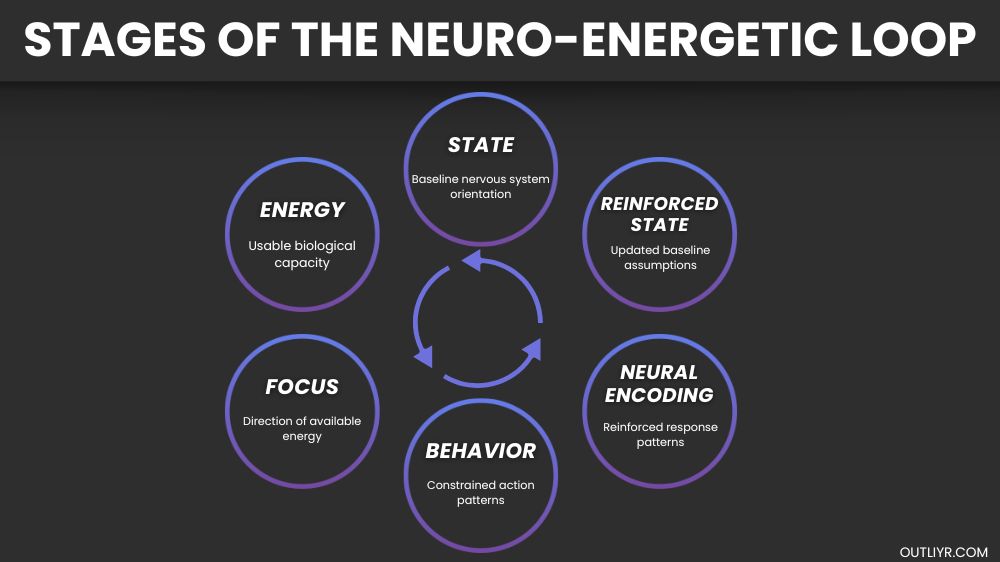
The Neuro-Energetics Loop explains how to improve health & peforming by focusing on the right areas
Stage 1: State
What it is: Your baseline nervous system orientation.
This includes sympathetic versus parasympathetic bias, threat perception, emotional tone, sense of safety, and your identity/belief informed expectations about what’s even possible (Int J Psychophysiol).
State isn’t the summation of your thoughts. It’s what your body believes and perceives about the world before stimuli reach consciousness.
In other words, State is your pre-cognitive interpretation of safety, threat, and cost.
State gates everything downstream.
A dysregulated nervous system leads to disharmony everywhere else.
Stage 2: Energy
What it is: Usable biological capacity in that State.
This includes mitochondrial capacity, fuel availability, oxygen utilization, (redox) balance, and neurotransmitter readiness (Curr Opin Neurobiol, Brain Sci).
You can have high potential energy and low usable energy simultaneously. Your bloodwork might look perfect while your performance suffers.
Stage 2 is usable energy after your nervous system constrains energy to what it predicts is a safe level.
That’s energy accessibility gated by your state (Front Comput Neurosci).
Stage 3: Focus
What it is: Direction and concentration of available ATP energy.
This includes attention, working memory, avoiding distraction, and improving cognitive endurance.
Low energy fragments focus. Fragmented focus wastes energy. This is an amplification point in the loop.
When energy is scarce, focus narrows to immediate threats. Strategic thinking becomes inaccessible.
No, not because you lack intelligence. Simply because your biology has correctly decided to protect resources (Brain Sci, Front Comput Neurosci).
Stage 4: Behavior
What it is: Consistent outputs while under constraint.
Contrary to pop psychology, behavior isn’t freely chosen. It’s not an issue of morality. Not an issue of willpower. Not an issue of intention.
Rather, it’s constrained by the energy and focus available in your current state.
Behavior is what your biology can do under its current constraints.
In other words, subconscious energy economics decisions.
That’s why the same person, with the same goals and morals may execute perfectly one week and struggle the next. The person didn’t change. Their constraints did.
Stage 5: Neural Encoding
What it is: What repetition teaches the nervous system.
This includes synaptic strengthening, pattern automation, default response formation, and habit crystallization.
Temporary states harden here. Your nervous system learns: This is how we do things.
Patterns and behaviors become automatic.
This stage is where short-term coping becomes long-term wiring.
Stage 6: Reinforced State
What it is: The nervous system updates its baseline assumptions and we return to Stage 1.
The new information and state inform:
- Who am I?
- How much usable energy does living require?
- What’s safe?
The next loop begins here. The reinforced state becomes the starting state for the next cycle.
This is why change feels increasingly difficult over time. You’re not starting from neutral. You’re starting from reinforced wiring (Front Comput Neurosci, Int J Psychophysiol).
Downward vs Upward Loops
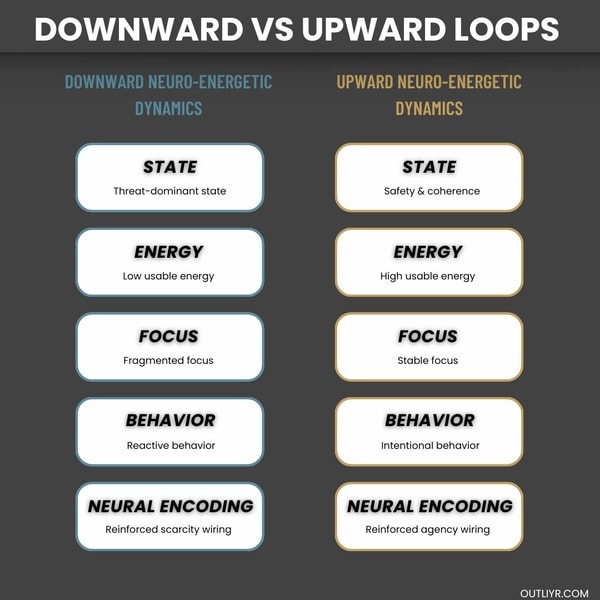
The Downward Loop
Threat-dominant state → Low usable energy → Fragmented focus → Reactive behavior → Reinforced scarcity wiring
Each cycle makes the next cycle harder (Front Comput Neurosci, Int J Psychophysiol).
Even though biology is doing exactly what it’s designed to do: conserve resources in perceived threat.
Frustrating, yes. But it’s fixable.
The Upward Loop
Safety & coherence → High usable energy → Stable focus → Intentional behavior → Reinforced agency wiring
Each cycle makes the next cycle easier.
Same mechanism, opposite direction (Front Comput Neurosci, Int J Psychophysiol).
Of course, we all want to maximize upward loops.
The Real Core of Behavior Change
Why do most people fail for years or even decades to change behavior?
The Neuro-Energetic Loop explains a better way.
Behavior is stage 4 of 6.
It’s constrained by state and energy, which are ignored by most interventions and under-appreciated by behavior scientists (Front Comput Neurosci, Brain Sci).
You can’t habit-stack your way out of a threat-dominant nervous system state. The constraints won’t allow it.
This model also explains phenomena that seem unrelated: burnout, procrastination, addiction loops, inconsistency, emotional reactivity, loss of drive, and sudden crashes… even in high performers.
They’re all expressions of the same closed-loop dynamics. But operating at different scales.
Intervention Leverage
You can intervene at any of the 6 stages. Some, however, are more leveraged.
High leverage: State, Energy, Focus
Changing baseline nervous system orientation or increasing usable energy availability cascades through every downstream stage (Int J Psychophysiol, Brain Sci).
Low leverage alone: Behavior without state change; cognitive enhancement tools without energy availability; Planning and insight applied upstream of safety
Most habit advice fails because it targets the wrong stage.
Behavior change without addressing upstream constraints is temporary at best.
How to Use the Neuro-Energetic Loop Framework
Theory is useless without implementation. Here’s how to apply it to your real life, without guessing, journaling, or overthinking.
Here’s the golden rule:
If something feels hard, lower the energetic cost and the system upgrades itself.
You lower cost by removing unnecessary drains or making outputs cheaper to execute. Cost shows up as:
- Effort
- Vigilance
- Decision pressure
- Uncertainty
- Recovery debt
- Cognitive overhead
For a deeper explanation of the process.
Step 1: Identify your Bottleneck (2–5 Minutes)
Look through the loop and find the first broken stage. Stop there.
Key rule for step 1: You never fix a downstream stage directly.
Use this sequence, in order:
1. State check
Ask: “Does the world feel heavy, urgent, or threatening right now, even without a clear reason?”
If yes, stop. Fix State first.
2. Energy check
Ask: “Could I focus for 60–90 minutes without stimulants?”
If no, stop. Fix Energy.
3. Focus check
Ask: “Once I start, does my attention stay stable?”
If no, stop. Fix Focus.
4. Behavior check
If you “know what to do” but don’t do it, behavior isn’t the problem. It’s constrained by an upstream stage.
Step 2: Apply One Correct Intervention
Only do one thing at the correct stage and avoid stacking interventions initially (which can reduces signal and increase failure).
If State Is the Bottleneck
Goal: Lower perceived cost and threat.
Do one of the following:
- 5–10 minutes slow nasal breathing with long exhales
- Slow outdoor walking without phone or audio
- Orientation, name where you are, what’s safe, what’s not urgent
- Remove novelty, no news, no inbox, no decisions first hour
Don’t:
- Use affirmations
- “Push through”
- Reframe cognitively while activated
If State is off, nothing else sticks.
If Energy Is the Bottleneck
Goal: Increase usable (not potential) energy.
Pick one:
- Eat earlier, especially if already stressed
- Add carbohydrates if depleted
- Remove fasting temporarily
- Reduce output by ~20 percent for 3–5 days
- Prioritize earlier bedtime over more hacks
- Light Zone 2 movement, not hard training
Don’t:
- Add stimulants
- Add random supplements
- Add discipline
Energy improves when life gets energetically cheaper.
If Focus Is the Bottleneck
Goal: Stop energy leaks.
Do one:
- Single-task blocks, one task, one window, one timer
- Decide what tasks you’ll do, the day before
- Remove phone from room
- Block internet for the block
Don’t:
- Add productivity systems
- Rely on motivation
- Multitask “efficiently”
Focus provides direction.
If Behavior Is the Bottleneck
It isn’t. Behavior is the output of constraints.
Ask instead:
- What is this behavior protecting me from?
- What cost is my system trying to avoid?
Scrolling often protects from effort or uncertainty. Skipping training often protects from recovery debt.
Fix the upstream cost. Behavior follows automatically.
Common Questions About The Neuro-Energetic Loop
Is this just another way of saying “manage your stress”?
No. Stress management typically focuses on reducing external demands. This model focuses on changing how your nervous system interprets demands before they hit your conscious awareness.
Can you be in an upward loop and still experience setbacks?
Yes. The loop operates across multiple timescales simultaneously. You can have daily fluctuations within a monthly upward trend.
If state is the highest leverage point, how do you change it?
State responds to: nervous system regulation practices, energy substrate availability, circadian alignment, threat perception reframing, and environmental safety cues. But those are implementation details, not the model itself.
Does this mean willpower doesn’t exist?
Willpower exists. It’s just far more energy-expensive than people realize, and energy availability is state-dependent (Brain Sci). So willpower becomes a limited resource constrained by the loop you’re in.
Can you reverse a downward loop quickly?
Sometimes. But typically, the longer you’ve been reinforcing a particular loop, the more intervention cycles are required to shift baseline state.
Is this model backed by neuroscience?
Yes. The concept of state-dependent energy gating, closed-loop neural dynamics, and habit formation through repeated encoding are all founded in scientific literature (Front Comput Neurosci, Int J Psychophysiol).
What if I can’t identify which stage I’m stuck in?
Start with state. It’s upstream of everything else. If you’re uncertain where the constraint is, default to nervous system baseline orientation (Int J Psychophysiol).
Applying The Neuro-Energetic Loop Framework to Optimize Your Life
Behavior change is hard and often full of shame. Part of that’s because it has largely been explained and promoted wrong.
It begins with the nervous system. To go deeper, here are some of my recommendations.
For nervous system state work: investigate polyvagal theory, respiratory sinus arrhythmia, and vagal tone training (Int J Psychophysiol).
For energy dynamics: explore mitochondrial function, redox biology, and substrate utilization under different autonomic states (Curr Opin Neurobiol, Brain Sci).
For focus optimization: study attention economics, cognitive load theory, and working memory constraints under stress (Front Comput Neurosci).
When applying the framework, if you’re ever unsure where to begin, always intervene in this order:
- Stabilize State
- Restore Energy access
- Narrow Focus
- Let Behavior emerge
You can’t think your way out of a system you can’t see. Now you can see it.
Got any questions about this framework? Leave them in the comments below and let’s discuss!
If you found this interesting or know of someone who’ll benefit from this guide, go ahead and click the share buttons below this article or email a link to them. Thanks.

0 reader comments