

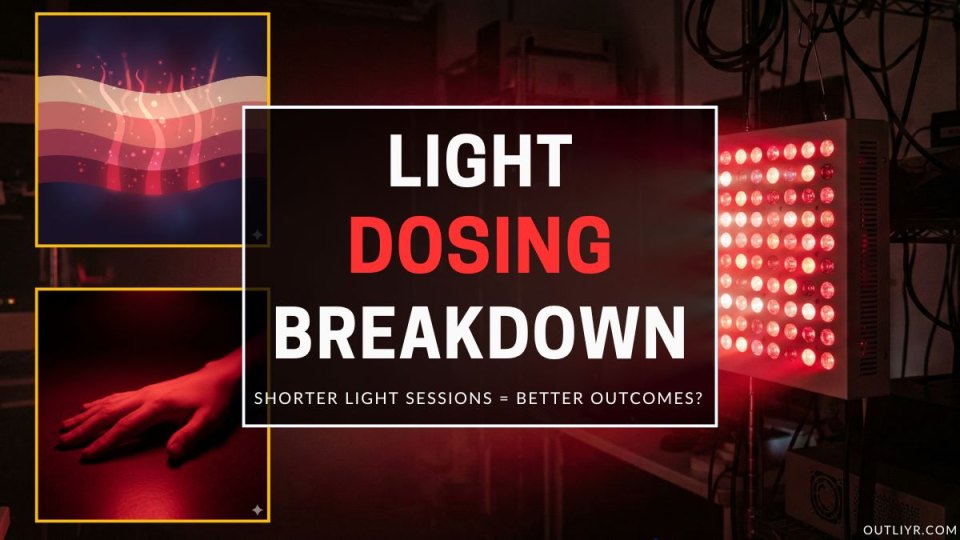
Light therapy dosing determines how much photon energy your tissue receives per session. It depends on three variables: irradiance (power density in mW/cm²), time (seconds), and distance from the device.
Energy Density (J/cm²) = Irradiance (W/cm²) x Time (seconds). Most benefits occur between 4-30 J/cm² per session.
Each wavelength acts differently in your body. Red light helps skin differently than infrared helps deeper tissues like muscle and joints. To understand why, see how red light therapy works at the cellular level.
Light therapy dosing means balancing intensity, session length, frequency, distance, and total energy delivered. Energy delivery matters more than time.
This guide covers how to optimally dose every major light therapy wavelength. Red and NIR for recovery and skin.
Blue and green for mood and pain. UVB for vitamin D. Full spectrum for circadian rhythm and overall health.
Optimal red light therapy dose ranges from 10-40 J/cm² depending on wavelength and target tissue depth. Most therapeutic benefits occur within this window.
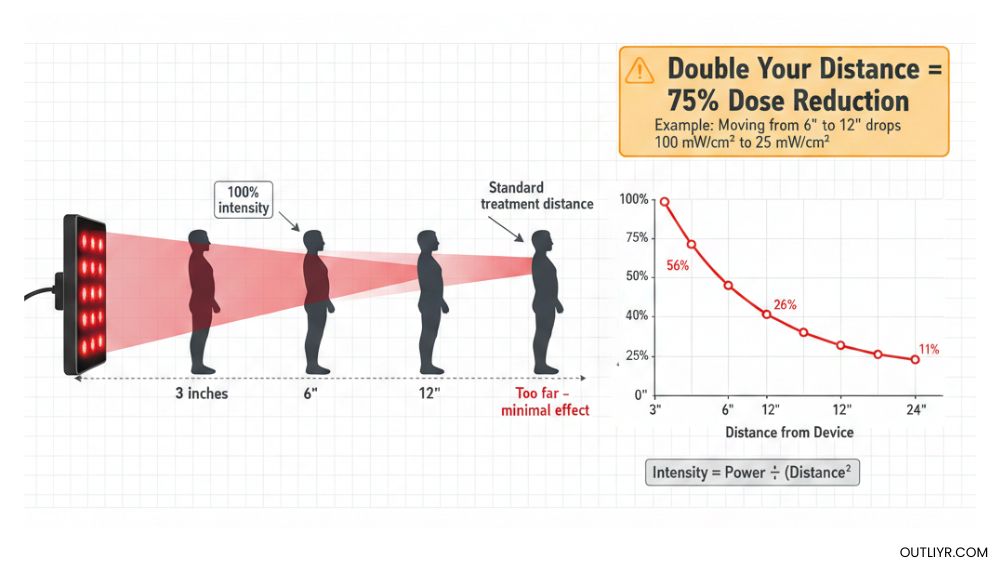
Treatment distance is the most critical dosing variable. Irradiance drops with the inverse square law, so moving from 6 to 12 inches cuts your dose by roughly 75%.
Photobiomodulation follows a biphasic dose response (Arndt-Schulz curve). Exceeding the optimal dose can reduce or reverse the therapeutic effect.
Red and NIR wavelengths tolerate daily use at moderate doses (10-20 J/cm²). Blue light should be limited to 2-4 sessions per week due to higher cellular stress.
Most consumer panels deliver a therapeutic dose in 10-15 minutes at 6-12 inches. Manufacturer claims measured at the LED surface inflate real-world dosing numbers.
How Does Light Therapy Dosing Work?
Light therapy dosing works by controlling three variables: irradiance (how much light hits your skin), exposure time, and distance from the device. Energy density (J/cm²) equals irradiance multiplied by time. Most therapeutic effects occur between 4-30 J/cm² per treatment area.
Below 4 J/cm², you won’t trigger meaningful cellular responses. Above 60 J/cm², benefits plateau or reverse due to the biphasic dose response. Distance matters enormously: a panel delivering 100 mW/cm² at 6 inches drops to roughly 25 mW/cm² at 12 inches.
I’ve measured this falloff on dozens of devices with my HOPOOCOLOR spectroradiometer.
- Red and NIR light activate cytochrome c oxidase (CCO) in your mitochondria (Biophotonics). This enzyme boosts ATP production (cellular energy).
- Blue light kills acne bacteria
- UV light makes vitamin D in your skin (NIH)
Let’s explore the fundamental characteristics that determine the effects of light.
Irradiance explained (mW/cm²)
Irradiance tells you how much power hits each square centimeter of your skin. Think of it as brightness or intensity. Higher numbers mean more photons reaching your body per second.
Companies often inflate their irradiance numbers.
They measure at the LED surface, not where your skin sits. My testing with a professional spectrometer shows real-world irradiance at 6-12 inches is usually 30-70% lower than advertised. Even premium brands like Joovv inflate their numbers.
| Treatment Area 🎯 | Typical Irradiance (mW/cm²) 💡 |
|---|---|
| Skin | 20-50 |
| Joints & Muscle | 50-150 |
| Brain & Deep Organs | 80-200 |
| General Range | 10-200 |
Distance changes everything. Doubling your distance cuts irradiance by 75%.
Moving from 6 inches to 12 inches drops a 100 mW/cm² panel to just 25 mW/cm².
Fluence explained (J/cm²)
Fluence is the total energy delivered during a session (MedcoVet). It’s irradiance multiplied by time. This number determines whether you stimulate or exhaust your cells.
The formula:
- Fluence (J/cm²) = Irradiance (mW/cm²) × Time (seconds) ÷ 1,000
For example…
A device delivering 50 mW/cm² for 10 minutes gives you 30 J/cm² (50 × 600 ÷ 1,000).
| Target Area 🎯 | Typical Fluence (J/cm²) 💡 |
|---|---|
| Skin & Face | 3-10 |
| Muscle, Joints, Body | 10-30 |
| Brain & Deep Organs | 20-60 |
Higher doses reach deeper tissue. But too much causes problems. Studies show doses above 30-50 J/cm² create oxidative stress and reduce benefits (MedcoVet).
Wavelength choice (nm)
Each wavelength penetrates your body a different amount (Lumivisage). Longer wavelengths go deeper. Shorter wavelengths stay at the surface.
- Red light (660nm): reaches 5-10 millimeters into tissue (Lumivisage, Platinum Therapy Lights). Good for skin, surface inflammation, and collagen production
- NIR light (810-850nm): penetrates 10-40 millimeters (Lumivisage). Perfect for joints, muscles, organs, and brain
- Blue light (405-480nm): only reaches 0.5-1 millimeter (Red Light Man). It kills surface bacteria, entrains circadian rhythm, and stimulates the body, but doesn’t go deep
- Green light (520-560nm): penetrates 1-2 millimeters. Mainly used for migraine, headache, pain, and possibly mood
- UV light (100-400nm): barely goes past the top skin layer but stimulates vitamin D, immune modulation, and the production of melanin and bioactive peptides
Here’s how each wavelength band benefits and mechanisms compare.
| Wavelength 💡 | Penetration Depth 🔍 | Primary Use ✅ |
|---|---|---|
| Red (620-660nm) | 5-10 mm | Skin, collagen, surface healing |
| NIR (810-850nm) | 10-40 mm | Joints, muscle, brain, organs |
| Blue (405-480nm) | 0.5-1 mm | Acne, bacteria, surface treatment |
| Green (520-560nm) | 1-2 mm | Pain relief, migraine |
| UVA/UVB | <1 mm (surface) | Vitamin D, skin conditions |
Matching wavelength to your goal matters more than session length. Deep tissue problems need NIR (NIH).
Skin problems need red. Surface bacteria need blue.
Once you understand dose, use the red-light buyer’s guide to evaluate hardware claims and the testing methodology to see how I measure output at a consistent distance.
What Dose Should You Use for Each Wavelength?
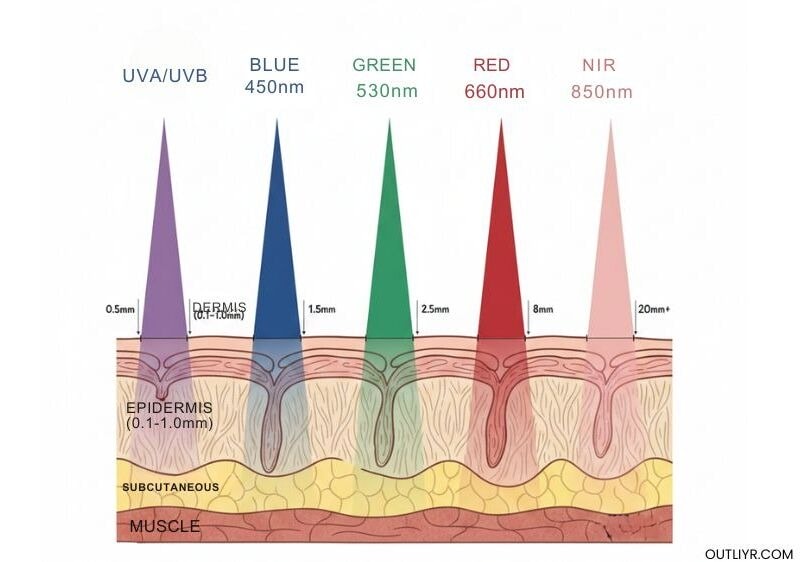
Optimal dosing varies by wavelength and target tissue. Red light (630-660nm) penetrates 1-3cm, working best at 10-20 J/cm² for skin and collagen. Near-infrared (810-850nm) goes deeper, requiring 20-40 J/cm² for joints, muscles, and brain.
Blue light (415-480nm) targets surface bacteria at 5-15 J/cm². A 660nm session targeting skin needs less total energy than an 850nm session targeting a deep knee joint (Artica Systems).
Red light therapy dosing (620-660 nm)
Red light works best for skin health, collagen production, and surface healing. It doesn’t go deep enough for joints or muscle recovery.
| Application 🎯 | Dose (J/cm²) 🧬 | Time (min) ⏱️ | Frequency 📅 | Irradiance (mW/cm²) 💡 | Distance 📏 | Notes ✍🏼 | Research Support 🗒️ |
|---|---|---|---|---|---|---|---|
| Skin/Anti-aging | 3-10 | 10-15 | 3-5x/week | 20-50 | 6-12″ | Collagen, rejuvenation, anti-aging | Chung et al., Ann Biomed Eng, 2012 |
| Surface inflammation/wound | 2-10 | 5-15 | Daily until healed | 20-50 (lower = better) | 6-12″ | Lower dose better for wounds, avoid high doses | de Freitas & Hamblin, Photomed Laser Surg, 2016 |
| General benefits | – | 10 (short) | Daily (frequent) | 20-50 | 6-12″ | Short, regular sessions more effective | Huang et al., Dose-Response, 2009 |
There are devices that stay effective and have no heat dissipation after long sessions (I detail my experience in the LightPath LED review).
However, shorter, frequent sessions beat long occasional ones. Learn more about red light therapy benefits.
You can also explore some of the safest and best red light therapy devices that I’ve tried and recommend.
Near infrared dosing (810-850 nm)
NIR penetrates 10-40 millimeters into your body (Red Light Wellness). Perfect for joints, muscles, brain, and organs. It needs higher doses than red light.
| Application 🎯 | Dose (J/cm²) 🧬 | Time (min) ⏱️ | Frequency 📅 | Irradiance (mW/cm²) 💡 | Distance 📏 | Notes ✍🏼 | Research Support 🗒️ |
|---|---|---|---|---|---|---|---|
| Joints, muscle, deep tissue | 10-40 | 10-20 | 3-5x/week | 100-200 | 2-6″ | Deep tissue penetration | Vanin et al., J Biophotonics, 2018 |
| Brain/cognitive support | 20-60 | 10-25 | 3-5x/week | 10-100 | Contact to 6″ | Cognitive, mood, neurological | Hamblin, BBA Clin, 2017 |
| Sports/recovery | 10-30 | 10-20 | Pre/post workout | 100-200 | 2-6″ | Pre/post-exercise use | Albuquerque-Pontes et al., Lasers Med Sci, 2014 |
Athletes should use NIR pre-workout or immediately after training. Pre-workout primes mitochondria. Post-workout accelerates recovery and reduces soreness.
This makes NIR a great addition to your routine when you’re optimizing athletic recovery and performance.
Blue light therapy dosing (405-480 nm)
Blue light only penetrates 0.5-1 millimeter (NIH). It kills acne-causing bacteria (P. acnes) and helps reset your body clocks (circadian rhythm).
| Application 🎯 | Dose (J/cm²) 🧬 | Time (min) ⏱️ | Frequency 📅 | Irradiance (mW/cm²) 💡 | Distance 📏 | Notes ✍🏼 | Research Support 🗒️ |
|---|---|---|---|---|---|---|---|
| Acne/antibacterial | 1-5 | 8-15 | 2-4x/week | 20-60 | Direct to skin | Bacterial reduction | Papageorgiou et al., Br J Dermatol, 2000 |
| Circadian entrainment | – | 15-30 | Morning use | 1,000-5,000 lux | – | Reset body clock | Lockley et al., Sleep, 2006 |
| Safety | – | <15 | – | – | – | Limit exposure, protect eyes | Oh, Int J Mol Sci, 2021 |
Studies show 65% improvement in acne after 4-8 weeks (Medical News Today). Avoid blue light after sunset, it disrupts melatonin production.
Blue light damages skin and eyes with overuse (NIH). Limit sessions to under 15 minutes. Wear protective glasses during facial treatments.
Green light therapy dosing (520-560 nm)
Green light shows promise for migraine relief and pain management (Emitted LEDs). Research is still emerging. It penetrates 1-2 millimeters.
| Application 🎯 | Dose (J/cm²) 🧬 | Time (min) ⏱️ | Frequency 📅 | Irradiance (mW/cm²) 💡 | Wavelength (nm) | Notes ✍🏼 | Research Support 🗒️ |
|---|---|---|---|---|---|---|---|
| Migraine/pain relief | 4-6 | 10-15 | Daily/as needed | 20-60 | 515-530 | Narrow window, morning | Noseda et al., Brain, 2016 |
Green light has a narrow therapeutic window. More doesn’t help. Don’t exceed 30 minutes per day.
Best results happen in the morning or early afternoon. Evening use may interfere with sleep.
UVA & UVB dosing
UV light makes vitamin D in your skin (NIH, Nature). UVB (290-315 nm) is most effective. UVA (315-400 nm) penetrates deeper but makes less vitamin D.
| Application 🎯 | Dose 🧬 | Time (min) ⏱️ | Frequency 📅 | Wavelength 💡 | Notes ✍🏼 | Research Support 🗒️ |
|---|---|---|---|---|---|---|
| Vitamin D production | 0.1-0.5 MED | 2-10 | 2-3x/week | UVB (290-315nm) | Use with proper skin protection | Webb, Am J Clin Nutr, 2006 |
| Skin conditions | Start 30-50% MED | – | – | – | Only under medical supervision | Diffey, Photodermatol Photoimmunol Photomed, 2002 |
| Efficiency tip | 0.25 MED 3x/week | – | – | UVB (293-298nm) | Full body exposure, supplement alt. | Holick, N Engl J Med, 2007 |
Full-body exposure at 0.25 MED three times weekly outperforms 1,600 IU oral vitamin D supplements (PubMed). UVB at 293-298 nm is 2.4X more efficient than sunlight (Nature).
Start with 30-50% of your minimum burn time. Increase slowly.
Light skin burns faster than dark skin. Never use UV without proper eye protection. UV overdose causes burns, aging, and cancer risk.
Check out the full guide to Ultraviolet (UVA + UVB) therapy to learn more about how it works and the safety precautions you should take.
Full spectrum dosing
Full spectrum light mimics sunlight (NIH). It treats seasonal affective disorder (SAD) and supports circadian health (helping you optimize sleep).
Most SAD lamps use 2,500-10,000 lux and recommend 30 minutes of daily morning use (NIH, NAMI Detroit).
| Application 🎯 | Dose 🧬 | Time (min) ⏱️ | Frequency 📅 | Lux 💡 | Distance 📏 | Notes ✍🏼 | Research Support 🗒️ |
|---|---|---|---|---|---|---|---|
| SAD & mood support | 10,000 | 30 | Daily AM | 10,000 | 16-24″ | Use in morning, mimics sunlight | Terman et al., Am J Psychiatry, 1998 |
| Circadian rhythm support | 1,000-5,000 | Varies | Daily AM | 1,000-5,000 | 16-24″ | Longer exposure, avoid evening | Burgess et al., Sleep, 2003 |
| Comparison | 100-500 | – | – | – | – | Home bulbs weaker than therapy lamps | Lewy et al., J Biol Rhythms, 1998 |
Don’t stare directly at the light. Therapy lights are way more intense than regular bulbs.
Standard indoor lighting is only 100-500 lux. Healthy lighting throughout your home matters too.
I go through my experience with SAD lamps, the benefits of these light wavelengths, and more in my comprehensive Solshine review.
What Are the Key Light Therapy Dosing Principles?
Some general principles can help you optimize your light therapy.
When it comes to your sessions, take note of these essentials:
- Master the Fundamentals: Light therapy dosing basics apply to all wavelengths: red, NIR, blue, UV. Consistently following key principles yields better, faster results than chasing specific numbers or protocols
- Start Low, Increase Slowly: Begin with 50% of your intended dose for the first week to let your body adapt. Gradually increase duration or intensity, watching for redness, burning, or irritation. If any of these appear, reduce dose
- Dose = Irradiance × Time: Effective light therapy is about how much energy your cells receive (fluence), not just how long you use a device. Use the formula: Fluence (J/cm²) = Irradiance (mW/cm²) × Time (seconds) ÷ 1,000
- Distance Matters: The farther you are from the device, the weaker the dose. Doubling your distance typically cuts dose by 75%. Regularly measure your device’s output at typical treatment distances
Though power plays and important role, it isn’t everything. Here’s what you should remember:
- Real-World Device Specs: Manufacturers often overstate power output. Measure irradiance at the distance you’ll actually use, not the surface of the device
- Consistency Beats Intensity: Daily, moderate sessions outperform sporadic, high-intensity ones. Benefits build over 2-4 weeks with consistent use
- Adjust As Needed:
- Lower dose: Move farther away or reduce time
- Higher dose: Move closer or add time, once adapted
Lastly, thanks to the research and innovation done today, it’s become easier to personalize your light therapy sessions. Make sure you take time to understand what actually works for your biology:
- Track and Personalize: Journal your sessions and results. Adjust based on your response, not just on theory or brand claims
- Hydration and Bare Skin: Stay hydrated for better results. Treat bare skin as clothes and lotions block light
- Safety: Protect your eyes with blue/UV, and be cautious with UV exposure to avoid burns. Consult your doctor if you have underlying conditions or are combining treatment modalities
How to Use Your Device’s Specs to Find Your Real Dose
You need accurate numbers to calculate a meaningful dose (Vital Red Light, UVTREAT).
Why manufacturer specs are usually wrong
Brands measure irradiance at impossible distances. “200 mW/cm² at surface” means nothing if you use the device at 12 inches. Some companies test one LED instead of the full panel average (Vital Red Light).
I’ve tested over 30 devices. Actual irradiance at 6 inches is typically 40-60% of claimed specs.
At 12 inches, it drops to 20-35% of marketing claims. See the full light therapy testing methodology for how these measurements are taken.
Marketing teams pick the best-case numbers. Engineering reality is different. Always verify before trusting manufacturer data.
Another aspect of this to consider is light flicker which can be detrimental mainly because of low quality red light devices.
Using real irradiance data
Measure your device yourself or find independent testing.
You need a calibrated spectrometer (better) or solar power meter (worse). Position it at your typical treatment distance.
Take 3-5 readings across the panel surface. Average them.
This real-world irradiance number is what you use in the dose formula. Not the box specs. Not the website claims.
Independent reviewers sometimes publish test data. Look for third-party measurements before buying. I have a meter and now test every device I review and publish actual numbers.
When to adjust distance or time
Most home panels work best at 6-12 inches for 10-20 minutes (Atria, Best Practices for Maximizing).
When someone is first starting with light, I don’t say just jump in and do your 15 minutes. I say, start at 2 minutes or start further away because that light can be too much for the body all at once.
Scott Kennedy, certified laser and light specialist and founder of LightpathLED, on the High Performance Longevity podcast
Quick rules of thumb:
- Double your distance = cut dose by 75%, so increase time 4X
- Half your distance = increase dose 4X, so cut time by 75%
- Add 3 minutes of time = adds about 10 J/cm² at 50 mW/cm²
Start there. Adjust based on your response.
Light Therapy Dosing Calculator
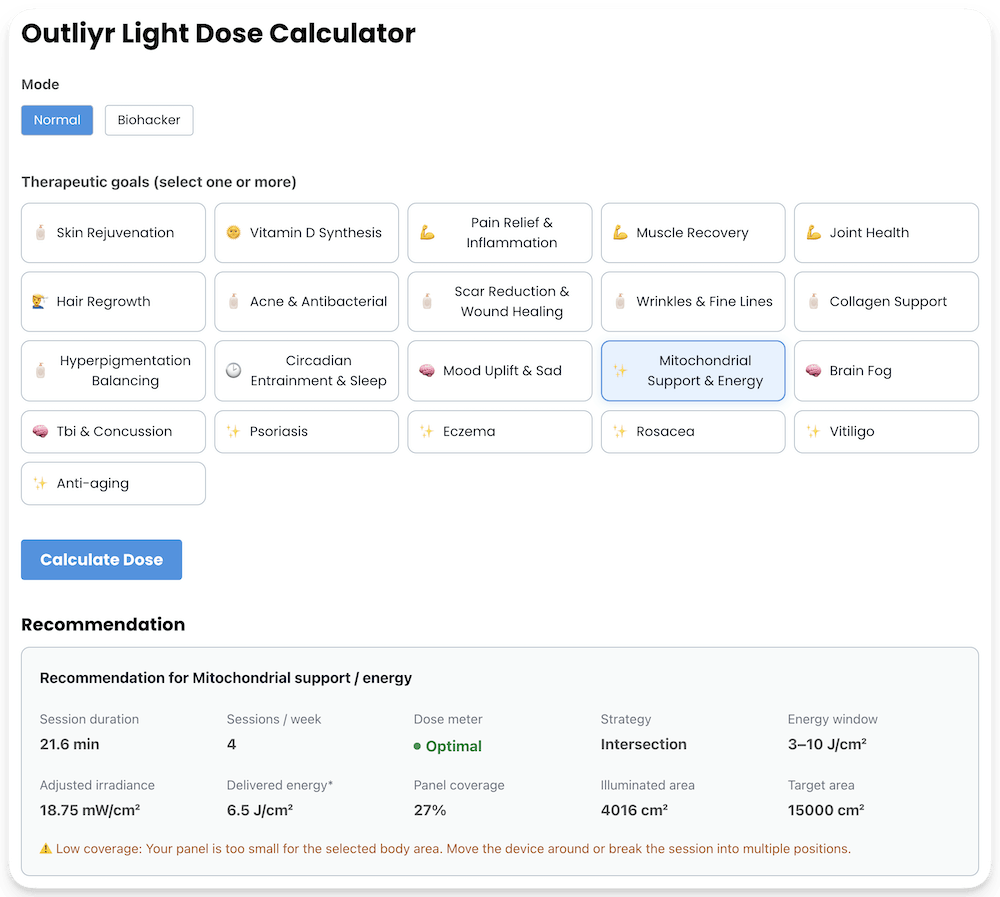
A dosing calculator removes guesswork and helps you dial in your routine.
Manual calculations work but take time. Most people mess up the units or forget to convert seconds. A calculator does it instantly and more accurately.
Inputs
You’ll enter:
- Your device’s measured irradiance (mW/cm²)
- Treatment distance in inches
- Target body area (skin, muscle, brain, etc.)
- Your goal (recovery, skin health, energy, etc.)
- Session frequency per week
The calculator uses these inputs to build your custom protocol. It accounts for wavelength, penetration depth, and safety limits.
Outputs
The calculator tells you:
- Exact session duration in minutes
- Total fluence delivered (J/cm2J/cm2)
- Recommended frequency per week
- When to increase or decrease dose
- Safety warnings if your inputs exceed limits
This tool will save you hours of trial and error. It prevents overdosing and underdosing. You’ll know exactly what your body receives each session.
FAQ: Light Therapy Dosing
What happens if I use too much light therapy?
Overdosing causes oxidative stress, skin irritation, and headaches (Deeply Vital Medical, Maysama). You might have trouble sleeping or wake up with a headache. Your skin may look red or feel sensitive. Cut your session time in half or move the device farther away. Benefits decrease when you exceed 30-50 J/cm² (MedcoVet).
Can I use light therapy every day?
Yes, for most wavelengths (Red Light Therapy Kits). Red and NIR work well daily at moderate doses (10-20 J/cm²). Blue light should stay at 2-4 times per week maximum. UV needs 2-3 times per week only.
Consistency beats intensity, daily 10-minute sessions outperform weekly 30-minute blasts (GembaRed, Red Light Therapy Kits).
What’s the best time of day for light therapy?
Morning works best for most goals (GembaRed, Tracy Donegan Blog). Red and NIR in the morning boost ATP production 3-6 hours later. Your body temperature is cooler, allowing deeper penetration.
Morning eye treatments show better results than afternoon sessions (Tracy Donegan Blog). Evening sessions can disrupt sleep in sensitive people. Avoid bright light within 2 hours of bedtime (GembaRed).
Should I wear clothes during treatment?
No (Red Light Therapy Kits). Bare skin absorbs the most photons. Clothes block 70-90% of light. Remove makeup, lotions, and oils too. These products scatter and reflect light before it reaches your cells (Best Practices for Maximizing, Red Light Therapy Kits).
Is light therapy safe for everyone?
Almost everyone (Degree Wellness, Cleveland Clinic). Avoid if you’re pregnant, have active cancer, take photosensitive medications, or have epilepsy (Degree Wellness). Light therapy is non-toxic and non-invasive.
It doesn’t cause the damage UV light from tanning beds creates (Cleveland Clinic). Children can use it safely at lower doses (Avena Medical).
Can I combine different wavelengths?
Yes (Emitted LEDs). Many devices include both red (660nm) and NIR (850nm). This combination treats skin and deep tissue simultaneously.
Don’t use blue or UV with red/NIR in the same session. Blue light disrupts melatonin when combined with red in the evening.
Why do some devices feel hot?
High irradiance (over 100 mW/cm²) generates heat (Bestqool). This doesn’t mean the therapy is working better. Heat can damage cells if excessive.
Take breaks if the device feels too hot. Stay at least 2-3 inches away from powerful panels (Vital Red Light).
What if my device specs seem wrong?
They probably are. Most brands exaggerate irradiance by 40-70%. Measure your device yourself with a spectrometer or solar power meter. Independent reviews sometimes publish real measurements. See my device testing guide for accurate testing methods.
Does hydration affect results?
Absolutely. Dehydrated tissue responds poorly to light therapy. Water helps photons penetrate deeper. Drink half your body weight in ounces daily. Add an extra 8-16 ounces on treatment days. Poor hydration is one of the most common reasons people see weak results.
What’s the Best Way to Dose Red Light Therapy?
Light therapy works when you dose it correctly.
Guessing wastes time and money. Too little light does nothing.
Too much creates oxidative stress and blocks the benefits you want. The biphasic dose response is real.
More isn’t better after you hit your therapeutic window.
All in all:
- Measure your device’s real irradiance at your treatment distance
- Calculate fluence using the formula: (Irradiance × Time) ÷ 1,000
- Match your wavelength to your goal. Red for skin, NIR for deep tissue
- Begin with 50% of recommended doses for the first week
- Track your results and adjust based on what you see
Consistency beats intensity every time. Daily 10-minute sessions outperform weekly 30-minute blasts. Your cells adapt to regular stimulus, not random overloads. Dosing is one layer of the picture, and I cover the rest across my guides to light therapy.
Most people never dial in their dose. They use their device randomly and wonder why results disappoint.
You’re not most people. You have the formula, the ranges, and the principles.
The three most important factors:
- Energy delivery rate (irradiance) = mW/cm²
- Total energy delivered (fluence) = J/cm²
- Which specific spectrum of light (wavelength)
Use this guide. Test and choose a quality red light therapy device.
Calculate your dose. Stick with it for 4-6 weeks.
Light therapy becomes one of your most powerful biohacking tools when you dose it right. Not sure which panel to buy? The red light therapy buyer’s guide walks through every key spec
Drop a comment below with your light therapy goals or questions.
Comments